Trieste Travel Guide: Everything You Need to Know for 2026
Last Updated: March 2026
Your complete guide to visiting Italy's hidden gem on the Adriatic — where Italian style meets Central European soul.
Trieste is a captivating port city in the far northeastern corner of Italy, nestled between the Adriatic Sea and the Slovenian border, and serves as the capital of the Friuli-Venezia Giulia region. It is best known for its grand Austro-Hungarian architecture, its title as Italy's "Capital of Coffee," the romantic Miramare Castle, and its remarkable literary heritage linked to writers like James Joyce. Visitors come here for a completely unique Italian experience — one flavoured with Austrian elegance, Slovenian influences, extraordinary cafés, and some of the finest seafood on the Adriatic coast.
Table of Contents
- Trieste Overview
- Getting There & Around
- Top Attractions & Landmarks
- Neighborhoods & Districts
- Food & Dining
- Nightlife & Entertainment
- Shopping
- Seasonal Events & Festivals
- Accommodation Recommendations
- Practical Information
- Day Trips & Nearby Destinations
- Insider Tips & Hidden Gems
- Money-Saving Tips
- Common Tourist Mistakes to Avoid
- Sample Itineraries
- Frequently Asked Questions
What Is Trieste and Why Should You Visit?
Trieste is one of Europe's most underrated cities — a sophisticated, culturally layered port town that feels like nowhere else in Italy. Sitting at the crossroads of Latin, Slavic, and Germanic worlds, it spent centuries as the Habsburg Empire's most important seaport, and that Central European grandeur is still woven into every palazzo, every café, and every perfectly pulled espresso. Unlike Rome or Venice, Trieste has no screaming crowds. It greets you quietly, with wide waterfront promenades, grand neoclassical squares, and a café culture so serious it's legendary throughout the country.
People visit Trieste for a genuinely different Italian experience. You will find magnificent Austro-Hungarian architecture lining the seafront, a literary café scene that inspired James Joyce to write parts of Ulysses here, and a food culture that blends Italian pasta with Viennese strudel and Slovenian goulash. Add in a romantic hilltop castle, one of the world's largest accessible caves just outside the city, and easy day trips to Slovenia and Croatia, and you have a destination that truly punches above its weight.
The city does have a slightly melancholy, reflective personality — locals call it "Tristezza" (sadness) — but this only adds to its charm. Trieste is a city for curious, independent travellers who love history, food, and finding beauty in the quietly extraordinary.
When Is the Best Time to Visit Trieste?
Spring (April–June): Spring is arguably the finest time to visit. Temperatures range from a comfortable 15°C to 22°C (59°F–72°F), flowers bloom along the seafront promenades, and the city feels alive but not crowded. Café terraces open up, and the coastal hiking trails are at their most pleasant. Book accommodation a few weeks ahead as Trieste begins to attract visitors in May and June.
Summer (July–August): Summers are warm and sunny, with temperatures reaching 28°C–32°C (82°F–90°F). The waterfront comes alive with swimmers and outdoor events. This is peak season, so expect slightly higher accommodation prices and more visitors, though Trieste never gets as overwhelmed as Venice. The Barcola beach strip becomes a beloved local gathering spot on hot evenings.
Autumn (September–October): Early autumn is a favourite of seasoned travellers. The crowds thin out, prices drop, and temperatures stay warm enough for outdoor dining well into October. The famous Trieste Coffee Festival in October is a highlight of the year. The Bora wind (a fierce northeast wind) starts to make appearances, which is dramatic and exhilarating rather than unpleasant for most visitors.
Winter (November–March): Winter is quiet, cold, and atmospheric. The Bora wind can be biting and strong enough to warrant holding ropes stretched along some streets. However, Christmas markets are charming, hotel prices drop significantly, and you will have the historic cafés almost to yourself — which is a real treat. This is the time for slow, intimate exploration.
How Many Days Do You Need in Trieste?
- 1–2 days: Enough to see the key highlights: Piazza Unità d'Italia, Miramare Castle, San Giusto Hill, Canal Grande, and the historic literary cafés. Perfect for those passing through on a wider Italy or Adriatic itinerary.
- 3–4 days: Ideal for a first-time visit. This gives you time for all the major sights, a day trip to the Grotta Gigante or Miramare Park, the Revoltella Museum, and proper exploration of the neighbourhood food scene.
- 5–7 days: Opens up excellent day trips to Ljubljana, Lake Bled in Slovenia, the Istrian coast of Croatia, and the Karst plateau. You will have time to truly sink into the café culture and discover hidden gems.
- 1 week+: For those who want to live like a local — morning espresso at the bar, afternoon strolls along the Molo Audace, evening aperitivo in Cavana, and lazy day trips whenever the mood strikes.
Quick Facts About Trieste
- Population: Approximately 200,000 (city); 235,000 (metropolitan area)
- Language: Italian (English is spoken in most tourist areas, hotels, and restaurants)
- Currency: Euro (€)
- Time Zone: Central European Time (CET) / UTC+1 (UTC+2 in summer)
- Country Code: +39
- Area Code: 040
- Climate: Mediterranean/Continental, with warm summers, cool winters, and the famous Bora wind
- Altitude: 2 metres (7 feet) above sea level at the seafront; up to 323 m (1,060 ft) on the Karst plateau
- Region: Friuli-Venezia Giulia, northeastern Italy
How Do You Get To and Around Trieste?
The easiest way to reach Trieste from within Italy is by train, with excellent direct connections from Venice (2 hours), Udine (1 hour), and fast trains from Rome, Milan, and Florence. Trieste also has its own international airport for flights from elsewhere in Europe.
Which Airports Serve Trieste?
Trieste – Friuli Venezia Giulia Airport (TRS) – "Ronchi dei Legionari"
Via Aquileia 46, 34077 Ronchi dei Legionari (Gorizia), Italy
Located approximately 35 km (22 miles) from Trieste city centre, this airport handles both domestic Italian routes and connections to European hubs. Airlines including Ryanair, Wizz Air, and others operate seasonal and year-round services. The airport is compact and easy to navigate, with standard facilities including car rental desks, a café, and a small shopping area.
How Do You Get from the Airport to the City Centre?
APT Bus (Airport Bus): The most affordable option. The direct bus service runs between Ronchi dei Legionari Airport and Trieste's main bus/train station (Piazza della Libertà). Cost: approximately €4–€6 (2026). Journey time: around 50 minutes. Buses generally align with flight arrivals and departures — check the Trieste Trasporti website for current timetables.
Train: Ronchi dei Legionari also has a train station approximately 1 km from the terminal. You can take a regional train to Trieste Centrale. Cost: approximately €4–€5. This is a slightly longer option requiring the walk to the station, but it's very reliable.
Taxi: A licensed taxi from the airport to central Trieste costs approximately €45–€65 (2026) and takes around 30–40 minutes depending on traffic. Always use official white taxis with meters running from the designated taxi rank outside arrivals.
Private Transfer: Pre-booked private transfers cost approximately €55–€80 (2026) for a standard vehicle and offer door-to-door convenience, especially useful for families or groups with luggage.
What Is the Best Way to Get Around Trieste?
The best way to get around Trieste is on foot. The historic city centre is compact and flat along the waterfront, with virtually all major attractions within a 20–30 minute walk of each other. For hilly areas like San Giusto or destinations further out like Miramare Castle, the public bus network is efficient, affordable, and easy to use.
Public Transport System
Trieste Trasporti operates the city's bus network, which covers the entire city and runs from approximately 5:30 AM until midnight, with reduced services at night. Buses are frequent on main routes and very reliable. The network also includes the historic tram line to Opicina — a unique and charming experience worth doing for its own sake.
Tickets & Passes (2026 prices):
- Single ride: €1.40 (must be validated on board)
- Daily pass: approximately €3.50
- Tickets can be purchased at tobacconists (tabaccai), news kiosks, and ticket machines at main stops
Taxis & Rideshare
Official white taxis in Trieste are metered and reliable. The starting rate is approximately €6.00 (2026), with a per-kilometre charge of around €1.20. Uber does not operate in Trieste. You can hail taxis on the street, find them at taxi ranks around Piazza Goldoni and Piazza della Libertà, or call for one using the local RadioTaxi service (number: 040 307730).
Walking
Trieste's flat seafront and historic centre make it one of the most walkable cities in northeastern Italy. You can comfortably walk from the train station to Piazza Unità d'Italia in under 10 minutes, and from there to Canal Grande in another 5 minutes. San Giusto Hill requires a moderate uphill walk of about 15–20 minutes from the centre — wear comfortable shoes. The seafront promenade stretching to Miramare is a beautiful 7 km walk, though most people prefer the bus for that stretch.
Walkability Score: 85/100 for the historic city centre. Almost everything you want to see is walkable; only Miramare Castle and the Opicina tram require separate transport.
Smart travellers always compare transfer options before booking — prices for the same route can vary by 40% or more. Take 60 seconds to check all options and choose what works best for your arrival.
What Are the Top Attractions and Landmarks in Trieste?
Trieste's top attractions include the magnificent Piazza Unità d'Italia, the fairy-tale Miramare Castle, the ancient Roman Theatre, the hilltop San Giusto Castle and Cathedral, the stunning Grotta Gigante cave, the historic literary cafés, and miles of beautiful Adriatic waterfront.
Piazza Unità d'Italia
Piazza Unità d'Italia, 34121 Trieste, Italy
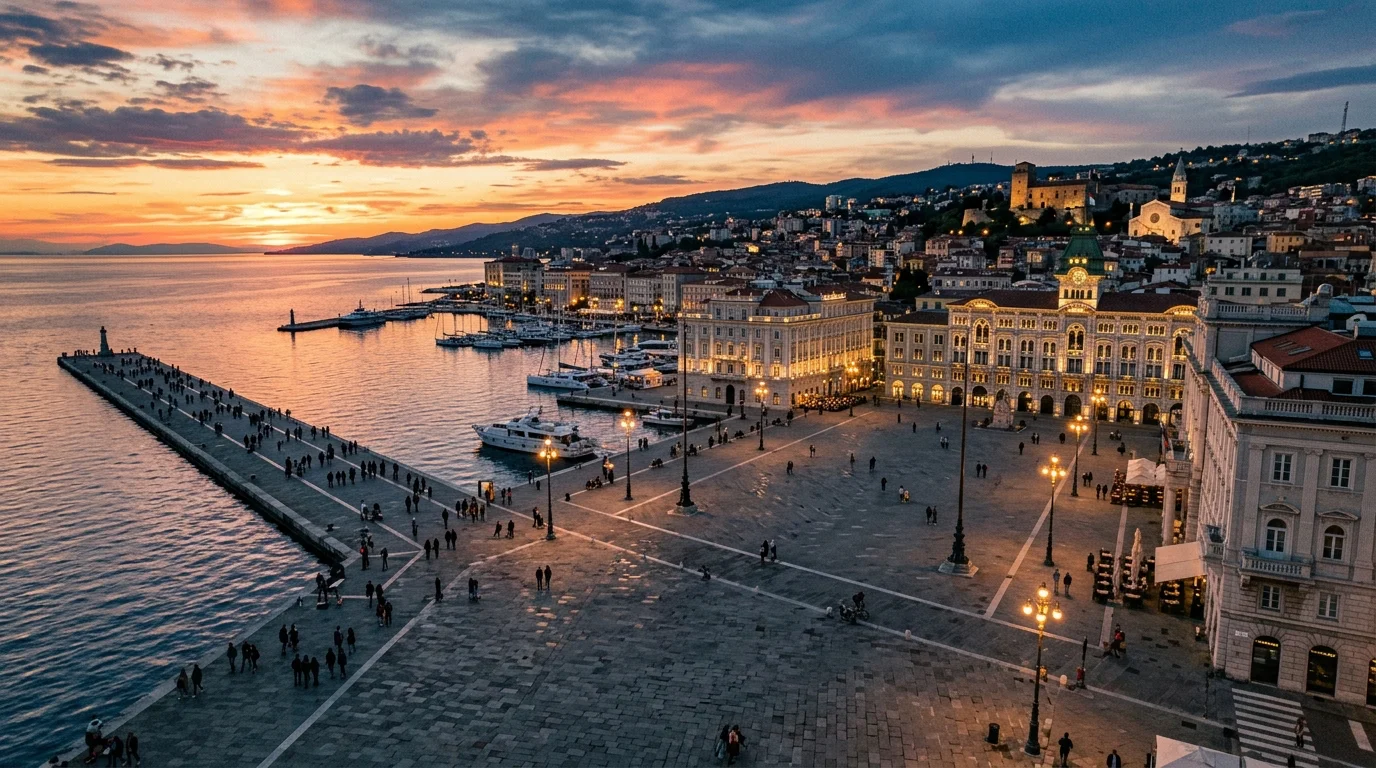
Piazza Unità d'Italia is unquestionably the heart and soul of Trieste — and one of the most spectacular public squares in all of Europe. It holds the remarkable distinction of being the largest seafront piazza in Europe, opening directly onto the Gulf of Trieste with grand views of the Adriatic. The square is framed on three sides by magnificent palaces in neoclassical and Baroque-Eclectic styles: the Palazzo del Municipio (Town Hall), the Palazzo della Regione, the Palazzo del Lloyd Triestino (now the headquarters of the Friuli-Venezia Giulia regional government), and the impressive Palazzo del Governo.
The buildings were largely constructed during the 18th and 19th centuries when Trieste served as the Austro-Hungarian Empire's main port and was one of the wealthiest cities in central Europe. At the centre of the square stands a large bronze fountain, and the whole space comes alive with markets, concerts, and celebrations throughout the year. At night, the palaces are beautifully illuminated, casting a warm golden glow across the cobblestones and creating an atmosphere that is truly unforgettable.
Why visit: This is the single most iconic image of Trieste, and standing here at sunset with the Adriatic stretching before you is one of the great travel moments in northeastern Italy. It costs nothing to visit and is accessible at all hours.
Entrance: Free
Best time: Sunset for the golden light on the buildings; early morning for peaceful photos without crowds
Hours: Open 24 hours
Castello di Miramare (Miramare Castle)
Viale Miramare, 34151 Trieste (Grignano), Italy
Miramare Castle is one of the most romantic and picturesque castles in all of Italy. Built between 1856 and 1860 on a rocky promontory overlooking the Gulf of Trieste, it was constructed as the residence of Archduke Ferdinand Maximilian of Austria and his wife, Charlotte of Belgium. The white-turreted castle rising directly from the sea is a sight of breathtaking beauty, particularly when approached from the water or viewed from the seafront road. The interior is largely preserved with its original 19th-century royal furnishings, portraits, and decorative arts, giving visitors a vivid sense of the life of Habsburg royalty.
The story of Miramare is tinged with tragedy: Maximilian left here in 1864 to become Emperor of Mexico, was captured and executed in 1867. His wife Charlotte never returned from Europe and spent the rest of her long life in mental institutions. The castle's elaborate gardens span 22 hectares with Mediterranean and exotic trees, formal Italian gardens, and stunning views from every angle. A marine nature reserve surrounds the promontory, making it a beautiful spot for walking even without entering the castle itself.
Why visit: Miramare is the defining image of Trieste and one of the finest examples of 19th-century royal architecture in Italy. The combination of castle, gardens, sea views, and human story makes it unmissable.
Entrance: Castle museum: €10 adults, €5 reduced (2026); Gardens only: Free
Best time: Morning on weekdays to avoid coach groups
Hours: Daily 9:00 AM – 7:00 PM (last entry 6:30 PM); reduced winter hours
Castello di San Giusto (San Giusto Castle)
Piazza della Cattedrale 3, 34121 Trieste, Italy
Perched on the top of San Giusto Hill above the old town, this impressive medieval fortress offers panoramic views across the entire Gulf of Trieste and is one of the city's most historically significant landmarks. The castle began as a Roman fortification and was expanded by the Venetians in the 14th century before the Habsburgs completed its current form in the 16th and 17th centuries. It is a genuinely dramatic hilltop fort with thick walls, bastions, towers, and a moat, set against a backdrop of deep blue sea. Inside, the castle houses a civic museum with a collection of medieval armour, weapons, furniture, and documents relating to Trieste's history under various rulers.
The castle courtyard hosts an excellent open-air cinema in summer (Cinema all'Aperto al Castello), which is one of Trieste's most beloved seasonal traditions. The views from the ramparts stretch from the Karst plateau behind the city all the way to the Croatian coastline on clear days, making the climb worthwhile even without entering the museum.
Why visit: The combination of impressive military architecture, excellent views, interesting museum, and the adjacent Cathedral of San Giusto makes this Trieste's finest hilltop destination.
Entrance: €5 adults, €3 reduced (museum + ramparts, 2026); grounds free
Best time: Late afternoon for the best light over the gulf
Hours: Tuesday–Sunday, 10:00 AM – 5:00 PM (extended hours in summer)
Cattedrale di San Giusto (Cathedral of San Giusto)
Piazza della Cattedrale 2, 34121 Trieste, Italy
Standing next to the castle on the hill of the same name, the Cathedral of San Giusto is a remarkable and architecturally unique church that was built in the 14th century by merging two earlier Romanesque basilicas into a single structure. This unusual origin is visible in the asymmetrical façade and interior layout. The church is named after the patron saint of Trieste, San Giusto, who was martyred here in around 304 AD. Inside, the cathedral is home to extraordinary 5th and 6th-century Byzantine mosaics in the apses — some of the finest early Christian mosaics in northeastern Italy, glowing with gold and rich colour.
The bell tower at the front of the cathedral incorporates Roman columns from a 1st-century AD temple that once stood on this hill, beautifully illustrating Trieste's many layers of history in a single structure. The small museum attached to the cathedral houses Roman artefacts, church treasures, and exhibits on the hill's long history.
Why visit: The Byzantine mosaics alone are worth the climb. This is one of Trieste's genuine artistic masterpieces and is completely free to enter.
Entrance: Free (small charge for museum)
Best time: Morning for the best light on the mosaics
Hours: Daily 8:00 AM – 12:00 PM and 3:30 PM – 7:30 PM
Teatro Romano (Roman Theatre)
Via del Teatro Romano, 34121 Trieste, Italy
Trieste's ancient Roman Theatre is one of the most impressive and atmospheric Roman ruins in northeastern Italy, and it is surprisingly little-known outside the city. Built in the 1st–2nd century AD at the base of San Giusto Hill, the theatre was constructed directly into the slope of the hill in the Roman style and could seat approximately 6,000 spectators. It was used for theatrical performances, gladiatorial contests, and public events. The theatre was buried and forgotten for centuries beneath the medieval city before being excavated from 1938 onwards — even today, some of its structure is embedded in the surrounding buildings.
What remains is genuinely striking: a large arc of stepped seating, the stage area, and portions of the outer wall, all in warm honey-coloured stone with weeds and wildflowers growing between the ancient rocks. The theatre still hosts cultural performances and events in summer, continuing its 2,000-year tradition of public entertainment.
Why visit: This is an authentic Roman site that you can walk right up to and explore freely, without the crowds of Rome. Standing in the ancient seating with San Giusto Hill rising behind you is a genuinely moving experience.
Entrance: Free (viewing from outside); check event schedule for performances
Best time: Morning or late afternoon
Hours: Exterior visible 24 hours; some areas may be fenced during events
Canale Grande (Canal Grande)
Canale Grande, Borgo Teresiano, 34121 Trieste, Italy
The Canal Grande is a beautiful 18th-century navigable canal that cuts into the heart of the Borgo Teresiano district. Lined with handsome neoclassical palaces, outdoor café tables, and moored boats, it has a romantic atmosphere that feels more like a smaller, quieter Venice. The canal was built in 1756 under Empress Maria Theresa to allow merchant ships to unload goods directly in the city centre, reflecting Trieste's immense commercial importance as the Habsburg Empire's only major port. At the head of the canal stands the Neoclassical Church of Sant'Antonio Nuovo, creating a perfectly composed vista.
The canal is surrounded by some of Trieste's best cafés and restaurants, making it the perfect place for an aperitivo or evening meal beside the water. The tree-lined banks are a favourite evening stroll for locals, and the whole area buzzes with life from late afternoon onwards. The Serbian Orthodox Church of San Spiridione, with its Byzantine domes and turquoise bell tower, stands just a short walk away and is one of the most visually striking buildings in Trieste.
Why visit: The Canal Grande is one of the most photogenic corners of Trieste and the perfect place to settle into the city's relaxed, elegant pace with a coffee or glass of Friulian wine.
Entrance: Free
Best time: Evening for aperitivo culture; late afternoon for the best light
Hours: Outdoor area 24 hours; cafés/restaurants from morning until late evening
Grotta Gigante (Giant Cave)
Borgo Grotta Gigante 42/a, 34016 Sgonico (Trieste), Italy
Located just 12 km north of Trieste on the Karst plateau, the Grotta Gigante is one of the world's largest tourist-accessible caves and is one of the most extraordinary natural spectacles in Italy. The main cavern measures approximately 98 metres high and 76 metres wide — large enough that the dome of St. Peter's Basilica in Rome could fit comfortably inside. This vast underground cathedral was formed over millions of years by the erosive action of the Timavo River, and its floor and walls are covered with spectacular stalactites, stalagmites, and column formations in cream, amber, and white.
The cave maintains a constant temperature of 11°C (52°F) year-round, making it a refreshing visit in summer and a cosy one in winter. Guided tours run approximately every 30–40 minutes and last about 45 minutes, taking visitors deep into the cavern on illuminated pathways with a knowledgeable guide explaining the geology and history. The cave also houses two of the world's most sensitive pendulums, used for scientific measurement of the Earth's movements.
Why visit: Grotta Gigante is genuinely awe-inspiring — the scale of the cavern is difficult to prepare yourself for, and standing in the main chamber looking up at the soaring ceiling is one of those travel moments you don't forget. It is easily combined with the Opicina tram journey from Trieste.
Entrance: €14 adults, €8 children 6–12 years, free under 6 (2026)
Best time: Weekday mornings; arrives earlier in summer to avoid afternoon coach groups
Hours: Tuesday–Sunday (closed Monday); tours run approximately every 30 minutes; check grottagigante.it for current schedule
Museo Revoltella
Via Armando Diaz 27, 34123 Trieste, Italy
Trieste's premier art museum is housed in the magnificent palazzo that was home to Baron Pasquale Revoltella, one of the city's wealthiest 19th-century financiers and a key backer of the Suez Canal. The building itself is extraordinary — a palatial six-storey neoclassical mansion that has been extended by a striking modern wing designed by Carlo Scarpa, one of Italy's great 20th-century architects. The combination of the ornate 19th-century original and the minimalist Scarpa extension is a wonderful contrast. The collection spans 19th- and 20th-century Italian art, with particularly strong holdings in Venetian and Triestine painting, sculpture, and decorative arts.
The museum also offers one of the best rooftop terraces in the city, with sweeping views over the gulf. The ground-floor café is elegant and a lovely spot for a break.
Why visit: Whether you love art or just architecture, the Revoltella is a pleasure to visit. The Scarpa extension alone is worth the entrance price for design enthusiasts.
Entrance: €10 adults, €7 reduced (2026)
Best time: Thursday evening (extended hours and sometimes events)
Hours: Wednesday–Monday 10:00 AM – 7:00 PM; Thursday until 10:00 PM; closed Tuesday
Caffè San Marco
Via Cesare Battisti 18, 34121 Trieste, Italy
Caffè San Marco is not just a café — it is one of the great literary cafés of Europe and an essential part of Trieste's cultural identity. Founded in 1914, the café was a gathering place for intellectuals, writers, and free thinkers throughout the 20th century. James Joyce was a regular visitor here while living in Trieste from 1904 to 1915, and the atmosphere of thoughtful contemplation he found here undoubtedly influenced his work. The café is magnificent: a long, high-ceilinged room of gilded mirrors, green leather banquettes, marble tables, and art nouveau decorative detail. It feels like stepping back into fin-de-siècle Vienna.
In addition to serving excellent coffee and pastries, Caffè San Marco today houses a small bookshop at the back — making it the perfect combination of coffee, books, and history. It's the kind of place you can sit for two hours over a single espresso and nobody will rush you.
Why visit: This is one of Italy's most historically important cafés, and sitting here with a coffee feels like a genuine connection to the intellectual life of old Europe. Don't miss it.
Entrance: Free; coffee from €1.30 at the bar, €2.50+ at a table (2026)
Best time: Mid-morning (10 AM–noon) for a classic café experience
Hours: Tuesday–Sunday 8:00 AM – 11:00 PM (approximate)
Molo Audace
Molo Audace, Riva Tre Novembre, 34121 Trieste, Italy
The Molo Audace is Trieste's beloved stone pier — a wide, 246-metre jetty extending out into the Gulf of Trieste from the heart of the waterfront, just off Piazza Unità d'Italia. This is where Trieste goes to breathe. Locals stroll its length at all hours of the day and evening, watching the ships, breathing the salt air, and taking in the extraordinary panorama of the gulf and the city's elegant seafront. The pier gets its name from the torpedo boat "Audace," which docked here on November 3, 1918, when Trieste was finally incorporated into Italy after centuries of Habsburg rule — one of the most emotional moments in the city's history.
There is nothing to do on the Molo Audace but walk, look, and be. That is precisely the point. The views back to the city's seafront palaces, the open sea horizon, and the distant Croatian mountains on a clear day are all magnificent. Sunset from the end of the pier is one of the finest free experiences in Trieste.
Why visit: The Molo Audace captures the soul of Trieste better than anywhere else — a city that faces the sea with quiet confidence. It is free, always open, and always beautiful.
Entrance: Free
Best time: Sunset
Hours: Open 24 hours
Risiera di San Sabba
Ratto della Pileria 43, 34148 Trieste, Italy
The Risiera di San Sabba is one of the most solemn and historically important sites in Trieste — and in Italy. This former rice-husking factory was used by the Nazis from 1943 to 1945 as a transit and detention camp, and crucially, as a site of execution. It was the only Nazi extermination facility on Italian soil equipped with a crematorium. Thousands of prisoners — Jews, Slavs, Italian partisans, and political opponents — were killed or passed through here on their way to other camps. Today it functions as a national monument and museum dedicated to the victims. The permanent exhibition is moving, thoughtful, and historically rigorous.
A visit here is not easy, but it is important. Trieste's complex wartime history — its position as a contested border city between Italy, Yugoslavia, and the former Nazi-occupied zone — is brought into sharp, human focus at this memorial.
Why visit: Essential for anyone with an interest in 20th-century history, the Holocaust, or Trieste's complex wartime past. The museum is free to enter and respectfully presented.
Entrance: Free
Best time: Morning, when the space is quieter
Hours: Tuesday–Sunday 9:00 AM – 5:00 PM; closed Monday
Book your tours and tickets in advance — it saves hours of queuing and often gets you a better price. These two platforms cover different options, so it's worth checking both.
What Are the Best Neighborhoods to Explore in Trieste?
Trieste's neighbourhoods each have a very distinct character, shaped by the city's layered history. Here are the best areas to explore, from the grandest historic squares to the most colourful hidden alleys.
Città Vecchia (Old Town)
Character: The oldest part of Trieste, climbing the slopes of San Giusto Hill with narrow cobblestone streets, medieval churches, and ancient Roman remains embedded in the walls. The atmosphere here is quiet, intimate, and deeply historic.
What makes it special: This is where you will find the Cathedral of San Giusto, the Roman Theatre, the Arch of Riccardo (a 1st-century BC Roman arch), and dozens of atmospheric narrow lanes that feel completely unchanged from the 19th century. The views down to the sea from the upper alleys are wonderful.
Best for: History lovers, architecture enthusiasts, photographers, and those who want to escape the tourist crowds
Must-see in this area: San Giusto Castle and Cathedral, Teatro Romano, Arco di Riccardo, Piazza Barbacan
How to get there: 15-minute walk uphill from Piazza Unità d'Italia; buses 24 and 30 also serve the area
Location: Piazza della Cattedrale, 34121 Trieste, Italy
Borgo Teresiano (New Town / Città Nuova)
Character: The elegant, grid-planned 18th-century district built under Empress Maria Theresa when Trieste was the empire's commercial powerhouse. Wide boulevards, grand neoclassical palaces, and the beautiful Canal Grande define this sophisticated area.
What makes it special: This is the beating commercial heart of modern Trieste — lined with designer shops, excellent restaurants, historic cafés, and the Canal Grande as its centrepiece. Teatro Verdi, Trieste's grand opera house, is here. The Revoltella Museum is a short walk away. The area is lively day and night.
Best for: First-time visitors, shoppers, café lovers, opera-goers, and anyone who wants to be in the centre of the action
Must-see in this area: Canal Grande, Piazza della Borsa, Via Carducci (main shopping street), Teatro Verdi
How to get there: 5-minute walk north of Piazza Unità d'Italia
Location: Canale Grande di Trieste, 34121 Trieste, Italy
Cavana
Character: Trieste's most vibrant and colourful neighbourhood — a small district running parallel to the coast south of the Canal Grande, filled with narrow alleys, brightly painted buildings, local trattorie, wine bars, and the best nightlife in the city. Unlike most of Trieste, which feels more Austrian than Italian, Cavana has a distinctly Mediterranean, almost Venetian character.
What makes it special: This is where locals eat, drink, and socialise in the evenings. The density of excellent restaurants, craft beer bars, and wine bars in a very small area makes it the perfect neighbourhood for a long, leisurely evening. The colourful architecture makes it extremely photogenic.
Best for: Foodies, nightlife seekers, solo travellers, and anyone who wants to experience Trieste as locals do
Must-see in this area: Via della Cavana (main alley), Vico Tre Novembre, the small piazzas and side streets
How to get there: 10-minute walk south of Piazza Unità d'Italia
Location: Via della Cavana, 34121 Trieste, Italy
Barcola
Character: A long, flat seafront promenade district running north of the city centre along the coast toward Miramare Castle. Barcola is Trieste's summer playground — a 4 km stretch of rocky sea access points, bathing platforms, beach bars, and the beloved Stabilimento Balneare Ausonia lido.
What makes it special: On warm evenings from May to September, virtually all of Trieste descends on Barcola for swimming, sunbathing, and socialising. It is a genuine local experience that most tourists miss entirely. The seafront walk between the city and Miramare Castle is lovely at any time of year.
Best for: Beach lovers, families, cyclists, anyone wanting to swim in the Adriatic, and those seeking a local (not touristy) experience
Must-see in this area: The Barcola seafront, Ausonia Lido, the promenade view toward Miramare
How to get there: Bus 6 from the city centre; or a pleasant 30-minute walk along the seafront
Location: Passeggio Sant'Andrea, 34136 Trieste, Italy
Opicina / Carso (Karst Plateau)
Character: The dramatic limestone plateau rising steeply behind the city, covered with Mediterranean scrub, dramatic sinkholes (dolinas), and the small, elegant village of Villa Opicina at the top. The views from the plateau down over Trieste and the gulf are extraordinary.
What makes it special: Opicina is accessible by the historic funicular tram (Tram de Opcina) — a charming and unique experience. The Karst landscape is completely different from the coastal city: rugged, windswept, and wild. Local konobe (Slovenian-style rural restaurants) serve hearty food and local wine (Terrano and Vitovska) in a completely different atmosphere to the city below.
Best for: Hikers, food and wine lovers, those interested in Slovenian culture, photographers, and visitors seeking a half-day escape from the city
Must-see in this area: The Opicina Tram journey, Obelisco di Opicina viewpoint, Grotta Gigante, Faro della Vittoria (Lighthouse of Victory)
How to get there: Tram de Opcina from Piazza Oberdan (check current operating schedule as the tram has had periods of suspension)
Location: Villa Opicina, 34151 Trieste, Italy
What Food Should You Try in Trieste?
Trieste's food culture is one of the most distinctive in Italy, shaped by centuries of Austrian rule, Slovenian neighbours, and a major port that brought influences from across the Mediterranean and Central Europe. Expect hearty stews, excellent seafood, mitteleuropean pastries, and one of the finest coffee cultures in the world.
What Are the Must-Try Local Dishes in Trieste?
- Jota — Trieste's iconic hearty soup-stew made with sauerkraut (or fresh cabbage), borlotti beans, potatoes, and cured pork. Rich, smoky, and deeply satisfying — especially perfect on a cold day when the Bora wind is blowing. Find it at almost any traditional trattoria in the city.
- Goulash alla Triestina — A local version of the Hungarian/Austrian goulash, made with beef, onions, paprika, and red wine, but without peppers. It is slightly lighter than the original and is typically served with polenta. A perfect example of Trieste's Central European soul.
- Chifeletti — Trieste's beloved fried potato-based dumplings, made from a mixture of mashed potato, flour, butter, and eggs, shaped like small crescents. They are a cherished street food and snack, served hot and perfectly golden.
- Strucolo de Pomi — The Triestino version of Austrian Apfelstrudel — a rolled pastry filled with spiced apples, raisins, and cinnamon. A direct inheritance from the Habsburg kitchen. Find the best versions at traditional pastry shops (pasticcerie) in the city.
- Fresh Adriatic Seafood — Trieste is a port city and the seafood is exceptional. Look for grilled branzino (sea bass), sarde in saor (sardines in a sweet-sour onion and raisin marinade), calamari fritti, and bisato (eel) at seafood-focused restaurants near the waterfront.
- Prosciutto di San Daniele — The region of Friuli-Venezia Giulia produces one of Italy's finest prosciuttos, from the town of San Daniele. It is sweeter and more delicate than Prosciutto di Parma. You will find it on antipasto platters across the city.
- Terrano and Vitovska wines — The local wines of the Karst plateau are unique to this corner of the world. Terrano is a deep red with earthy, tangy character; Vitovska is a white of great mineral complexity. Order either by the glass in any good restaurant — they pair perfectly with the local food.
- Caffè Triestino — Coffee in Trieste deserves its own category. Illy, one of the world's most famous coffee brands, was founded here. Trieste has its own coffee vocabulary: a "nero" is a short black espresso; a "capo in b" is an espresso topped with foam in a glass; a "goccia" has a drop of milk. Order correctly and feel like a local.
Where Should You Eat in Trieste?
Budget-Friendly (Under €15 per meal)
- Buffet Rudy — Via Valdirivo 32, 34122 Trieste — A classic Triestino buffet where you order at the counter: hearty portions of jota, goulash, and boiled meats served in a no-frills, welcoming environment loved by locals for generations. Expect to pay €8–€12 for a full meal with wine.
- Al Nuovo Antico Buffet — Piazza Sant'Antonio Nuovo 2, 34121 Trieste — Another excellent traditional buffet right on the canal, serving the classic Triestino comfort food menu. Very popular with office workers at lunchtime — a sure sign of quality.
- Antico Panificio Veneziani — Via San Lazzaro 14, 34122 Trieste — Outstanding bakery and sandwich shop for a cheap, high-quality lunch: fresh bread, local cured meats, and Friulian cheeses to take away or eat at the counter.
Mid-Range (€20–€45 per meal)
- Hostaria G. Strehler — Via del Teatro Romano 7, 34121 Trieste — A much-loved neighbourhood trattoria near the Roman Theatre. Handwritten menus change daily, the food is entirely homemade, and the atmosphere is like eating in a Triestino grandmother's dining room. Book ahead as it fills quickly.
- Al Petes — Vicolo del Pesce 1, 34121 Trieste — A charming small restaurant tucked in a Cavana alleyway, serving traditional Triestian food: excellent homemade pasta, fresh fish, and polenta dishes. Welcoming staff and a wonderful local craft beer and Karst wine selection.
- Anticafe — Via del Coroneo 3, 34133 Trieste — Modern takes on Italian and Triestino cuisine with beautifully presented seafood dishes. Excellent gnocchi with saffron and prawns. Quiet neighbourhood location away from the tourist centre.
- Trattoria da Giovanni — Via S. Lazzaro 14, 34122 Trieste — Traditional Triestino trattoria with excellent fresh fish, homemade pasta, and the full range of Central-European influenced dishes. Consistent quality and reasonable prices.
Fine Dining (€55+ per meal)
- Harry's Piccolo — Piazza Unità d'Italia 2, 34121 Trieste — One of Trieste's most prestigious restaurants, occupying a magnificent position on the main square. Creative modern Italian cuisine with exceptional service and the finest ingredients from the Friuli-Venezia Giulia region. Reserve well in advance, especially for a window table facing the gulf.
- Al Bagatto — Via Luigi Cadorna 7, 34124 Trieste — A celebrated Triestine restaurant known for outstanding seafood and inventive tasting menus. One of the top dining destinations in northeastern Italy, with a strong regional wine list.
What Are the Dining Customs in Trieste?
Meal times: Triestinos eat lunch between 12:30 PM and 2:30 PM and dinner from 7:30 PM onwards. The aperitivo hour runs from about 6 PM to 8 PM, when bars offer free or reduced-price snacks with drinks — an excellent and affordable way to eat in the early evening.
Tipping: Tipping is not mandatory in Italy but is appreciated. Leaving €1–€2 per person, or rounding up to the nearest €5, is common in mid-range restaurants. Many bills include a coperto (cover charge) of €1–€3 per person, which is standard and not a tip.
Reservations: Essential for popular restaurants, especially on weekends. Call ahead or book via the restaurant website or Google. In summer, some popular spots are booked 2–3 days in advance.
Dress code: Smart-casual for mid-range and fine dining. Triestinos dress well for dinner — leave the shorts and sandals for the waterfront.
What Is the Nightlife Like in Trieste?
Trieste's nightlife scene is sophisticated, relaxed, and thoroughly Italian rather than wild. The city's evenings revolve around long aperitivo sessions, excellent wine bars, live music, and unhurried dining. Things get going from around 6 PM for aperitivo and dinner runs late; clubs are relatively few but the bar scene in Cavana and along Viale XX Settembre is lively from Thursday to Saturday.
Where Are the Best Areas for Nightlife in Trieste?
- Cavana: Via della Cavana and surrounding alleyways, 34121 Trieste — The beating heart of Trieste's bar and restaurant scene. Packed with wine bars, craft beer spots, and local trattorie; most atmospheric from 7 PM onwards. Best for a relaxed evening with friends rather than a big night out.
- Viale XX Settembre: Viale XX Settembre, 34127 Trieste — Trieste's longest pedestrian boulevard, lined with cafés and bars and especially lively on weekend evenings. Popular with a slightly younger crowd and good for bar-hopping.
- Borgo Teresiano / Canal Grande area: Canal Grande di Trieste, 34121 Trieste — The waterfront cafés around the canal and along Riva Tre Novembre come alive at aperitivo hour, with outdoor seating and beautiful views. More refined and elegant than Cavana.
What Are the Best Bars and Clubs in Trieste?
Bars & Pubs
- Caffè degli Specchi — Piazza Unità d'Italia 7, 34121 Trieste — Trieste's most famous café-bar, occupying a prime corner of the main piazza since 1839. The mirrored interior is stunning; the terrace is the best seat in the city. Perfect for a morning coffee, aperitivo, or evening drink.
- Bar Laghetto — Via del Lazzaretto Vecchio 12, 34121 Trieste — A beloved local wine bar serving excellent Friulian and Karst wines by the glass with a great selection of cicchetti (small snacks). Popular with locals in the know.
- The James Joyce Pub — Via Giacomo Matteotti 4, 34121 Trieste — A well-run Irish-style pub near the city centre, honouring Trieste's most famous literary resident. Good selection of draught beers, friendly atmosphere, and regular live music nights.
Clubs & Dancing
- Nadir Club — Via dei Porta 6, 34123 Trieste — One of Trieste's longer-established clubs, with regular DJ nights. Cover charge approximately €10–€15 (2026). Busiest on Friday and Saturday nights from midnight onwards.
- Molo IV — Molo IV Porto Vecchio, 34123 Trieste — A waterfront venue in the old port area that functions as a bar-restaurant by day and hosts events and club nights in summer. Spectacular port setting.
Live Music & Shows
- Teatro Verdi — Piazza Verdi 1, 34121 Trieste — Trieste's magnificent opera house, one of the finest in northeastern Italy. The main season runs from October to May. Check the programme and book tickets online at teatroverdi-trieste.com. Tickets from approximately €15 for gallery seats to €80+ for premium positions (2026).
- Cinema all'Aperto al Castello di San Giusto — Piazza della Cattedrale 3, 34121 Trieste — Open-air cinema in the courtyard of San Giusto Castle in summer (July–August). One of Trieste's most magical seasonal experiences. Check programme at comune.trieste.it.
What Family-Friendly Evening Entertainment Is Available?
Trieste is an excellent city for families in the evening. The waterfront promenade and Piazza Unità d'Italia are perfect for evening strolls. Gelato shops stay open until late, and many family restaurants in Cavana and the city centre welcome children. In summer, various free outdoor events and cinema screenings are held around the city — check the city's event calendar at comune.trieste.it.
What and Where Should You Shop in Trieste?
The best things to buy in Trieste are locally roasted coffee, Friulian wines, regional food products, and unique Central European handicrafts. The top shopping areas are Corso Italia (high street), Via Carducci, and the antique market around Piazza dei Volontari.
What Are the Best Shopping Districts in Trieste?
- Corso Italia: Corso Italia, 34122 Trieste — Trieste's elegant main shopping street, running from Piazza della Borsa toward the station. Home to Italian and international fashion brands, bookshops, and jewellers. The pedestrianised stretch is pleasant for window shopping and café stops.
- Via Carducci & Via XXX Ottobre: Via Carducci, 34122 Trieste — Mid-range and boutique shopping in the Borgo Teresiano district. Excellent for independent fashion boutiques, homeware, and local design shops alongside established Italian brands.
- Via San Nicolò: Via San Nicolò, 34121 Trieste — A charming street in the old town area with antique dealers, vintage shops, and specialist food stores. Perfect for browsing and finding unusual, one-of-a-kind gifts.
What Markets Should You Visit in Trieste?
Mercato Coperto (Covered Market) — Via Carducci 34, 34122 Trieste — Trieste's main covered food market, open Monday–Saturday 8:00 AM – 1:30 PM. An excellent place to buy local cheeses, cured meats, fresh pasta, regional wines, and seasonal produce. Atmospheric and thoroughly local.
Piazza dei Volontari Antique Market — Piazza dei Volontari Giuliani e Dalmati, 34121 Trieste — An antique and flea market held on the first and third Sunday of each month. A wonderful place to hunt for vintage prints, Central European curios, old maps, silverware, and unusual objects with a distinctly Mitteleuropean flavour.
Mercato di Trieste (Open-Air Food Market) — Piazza Carlo Goldoni and Ponte Rosso, 34121 Trieste — A daily outdoor food and general market near the canal area, open Monday–Saturday from morning. Good for fresh fruit, vegetables, and inexpensive household goods.
What Should You Buy in Trieste?
- Illy Coffee or Local Roasted Coffee — Illy was founded in Trieste and is the city's most famous export. Buy beans at any supermarket or specialist coffee shop. For an even more local alternative, seek out Caffè Cremcaffè or Hausbrandt, other quality Triestino roasters. Price: €8–€20 for 250g of premium coffee (2026).
- Karst Wines (Terrano, Vitovska, Malvasia) — The wines of the Carso/Karst zone are unique to this corner of the world and difficult to find elsewhere. Buy them at the Mercato Coperto, specialist wine shops (enoteche), or directly from producers during a Karst day trip. Price: €8–€18 per bottle (2026).
- Local Honey and Jams — The Karst plateau produces distinctive wildflower and acacia honeys, along with jams made from local fruits. Available at the covered market and specialist food shops. Make beautiful, affordable gifts.
- Prosciutto di San Daniele — Vacuum-packed portions of the region's superb prosciutto travel well and are available at delis and supermarkets. Price: €10–€20 per 200g pack (2026).
- Strudel and Pastries — Boxes of Triestino pastries — strudel, krapfen (doughnuts), and presnitz (a spiral pastry of walnuts, dried fruit, and spices) — make excellent souvenirs. Best bought fresh from a local pasticceria.
- Books about Trieste — The city has a remarkable literary heritage. Look for Jan Morris's magnificent "Trieste and the Meaning of Nowhere" — available in English at Libreria Umberto Saba (Via San Nicolò 30, 34121 Trieste), named after one of Trieste's greatest poets.
What Are the Shopping Hours and Customs?
Most shops in Trieste are open Monday–Saturday 9:00 AM – 1:00 PM and 3:30 PM – 7:30 PM. Many central shops now skip the afternoon closure (no riposo) but traditional smaller shops still observe it. Sunday openings are limited to larger stores and the tourist centre. Bargaining is not customary in shops — only at flea markets.
Can Non-EU Visitors Claim a VAT Tax Refund in Trieste?
Yes — if you are a visitor from outside the European Union (including travellers from the USA, Canada, Australia, the UK, and most of Asia and Latin America), you are entitled to a refund of the VAT (Value Added Tax) included in the price of goods you buy in Italy. VAT in Italy is 22% on most goods; 10% on some food items, which means this refund can be significant on high-value purchases like clothing, leather goods, jewellery, designer fashion, and electronics.
How to Claim Your VAT Refund — Step by Step
- Spend at least €154.94 in a single shop in a single day. This is the minimum threshold for a VAT refund claim in Italy. It does not apply across multiple shops — the full amount must be spent in one store.
- Look for the "Tax Free" sign. Participating shops display a "Tax Free Shopping," "Global Blue," or "Planet" logo in the window or at the register.
- Ask for the tax refund form at the register before you pay. Present your non-EU passport — the shop will fill out the form with your details and the purchase amount. Keep the form with your receipt.
- Get the form stamped at customs before you leave. Go to the Customs office at Trieste Airport (TRS) before check-in and have an officer stamp your tax refund form. Keep your purchases accessible in hand luggage — do not pack them deep in your checked bags.
- Collect your refund. Hand the stamped form to the Global Blue or Planet desk at the airport. You can receive the refund in cash (minus a processing fee) or as a credit card refund (lower fees, takes a few weeks).
VAT Refund Quick Facts for Trieste
- Minimum spend: €154.94 in one shop in one day
- VAT rate on most goods: 22% on most goods; 10% on some food items
- Typical refund after fees: 10–15% of the purchase price
- Refund processors: Global Blue and Planet (formerly Premier Tax Free) at Trieste Airport (TRS)
- Who qualifies: Anyone with a non-EU passport who is not a resident of an EU country
- UK visitors: British passport holders qualify since Brexit — the UK is no longer in the EU
- Deadline: Purchases must be exported within 3 months of the date of purchase
- Full guide: VAT Refund in Europe — Complete Guide for Non-EU Travelers
What Festivals and Events Happen in Trieste?
Trieste hosts a rich calendar of events throughout the year, from major international film and science festivals to local religious celebrations and the beloved annual Coffee Festival. The city's cultural programme reflects its unique position at the intersection of Italian, Central European, and Slavic traditions.
What Is the Annual Events Calendar for Trieste?
| Month | Event Name | Description |
|---|---|---|
| January | Trieste Winter Sales (Saldi Invernali) | Post-Christmas sales begin in January, with excellent discounts in fashion and homeware shops along Corso Italia and Via Carducci. A good time for budget shopping. |
| February | Carnevale di Trieste | Trieste's Carnival is celebrated with costumed events, street performances, and a children's procession. Smaller than Venice's Carnevale but charming and very local in character. |
| March | Boule de Suif Literary Festival | A celebration of literature and writing held in venues across the city, with author readings, panel discussions, and book launches. Mostly in Italian but with occasional international guests. |
| April | Trieste Running Festival | An international running event with races of various distances through the city streets and along the seafront. Spectators line the route making it a fun city-wide event even for non-runners. |
| May | Barcolana Sailing Regatta (Preparation/Qualifier Events) | Preliminary sailing events in the Gulf of Trieste ahead of the main October Barcolana. The gulf fills with sailing boats and the atmosphere along the waterfront is excellent. |
| June | Trieste Film Festival / Open-air Cinema Season Begins | International short film festival held in Trieste in late June. The outdoor cinema season at San Giusto Castle and other open-air venues also opens this month with films from across Europe. |
| July | Trieste Loves Jazz / Carso sotto le Stelle | Jazz concerts and open-air music events in venues around the city and on the Karst plateau. Long summer evenings and outdoor settings make July one of the most enjoyable months to visit. |
| August | Ferragosto & Estate Triestina | Italy's major summer holiday (August 15) is celebrated with beach events and outdoor concerts. The Barcola seafront is at its most lively. Note that some restaurants and shops close for part of August. |
| September | Trieste Science+Fiction Festival (Early screenings) | Trieste's renowned international science fiction, fantasy, and horror film festival begins its autumn events programme. One of the most important genre film festivals in Europe. |
| October | Barcolana Sailing Regatta + Trieste Coffee Festival | The Barcolana is the world's largest sailing regatta by number of boats, held in the Gulf of Trieste in the second week of October — a spectacular sight with thousands of sailing vessels. The Trieste Coffee Festival runs simultaneously, with tastings, competitions, and café events. This is the best single month to visit Trieste. |
| November | Trieste Science+Fiction Festival (Main programme) | The main programme of the science fiction film festival in November fills cinemas across the city for a week of international screenings and events. A truly unique event that draws fans from across Europe. |
| December | Christmas Markets (Mercatini di Natale) | Charming Christmas markets on Piazza della Borsa and in the historic centre, with mulled wine, handmade crafts, and a distinctly Central European festive atmosphere. The city is beautifully decorated. |
How Do Festivals Affect Hotel Prices and Availability?
Trieste's two biggest event weekends — the Barcolana Regatta in October and the main Science+Fiction Festival in November — fill hotels well in advance. For Barcolana weekend specifically, book accommodation 3–6 months ahead as the city receives tens of thousands of visitors and rooms become scarce and expensive. For the Coffee Festival in October, 4–6 weeks ahead is generally sufficient. Outside these peak events, Trieste rarely has accommodation scarcity issues except in August.
Where Should You Stay in Trieste?
The best neighbourhood to stay in Trieste depends on your travel style, but for most visitors the historic city centre — particularly the area around Piazza Unità d'Italia and Borgo Teresiano — is the top choice for proximity to attractions and the best restaurants. Here is a full breakdown.
What Are the Best Neighborhoods to Stay in Trieste?
| Neighbourhood | Vibe | Price Range (per night, 2026) | Best For |
|---|---|---|---|
| City Centre / Piazza Unità d'Italia | Grand, elegant, central, lively | €80–€250+ | First-time visitors, couples, luxury travellers |
| Borgo Teresiano / Canal Grande | Sophisticated, walkable, great restaurants nearby | €60–€180 | Food lovers, culture seekers, couples |
| Cavana | Lively, colourful, local, best nightlife access | €55–€150 | Solo travellers, nightlife seekers, foodies |
| Train Station Area | Practical, quiet, affordable, 15-min walk to centre | €35–€100 | Budget travellers, those arriving by train |
| Grignano / Miramare area | Peaceful, scenic, coastal, away from crowds | €70–€200 | Families, couples, beach lovers |
What Are the Pros and Cons of Each Area?
City Centre / Piazza Unità d'Italia:
Pros: Steps from all major attractions, the finest hotels and restaurants, wonderful seafront promenade, excellent atmosphere day and evening.
Cons: Most expensive area; can be noisy in summer during events and festivals.
Borgo Teresiano / Canal Grande:
Pros: Beautiful neighbourhood with the canal, close to museums, top restaurants, and shopping; slightly quieter than the main square area; excellent value hotels.
Cons: Slight distance from the Cavana food and bar scene (though still walkable in 5–10 minutes).
Cavana:
Pros: Heart of the local restaurant and bar scene; most characterful neighbourhood; very walkable to all attractions.
Cons: Fewer formal hotel options; can be noisy on Friday and Saturday nights from bars.
Train Station Area:
Pros: Very affordable; practical for early/late trains; 10–15 minutes walk to the centre.
Cons: Less atmospheric than staying in the centre; some streets around the station are not the most picturesque.
Grignano / Miramare area:
Pros: Right beside Miramare Castle; quieter and more romantic; access to beaches; great for families.
Cons: Requires a bus into the city centre (20–30 minutes); fewer restaurant options nearby.
Recommended Hotels in Trieste
- Savoia Excelsior Palace (Luxury, 5★) — Riva del Mandracchio 4, 34124 Trieste — The iconic seafront grand hotel on Piazza Unità d'Italia, with a rich Austro-Hungarian history, stunning Adriatic views, Illy espresso machines in every room, and one of the finest hotel restaurants in the city. From approximately €150–€300 per night (2026).
- Grand Hotel Duchi d'Aosta (4★) — Piazza Unità d'Italia 2, 34121 Trieste — A beautifully restored historic hotel right on the main square, with elegant classical rooms and excellent service. From approximately €120–€220 per night (2026).
- DoubleTree by Hilton Trieste (4★) — Corso Cavour 7, 34132 Trieste — Excellent mid-range international hotel in the city centre, very well reviewed for comfort, service, and location. From approximately €90–€160 per night (2026).
- The Modernist Hotel (Boutique, 4★) — Corso Italia 16, 34122 Trieste — Stylish, design-forward boutique hotel on the main shopping street. Connected to one of Trieste's finest restaurants. From approximately €100–€180 per night (2026).
- Hostel Controvento (Budget) — Via Mazzini 3, 34121 Trieste — Clean, well-run, central hostel with private rooms and dormitory options. From approximately €25–€50 per person per night (2026).
How Far in Advance Should You Book in Trieste?
For most of the year, 2–4 weeks ahead is sufficient for good availability in Trieste. During the Barcolana Regatta in October, book at least 3 months ahead. For the Science+Fiction Festival in November, 6–8 weeks ahead is wise. August can also be busy, especially in the city centre, so book 4–6 weeks ahead for that period.
What Do You Need to Know Before Visiting Trieste?
Here are the essential practical details every visitor to Trieste needs to know — from money and transport to safety and local customs.
Essential Travel Details for Trieste
- Currency: Euro (€). ATMs are widely available throughout the city centre. The best exchange rates are from ATMs; avoid exchange bureaux at the airport or station.
- Credit Cards: Widely accepted in hotels, restaurants, and shops. Some smaller trattorias and bars still prefer cash — carry €20–€30 in small notes.
- ATMs: Plentiful throughout the centre. Most have a €250–€500 daily withdrawal limit. International transaction fees may apply — check with your bank before travelling.
- Language: Italian is the primary language. English is widely spoken in hotels, restaurants, and at tourist attractions. Some older locals may prefer German as a second language, reflecting Trieste's Habsburg heritage.
- Tipping: Not mandatory but appreciated. €1–€2 per person in restaurants is generous by local standards. No need to tip for coffee at the bar.
- Electrical Plugs: Type F (Schuko) and Type L (Italian), 230V/50Hz. Bring a universal EU adapter.
- Emergency Number: 112 (European emergency number — police, ambulance, fire)
- Police (Carabinieri/Polizia): 113 or 112
- SIM Cards: Available at TIM, Vodafone, and WindTre stores throughout the city. A prepaid SIM with data starts from approximately €10–€15 (2026). Bring your passport for registration. EU residents can use their existing plans without roaming charges.
- WiFi: Widely available in hotels, cafés, and restaurants. Free public WiFi is available in some areas of the city centre.
- Tap Water: Trieste's tap water is clean, safe, and excellent quality. Drink freely from taps and public fountains — this also saves money and reduces plastic waste.
Skip the airport queue — order your eSIM before you travel and activate it the moment you land. Prices and data allowances vary, so it pays to compare providers.
How Much Does It Cost to Visit Trieste?
| Budget Type | Daily Cost (2026) | What's Included |
|---|---|---|
| Budget Traveller | €50–€80 | Hostel/budget B&B, buffet lunches and aperitivo dinners, public transport, free attractions (Roman Theatre, piazzas, waterfront) |
| Mid-Range Traveller | €100–€160 | 3-star hotel or boutique B&B, lunch at a trattoria, dinner at a mid-range restaurant, taxis, Miramare Castle entrance, one museum visit per day |
| Luxury Traveller | €200–€400+ | 4–5 star hotel (Savoia Excelsior or Grand Hotel), fine dining every evening, private tours, private transfers, premium wine tastings |
What Are the Most Useful Phrases in Trieste?
- Hello: Ciao (informal) / Buongiorno (formal)
- Thank you: Grazie
- Please: Per favore
- Excuse me: Scusi (formal) / Scusa (informal)
- How much?: Quanto costa?
- Where is...?: Dov'è...?
- I don't understand: Non capisco
- Help!: Aiuto!
- Bathroom: Il bagno
- Check, please: Il conto, per favore
- One coffee, please: Un caffè, per favore (you will use this constantly in Trieste)
Is Trieste Safe for Tourists?
Trieste is generally a very safe city for tourists. The historic centre is well-policed and pleasant to walk at night. The overall crime rate is low by European standards, and violent crime against tourists is very rare. Trieste feels calm, civilised, and unhurried in a way that contributes to a relaxed, safe travel experience.
Areas to be slightly cautious: The area immediately around the train station at night attracts some petty crime. Exercise normal urban awareness in these areas after dark. The rest of the city centre is safe at all hours.
Common concerns: Pickpocketing is the most common issue, mainly in crowded areas during summer and at the Barcolana regatta. Keep your phone in your front pocket and your bag zipped and in front of you in busy squares and markets.
Solo traveller safety: Trieste is excellent for solo travellers, including women travelling alone. The city is walkable, well-lit, and locals are generally helpful and friendly. The LGBTQ+ scene is small but present; Trieste is broadly tolerant and accepting.
What Are the Cultural Customs in Trieste?
- Greetings: Italians greet with "buongiorno" (good morning) until about 1 PM, then "buonasera" (good evening). A light handshake is standard in formal contexts; close friends exchange cheek kisses (one each side).
- Dress code: Smart-casual for restaurants and evening; modest dress (covered shoulders and knees) required for churches and the cathedral. Swimwear is acceptable only at the beach, not in the city.
- Photography: Ask before photographing local people, especially in markets. Photography is free at most outdoor sites; some museums restrict or charge for interior photography.
- Public behavior: Italians take dining seriously — keep voices at a conversational level in restaurants. Queueing at bars is informal but politely observed. Loud behaviour is considered poor form.
- Dining: Don't ask for a cappuccino after 11 AM — Italians only drink milky coffee in the morning. Ordering a cappuccino with lunch or dinner marks you as a tourist. Stick to espresso or a capo (espresso with foam) in the afternoon.
- Gestures to avoid: The chin flick (brushing fingers under the chin outward) is offensive. Pointing with the index finger is considered rude — use an open hand instead.
Do You Need a Visa to Visit Trieste?
Trieste is in Italy, which is part of the European Union and the Schengen Zone. Citizens of EU/EEA countries and Switzerland need only a valid national ID card or passport to enter with no visa required. Citizens of the USA, Canada, Australia, New Zealand, the UK, and most other Western countries can visit for up to 90 days within a 180-day period without a visa under the Schengen Agreement. As of 2025, UK citizens are subject to a 90/180 day rule following Brexit — the ETIAS pre-travel authorisation system is expected to apply from 2025/2026 onwards. Always check the Italian embassy website for your nationality before travel, as requirements can change.
What Health Precautions Should You Take in Trieste?
Vaccinations: No specific vaccinations are required for Italy. Standard up-to-date vaccinations (tetanus, hepatitis A) are recommended. EU citizens should bring their EHIC card for access to public healthcare.
Pharmacies: Farmacie (pharmacies) are widely available and display a green cross sign. They can provide over-the-counter medicines and basic medical advice. A rotation of 24-hour pharmacies covers the city; the schedule is displayed in all pharmacy windows.
Hospitals: Trieste's main hospital is Azienda Sanitaria Universitaria Giuliano Isontina (ASUGI) — Ospedale di Cattinara, Strada di Fiume 447, 34149 Trieste. Public hospital care is available to EU citizens with an EHIC card. Travel insurance with medical coverage is strongly recommended for all non-EU visitors — and advisable for EU citizens as well, as private hospital care and repatriation are not covered by the EHIC.
Common health issues: Trieste's tap water is excellent — no stomach issues from drinking it. Heat in summer can be significant; stay hydrated. In winter, the Bora wind can make it feel much colder than the thermometer suggests — dress in warm layers.
Do You Need Travel Insurance for Trieste?
Yes — and you should buy it before you board your flight, not after. Travel insurance covers the situations that can turn a great trip into a financial disaster: a medical emergency (a single ambulance ride and hospital stay in Europe can cost €3,000–€10,000 without coverage), a cancelled or delayed flight, lost or stolen baggage, or a last-minute trip cancellation. EU citizens with an EHIC or GHIC card receive reciprocal state healthcare, but this does not cover repatriation, trip cancellation, or lost luggage — a full travel policy fills those gaps. Non-EU travellers have no state coverage at all and should never visit without insurance.
Choosing the right policy matters — coverage limits, exclusions, and pre-existing condition terms vary significantly between providers. Read our full guide before you buy: Best Travel Insurance for Europe — Honest Comparison for 2026.
Travel insurance is strongly recommended for Trieste — an unexpected medical bill, flight cancellation, or lost luggage can cost far more than the policy. Get covered before you go.
What Are Your Rights If Your Flight to Trieste Is Delayed or Cancelled?
Under EU Regulation 261/2004, if your flight to or from Trieste is delayed by more than 3 hours or cancelled without sufficient notice, you are entitled to compensation of up to €600 per passenger — regardless of which airline you flew with, and regardless of how long ago it happened (claims can go back up to 6 years in some countries). This applies to all flights departing from an EU airport, and all flights arriving into an EU airport on an EU-based carrier. Most travellers don't realise they are owed money, and airlines rarely volunteer to pay. A claims service handles everything on your behalf and only charges a fee if they win — so there is no risk to you.
Both services check your eligibility for free with no upfront cost — they only charge a commission if they successfully recover your compensation.
Is Trieste Accessible for People with Disabilities?
Trieste's flat waterfront and Borgo Teresiano district are reasonably accessible, with smooth paving and dropped kerbs. However, the Città Vecchia (Old Town) and San Giusto Hill involve steep cobbled streets and steps that present challenges for wheelchair users. Miramare Castle's gardens are largely accessible, though the castle itself has some stairs. Public buses are increasingly equipped with ramps. Contact the hotel or attraction in advance to confirm accessibility arrangements.
Is Trieste Good for Families with Kids?
Trieste is a very family-friendly destination. The spacious piazzas and safe waterfront promenades are ideal for children. The Grotta Gigante is a fantastic family outing. The Miramare Castle gardens are free to enter and beautifully maintained for picnics and exploration. The Museo di Storia Naturale (Natural History Museum) at Via Torrebianca 4 is excellent for children interested in nature and science. High chairs are available in most family-friendly restaurants, and gelaterias keep children happy on every corner.
What Are the Best Day Trips from Trieste?
Trieste's extraordinary location at the crossroads of Italy, Slovenia, and Croatia makes it one of the finest bases in Europe for day trips. Within 1–3 hours you can be in a completely different country with a completely different landscape and culture.
Ljubljana, Slovenia
Distance: 100 km / 62 miles; approximately 1.5–2 hours by car or bus
What to see: Slovenia's charming baroque capital is one of Europe's best small cities — compact, walkable, and packed with castle, cathedral, dragon bridges, and a legendary café and restaurant scene along the Ljubljanica River. The old town is a pleasure to wander and the castle on the hill offers panoramic views of the Julian Alps. Ljubljana is blissfully free of the crowds that plague larger European capitals and has a relaxed, creative energy that is instantly charming.
How to get there: Direct buses depart from Trieste's main bus station (Autostazione) multiple times daily — operated by FlixBus and local Slovenian carriers. Cost: approximately €10–€20 each way (2026). Journey: 1.5–2 hours. Alternatively, rent a car for more flexibility — the drive through the Karst plateau and Slovenian countryside is scenic.
Time needed: Full day; overnight if budget allows
Best for: All types of travellers — one of the most universally enjoyable day trips from Trieste
Location: Prešernov trg, 1000 Ljubljana, Slovenia
Lake Bled, Slovenia
Distance: 130 km / 81 miles; approximately 2–2.5 hours by car
What to see: Lake Bled is one of the most photographed landscapes in Europe — a glacial lake of vivid turquoise water with a tiny island church and a medieval castle on a clifftop behind. The famous "Bled cream cake" (kremšnita) is an additional reason to visit. Swimming in the lake, rowing to the island, hiking the Vintgar Gorge nearby, and the view from the castle are the main highlights. It is staggeringly beautiful in all seasons.
How to get there: No direct public transport from Trieste — a rental car or organised guided day tour is the practical option. Some tour operators in Trieste combine Ljubljana and Lake Bled in one day trip. Drive: approximately 2–2.5 hours via the A1/E61 motorway. Alternatively, take the bus to Ljubljana and then a local Slovenian bus to Bled (additional 1.5 hours).
Time needed: Full day (ideally combine with Ljubljana)
Best for: Nature lovers, photographers, families, romantic couples
Location: Cesta Svobode 10, 4260 Bled, Slovenia
Postojna Cave & Predjama Castle, Slovenia
Distance: 60 km / 37 miles to Postojna; approximately 1 hour by car or bus
What to see: Postojna Cave is one of the most spectacular and extensive cave systems in the world — a 24 km network of passages, chambers, and galleries explored partly by a small electric train running deep into the mountain. The cave is home to the remarkable Proteus anguinus (human fish), a blind cave-dwelling salamander found nowhere else. A short drive away, Predjama Castle is a jaw-dropping medieval fortress literally built into the mouth of a cave, dramatically cantilevered over a 123-metre cliff face.
How to get there: Direct buses from Trieste to Postojna run several times daily via Slovenian carriers. Cost: approximately €10–€15 each way (2026). Journey: around 1 hour. The two sites are easily combined in one day by car or local bus.
Time needed: Full day
Best for: Families with children, nature lovers, adventure seekers, history buffs
Location: Jamska cesta 30, 6230 Postojna, Slovenia
Piran & the Slovenian Coast (Koper, Izola)
Distance: 40–50 km / 25–31 miles; approximately 1 hour by car or bus
What to see: The Slovenian coastal town of Piran is one of the most beautiful small towns in the Adriatic — a perfectly preserved Venetian-era old town on a narrow peninsula, with winding alleys, a magnificent main square (Tartinijev trg), and sparkling sea views in all directions. It is a fraction of the size of Venice and far less crowded. The nearby towns of Koper and Izola are also charming and have excellent seafood restaurants. The short stretch of Slovenian coast is a delightful and often overlooked gem.
How to get there: Frequent buses from Trieste's main bus station to Koper (30 minutes, €3–€5) with connections to Piran. Direct buses to Piran also run several times daily. By car: 45–60 minutes.
Time needed: Half day to full day
Best for: Beach lovers, architecture enthusiasts, foodies, anyone who loves Venetian history
Location: Tartinijev trg 1, 6330 Piran, Slovenia
Venice, Italy
Distance: 160 km / 100 miles; approximately 2 hours by train
What to see: Venice needs no introduction — the world's most unique city, built on islands in a lagoon, filled with canals, Gothic palaces, the magnificent Piazza San Marco, the Rialto Bridge, and world-class art in the Gallerie dell'Accademia and the Doge's Palace. From Trieste's position on the Adriatic, Venice is a natural and very practical day trip by fast regional train.
How to get there: Frequent Trenitalia regional and Intercity trains from Trieste Centrale to Venezia Santa Lucia. Cost: approximately €12–€25 each way depending on service and booking timing (2026). Journey: approximately 1 hour 50 minutes – 2 hours 15 minutes. Book ahead for the best prices.
Time needed: Full day; overnight stay for a more relaxed visit
Best for: All types of travellers — an unmissable addition to any Trieste itinerary
Location: Piazza San Marco, 30124 Venezia, Italy
Car rental prices vary significantly between agencies — the same car on the same date can differ by 30–50% depending on where you book. Always compare before confirming.
What Are the Hidden Gems and Insider Tips for Trieste?
Beyond the main tourist sites, Trieste hides some incredible spots, experiences, and secrets that most visitors never find — but that locals treasure.
What Are the Best Hidden Gems in Trieste?
- Libreria Antiquaria Umberto Saba: Via San Nicolò 30, 34121 Trieste — Named after one of Trieste's greatest poets, this legendary antiquarian bookshop is one of the oldest and most atmospheric in Italy. The shop still contains the original shelving and atmosphere that Saba himself created. Even if you don't read Italian, browsing here is a moving experience connecting you to Trieste's remarkable literary soul.
- Faro della Vittoria (Lighthouse of Victory): Piazzale della Vittoria 1, 34136 Trieste — A spectacular lighthouse-monument on the highest point of the city's coastline, built after World War I to commemorate the Italian sailors who died in the Adriatic. The lighthouse itself is impressive, but the reason to come is the view — a 360-degree panorama of the gulf, the city, the Karst plateau, and the distant Alps. Almost no tourists visit. Bus 30 takes you close.
- Arco di Riccardo: Via del Mercato Vecchio, 34121 Trieste — A remarkably intact 1st-century BC Roman arch standing quietly at the edge of the old town. Almost two thousand years old, partially incorporated into a medieval building, and just a few steps from the cathedral. Most visitors walk past without noticing it.
- Via Romagna and the Jewish Quarter: Via Romagna, 34121 Trieste — Trieste had one of the most important Jewish communities in Austria-Hungary. A walk through the old Jewish quarter around Via Romagna and the magnificent Synagogue (Sinagoga di Trieste, Via San Francesco d'Assisi 19) reveals beautiful architecture and a moving slice of the city's diverse history. The synagogue interior is among the finest in Europe.
- Barcola Evening Swim: Passeggio Sant'Andrea, 34136 Trieste — Join the Triestinos for an evening swim at Barcola, the beloved rocky seafront stretch north of the city. The locals descend here from 6 PM in summer, swimming, chatting, and watching the sunset. No beach facilities, no entrance fee — just rock platforms, clear Adriatic water, and genuine local life.
- Karst Konobe (Rural Restaurants): Various locations on the Karst plateau — The osmize (temporary farm-restaurant openings) and permanent konobe (Slovenian-style taverns) on the Carso plateau above the city serve local Karst wine (Terrano, Vitovska), prosciutto, cheese, and hearty food in atmospheric farmhouse settings. Ask locals for current recommendations or look for the osmiza signs (a branch of greenery hung outside the door indicates one is open).
- Caffè Tommaseo: Piazza Tommaseo 4c, 34121 Trieste — Founded in 1830, this is possibly Trieste's oldest café. Slightly less touristy than Caffè San Marco, it retains a magnificent 19th-century interior and serves excellent coffee and pastries in an atmosphere of genuine old-world refinement. A beautiful, underrated gem.
Where Are the Best Photo Spots in Trieste?
- Molo Audace at Sunset: Molo Audace, Riva Tre Novembre — Walk to the end of the pier at golden hour for the definitive Trieste shot: the city's illuminated neoclassical seafront reflected in the calm gulf water. Best in spring and autumn when the light is softest.
- Canal Grande and Sant'Antonio Church: Canale Grande di Trieste — The view up the canal toward the white neoclassical church at the far end, framed by the elegant palazzi on either side, with boats moored in the foreground. Best in early morning before the café tables clutter the foreground.
- San Giusto Castle Ramparts: Piazza della Cattedrale 3 — The views from the castle walls toward the gulf at dusk, with the Adriatic turning pink and gold, are extraordinary. Late afternoon is perfect.
- Miramare Castle from the Sea or Road: Viale Miramare, Grignano — Approach Miramare along the coastal road on foot or by bus for the classic postcard view of the white castle rising from its rocky promontory with the deep blue sea on all sides.
- Cavana Alleys: Via della Cavana, 34121 Trieste — The colourful buildings, washing lines, and narrow perspectives of Cavana's alleys create beautiful, character-filled compositions very different from the grand boulevards of the city centre.
What Do Locals Know That Tourists Don't?
How Can You Save Money in Trieste?
The biggest way to save money in Trieste is to eat and drink where locals eat and drink — the traditional buffets and standing cafés are not only more authentic, they are dramatically cheaper than tourist-facing restaurants on the main square.
What Are the Best Money-Saving Strategies for Trieste?
- Eat lunch at a traditional buffet (Buffet Da Pepi, Buffet Rudy) for a full, authentic Triestino meal for €8–€12 including wine — about half the cost of a standard restaurant lunch.
- Take advantage of the aperitivo culture: a drink with generous free snacks for €6–€8 in Cavana bars from 6–8 PM is a legitimate and enjoyable early dinner.
- The Miramare Castle park (gardens) is completely free to enter at all times — only the interior museum requires a ticket. Spending two hours in the beautiful gardens and along the waterfront costs nothing.
- The Roman Theatre, Piazza Unità d'Italia, Molo Audace, Canal Grande, Città Vecchia old town alleys, and Barcola seafront are all completely free and require no entrance ticket.
- Buy bus tickets in advance from a tabacchi (tobacconist) in strips of 10 — each ticket costs less than buying individually on the bus or from a machine.
- Visit the Grotta Gigante on a weekday morning to avoid the premium of guided-tour packages sold on GetYourGuide — buying directly at the cave entrance costs the same or less.
- Drink tap water (acqua del rubinetto) — it is excellent quality in Trieste and completely free. Ordering a still water bottle in a restaurant typically costs €2–€4.
- Shop for picnic supplies at the Mercato Coperto (covered market) rather than in tourist shops — local prosciutto, cheese, olives, and bread for a waterfront picnic will cost a fraction of a restaurant lunch.
- Travel to day trip destinations by public bus rather than guided tour — the bus to Postojna Cave costs about €10–€15 return versus €50–€80 for an organised tour.
- Book train travel to/from Venice or other Italian cities in advance on the Trenitalia website for the best fares — last-minute regional train tickets cost 2–3x more than advance bookings.
- Stay in the Borgo Teresiano or station area rather than directly on Piazza Unità d'Italia — accommodation is 20–30% cheaper and you are still within 5–10 minutes' walk of all the main sights.
- The Museo Revoltella and San Giusto Castle are free on the first Sunday of the month — plan your visit accordingly if budget is a priority.
What Can You Do for Free in Trieste?
- Piazza Unità d'Italia: The grandest seafront square in Europe — no entrance ticket required, open 24 hours.
- Molo Audace waterfront walk: The city's beloved pier is free and open at all hours. Sunset here is spectacular.
- Canal Grande stroll: The full length of the canal is walkable and free; the area is most beautiful at dusk.
- Città Vecchia exploration: The old town and its medieval alleys, the exterior of San Giusto Cathedral, the Roman Theatre exterior — all free to explore on foot.
- Barcola seafront swimming: Free access to the sea along the rocky Barcola promenade — bring a towel and join the locals.
- Miramare Castle gardens: The 22-hectare park around the castle is free at all times — only the interior costs money.
- Faro della Vittoria viewpoint: The lighthouse and its extraordinary views are free; Bus 30 gets you there for €1.40.
- Risiera di San Sabba: Free entry to this important historical monument and museum.
Are There Any Discount Cards or Passes Worth Buying?
FVG Card (Friuli-Venezia Giulia Card): This regional card provides discounts and free entry to a range of museums and attractions across the entire Friuli-Venezia Giulia region, including Trieste, Udine, and Grado. Available for 48 hours (€23) or 72 hours (€28). Worth buying if you plan to visit multiple museums and also take a regional day trip. Check the official FVG Tourism website for current pricing and what's included.
What Mistakes Should You Avoid in Trieste?
The biggest mistake tourists make in Trieste is treating it like a day trip from Venice and rushing through the highlights. Trieste is a city that rewards slow, attentive exploration — those who give it only a few hours miss everything that makes it special.
What Are the Most Common Tourist Mistakes in Trieste?
- Mistake: Staying only one day and rushing the highlights. → Instead: Allocate at least 3 nights. The city's pleasures — the cafés, the neighbourhoods, the pace — reveal themselves slowly. One day gives you only a surface-level impression.
- Mistake: Eating every meal on Piazza Unità d'Italia or in the most touristy spots. → Instead: Walk five minutes to Cavana or further into Borgo Teresiano — you will find genuinely better food at significantly lower prices in the neighbourhood trattorias and buffets.
- Mistake: Skipping Miramare Castle because it "looks too far." → Instead: Bus 36 from Piazza Oberdan takes about 25 minutes and costs €1.40. Miramare is one of the most beautiful castles in Italy and essential for any Trieste visit.
- Mistake: Overlooking the Grotta Gigante as "just a cave." → Instead: The Grotta Gigante is one of the most awe-inspiring natural spaces in Europe. The scale is genuinely difficult to believe until you stand inside. Do not skip it.
- Mistake: Sitting at café tables for every coffee without realising the price difference. → Instead: Stand at the bar like a local — it is much cheaper, faster, and actually more authentic to how Triestinos drink coffee.
- Mistake: Missing the Karst plateau (Carso) above the city. → Instead: Take the Opicina tram up to the plateau at least once during your stay. The landscape, the views, and the konobe taverns serving local wine and food are completely unlike anything in the city below.
- Mistake: Visiting in late October without booking accommodation weeks in advance. → Instead: The Barcolana Regatta fills the city to capacity. Book at least 3 months ahead if you want to visit during this period.
- Mistake: Not allowing time for the café culture. → Instead: Sit in Caffè San Marco for an hour. Walk slowly along the canal. Have a second coffee. Trieste is a city for lingering, not rushing. The café culture is genuinely worth experiencing as an end in itself.
- Mistake: Ignoring the city's Central European (Austro-Hungarian) character and treating it like any other Italian city. → Instead: Trieste is profoundly shaped by its Habsburg past. Look for the Austrian architectural references, order the goulash alongside the pasta, and read a little about the city's fascinating history before you arrive — it transforms the experience completely.
- Mistake: Not packing a warm, windproof layer even in spring and early summer. → Instead: The Bora wind can blow suddenly and powerfully at any time of year. A good windbreaker is essential for comfortable Trieste exploration, especially on the seafront and hilltop viewpoints.
- Mistake: Exchanging currency at the airport or tourist exchange offices. → Instead: Use a bank ATM in the city centre for the best exchange rates. The international airport exchange desk charges significantly higher fees and less favourable rates.
- Mistake: Renting an Airbnb when the market is inflated (especially during events). → Instead: Local travel experience suggests that Trieste's hotel market offers better value and quality than most vacation rentals in the city. Compare carefully and check hotel reviews before booking.
What Is the Best Itinerary for Trieste?
The best itinerary depends on your time. Here are three options — one day, three days, and a full week — to help you plan the perfect Trieste visit at any pace.
What Can You Do in One Day in Trieste?
Morning (8:00 AM – 12:30 PM): Start with an espresso at the bar in Caffè degli Specchi or Caffè Tommaseo. Walk to Piazza Unità d'Italia and spend 30 minutes absorbing the seafront grandeur. Stroll the Molo Audace pier. Walk along the waterfront to the Canal Grande and explore Borgo Teresiano. Head up to San Giusto Hill (20-minute walk) to visit the Castle and Cathedral. Stop at the Roman Theatre on your way back down.
Afternoon (12:30 PM – 5:30 PM): Lunch at a traditional buffet (Buffet Da Pepi or Buffet Rudy). After lunch, take Bus 36 to Miramare Castle — spend 2 hours in the castle and gardens. Return by bus to the city centre. Explore the alleys and architecture of the Cavana neighbourhood.
Evening (5:30 PM – 10:00 PM): Aperitivo drinks with complimentary snacks at a Cavana bar. Dinner at a neighbourhood trattoria in Cavana — try the jota and goulash. Evening walk back along the illuminated seafront to Piazza Unità d'Italia, which is magical at night.
What Is the Perfect 3-Day Itinerary for Trieste?
Day 1: The Grand Trieste
Follow the one-day itinerary above for a comprehensive introduction to the main highlights. Include the Castle and Cathedral of San Giusto, the Roman Theatre, Canal Grande, and Miramare Castle. In the evening, have a proper sit-down dinner at a mid-range trattoria in Cavana — try Hostaria G. Strehler or Al Petes. Spend the final part of the evening on the illuminated Piazza Unità d'Italia with a glass of local wine.
Day 2: Culture, Cafés & the Karst
Morning: Spend 90 minutes at the Museo Revoltella (allow time for the Scarpa wing architecture). Lunch at a Borgo Teresiano café or trattoria near the canal. Afternoon: Take the historic Opicina Tram from Piazza Oberdan up to the Karst plateau. Explore Villa Opicina, walk to the Obelisco viewpoint, and have an early dinner at one of the Karst konobe taverns with local Terrano wine and hearty food. Return by tram or bus.
Day 3: Grotta Gigante & Hidden Trieste
Morning: Take Bus 42 or a taxi to the Grotta Gigante — be there early to catch the first tour of the day. Afternoon: Return to Trieste and explore the Città Vecchia and Jewish Quarter on foot at a leisurely pace. Visit the Arco di Riccardo, the Libreria Saba, and the magnificent Synagogue. Final evening: sunset from the end of the Molo Audace with a local wine, followed by a relaxed dinner at a waterfront restaurant.
What Is the Best 5-7 Day Itinerary for Trieste?
Days 1–3: Follow the 3-day itinerary above for a thorough exploration of Trieste itself.
Day 4: Ljubljana Day Trip
Take the morning bus to Ljubljana (1.5–2 hours). Spend the day exploring the old town, Ljubljana Castle, the Dragon Bridge, and the café-lined Ljubljanica riverbanks. Have a long lunch at a riverside restaurant. Return to Trieste in the early evening.
Day 5: Lake Bled or Postojna Cave
Rent a car or join an organised day tour for either Lake Bled (2 hours drive, extraordinary natural beauty) or the combination of Postojna Cave and Predjama Castle (1 hour drive, spectacular geological and historical sights). Both are full-day experiences. Return to Trieste for a late dinner.
Day 6: Piran and the Slovenian Coast
Take the morning bus to the beautiful Venetian-era town of Piran on the Slovenian coast (1 hour). Wander the perfect old town, swim in the clear Adriatic from the harbour walls, and have a long fresh seafood lunch. In the afternoon, stop briefly in Koper or Izola on the way back to Trieste. Evening: a final aperitivo and dinner in Cavana.
Day 7: Slow Trieste — Revisit Favourites & Departure
A relaxed final morning: return to your favourite café, pick up gifts at the Mercato Coperto, and walk the seafront one last time. If your departure allows, a final lunch at a traditional buffet or trattoria before heading to the airport or station. Trieste is the kind of city that improves every time you return — savour the last hours.
Ready to Explore Trieste?
Trieste is a city that rewards every traveller who gives it the time and attention it deserves. From the grandeur of its Austro-Hungarian architecture to the melancholy beauty of its seafront at sunset, from the world's finest espresso to goulash served in a centuries-old buffet, this is a destination unlike any other in Italy — or anywhere in Europe. It is a city with soul, depth, and a thousand stories to tell if you are patient enough to listen.
Whether you are planning your first visit or your tenth, Trieste will surprise and delight you in ways you won't expect. Book your trip, pack your windbreaker, and go find a bar for your first caffè triestino. We guarantee you'll be back.
Have a question about Trieste or want to share your own experience of this remarkable city? Send us a message — we'd love to hear from you!
Frequently Asked Questions
Yes, Trieste is a very safe city for tourists. It has a low overall crime rate by European standards, and violent crime against visitors is extremely rare. The main concern is petty theft (pickpocketing) in crowded areas during summer and at the Barcolana regatta. Exercise normal urban caution with your phone and bag, and you are very unlikely to encounter any problems. The city is also safe to walk at night in the historic centre.
Trieste is known for being Italy's "Capital of Coffee" (home of Illy coffee and a deep café culture), its magnificent Austro-Hungarian architecture, the romantic Miramare Castle, the literary heritage linked to James Joyce and Italo Svevo, the spectacular Piazza Unità d'Italia (Europe's largest seafront square), the world-class Grotta Gigante cave, and the famous Barcolana sailing regatta — the world's largest by number of boats. It is also celebrated for its unique blend of Italian, Austrian, and Slovenian culture.
The best times to visit Trieste are spring (April to June) and early autumn (September to October). These shoulder seasons offer comfortable temperatures, fewer crowds than peak summer, and lower accommodation prices. Early October is particularly special with the Barcolana Regatta and Trieste Coffee Festival coinciding — though you must book well in advance. Summer (July–August) is warm, lively, and excellent for swimming but busier and slightly pricier.
You need at least 3 days in Trieste to see the main attractions (Miramare Castle, Piazza Unità, San Giusto Hill, Grotta Gigante, and the historic cafés) and get a genuine feel for the city's character. A 5–7 day stay is ideal for combining the city with day trips to Slovenia (Ljubljana, Lake Bled, Postojna) and the Slovenian coast. Even a single day gives you a flavour of Trieste's unique atmosphere — but you will wish you had booked longer.
Trieste is in Italy, which is part of the Schengen Zone. EU/EEA citizens need only a valid ID or passport. Citizens of the USA, Canada, Australia, New Zealand, and most Western countries can visit for up to 90 days in 180 without a visa under the Schengen Agreement. UK citizens are subject to the 90/180 Schengen rule post-Brexit. Always check the current requirements for your nationality at the Italian embassy website before travel, as the ETIAS pre-travel authorisation system may apply from 2025/2026 onwards.
Walking is the best way to explore Trieste's flat historic city centre — virtually all major attractions are within 20–30 minutes' walk of each other. For destinations further out (Miramare Castle, Grotta Gigante, Barcola, Opicina), the public bus network is efficient and costs just €1.40 per ride. Taxis are available for convenience, and a rental car is recommended for day trips to Slovenia and the Slovenian coast.
Budget travellers can get by on €50–€80 per day including a budget B&B or hostel, traditional buffet lunches (€8–€12), aperitivo dinners in Cavana bars (€6–€8), and public transport. Mid-range travellers should budget €100–€160 per day for a comfortable 3-star hotel, lunch and dinner at quality trattorias, occasional taxis, and entrance fees to key museums. Luxury travellers at the Savoia Excelsior or Grand Hotel Duchi d'Aosta should budget €200–€400+ per day.
The must-try dishes in Trieste are jota (a hearty bean, sauerkraut, and pork stew), goulash alla Triestina (a local version of Hungarian-style beef stew), chifeletti (fried potato dumplings), strucolo de pomi (local Apfelstrudel), fresh Adriatic seafood, and local Karst wines (Terrano and Vitovska). And above all, you must experience the coffee culture — order "un nero" at a bar and drink it standing up like a Triestino.
Yes, absolutely. Trieste's tap water is clean, safe, and actually quite good quality. Drink freely from taps and the city's public fountains. Doing so also saves money and reduces plastic waste — a win on all fronts.
English is widely spoken in Trieste's hotels, restaurants, museums, and tourist-facing businesses. The city has a cosmopolitan, educated population with a history of multilingualism (Italian, German, and Slovenian have all been spoken here). You will rarely have communication difficulties in tourist areas. Learning a few basic Italian phrases (grazie, per favore, un caffè) will always be appreciated by locals.
Trieste is an excellent city for solo travellers. It is safe, walkable, and easy to navigate independently. The café culture makes it very easy to sit comfortably alone for hours. The city's literary and intellectual character attracts independent, thoughtful travellers who tend to make for interesting fellow guests at hostels and small hotels. Solo women travellers report feeling very safe and comfortable here. The day trip options to Slovenia and Croatia are all easily done solo.
Pack comfortable walking shoes (essential for cobblestones and the San Giusto Hill climb), a windproof jacket or layer (the Bora wind is no joke, even in summer), and modest clothing for church visits (covered shoulders and knees). In summer, add sunscreen and a hat for the seafront. In winter, a genuinely warm coat and scarf are necessary. Year-round: a compact umbrella and a small day bag for exploring on foot.