Sicily Travel Guide: Everything You Need to Know for 2026
Last Updated: March 2026
Your complete guide to visiting Sicily — Italy's sun-drenched island of ancient ruins, volcanic landscapes, and unforgettable food
Sicily is Italy's largest island, located in the heart of the Mediterranean Sea just off the southwestern tip of the Italian peninsula. It is best known for its extraordinary Greek and Roman ruins, the active volcano Mount Etna, and one of the most celebrated cuisines in all of Europe. Visitors come here for a unique blend of history, culture, natural beauty, and world-class food — all wrapped in a warm, unhurried atmosphere that feels worlds away from the crowds of mainland Italy.
Table of Contents
- Sicily Overview
- Getting There & Around
- Top Attractions & Landmarks
- Neighborhoods & Districts
- Food & Dining
- Nightlife & Entertainment
- Shopping
- Seasonal Events & Festivals
- Accommodation Recommendations
- Practical Information
- Day Trips & Nearby Destinations
- Insider Tips & Hidden Gems
- Money-Saving Tips
- Common Tourist Mistakes to Avoid
- Sample Itineraries
- Frequently Asked Questions
What Is Sicily and Why Should You Visit?
Sicily is the largest island in the Mediterranean and one of Italy's most rewarding destinations, offering a deeper, rawer, and more authentic experience than almost anywhere else in Europe. It sits at a cultural crossroads where Greek, Arab, Norman, and Spanish civilizations have all left their mark — on the architecture, the food, the language, and the way of life. This isn't just a beach destination: it's a living museum with a heartbeat.
People visit Sicily because it offers something genuinely rare — the feeling of being somewhere ancient and alive at the same time. You can stand inside a perfectly preserved Greek temple in the morning, eat the freshest swordfish of your life at lunch, and watch the sun set over a volcano in the evening. The island rewards slow travel, curiosity, and an open appetite.
Sicily does come with some quirks — public transport between smaller towns can be slow, summer heat can be intense, and the island's sheer size means you can't see everything in one trip. But these are small prices to pay for an experience that stays with you for years.
When Is the Best Time to Visit Sicily?
Spring (April–June): This is widely considered the best time to visit Sicily. Temperatures are warm (20–28°C / 68–82°F), wildflowers are in bloom, almond trees are blossoming, and the crowds haven't yet arrived. Prices are reasonable and the island feels genuinely alive. Book accommodation a few weeks in advance for popular coastal areas.
Summer (July–August): Peak season brings hot, dry weather with temperatures regularly reaching 35–40°C (95–104°F). Beaches are packed, prices spike significantly, and popular sites like Agrigento and Taormina are crowded. That said, summer has its magic — festivals, beach life, and long warm evenings. If you visit in August, book everything months in advance.
Autumn (September–October): September is arguably Sicily's sweet spot — the sea is still warm (perfect for swimming), crowds thin out considerably, and the harvest season means food is at its absolute best. October sees grape harvests, olive picking, and some of the most pleasant weather of the year. Highly recommended for food lovers.
Winter (November–March): Sicily in winter is quiet, cheap, and surprisingly beautiful — especially in the interior, where hilltop towns feel genuinely timeless. The coast can be grey and rainy, but Palermo and Catania remain lively, and there are almost no tourist crowds. Perfect for budget travelers and those who prefer to travel without the crowds.
How Many Days Do You Need in Sicily?
- 3–4 days: You can cover one corner of the island — either Palermo and the northwest, or Catania, Taormina, and Mount Etna. Good for a taste of Sicily.
- 5–7 days: The ideal minimum for a first visit. Allows you to see Palermo, the Valley of the Temples, Taormina, and Mount Etna with some breathing room.
- 8–10 days: Enough to explore the whole island at a relaxed pace — including the south coast, the Aeolian Islands, and smaller hill towns.
- 2 weeks+: For those who want to live like a local — rent an apartment, explore rural villages, cook local food, and discover Sicily's many hidden corners.
Quick Facts About Sicily
- Population: Approximately 4.8 million (island-wide); Palermo metro area \~900,000
- Language: Italian (with Sicilian dialect widely spoken); English is common in tourist areas
- Currency: Euro (€)
- Time Zone: Central European Time (CET), UTC+1; CEST (UTC+2) in summer
- Country Code: +39 (Italy)
- Area Code: Palermo: 091 | Catania: 095 | Messina: 090
- Climate: Mediterranean — hot dry summers, mild wet winters
- Altitude: Coastal (sea level) to 3,357m / 11,014ft (Mount Etna summit)
How Do You Get To and Around Sicily?
The easiest way to reach Sicily is by flying into Palermo or Catania, both of which have international airports with good connections across Europe. You can also arrive by ferry from mainland Italy or from neighboring islands, which is a scenic and relaxed option.
Which Airports Serve Sicily?
Palermo Falcone–Borsellino Airport (PMO)
Viale Pio La Torre, 90045 Cinisi PA, Italy
Located 35 km (22 miles) west of Palermo city center, this is Sicily's busiest airport. It handles flights from across Europe year-round, with additional summer routes from the UK, Germany, and Scandinavia. Major airlines include Ryanair, Wizz Air, Alitalia/ITA Airways, easyJet, and Lufthansa.
Catania Fontanarossa Airport (CTA)
Via Fontanarossa, 95121 Catania CT, Italy
Located just 7 km (4 miles) from Catania city center, this airport is the eastern gateway to Sicily and is ideal for visiting Taormina, Mount Etna, and the southeast coast. It's smaller than Palermo but extremely well-connected and easy to use.
How Do You Get from the Airport to the City Center?
From Palermo Airport — Official Taxi: Licensed yellow taxis charge a fixed rate of €40–€45 (2026) for the journey to central Palermo, taking approximately 40–50 minutes. Always use official taxis from the designated rank outside arrivals.
From Palermo Airport — Trinacria Express Train: The most economical option. Trains run every 30–60 minutes to Palermo Centrale station, taking about 45 minutes. Cost: €5.90 per person (2026). Buy tickets at the airport station or online.
From Palermo Airport — Private Transfer: Pre-booked private transfers cost €50–€70 and offer door-to-door convenience, especially good for families or groups with luggage.
From Catania Airport — Official Taxi: Fixed fare to central Catania is €25–€30 (2026), taking about 15–20 minutes.
From Catania Airport — Alibus: Shuttle bus to Catania Centrale train station and the port, running every 25 minutes. Cost: €4 (2026). Journey time: 15 minutes.
What Is the Best Way to Get Around Sicily?
The best way to get around Sicily is by rental car — especially if you want to explore the interior, the south coast, or smaller hilltop towns not served by public transport. Public transport is good between major cities but limited in rural areas, so a car opens up the island completely.
Trains
Trenitalia operates trains between Sicily's main cities. The Palermo–Catania route takes about 2.5–3 hours (€13–€22, 2026). Trains also run from Catania to Syracuse (1.5 hours, €7–€9), and from Messina along both coasts. Trains are reliable and scenic on major routes but infrequent on smaller lines.
Tickets & Passes:
- Single ride (intercity): €7–€22 depending on route and class
- Eurail pass: Covers most intercity Trenitalia trains
- Interrail (for EU residents): Valid on all Trenitalia trains
Buses (Autobus / Pullman)
Long-distance buses are often faster and more convenient than trains for many Sicilian routes, especially to towns like Agrigento, Ragusa, and Marsala. The main operators are Flixbus, Interbus, SAIS Autolinee, and Autoservizi Marino. A Palermo–Agrigento bus costs about €9–€12 (2026) and takes 2 hours. Buy tickets at bus stations or on the operator's website.
Rental Car
Renting a car in Sicily unlocks the entire island. Daily rates start from €25–€40 (2026) for a compact car from major operators including Hertz, Europcar, Sixt, and Autoeurope. Note that driving in Palermo city center can be chaotic — the car is most useful for day trips and touring the interior and south coast, not for urban exploration.
Taxis & Rideshare
Licensed taxis are metered and available in Palermo and Catania. Uber operates in Palermo (Uber Black only, at taxi prices). In smaller towns, taxis must often be pre-booked by phone. Avoid unofficial taxis, especially at airports and ferry terminals. A typical in-city journey costs €8–€15 (2026).
Walking
Palermo and Catania historic centers are very walkable — most major sights are within 20–30 minutes on foot. However, Sicily's hill towns often involve steep climbs, and coastal towns can be spread out. Wear comfortable shoes with grip, especially on cobblestones.
Walkability Score: 72/100 for Palermo's historic center. Most of the top tourist sights in both Palermo and Catania are easily reached on foot from a central hotel.
Smart travellers always compare transfer options before booking — prices for the same route can vary by 40% or more. Take 60 seconds to check all options and choose what works best for your arrival.
What Are the Top Attractions and Landmarks in Sicily?
Sicily's top attractions include ancient Greek temples, a live volcano, Baroque hilltop towns, Norman cathedrals, and stunning coastal scenery. The island has more UNESCO World Heritage Sites than almost any other comparably sized destination on earth.
Valley of the Temples (Valle dei Templi), Agrigento
Via Passeggiata Archeologica, 92100 Agrigento AG, Italy
The Valley of the Temples is one of the most spectacular archaeological sites in the entire world — a ridge overlooking the Mediterranean filled with seven ancient Greek temples, most dating from the 5th century BC. The Temple of Concordia is one of the best-preserved Greek temples anywhere on the planet, its golden limestone columns glowing orange at sunset. Walking through the site feels like stepping directly into ancient history.
The site stretches for about 3 km along a ridge and includes the Temple of Juno, the Temple of Hercules (the oldest, dating to 520 BC), and the atmospheric ruins of the Temple of Olympian Zeus, which would have been the largest Doric temple ever built. The Archaeological Museum in town is excellent for context and should be visited before or after the temples.
Why visit: This is Sicily's single most impressive ancient site and one of the greatest surviving examples of Greek civilization anywhere. The temples at sunset are simply unforgettable — plan your visit to end at golden hour.
Entrance: Adults €12, Reduced €6, Under 18 free (2026); Combined ticket with museum €18
Best time: Late afternoon for golden light; weekday mornings to avoid tour groups
Hours: Daily 8:30 AM – 7:30 PM (last entry 7:00 PM); Museum closed Mondays
Mount Etna
Parco dell'Etna, Catania CT, Italy (main visitor center: Via del Convento, 95030 Nicolosi CT)
Mount Etna is Europe's tallest and most active volcano, rising to 3,357 meters (11,014 feet) above Catania's eastern skyline. It is a constant, smoking, rumbling presence in Sicilian life — eruptions happen regularly, and that sense of living power is part of what makes Etna so thrilling to visit. The volcano is a UNESCO World Heritage Site and a destination for hikers, adventure seekers, and anyone who wants to witness nature at its most raw and dramatic.
Visitors can access the volcano from the southern Rifugio Sapienza base (1,923m) via the Funivia dell'Etna cable car, which ascends to 2,500m, followed by an optional 4WD jeep ride to craters at 2,900m. The northern approach from Piano Provenzana offers different landscapes and is often less crowded. Guided hikes to the active summit craters are available with certified Etna guides.
Why visit: Standing on an active volcano and looking across Sicily to the sea is one of the most extraordinary experiences available to any traveler in Europe. Even a gentle walk through the lava fields at the lower levels is deeply memorable.
Entrance: Parco dell'Etna entry free; Cable car €35 round trip; 4WD jeep to top craters €30 additional; Guided summit hike €50–€80 per person (2026)
Best time: Morning for clearest views; Spring and autumn for best hiking conditions
Hours: Cable car operates daily 9:00 AM – 4:30 PM (weather permitting)
Palermo Cathedral (Cattedrale di Palermo)
Corso Vittorio Emanuele, 90134 Palermo PA, Italy
Palermo Cathedral is one of the most extraordinary buildings in the Mediterranean — a remarkable fusion of Arab-Norman, Gothic, Baroque, and Neoclassical architecture that reflects every civilization that has ruled Sicily over the centuries. Built in 1185 by Archbishop Gualtiero Offamiglio on the site of an earlier mosque (itself built on a Byzantine church), the cathedral has been modified by every culture that touched it, resulting in an architectural masterpiece unlike anything else in Europe.
Inside, the royal tombs hold the remains of Norman kings including Roger II, the Holy Roman Emperor Frederick II, and Constance of Aragon. The treasury contains the stunning Imperial Crown of Constance and other royal regalia. Climb to the cathedral roof for extraordinary panoramic views over Palermo's rooftops and domes — one of the best views in the city.
Why visit: The cathedral perfectly encapsulates Sicily's layered history and its unique Arab-Norman architectural heritage. It's free to enter the main nave, making it also one of the best value sights in Palermo.
Entrance: Main nave free; Royal tombs + treasury €3; Roof terrace €5; Combined €7 (2026)
Best time: Weekday mornings before tour groups arrive
Hours: Monday–Saturday 7:00 AM – 7:00 PM; Sunday 8:00 AM – 1:00 PM & 4:00 PM – 7:00 PM
Taormina & the Greek Theatre
Via del Teatro Greco, 98039 Taormina ME, Italy
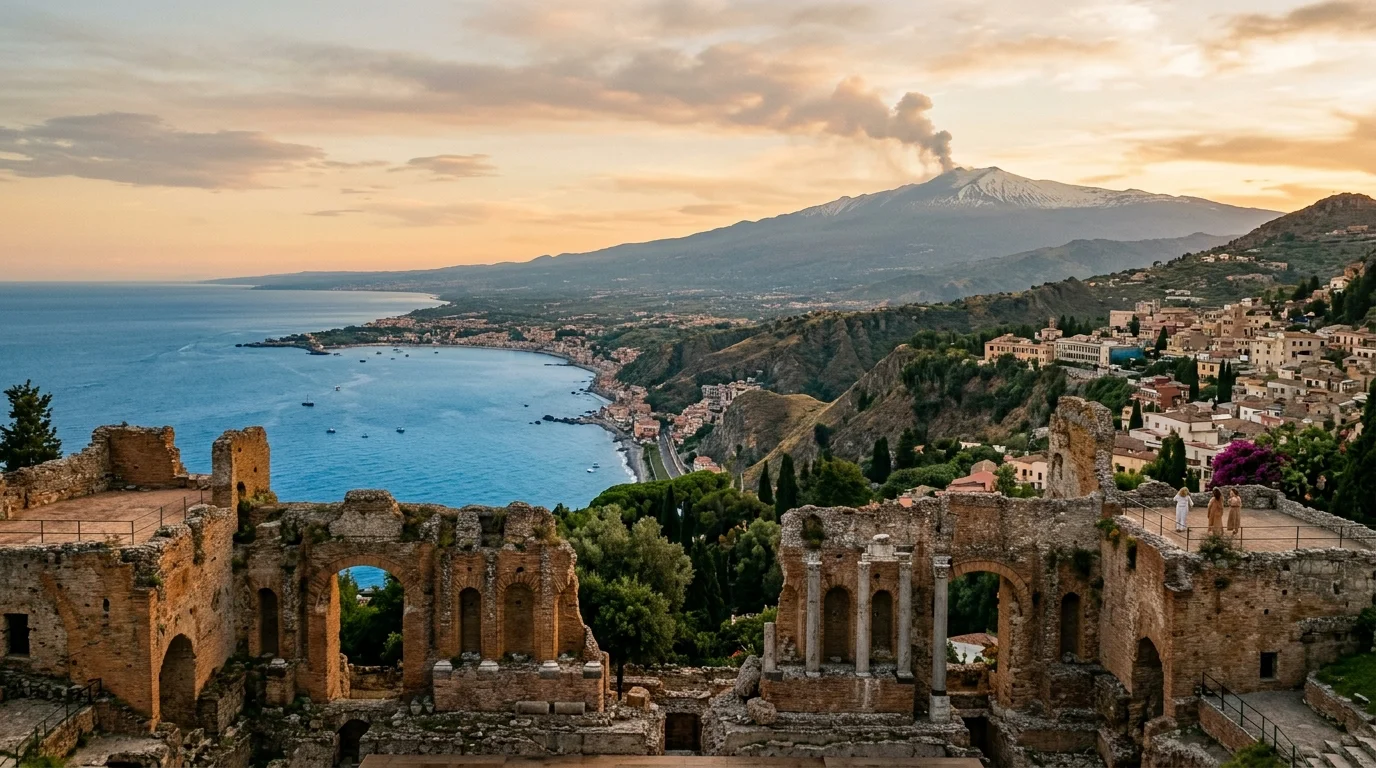
Taormina is Sicily's most glamorous town — a clifftop medieval jewel perched 250 meters above the Ionian Sea, with views of both the coastline and the smoking cone of Mount Etna. It has been a destination for wealthy travelers since the 19th century, attracting writers, artists, and aristocrats who fell in love with its beauty. Today it's popular but remains genuinely magical, especially in the early morning or at sunset.
The Teatro Greco (Greek Theatre) is Taormina's crown jewel — a 3rd-century BC theatre that was later expanded by the Romans. It is one of the largest ancient theatres in Sicily and offers what is arguably the most dramatic theatrical backdrop on earth: a perfectly framed view of Mount Etna through the ruined stage arches. The theatre is still used today for the Taormina Film Festival and summer concerts.
Why visit: Taormina offers the most photogenic combination of ancient ruins, volcanic landscape, and Sicilian elegance anywhere on the island. The Greek Theatre view at sunset is one of those travel moments that photographs can't quite capture.
Entrance: Teatro Greco: Adults €10, Reduced €5, Under 18 free (2026)
Best time: Open early morning or late afternoon; avoid midday in summer
Hours: Daily 9:00 AM – 1 hour before sunset
Palazzo dei Normanni & Cappella Palatina, Palermo
Piazza del Parlamento 1, 90129 Palermo PA, Italy
The Palace of the Normans is the oldest royal residence in Europe still in use — it currently houses the Sicilian Regional Parliament. Built on the site of a 9th-century Arab fortress, it was expanded into a magnificent palace by the Norman kings in the 12th century and remains one of the great architectural achievements of the medieval world. The building is a living symbol of Sicily's multicultural history.
Inside the palace, the Cappella Palatina (Palatine Chapel) is widely regarded as one of the most beautiful rooms in the world. Built by Roger II between 1130 and 1143, it combines Arab muqarnas ceilings, Byzantine gold mosaics covering every surface, and Norman arches in a breathtaking fusion that must be seen to be believed. The golden mosaics depicting biblical scenes glow in the candlelight with an almost supernatural intensity.
Why visit: The Cappella Palatina is the single most impressive interior space in Sicily — the gold mosaics are extraordinary and the cross-cultural fusion is unlike anything else in Europe. It is the crown jewel of Palermo's UNESCO-listed Arab-Norman architecture.
Entrance: Adults €12, Reduced €9 (includes Royal Apartments and Chapel, 2026)
Best time: Weekday mornings; Saturday afternoons when Parliament is not in session
Hours: Monday–Saturday 8:15 AM – 5:45 PM; Sunday 8:15 AM – 1:00 PM
Syracuse (Siracusa) & the Ortygia Island
Piazza del Duomo, 96100 Siracusa SR, Italy
Syracuse was once the greatest city in the ancient Greek world — larger and more powerful than Athens itself — and the old city of Ortygia is still one of Sicily's most beautiful places. This small island, connected to the mainland by bridges, contains the stunning Piazza del Duomo (one of Italy's most beautiful squares), a Baroque cathedral built inside a 5th-century BC Greek temple, ancient alleyways, and gorgeous waterfront terraces. Walking through Ortygia at sunset is a magical experience.
The mainland Archaeological Zone (Parco Archeologico della Neapolis) contains one of the best ancient theatre complexes in the world — the Greek Theatre can seat 15,000 people and is still used for summer performances, alongside the Roman Amphitheatre, the Ear of Dionysius cave, and the Altar of Hiero II, which once accommodated the sacrifice of 450 oxen simultaneously.
Why visit: Syracuse offers the rare combination of living Baroque city life on Ortygia and world-class ancient ruins on the mainland — all in one of Sicily's most relaxed and beautiful cities.
Entrance: Parco Neapolis: Adults €13.50, Reduced €7 (2026); Ortygia is free to explore
Best time: Early morning for the archaeological park; evening for Ortygia's atmosphere
Hours: Parco Neapolis: Daily 9:00 AM – 7:00 PM (last entry 6:00 PM)
Cefalù Medieval Town & Cathedral
Piazza del Duomo, 90015 Cefalù PA, Italy
Cefalù is many visitors' idea of the perfect Sicilian town — a compact medieval fishing village tucked between a dramatic rocky promontory and a gorgeous sandy beach, with a magnificent Norman cathedral dominating the skyline. It sits 70 km east of Palermo and makes an excellent day trip or overnight stay. The town's pastel-painted houses, Arab-Norman alleyways, and lively waterfront have made it one of Sicily's most photographed places.
The Cefalù Cathedral (Cattedrale di Cefalù), built in 1131 by Roger II, contains some of the oldest and finest Byzantine mosaics in all of Sicily — the huge Christ Pantocrator mosaic in the apse is older than those in Monreale and Palermo and considered one of the greatest mosaic masterworks of the medieval world. The climb up La Rocca fortress above the town rewards with sweeping coastal views.
Why visit: Cefalù is the ideal combination of beach, history, and authentic Sicilian atmosphere — without the tourist density of Taormina. It's genuinely beautiful in every direction.
Entrance: Cathedral: €3 (2026); La Rocca: €4; Beach: free
Best time: Early morning before day-trippers arrive from Palermo; September–October for perfect sea and weather
Hours: Cathedral: Daily 8:30 AM – 1:00 PM & 3:30 PM – 7:00 PM
Monreale Cathedral (Cattedrale di Monreale)
Piazza Guglielmo II, 1, 90046 Monreale PA, Italy
Monreale Cathedral is considered the greatest achievement of Arab-Norman art and architecture, and one of the finest cathedrals in the world. Built by King William II between 1174 and 1185, its interior is covered with 6,340 square meters of gold mosaics — the largest collection of medieval mosaics in the world. The gold shimmers and glows in the light in a way that photographs cannot capture — you simply have to experience it in person.
The mosaics cover the entire interior, depicting the complete Old and New Testament story across a series of panels of extraordinary detail and beauty. The adjoining Benedictine cloister, with its 228 paired columns decorated with intricate Norman carvings and colored stone inlays, is equally stunning and often overlooked by visitors in a hurry.
Why visit: The sheer scale, quality, and golden otherworldly beauty of the mosaics inside Monreale make it one of the most extraordinary interiors in Europe. It is slightly away from Palermo (a 30-minute bus ride) but absolutely worth every minute.
Entrance: Cathedral: €5; Cloister: €6; Combined: €9 (2026)
Best time: Weekday mornings when light streams through the windows onto the mosaics
Hours: Cathedral: Monday–Saturday 8:00 AM – 12:30 PM & 2:30 PM – 5:00 PM; Sunday 2:30 PM – 5:00 PM
Val di Noto — Baroque Towns of the Southeast
Piazza XVI Maggio, 97015 Modica RG, Italy (Noto: Corso Vittorio Emanuele III, 96017 Noto SR)
The southeastern corner of Sicily is home to eight towns — including Noto, Ragusa Ibla, Modica, and Scicli — that were almost entirely rebuilt in the Baroque style after the catastrophic 1693 earthquake. The result is one of the most architecturally uniform and beautiful landscapes in the world. These golden limestone towns, cascading down hillsides and gleaming in the Mediterranean sun, are collectively a UNESCO World Heritage Site.
Noto is the most refined — its Corso Vittorio Emanuele is considered the finest Baroque street in Sicily. Ragusa Ibla is the most dramatic — built on a rocky spur with breathtaking views. Modica is famous worldwide for its unique ancient chocolate, made without cocoa butter in a recipe brought from Mexico by the Spanish in the 16th century. All three towns deserve at least a few hours each.
Why visit: The Baroque southeast is Sicily's most underrated region — less visited than the north but arguably more beautiful, with extraordinary architecture, excellent food, and a genuinely unhurried pace of life.
Entrance: Towns are free to explore; individual churches/museums: €2–€5 each (2026)
Best time: Spring and autumn; avoid August when the heat is extreme
Hours: Towns always accessible; most churches open 9:00 AM – 1:00 PM & 4:00 PM – 7:00 PM
Aeolian Islands (Isole Eolie)
Via Roma, 98055 Lipari ME, Italy (main island; ferries from Milazzo, Via Rizzo 22, 98057 Milazzo ME)
The Aeolian Islands are a UNESCO-listed volcanic archipelago of seven islands north of Sicily, each with its own distinct character. Lipari is the largest and most accessible, with an impressive citadel and excellent beaches. Stromboli offers the remarkable spectacle of an active volcano erupting every 15–20 minutes — you can hike to the summit at night to watch lava and ash shooting into the sky above the sea. Vulcano has hot mud baths and sulfur fumaroles. Salina is lush, green, and famous for its capers and Malvasia wine.
The islands have been inhabited since the Neolithic period and were a major trading hub in antiquity. The Aeolian Archaeological Museum on Lipari holds one of the finest collections of prehistoric and Greek artifacts in Italy. In summer, the islands are a destination for wealthy Italian yachters and international travelers, but they remain accessible on regular ferries.
Why visit: The Aeolian Islands offer something genuinely rare — a volcanic landscape of extraordinary beauty with pristine seas, excellent seafood, and a pace of life that immediately slows your own heartbeat. Stromboli in particular is a once-in-a-lifetime experience.
Entrance: Ferry from Milazzo to Lipari: €25–€35 hydrofoil (2026); Stromboli guided hike: €30–€35 per person
Best time: June–September for sea; May and October for quiet and reasonable prices
Hours: Ferries run year-round; reduced winter schedules
Book your tours and tickets in advance — it saves hours of queuing and often gets you a better price. These two platforms cover different options, so it's worth checking both.
What Are the Best Neighborhoods to Explore in Sicily?
Sicily's neighborhoods each have a distinct character shaped by history, culture, and geography — from the chaotic, beautiful markets of Palermo's old city to the elegant Baroque streets of Catania. Here are the best areas to explore.
Il Capo & Ballarò, Palermo
Character: Two of Palermo's most ancient and atmospheric street markets, dating back to the Arab era. Il Capo and Ballarò are loud, colorful, chaotic, and utterly fascinating — stalls piled high with blood oranges, swordfish, offal, spices, vegetables, and street food. The surrounding alleyways are layered with history and decay in equal measure.
What makes it special: These markets are where Palermo's soul lives — the vendors call out in Sicilian dialect, the smells of roasting meat and fresh fish fill the air, and the street food (panelle, arancine, pane ca meusa) is the best in the city. Ballarò is one of the oldest markets in the Mediterranean world.
Best for: Food lovers, market enthusiasts, photographers, cultural immersion seekers
Must-see in this area: Ballarò market (Via Ballarò), Il Capo market (Via Sant'Agostino), the Albergheria quarter, Palazzo Abatellis
How to get there: 10-minute walk from Palermo Centrale station; Metro Line 1 to Ballarò stop
Location: Piazza del Carmine, 90134 Palermo PA, Italy
La Kalsa, Palermo
Character: La Kalsa is Palermo's most historically significant and now most gentrifying neighborhood — a former Arab royal quarter that suffered heavy WWII bombing and subsequent neglect, but is now experiencing a remarkable creative renaissance. Its crumbling palaces, contemporary art galleries, and independent restaurants create a fascinating atmosphere of old and new.
What makes it special: The neighborhood contains some of Palermo's best museums (Palazzo Abatellis, Museo Internazionale delle Marionette), beautiful gardens (Villa Giulia, Orto Botanico), and the vibrant Piazza Magione. Street art by international artists covers many walls, and the vibe is young, creative, and genuinely local.
Best for: Art lovers, history buffs, those who like a neighborhood that feels real and evolving
Must-see in this area: Palazzo Abatellis, Piazza della Kalsa, Piazza Magione, Orto Botanico di Palermo
How to get there: 15-minute walk from the Cathedral; bus 101 from Piazza Massimo
Location: Piazza della Kalsa, 90133 Palermo PA, Italy
Historic Center (Centro Storico), Catania
Character: Catania's historic center is a masterpiece of Baroque urban design, rebuilt after the 1693 earthquake in gleaming black lava stone and white limestone — a striking high-contrast aesthetic found nowhere else in the world. The streets radiate from Piazza del Duomo, dominated by the iconic elephant fountain (the city symbol), and the atmosphere is lively, urban, and genuinely energetic.
What makes it special: Catania feels like Sicily's most liveable big city — a place where university students, market vendors, and Baroque palaces all share the same streets. La Pescheria (the fish market behind the cathedral) is one of Sicily's great spectacles, operating from dawn until noon. The city's nightlife around Via Teatro Massimo is excellent.
Best for: Urban explorers, nightlife seekers, food lovers, those who want a working Sicilian city rather than a tourist bubble
Must-see in this area: Piazza del Duomo, La Pescheria fish market, Via Etnea, Teatro Massimo Bellini, Castello Ursino
How to get there: Central — all arrivals by train or air connect here directly
Location: Piazza del Duomo, 95121 Catania CT, Italy
Ortygia Island, Syracuse
Character: Ortygia is the ancient island heart of Syracuse — a tiny, extraordinarily beautiful labyrinth of Baroque palaces, Greek ruins, Arab alleyways, and glittering harbors. Connected to the mainland by two bridges, it feels like a world apart from modern Sicily. The atmosphere is elegant, romantic, and layered with three millennia of history.
What makes it special: Ortygia has one of the most beautiful main squares in Italy (Piazza del Duomo), a cathedral built inside a standing Greek temple, the ancient Arethusa Fountain surrounded by papyrus plants, and some of Sicily's best restaurants. It combines UNESCO-listed architecture with a genuine, living community.
Best for: Romantics, history lovers, food enthusiasts, photographers, couples
Must-see in this area: Piazza del Duomo, Cattedrale di Siracusa, Fonte Aretusa, Via della Maestranza, Castello Maniace
How to get there: 20-minute walk from Syracuse train station; shuttle bus from mainland
Location: Piazza Archimede, 96100 Siracusa SR, Italy
Ragusa Ibla
Character: Ragusa Ibla is one of Sicily's most dramatic and beautiful neighborhoods — the original lower town of Ragusa, built on a rocky spur with honey-colored Baroque churches and palaces cascading down steep hillsides to the Irminio valley. After the 1693 earthquake, the new town of Ragusa was built on the adjacent hill, leaving Ibla as a perfectly preserved Baroque time capsule.
What makes it special: The steep stairways, wisteria-draped balconies, crumbling palazzi, and the magnificent dome of San Giorgio church create an atmosphere of decaying grandeur that is entirely unique in Sicily. The Giardino Ibleo public garden at the eastern tip offers sweeping valley views. Inspector Montalbano was filmed extensively here, and the show's fans flock to recognizable locations.
Best for: Photographers, architecture lovers, Montalbano fans, anyone who loves beautiful, quiet hilltop towns
Must-see in this area: Duomo di San Giorgio, Piazza del Duomo, Giardino Ibleo, Palazzo della Cancelleria, Circolo di Conversazione
How to get there: Bus or taxi from Ragusa Superiore (15 minutes); steep walk down from new town
Location: Piazza del Duomo, 97100 Ragusa RG, Italy
Trapani & the Salt Pans District
Character: Trapani is an often-overlooked western Sicilian port city with a beautifully preserved historic center on a narrow peninsula jutting into the sea. It is the gateway to the Egadi Islands, the saltpans of Marsala, and the hilltop town of Erice — and its own historic center, with Arab-influenced architecture and excellent seafood restaurants, is well worth exploring.
What makes it special: The salt pans (saline) south of Trapani, stretching to Marsala, are a remarkable landscape of white salt mountains, pink-tinged water, and photogenic windmills at golden hour. The Museo del Sale explains the centuries-old salt production tradition. From Trapani, you can also catch ferries to the pristine beaches of Favignana in under an hour.
Best for: Photographers, nature lovers, seafood enthusiasts, island-hoppers
Must-see in this area: Saline di Trapani e Paceco, Museo del Sale, Corso Vittorio Emanuele, Santuario dell'Annunziata, ferry to Favignana
How to get there: 1-hour train from Palermo (€6, 2026); bus connections from Palermo airport
Location: Piazza Vittorio Veneto, 91100 Trapani TP, Italy
What Food Should You Try in Sicily?
Sicily is famous for having one of the most distinctive and exciting cuisines in all of Italy — a unique blend of Greek, Arab, Norman, and Spanish influences that resulted in dishes found nowhere else in the world. The must-try dishes include arancine, pasta alla Norma, fresh seafood, and granita con brioche — but the full Sicilian food experience goes much deeper.
What Are the Must-Try Local Dishes in Sicily?
- Arancine (or Arancini) — Sicily's beloved fried rice balls, filled with ragù and peas (Palermo style) or ham and cheese, coated in breadcrumbs and fried to a golden crisp. Note: Palermitans say "arancine" (feminine); Catanesi say "arancini" (masculine) — a passionate linguistic debate that has divided the island for decades.
- Pasta alla Norma — Catania's most famous dish: pasta with tomato sauce, fried aubergine, salted ricotta, and fresh basil. Named after Bellini's opera "Norma," it is a masterpiece of simplicity and flavor.
- Granita con Brioche — Sicily's greatest breakfast contribution to world civilization. Granita is a partially frozen flavored ice (almond, coffee, mulberry, pistachio, lemon) served in a glass, eaten with an impossibly soft, airy brioche roll. This is how Sicilians eat breakfast in summer.
- Caponata — A sweet-and-sour cooked aubergine dish with tomatoes, celery, olives, capers, and vinegar. Served as an antipasto, it reflects the Arab-influenced agrodolce (sweet-sour) tradition in Sicilian cooking.
- Pane ca Meusa (Pane con la Milza) — Not for the faint-hearted: a Palermo street food specialty of spleen, lung, and trachea fried in lard, served in a soft bun with ricotta and caciocavallo cheese. A must-try for adventurous eaters at Ballarò market.
- Pasta con le Sarde — Pasta with fresh sardines, wild fennel, raisins, pine nuts, saffron, and breadcrumbs — a dish that perfectly encapsulates Sicily's Arab culinary legacy and its love of combining sweet and savory.
- Cannoli — The world's most famous Sicilian pastry: crisp fried pastry tubes filled with sweetened sheep's milk ricotta, chocolate chips, and candied citrus peel. The best are made fresh to order in pastry shops — avoid pre-filled ones, which go soggy.
- Cassata Siciliana — A festive cake of sponge, ricotta cream, marzipan, and elaborate candied fruit decoration. More elaborate and more intensely sweet than most Northern Italian desserts, it traces its origins directly to Arab-era Sicily.
- Pesce Spada (Swordfish) — Fresh Sicilian swordfish, grilled, marinated in lemon and capers, or prepared alla ghiotta (with tomatoes, olives, capers, and pine nuts). The swordfish from the Strait of Messina is exceptionally fresh and prized across Italy.
Where Should You Eat in Sicily?
Budget-Friendly (Under €15 per meal)
- Friggitoria Chiluzzo — Via Vittorio Emanuele 102, 90133 Palermo — Famous hole-in-the-wall for panelle (chickpea fritters), crocchè (potato croquettes), and other Palermo street food. Cash only, under €5 for a filling street food lunch.
- Trattoria da Nino — Via Plebiscito 112, 95121 Catania — No-frills local trattoria in Catania serving excellent pasta alla Norma and fresh fish at genuine local prices. A favorite of university students and market workers.
- Caffè Sicilia (Noto) — Corso Vittorio Emanuele 125, 96017 Noto SR — World-famous for its granita and pastries. The granita di mandorla (almond) is the finest in Sicily. Worth the detour for breakfast alone.
Mid-Range (€20–€45 per meal)
- Osteria dei Vespri — Piazza Croce dei Vespri 6, 90133 Palermo — Elegant but relaxed osteria in a beautiful Baroque courtyard in Palermo's La Kalsa district. Exceptional Sicilian cuisine with excellent local wine list. Reservations recommended.
- Ristorante Asmundo di Gisira — Via Crociferi 6, 95121 Catania — Modern Sicilian cuisine in a beautiful 18th-century palazzo with a lovely courtyard. The pistachio pasta and local catch are outstanding.
- Ristorante Don Camillo — Via delle Maestranze 96, 96100 Siracusa — Beloved institution in Ortygia serving beautiful seafood and traditional Syracusan cuisine for over 40 years. Excellent local wine selection.
- La Fenice — Piazza Santa Caterina, 98039 Taormina — Reliable mid-range spot in Taormina for fresh local fish, handmade pasta, and a good value tourist menu at lunch.
Fine Dining (€55+ per meal)
- Duomo Ristorante — Via Capitano Bocchieri 31, 97100 Ragusa Ibla — Two Michelin stars, led by chef Ciccio Sultano. One of Sicily's most celebrated restaurants, serving creative Sicilian fine dining in the heart of Ragusa Ibla. Book months in advance for a table.
- Il Bavaglino — Via P. Torrearsa 17, 91100 Trapani — One Michelin star with an emphasis on western Sicily's exceptional seafood and couscous tradition (the western end of Sicily has North African culinary roots). Exceptional tasting menu.
What Are the Dining Customs in Sicily?
Meal times: Sicilians eat breakfast (colazione) from 7:00–9:00 AM — usually a granita or cornetto at a bar. Lunch (pranzo) is from 1:00–3:00 PM and remains the main meal of the day. Dinner (cena) starts no earlier than 8:00 PM in restaurants; locals often eat at 9:00–10:00 PM.
Tipping: Tipping is not obligatory in Sicily but is appreciated. Leave 5–10% for good service. Many restaurants add a coperto (cover charge) of €1.50–€3 per person, which covers bread and the table setting — this is normal and not a scam.
Reservations: Required at all fine dining restaurants (book weeks in advance in summer). Recommended at popular mid-range restaurants, especially for Friday and Saturday evenings. Most trattorias accept walk-ins.
Dress code: Smart casual for mid-range and above. Fine dining restaurants expect neat dress — no beachwear, flip-flops, or shorts at dinner in nicer establishments.
What Is the Nightlife Like in Sicily?
Sicily's nightlife scene is lively and very much alive — it just starts late, as Italian tradition demands. Restaurants don't fill up until 9:00 PM, aperitivo begins around 7:00–8:00 PM, bars get going after 10:00 PM, and clubs don't really come alive until midnight or 1:00 AM. Catania has the most active club scene on the island; Palermo has excellent bars and live music; Taormina and Cefalù have beautiful summer terrace bars.
Where Are the Best Areas for Nightlife in Sicily?
- Via Teatro Massimo & Piazza Bellini, Palermo: Via Calcedonio, 90134 Palermo — The heart of Palermo's aperitivo and bar scene. Bars, craft beer pubs, and wine bars line these streets, with crowds spilling onto the pavements on warm evenings.
- Via Etnea & Piazza Teatro Massimo, Catania: Piazza Teatro Massimo, 95131 Catania — Catania's main nightlife spine, with everything from cocktail bars to clubs. The area around Piazza Bellini in Catania gets particularly lively on weekends.
- Corso Umberto I, Taormina: Corso Umberto I, 98039 Taormina — The glamorous pedestrian main street fills with evening strollers, and the terraced bars with views of the valley and sea are magical for summer evening cocktails.
What Are the Best Bars and Clubs in Sicily?
Bars & Pubs
- Kursaal Kalhesa — Foro Umberto I 21, 90133 Palermo — Atmospheric bar-restaurant in a beautifully restored 17th-century bastion on Palermo's old city walls. Excellent cocktails, aperitivo buffet, and regular jazz and live music events.
- Picanello Craft Beer — Via Dottor Consoli 26, 95100 Catania — Catania's best craft beer bar, with 20+ taps of Sicilian and Italian microbrews. Relaxed vibe, excellent snacks, and a genuinely local crowd.
- Bar San Placido — Via Landolina 1, 95131 Catania — A beloved Catania institution known for its extraordinary pastries, gelato, and evening cocktails. Gorgeous Art Deco interior.
Clubs & Dancing
- Mono Club — Via Medici 4, 95131 Catania — Catania's most well-known club venue with electronic music, guest DJs, and themed nights. Cover charge €10–€20 (2026). Busy from midnight on weekends.
- Lido Azzurro Beach Club — Via Cristoforo Colombo, 98039 Taormina — Summer beach club that transforms into an open-air party venue on warm evenings, with DJ sets and cocktails on the terrace overlooking the bay.
Live Music & Shows
- Teatro Massimo Vittorio Emanuele — Piazza Giuseppe Verdi, 90138 Palermo — One of the largest opera houses in Europe and Palermo's grandest venue. Opera, ballet, and classical concerts run from October to June. Tickets €25–€150 (2026); book at teatromassimo.it
- Teatro Greco di Taormina — Via del Teatro Greco, 98039 Taormina — The ancient Greek theatre hosts the Taormina Film Festival (late June/July) and summer concerts. Seeing a show here under the stars with Etna in the background is magnificent.
What Family-Friendly Evening Entertainment Is Available?
The evening passeggiata (traditional evening stroll) is family-friendly entertainment at its most Italian — join locals walking the main corso in any town between 6:00 and 8:00 PM, stopping for gelato and watching the world go by. In summer, many Sicilian towns host outdoor cinema screenings, puppet theatre (Opera dei Pupi), and local festival events that welcome all ages.
What and Where Should You Shop in Sicily?
The best things to buy in Sicily are food products (olive oil, wine, pistachios, capers, chocolate), handmade ceramics, woven baskets, and Sicilian puppet theatre souvenirs. The top shopping areas are the street markets of Palermo and Catania, the ceramic towns of Caltagirone, and the specialty food shops found throughout the island.
What Are the Best Shopping Districts in Sicily?
- Via della Libertà, Palermo: Via della Libertà, 90143 Palermo — Palermo's elegant main shopping boulevard, lined with high-street brands, boutiques, and department stores. Good for fashion and international brands.
- Via Etnea, Catania: Via Etnea, 95121 Catania — Catania's main shopping street running from Piazza del Duomo to Villa Bellini park. Mix of international chains, local boutiques, and excellent pastry and chocolate shops.
- Corso Umberto I, Taormina: Corso Umberto I, 98039 Taormina — Expensive tourist shopping street with ceramics, limoncello, jewelry, and designer goods. Beautiful but pricey — good for gifts if budget allows.
What Markets Should You Visit in Sicily?
Mercato di Ballarò — Via Ballarò, 90134 Palermo — Open Monday–Saturday 7:00 AM to early afternoon. The oldest and most authentic of Palermo's three historic street markets, selling fresh produce, fish, meat, olives, spices, and street food. The atmosphere is extraordinary — shouting vendors, exotic produce, and medieval alleyways. This is Sicily's most atmospheric market experience.
La Pescheria — Via Pardo, 95121 Catania (behind Piazza del Duomo) — Open Monday–Saturday from dawn until noon. Catania's famous fish market, held in a Roman-era space below the cathedral. The catch is spectacularly fresh and the vendors are extraordinarily theatrical. Even if you're not buying, it's one of Sicily's great free shows.
Mercato delle Pulci (Flea Market) — Piazza Peranni, 90133 Palermo — Open Sunday mornings. Palermo's antique and secondhand market, with vintage ceramics, old prints, furniture, and curiosities at negotiable prices. A good place to find unusual and affordable Sicilian souvenirs.
What Should You Buy in Sicily?
- Sicilian Olive Oil — Some of the world's finest olive oil comes from Sicily, especially from Trapani (Nocellara del Belice olives) and the Val di Mazara. Buy cold-pressed DOP oil from a local producer or specialty food shop — €10–€25 for 500ml (2026).
- Sicilian Wine — Nero d'Avola (full-bodied red), Etna Rosso (volcanic, increasingly prestigious), and Marsala (fortified dessert wine) are the standouts. Wine from Planeta, Tasca d'Almerita, and Benanti are excellent labels to look for.
- Pistachios from Bronte — The pistachio from Bronte, on the slopes of Etna, is considered the finest in the world — vibrant green, intensely flavored, and protected by DOP status. Buy them whole, as paste, or as pistachio cream. Available across the island; €15–€25 per kg (2026).
- Ceramics from Caltagirone — The hill town of Caltagirone is the ceramic capital of Sicily, producing brilliantly colored maiolica pottery in traditional designs. Plates, tiles, lemon trees, and decorative pieces make beautiful gifts — prices from €10 for small pieces upward.
- Modica Chocolate — Cold-processed chocolate made without cocoa butter, in the ancient Aztec/Spanish style. Available in dozens of flavors (cinnamon, chili, vanilla, carob). A genuinely unique food souvenir — €4–€8 per bar (2026).
- Capers from Pantelleria — The caper berries grown on the volcanic island of Pantelleria (salted, not in vinegar) are considered the finest in the world. Available at specialty food shops throughout Sicily for €5–€10 per jar (2026).
What Are the Shopping Hours and Customs?
Most shops in Sicily open Monday–Saturday from 9:00 AM to 1:00 PM, close for lunch until 4:00–5:00 PM, then reopen until 8:00 PM. Many shops close on Sunday and some close on Monday morning. In tourist areas (Taormina, Cefalù), shops often stay open continuously through the day and on Sundays in summer. Supermarkets generally open 8:30 AM – 8:30 PM, sometimes later. Bargaining is acceptable at street markets but not in shops with price tags.
Can Non-EU Visitors Claim a VAT Tax Refund in Sicily?
Yes — if you are a visitor from outside the European Union (including travellers from the USA, Canada, Australia, the UK, and most of Asia and Latin America), you are entitled to a refund of the VAT (Value Added Tax) included in the price of goods you buy in Italy. VAT in Italy is 22% on most goods; 10% on some food items, which means this refund can be significant on high-value purchases like clothing, leather goods, jewellery, designer fashion, and electronics.
How to Claim Your VAT Refund — Step by Step
- Spend at least €154.94 in a single shop in a single day. This is the minimum threshold for a VAT refund claim in Italy. It does not apply across multiple shops — the full amount must be spent in one store.
- Look for the "Tax Free" sign. Participating shops display a "Tax Free Shopping," "Global Blue," or "Planet" logo in the window or at the register.
- Ask for the tax refund form at the register before you pay. Present your non-EU passport — the shop will fill out the form with your details and the purchase amount. Keep the form with your receipt.
- Get the form stamped at customs before you leave. Go to the Customs office at Catania Fontanarossa Airport (CTA) before check-in and have an officer stamp your tax refund form. Keep your purchases accessible in hand luggage — do not pack them deep in your checked bags.
- Collect your refund. Hand the stamped form to the Global Blue or Planet desk at the airport. You can receive the refund in cash (minus a processing fee) or as a credit card refund (lower fees, takes a few weeks).
VAT Refund Quick Facts for Sicily
- Minimum spend: €154.94 in one shop in one day
- VAT rate on most goods: 22% on most goods; 10% on some food items
- Typical refund after fees: 10–15% of the purchase price
- Refund processors: Global Blue and Planet (formerly Premier Tax Free) at Catania Fontanarossa Airport (CTA)
- Who qualifies: Anyone with a non-EU passport who is not a resident of an EU country
- UK visitors: British passport holders qualify since Brexit — the UK is no longer in the EU
- Deadline: Purchases must be exported within 3 months of the date of purchase
- Full guide: VAT Refund in Europe — Complete Guide for Non-EU Travelers
What Festivals and Events Happen in Sicily?
Sicily's biggest festivals include the Feast of Saint Agatha in Catania (one of the largest religious processions in the world), the Taormina Film Festival, the Greek drama festivals at Syracuse and Agrigento, and dozens of local sagre (food festivals) celebrating everything from pistachios to couscous. The island's event calendar reflects its deep religious, cultural, and agricultural traditions.
What Is the Annual Events Calendar for Sicily?
| Month/Season | Event Name | Description |
|---|---|---|
| January | Feast of Sant'Agata, Catania (Feb 3–5) | One of the world's largest Catholic processions — over 1 million participants fill the streets of Catania for three days to honor the city's patron saint. Extraordinary and unmissable if you're there in early February. |
| February | Almond Blossom Festival, Agrigento | The Valley of the Temples turns white with almond blossoms, accompanied by an international folk music and dance festival in and around the archaeological site. Usually held the first or second week of February. |
| March | Easter Week (Settimana Santa) | Religious processions take place in virtually every Sicilian town, with the most dramatic in Trapani (Processione dei Misteri, 24 hours long) and Enna. Deeply moving and culturally fascinating. |
| April | Infiorata di Noto | The streets of Noto are carpeted with elaborate floral artworks on the third Sunday of May. One of Sicily's most photogenic annual events, usually attracting crowds of photographers and visitors. |
| May | INDA Classical Drama Festival, Syracuse | Ancient Greek and Roman dramas performed in the 5,000-year-old Greek Theatre of Syracuse — a magnificent and unique experience running from May through late June. Book tickets well in advance at indafondazione.org. |
| June | Taormina Film Festival (TaorminaFilmFest) | International film festival held in the Greek Theatre of Taormina in late June/early July. Screenings, premieres, and celebrity appearances in one of the world's most dramatic natural amphitheatres. |
| July | Festino di Santa Rosalia, Palermo | Palermo's biggest annual celebration (July 14–15) honoring the city's patron saint with a massive torchlit procession, fireworks over the sea, and street celebrations throughout the historic center. The island is at its most festive. |
| August | Etna Comics, Catania | One of Italy's largest comics, gaming, and pop culture conventions, held in Catania's Fiera complex in late July/early August. Draws major international guests and tens of thousands of attendees. |
| September | Cous Cous Fest, San Vito Lo Capo | International couscous cooking festival and competition held on the beautiful beach of San Vito Lo Capo, reflecting western Sicily's North African culinary heritage. World-class food, music, and beach atmosphere. |
| October | Sagra del Pistacchio, Bronte | The biennial pistachio festival (even years) in Bronte celebrates the harvest of Sicily's famous Etna-slope pistachios with tastings, markets, and cooking demonstrations. Next edition: October 2026. |
| November | Tutti i Santi (All Saints) & Commemoration of the Dead | November 1–2 are major family holidays in Sicily — traditionally, children receive gifts of marzipan fruit and sweets left by deceased relatives. The Sicilian marzipan tradition at this time is extraordinary and unique. |
| December | Christmas Markets & Presepi Viventi | Living nativity scenes (presepi viventi) in historic town centers across Sicily — particularly beautiful in Caltagirone, Custonaci, and Gangi. Christmas markets in Palermo and Catania run through December. |
How Do Festivals Affect Hotel Prices and Availability?
Major festivals like the Feast of Sant'Agata (Catania, February 3–5) and the Festino di Santa Rosalia (Palermo, July 14–15) can cause hotels to sell out weeks or months in advance in those cities. Easter week is extremely busy island-wide. In summer (July–August), all hotels in coastal areas and Taormina are under intense pressure — book at least 2–3 months ahead. For festival periods, book 3–6 months in advance.
Where Should You Stay in Sicily?
The best neighborhood to stay in Sicily depends on your travel style and the parts of the island you want to explore. Palermo is the best base for the northwest; Catania for the east coast and Etna; Taormina for luxury; Syracuse for the southeast; and Agrigento for the Valley of the Temples.
What Are the Best Neighborhoods to Stay in Sicily?
| Neighborhood/Area | Vibe | Price Range (per night, 2026) | Best For |
|---|---|---|---|
| Palermo Historic Center | Lively, cultural, authentic | €60–€180 (hotels); €45–€120 (apartments) | First-time visitors, culture seekers, market lovers |
| Taormina | Glamorous, scenic, touristy | €120–€400+ | Romantic breaks, luxury travelers, view-chasers |
| Catania Centro | Urban, energetic, authentic | €50–€150 | City explorers, nightlife seekers, Etna day-trippers |
| Syracuse / Ortygia | Romantic, historic, elegant | €70–€200 | Couples, history lovers, slow travelers |
| Cefalù | Charming, beach, family-friendly | €80–€220 | Families, beach lovers, day-trippers from Palermo |
| Agrigento | Quiet, convenient for temples | €50–€120 | Budget travelers, archaeology enthusiasts |
What Are the Pros and Cons of Each Area?
Palermo Historic Center:
Pros: Central to all major sights, excellent restaurant and bar scene, great transport connections, authentic city atmosphere, wide range of accommodation options at different budgets.
Cons: Some areas can feel run-down; traffic and noise can be significant; petty theft in very crowded market areas (keep bags secure).
Taormina:
Pros: The most beautiful setting in Sicily, spectacular views, excellent restaurants, pedestrian center, romantic atmosphere.
Cons: Very expensive by Sicilian standards; very crowded in summer; car-free center means luggage must be carried; limited transport links compared to Palermo or Catania.
Catania:
Pros: Best transport hub in eastern Sicily (airport 7km away); excellent food and nightlife scene; convenient for Etna day trips; more affordable than Taormina.
Cons: Less obviously beautiful than Taormina or Ortygia; parts of the city beyond the historic center are not scenic.
How Far in Advance Should You Book in Sicily?
For travel in July and August, book at least 3 months ahead — especially in Taormina, Cefalù, and coastal areas. For spring and autumn, 4–6 weeks is generally sufficient for most places except during major festivals. For winter travel, you can often book just a week or two ahead and find excellent last-minute deals of 30–50% below peak prices.
What Do You Need to Know Before Visiting Sicily?
Here are the essential practical details every visitor to Sicily needs to know — from money and language to safety and health.
Essential Travel Details for Sicily
- Currency: Euro (€); best rates at ATMs; avoid airport exchange bureaux
- Credit Cards: Widely accepted in hotels, restaurants, and larger shops; smaller trattorias, market vendors, and rural areas often cash-only
- ATMs (Bancomat): Very common in all towns; use your bank's network to minimize fees; daily withdrawal limit typically €250–€500
- Language: Italian; Sicilian dialect widely spoken. English is good in tourist areas, hotels, and restaurants; limited in rural areas and markets
- Tipping: 5–10% for restaurant service; not obligatory but appreciated; round up taxi fares
- Electrical Plugs: Type F (two round pins), 230V/50Hz — UK and US travelers need adapters
- Emergency Number: 112 (all emergencies — police, ambulance, fire)
- Tourist Police (Carabinieri): 112; tourist police in major cities: 113
- SIM Cards: Available at phone shops and tabacchi — TIM, Vodafone, and WindTre all offer good tourist SIMs from €10–€15 including data (2026)
- WiFi: Good in hotels and most restaurants/bars; patchy in rural areas; public WiFi available at airports and some historic sites
- Tap Water: Safe to drink in cities; in some rural areas the taste may be poor — locals often prefer bottled water but it's technically safe everywhere
Skip the airport queue — order your eSIM before you travel and activate it the moment you land. Prices and data allowances vary, so it pays to compare providers.
How Much Does It Cost to Visit Sicily?
| Budget Type | Daily Cost (2026) | What's Included |
|---|---|---|
| Budget Traveler | €50–€80/day | Hostel or budget B&B, street food and market lunches, public transport, free/low-cost attractions |
| Mid-Range Traveler | €100–€180/day | 3-star hotel or apartment, mix of trattorie and mid-range restaurants, occasional taxis, main paid attractions, one or two tours |
| Luxury Traveler | €250–€500+/day | 4–5 star hotel or villa, fine dining, private driver, guided tours, premium experiences, boat hire |
What Are the Most Useful Phrases in Sicily?
- Hello: Ciao (informal) / Buongiorno (formal, daytime) / Buonasera (formal, evening)
- Thank you: Grazie
- Please: Per favore / Per piacere
- Excuse me: Scusi (formal) / Scusa (informal)
- How much?: Quanto costa?
- Where is...?: Dov'è...?
- I don't understand: Non capisco
- Help!: Aiuto!
- Bathroom: Il bagno
- Check, please: Il conto, per favore
Is Sicily Safe for Tourists?
Sicily is generally safe for tourists — violent crime against visitors is rare and the island welcomes millions of visitors each year without serious incident. The Mafia (Cosa Nostra) exists in Sicily but does not target tourists and is largely invisible to everyday life. Standard urban precautions are all that's needed.
Areas to avoid: Some peripheral neighborhoods of Palermo (Brancaccio, Zen) are best avoided after dark, but tourists have no reason to visit these areas. Stick to the historic center and tourist zones.
Common scams: Fake "parking attendants" asking for payment in tourist parking areas (pay only at official meters); overcharging taxis that aren't using meters; restaurant menus without prices displayed (always ask for the menu con prezzi); unofficial tour guides offering "special access" to sites.
Pickpocketing: Most common in Palermo's busy markets (Ballarò, Vucciria), on crowded buses, and around tourist sites like the Valley of the Temples. Use a money belt or inside pocket for valuables and keep bags in front of you in crowds.
Solo traveler safety: Sicily is generally safe for solo travelers including solo women. Standard common-sense precautions apply — avoid walking alone in dark side streets late at night. The LGBTQ+ scene in Sicily is growing, particularly in Palermo and Catania, though public affection may attract attention in more conservative rural areas.
What Are the Cultural Customs in Sicily?
- Greetings: Italians greet with two kisses on the cheek (left first) among friends; a handshake for formal introductions. Always greet shopkeepers and restaurant staff when entering ("Buongiorno!").
- Dress code: Smart casual for evenings in restaurants. For religious sites (churches, cathedrals), shoulders and knees must be covered — both men and women. Carry a scarf to put on quickly.
- Photography: Always ask permission before photographing individuals, especially in markets. No photography inside most churches or near altars. The Valley of the Temples prohibits tripods without permission.
- Public behavior: Sicilians are warm and expressive but maintain decorum in public spaces. Eating on the go is acceptable; but loud behavior, excessive intoxication, or disrespect at religious sites will be noted with displeasure.
- Dining: Never ask for cappuccino after 11:00 AM — Italians consider it a breakfast drink only. Don't put cheese on seafood pasta. These are not rules, but following them marks you as a respectful visitor.
- Gestures to avoid: The "OK" sign can be offensive in some Italian contexts. Placing your feet on furniture in someone's home is very rude. Arriving very early to a dinner invitation (Sicilians run on a relaxed schedule).
Do You Need a Visa to Visit Sicily?
Sicily is part of Italy, which is a member of the Schengen Area. Citizens of EU/EEA countries and Switzerland do not need a visa. Citizens of the USA, UK (post-Brexit), Canada, Australia, New Zealand, and most other Western countries can enter Italy visa-free for up to 90 days in any 180-day period for tourism. From 2025, UK citizens and other non-EU visitors need to register via the EU's ETIAS (European Travel Information and Authorisation System) — check the official ETIAS website for current requirements before traveling.
What Health Precautions Should You Take in Sicily?
Vaccinations: No vaccinations are specifically required for Sicily. Standard up-to-date vaccinations (tetanus, MMR, COVID-19 where applicable) are recommended. EU residents should carry their EHIC/GHIC card for access to public healthcare.
Pharmacies (Farmacie): Pharmacies are found in every town and are very helpful — pharmacists in Italy can advise on and dispense many medications that require prescriptions elsewhere. Look for the green cross sign. Most towns have a rotating 24-hour pharmacy (farmacia di turno) — a notice posted outside all pharmacies directs you to the nearest one.
Hospitals: Public hospitals (ospedale) are accessible to all EU citizens with EHIC and available to all in emergencies. Private clinics offer faster service. Travel insurance with medical coverage is strongly recommended for non-EU visitors — medical costs without insurance can be very high.
Common health issues: Sunburn and dehydration are the main risks in summer — take sun protection seriously. Tap water is safe. Food safety is generally excellent. Mosquitoes are present in summer, especially near coastal wetlands — bring repellent.
Do You Need Travel Insurance for Sicily?
Yes — and you should buy it before you board your flight, not after. Travel insurance covers the situations that can turn a great trip into a financial disaster: a medical emergency (a single ambulance ride and hospital stay in Europe can cost €3,000–€10,000 without coverage), a cancelled or delayed flight, lost or stolen baggage, or a last-minute trip cancellation. EU citizens with an EHIC or GHIC card receive reciprocal state healthcare, but this does not cover repatriation, trip cancellation, or lost luggage — a full travel policy fills those gaps. Non-EU travellers have no state coverage at all and should never visit without insurance.
Choosing the right policy matters — coverage limits, exclusions, and pre-existing condition terms vary significantly between providers. Read our full guide before you buy: Best Travel Insurance for Europe — Honest Comparison for 2026.
Travel insurance is strongly recommended for Sicily — an unexpected medical bill, flight cancellation, or lost luggage can cost far more than the policy. Get covered before you go.
What Are Your Rights If Your Flight to Sicily Is Delayed or Cancelled?
Under EU Regulation 261/2004, if your flight to or from Sicily is delayed by more than 3 hours or cancelled without sufficient notice, you are entitled to compensation of up to €600 per passenger — regardless of which airline you flew with, and regardless of how long ago it happened (claims can go back up to 6 years in some countries). This applies to all flights departing from an EU airport, and all flights arriving into an EU airport on an EU-based carrier. Most travellers don't realise they are owed money, and airlines rarely volunteer to pay. A claims service handles everything on your behalf and only charges a fee if they win — so there is no risk to you.
Both services check your eligibility for free with no upfront cost — they only charge a commission if they successfully recover your compensation.
Is Sicily Accessible for People with Disabilities?
Sicily presents significant accessibility challenges — many historic sites involve uneven cobblestones, steep slopes, and ancient stairways that are impossible for wheelchairs. Major museums and some archaeological sites have improved accessibility in recent years, but it remains inconsistent. The flat seafront areas of Catania and parts of Ortygia in Syracuse are more manageable. Call ahead to individual sites to confirm current accessibility before planning your visit.
Is Sicily Good for Families with Kids?
Sicily is a wonderful family destination — Italians adore children and they are genuinely welcome everywhere. Kids will love the beaches, the volcano, the gelato, the puppet theatre, and the sheer scale of the Greek and Roman ruins. Family-friendly beaches like San Vito Lo Capo (shallow, clean, sandy) are ideal for young children. Stroller-pushing is challenging in historic town centers with cobblestones — a carrier-style baby carrier is more practical for market areas.
What Are the Best Day Trips from Sicily?
The best day trips from Sicily's main cities include excursions to the Aeolian Islands, the Egadi Islands, the hilltop town of Erice, the Baroque towns of the southeast, and the extraordinary underwater archaeological site at Baia off the Campanian coast. Within Sicily, there are dozens of excellent day trips between the island's own cities and attractions.
Erice — Medieval Hilltop Town
Distance: 14 km / 8.7 miles from Trapani; 20-minute cable car ride from Trapani city
What to see: Erice is one of Sicily's most magical hilltop towns — a medieval village of cobblestone streets, Norman castle, ancient Venus temple ruins, and sweeping views over the Trapani salt pans and the Egadi Islands. It sits at 751 meters and is frequently shrouded in mist, giving it an ethereal, fairy-tale atmosphere. The local almond pastries (made by the cloistered nuns of San Carlo monastery) are legendary.
How to get there: Cable car (funivia) from Via Capua, Trapani — runs hourly, €9.50 return (2026). Journey: 10 minutes. Alternative: bus from Trapani bus station (45 minutes, €2.50).
Time needed: Half day
Best for: History lovers, photographers, those based in Trapani or western Sicily
Location: Piazza Umberto I, 91016 Erice TP, Italy
Favignana & the Egadi Islands
Distance: 20 km / 12 miles from Trapani; 25-minute hydrofoil from Trapani port
What to see: Favignana is the main island of the Egadi archipelago — a small, flat island with some of the most crystal-clear turquoise water in the Mediterranean. The Cala Rossa bay (its quarried tuff stone walls descending into impossible blue water) is one of Italy's most photographed natural sites. Favignana is car-free — rent a bicycle and cycle around the island's coves and beaches in a few hours.
How to get there: Liberty Lines hydrofoil from Trapani Molo Sanità — departures every 30–60 minutes in summer. Cost: €12 each way (2026). Book ahead in peak summer.
Time needed: Full day
Best for: Beach lovers, snorkelers, cyclists, anyone wanting crystal-clear sea
Location: Piazza Madrice, 91023 Favignana TP, Italy
Caltagirone — City of Ceramics
Distance: 70 km / 43 miles from Catania; approximately 1 hour by bus or car
What to see: Caltagirone is Sicily's ceramic capital, a beautiful Baroque hill town whose most famous feature is the Scalinata di Santa Maria del Monte — a monumental staircase of 142 steps, each riser covered with hand-painted ceramic tiles depicting different historical and geometric patterns. The town's workshops produce some of the finest traditional Sicilian maiolica pottery in the world, and shopping for unique, handmade ceramics is the main draw for most visitors.
How to get there: SAIS bus from Catania bus station (Piazza Borsellino) — approximately 5 departures per day, 1 hour 20 minutes, €6.50 (2026). By car: A19 motorway then SS124, about 1 hour.
Time needed: Half to full day
Best for: Ceramics lovers, shoppers, architecture enthusiasts, Baroque lovers
Location: Piazza del Municipio, 95041 Caltagirone CT, Italy
Pantelleria — Volcanic Island
Distance: 100 km / 62 miles southwest of Sicily; 50-minute flight or 6-hour ferry from Trapani
What to see: Pantelleria is Sicily's most dramatic satellite island — a volcanic island of black lava, therapeutic mud lakes (Lago di Venere), ancient domed stone dwellings (dammusi), extraordinary capers, and Zibibbo grape vineyards producing the world-famous passito dessert wine. It has no sandy beaches but dramatic lava rock swimming spots. The island has an upscale reputation (Giorgio Armani and Madonna have holidayed here) but remains accessible on a modest budget.
How to get there: Flights from Palermo (50 minutes) or Trapani (30 minutes) with DAT or Lumiwings in summer — from €40–€80 one way. Grimaldi Lines ferry from Trapani (6 hours, €25–€40, 2026).
Time needed: Minimum 2 days; ideally 4–5 days
Best for: Volcanic landscape lovers, wine enthusiasts, those seeking off-the-beaten-path Sicily
Location: Piazza Cavour, 91017 Pantelleria TP, Italy
Palermo to Catania (Cross-Island Day Trip)
Distance: 213 km / 132 miles; approximately 2.5–3 hours by train or bus
What to see: A cross-island day trip (or vice versa) allows you to experience both of Sicily's great cities in one extended day. Leave Palermo early by train, spend the morning in Catania's historic center and fish market, take the Alibus out to the Etna foothills in the afternoon, and return on the evening train. The train journey itself crosses stunning Sicilian interior landscapes.
How to get there: Trenitalia train Palermo Centrale to Catania Centrale — approximately 2.5–3 hours, €13–€22 (2026). Buses (SAIS, Interbus) run a similar route in 2 hours and are sometimes faster.
Time needed: Full day (very full)
Best for: Travelers based in Palermo who want to see eastern Sicily; or vice versa
Location: Catania Centrale Station: Piazza Papa Giovanni XXIII, 95129 Catania CT, Italy
Car rental prices vary significantly between agencies — the same car on the same date can differ by 30–50% depending on where you book. Always compare before confirming.
What Are the Hidden Gems and Insider Tips for Sicily?
Beyond the main tourist sites, Sicily hides some incredible spots that most visitors never find — from secret viewpoints and underwater archaeological sites to tiny villages producing the world's best capers and olive oil.
What Are the Best Hidden Gems in Sicily?
- Scala dei Turchi, Realmonte: Contrada Scala dei Turchi, 92010 Realmonte AG — A dramatic white cliff of pure chalky limestone jutting into a turquoise sea near Agrigento. It looks surreal, almost artificial — like a giant staircase sculpted from snow. Visit at sunset when the white cliff turns orange and pink. Combine with a trip to the Valley of the Temples.
- Vendicari Nature Reserve: Riserva Naturale Orientata di Vendicari, 96017 Noto SR — A stunning coastal wetland reserve between Noto and Marzamemi with crystal-clear sea, wild beaches, Byzantine ruins, and exceptional birdwatching. One of Sicily's most beautiful natural spots and almost completely unknown to international visitors.
- Marzamemi fishing village: Piazza Regina Margherita, 96018 Marzamemi SR — A tiny, extraordinarily picturesque tuna fishing village on Sicily's southeastern tip, with colorful houses around a small piazza, excellent tuna-based restaurants, and a genuinely unhurried local atmosphere. Increasingly known but still far less visited than it deserves.
- Sperlinga Castle: Via Sperlinga, 94010 Sperlinga EN — An extraordinary cave castle carved directly into a sandstone rock face in central Sicily's interior. An ancient troglodyte settlement that was continuously inhabited until the mid-20th century. Almost completely off the tourist trail and one of Sicily's most astonishing historical curiosities.
- Palazzo Adriano: Piazza Umberto I, 90030 Palazzo Adriano PA — The Palermo province village where Cinema Paradiso was filmed — one of the greatest Italian films ever made. The village looks almost unchanged from the film. Small, beautiful, and deeply moving for fans of the movie.
- Zingaro Nature Reserve: Riserva Naturale dello Zingaro, 91010 San Vito Lo Capo TP — Sicily's first protected nature reserve, a 7-kilometer stretch of unspoiled coastline with crystal-clear coves accessible only on foot. The main coastal trail takes about 3–4 hours and passes seven stunning hidden beaches. No cars, no buildings — pure Sicilian coastline as it was before tourism.
- Morgantina Archaeological Site: Via Morgantina, 94010 Aidone EN — One of Sicily's greatest and least-visited archaeological sites — the ruins of a substantial Greek and Roman city in the island's interior, with an extraordinary agora, theatre, and some of the best-preserved mosaic floors in Sicily. The associated museum in Aidone houses the Goddess of Morgantina statue — once controversially held by the Getty Museum in LA.
Where Are the Best Photo Spots in Sicily?
- Temple of Concordia at Sunset: Via Passeggiata Archeologica, 92100 Agrigento — Position yourself on the path below and to the west of the temple just before sunset — the golden limestone columns glow in warm light with the sea glittering below. Extraordinary.
- Scala dei Turchi, Realmonte: Arrive 1 hour before sunset for the best light on the white cliffs. The contrast of white cliff, turquoise sea, and orange sky is one of Sicily's most iconic images.
- View from Taormina Theatre: The view from inside the Greek Theatre looking through the ruined stage to Mount Etna is one of the most spectacular compositions in travel photography — best captured in morning light before crowds arrive.
- Etna Lava Fields (Piano del Lago, 1950m): The surreal black lava landscape around the Piano del Lago parking area (accessible by car on SP92) offers dramatic foreground for Etna summit shots — especially at dawn or dusk when the crater glows.
- Salt Pans of Trapani (Windmill reflection): The windmill at Ettore e Infersa salt pans (Via delle Saline, 91026 Marsala) reflected in pink-tinged saltwater at sunset is one of western Sicily's most photographed scenes. Park on the roadside and walk to the windmill.
What Do Locals Know That Tourists Don't?
How Can You Save Money in Sicily?
The biggest way to save money in Sicily is to travel in the shoulder season (May–June or September–October) — accommodation prices drop by 20–40% compared to July and August, while the weather and sea remain excellent. Sicily is also considerably cheaper than northern Italy, meaning your money goes much further here even in peak season.
What Are the Best Money-Saving Strategies for Sicily?
- Travel in May, June, or September–October instead of July–August — accommodation is 20–40% cheaper and the weather is still excellent.
- Use Trenitalia's Supereconomica fares — available online up to 4 months in advance, these can be 40–50% cheaper than standard fares on intercity routes.
- Eat lunch at a trattoria with a menù del giorno (daily set menu) — two courses, bread, water, and often wine included for €10–€15. This is the best value eating strategy in Sicily.
- Buy granita and brioche at a local bar rather than tourist cafés — the same quality experience costs €2–€3 instead of €5–€6 in tourist hotspots like Taormina.
- Take the train from Palermo to Cefalù (€5, 50 minutes) rather than joining a guided day tour (€50–€80) — you get the same destination and more freedom.
- Visit free attractions strategically: Palermo Cathedral's main nave, all church interiors (modest entry fee or free), the Ortygia waterfront, all market areas, all beach access, and most scenic viewpoints are free.
- Buy food souvenirs at supermarkets, not tourist shops — olive oil, wine, pistachios, and chocolate are 30–50% cheaper at Lidl, Eurospin, or Conad.
- Stay in an agriturismo or B&B run by local families rather than international hotel chains — you'll pay less, eat better (many include excellent breakfasts or dinners), and get a far more authentic experience.
- Use local buses between major cities rather than private transfers — SAIS and Interbus routes cover most major routes for €6–€12 compared to €60+ for taxis or transfers.
- Visit the Valley of the Temples on the first Sunday of the month for free admission (EU citizens) — saving €12 per adult.
- Drink house wine (vino della casa) in restaurants — Sicilian house wine is almost always excellent and typically costs €4–€8 a carafe, compared to €15–€25+ for bottled wines.
- Book accommodation directly with hotels and B&Bs where possible — many offer a 5–10% discount over booking platform prices when you contact them directly.
What Can You Do for Free in Sicily?
- Ballarò and La Pescheria Markets: Palermo and Catania — Two of the Mediterranean's most spectacular markets to explore for free. The show of vendors, produce, and street life is worth an hour of anyone's time.
- Palermo Cathedral Main Nave: Corso Vittorio Emanuele, 90134 Palermo — Free entry to the main nave of one of Europe's most extraordinary cathedrals.
- Ortygia Waterfront, Syracuse: Via del Foro Siracusano, 96100 Siracusa — Walking the beautiful waterfront, seafront terraces, and old town streets of Ortygia is entirely free and endlessly rewarding.
- Beaches throughout Sicily: Access to Sicily's beaches is free by Italian law. Even at organized lidos, you can always find free beach space next to paid sunbed areas.
- Piazza del Duomo, Catania: 95121 Catania — Catania's stunning Baroque main square and fountain are free to admire. The best people-watching spot in eastern Sicily.
- Church interiors throughout Sicily: Most Sicilian churches (outside the cathedral museums) are free to enter and contain extraordinary art and architecture — including the Gesù in Palermo and San Giovanni degli Eremiti.
- Giardino Ibleo, Ragusa: Viale del Giardinaggio, 97100 Ragusa RG — Beautiful public garden at the tip of Ragusa Ibla with sweeping valley views. One of Sicily's loveliest free spots.
- Etna Foothills Walking: Piano dell'Etna area, Catania — The lower slopes of Etna around towns like Zafferana Etnea and Nicolosi are freely explorable on foot through lava landscapes, vineyards, and chestnut forests.
Are There Any Discount Cards or Passes Worth Buying?
Palermo Arabo-Normanna Pass: €12–€15 (2026) — covers entry to the main Arab-Norman monuments in Palermo including the Palazzo dei Normanni/Cappella Palatina, San Giovanni degli Eremiti, Martorana, and San Cataldo. Pays for itself with just two of the included sites.
Sicily Card (various operators): Check current offerings at regional tourist offices — combined tickets for archaeological sites in Agrigento, Syracuse, Selinunte, and Segesta are sometimes available at reduced rates for multiple entries. Ask at individual site ticket offices for current combined offers.
What Are the Budget-Friendly Alternatives?
Instead of paying for a guided Etna tour (€60–€80), drive or take a bus to the Rifugio Sapienza base and explore the lower lava fields independently — free to walk. Instead of eating at a restaurant in Taormina every night, picnic on the town's public terrace with provisions from the local alimentari (deli shop) — the views are the same and the food is better. Instead of booking a boat tour to the Aeolian Islands, take the regular Siremar or Liberty Lines public ferry — same route, half the price.
What Mistakes Should You Avoid in Sicily?
The biggest mistake tourists make in Sicily is trying to see too much in too little time — Sicily is a large island (the size of Wales or the state of Maryland) and distances between major sites are much greater than they appear on maps. Over-scheduling leads to exhaustion and missing the genuine pleasures of Sicilian life.
What Are the Most Common Tourist Mistakes in Sicily?
- Mistake: Visiting the Valley of the Temples at midday in July or August → Instead: Visit early morning (site opens at 8:30 AM) or late afternoon — the heat is less brutal, the light is better, and there are fewer tour groups.
- Mistake: Driving into ZTL restricted zones in Palermo or other historic centers → Instead: Always check for ZTL signs (a white circle with a red border and "ZTL" inside) and park in designated parking areas outside the restricted zone.
- Mistake: Only eating in tourist restaurants near major sites → Instead: Walk one or two streets back from the tourist trail — prices drop and quality often improves significantly.
- Mistake: Skipping Catania in favor of only Taormina → Instead: Spend at least half a day in Catania — its Baroque architecture, fish market, and food scene are extraordinary and much less crowded than Taormina.
- Mistake: Not booking accommodation in Taormina and Cefalù well in advance for summer → Instead: Book these coastal gems at least 2–3 months ahead for July and August — they sell out early every year.
- Mistake: Using unofficial taxis or accepting rides from strangers at Palermo and Catania airports → Instead: Use only metered yellow taxis from official ranks or pre-booked transfers — unofficial "taxis" frequently overcharge tourists significantly.
- Mistake: Trying to visit the Valley of the Temples, Agrigento, AND Syracuse in the same day → Instead: These are major sites requiring at least half a day each — don't rush them. Choose one per day minimum.
- Mistake: Forgetting that August is when all of Italy goes on holiday → Instead: If visiting in August, book absolutely everything — restaurants, ferries, excursions, hotels — months in advance. Spontaneous travel in August in Sicily will leave you disappointed.
- Mistake: Ignoring the less glamorous interior of Sicily → Instead: Some of Sicily's most remarkable towns (Enna, Piazza Armerina, Sperlinga, Gangi) are in the interior — a day trip into the inland landscapes is deeply rewarding and entirely tourist-free.
- Mistake: Not renting a car for the Baroque southeast (Val di Noto) → Instead: Public transport between Noto, Ragusa, and Modica is very limited. Rent a car to see this region properly — it's one of Sicily's greatest treasures and essentially inaccessible without wheels.
- Mistake: Climbing Mount Etna without layers and proper shoes → Instead: Even in summer, the summit area is cold (5–15°C / 40–60°F) and the terrain is rough lava rock. Bring a warm layer, closed shoes, and sunglasses regardless of the weather at sea level.
- Mistake: Eating a "cannolo" at an airport or tourist gift shop → Instead: Eat cannoli only from a proper pastry shop (pasticceria) that fills them fresh to order — a pre-filled cannolo goes soggy in minutes and is a pale shadow of the real thing.
What Is the Best Itinerary for Sicily?
The best itinerary depends on your available time. Here are three options — 1 day, 3 days, and 5–7 days — that maximize your experience of Sicily's best.
What Can You Do in One Day in Sicily?
Morning (8:00 AM – 12:00 PM): Base yourself in Palermo for a one-day visit. Start with breakfast (granita con brioche) at a bar near your hotel. By 8:30 AM, head to the Palazzo dei Normanni to see the Cappella Palatina — arrive early to beat tour groups and let the gold mosaics glow in morning light. Then walk five minutes to the Palermo Cathedral for the rooftop views. By 11:00 AM, wander into the Ballarò market for street food tasting — panelle, crocchè, and arancine make an excellent second breakfast.
Afternoon (12:00 PM – 5:00 PM): Head to Monreale by bus 389 from Piazza Indipendenza (30 minutes, €1.40) for lunch in the town square followed by the cathedral and its extraordinary mosaics. Return to Palermo by 4:00 PM and walk through the La Kalsa neighborhood — stop at the Museo Internazionale delle Marionette for a quick introduction to the Opera dei Pupi puppet tradition that shaped Sicilian culture.
Evening (5:00 PM – 10:00 PM): Aperitivo around Piazza Bellini at 7:30 PM, followed by dinner at one of the trattorias on Via Calderai or Via dell'Argenteria near the market area. Finish with a walk through Palermo's beautifully illuminated historic streets.
What Is the Perfect 3-Day Itinerary for Sicily?
Day 1: Palermo — The Arab-Norman Capital
Spend the full first day in Palermo following the one-day itinerary above, but at a more relaxed pace. Add the Palazzo Abatellis (early afternoon) for its magnificent Triumph of Death fresco and Antonello da Messina paintings. End the evening with a passeggiata along Via Maqueda and dinner in the historic center. Book the next day's transport to Agrigento before bed.
Day 2: Agrigento — The Valley of the Temples
Take the early bus from Palermo to Agrigento (departs 6:30 AM, arrives 8:30 AM, €9). Head directly to the Valley of the Temples for the gates opening at 8:30 AM — walk the entire site in the cool morning hours before tour groups arrive. See the Temple of Concordia, Temple of Juno, and Temple of Hercules. Visit the Regional Archaeological Museum in the afternoon for context on the site. Return to Palermo by evening bus (last service around 7:30 PM), or stay overnight in Agrigento for an early morning at the Scala dei Turchi cliffs before continuing east.
Day 3: Taormina & Mount Etna — Eastern Sicily
Take an early train from Palermo to Catania (departs 5:47 AM or 6:17 AM, arrives by 9:00 AM — book ahead). From Catania, take the Interbus to Taormina (1 hour, €4.50). Visit the Greek Theatre in late morning, walk Corso Umberto, have lunch on the terrace of a restaurant with Etna views, then take the cable car down to Isola Bella for an afternoon swim. Return to Catania by early evening and explore Catania's Baroque center and La Pescheria area (market is long over but the piazza is beautiful at night). Stay overnight in Catania.
What Is the Best 5-7 Day Itinerary for Sicily?
Days 1–3: Follow the 3-day itinerary above (Palermo, Agrigento, Taormina/Catania). Stay the night in Catania after Day 3.
Day 4: Mount Etna in Depth
Rent a car from Catania airport for the remaining days. Drive up to the Rifugio Sapienza (1 hour from Catania) for the cable car to 2,500m, then an optional 4WD to the top craters. In the afternoon, drive around Etna's northern slope through Bronte (pistachio capital — stop to buy some at a local shop) and Randazzo (the best-preserved medieval town on Etna). Arrive in Taormina for the night — seeing it without the daytime crowds is a completely different experience.
Day 5: Syracuse & Ortygia — The Ancient Greek City
Drive south from Taormina to Syracuse (1.5 hours). Spend the morning at the Parco Neapolis (Greek Theatre, Roman Amphitheatre, Ear of Dionysius). Lunch in Ortygia followed by an afternoon exploring the island's alleyways, the cathedral, and the Fonte Aretusa. Sunset aperitivo on the Ortygia waterfront. Overnight in Syracuse.
Day 6: Val di Noto — The Baroque Triangle
Drive from Syracuse through Noto (stroll the golden Baroque corso, coffee at Caffè Sicilia), then to Modica (chocolate at Bonajuto, lunch at a local trattoria), then to Ragusa Ibla for the afternoon — the most dramatic of the three towns. Wander Ragusa Ibla's steep streets, visit San Giorgio cathedral, and sit in the Giardino Ibleo for the valley views. Overnight in Ragusa or drive back to Catania (1.5 hours).
Day 7: Catania & Departure
If flying from Catania, spend the morning in Catania's historic center — the fish market (open until noon), the elephant fountain, and Via Crociferi. Have a final Sicilian breakfast of granita and brioche. Return the rental car at the airport and depart. If flying from Palermo, take the early bus (3 hours) or train (2.5 hours) back across the island.
Ready to Explore Sicily?
Sicily is one of those rare destinations that rewards travelers with genuine discovery at every turn — ancient temples that still stop you in your tracks, a volcano that reminds you of nature's raw power, and a food culture that might be the most distinctive and satisfying in all of Italy. Whether you're a first-time visitor or returning for the fifth time, the island always has something new and extraordinary to reveal.
From the golden mosaics of Monreale's cathedral to the turquoise coves of the Egadi Islands, from Ballarò market's magnificent chaos to the timeless silence of Ragusa Ibla at dusk — Sicily is an island that gets under your skin and stays there. Book your trip, take your time, and eat everything you possibly can. You won't regret a single moment of it.
We'd love to hear about your Sicilian adventures! Send us a message with your own tips, hidden gems, or questions — we're always here to help you plan the perfect trip.
Frequently Asked Questions
Sicily is generally safe for tourists — violent crime against visitors is very rare and millions of international visitors travel here each year without incident. The main concerns are petty theft (pickpocketing in crowded markets and on buses) and taxi scams. The Mafia exists but has no interest in tourists and is essentially invisible to everyday visitor experience. Use standard urban common sense, keep valuables secure in crowds, and you'll have no problems.
Sicily is known for its extraordinary ancient Greek and Roman ruins (especially the Valley of the Temples at Agrigento), the active volcano Mount Etna (Europe's largest), its unique cuisine (arancine, cannoli, granita, pasta alla Norma), and its stunning Arab-Norman architecture in Palermo, Cefalù, and Monreale. It's also known for its connection to Italian-American culture and, historically, the Mafia — though the latter has little relevance to modern tourism.
The best time to visit Sicily is in spring (April–June) or autumn (September–October). Spring brings warm temperatures, fewer crowds, lower prices, and spectacular wildflowers. September is particularly outstanding — the sea is still warm from summer, the harvest begins, and the island is at its most atmospheric. July and August are hot, crowded, and expensive, but offer the full beach and festival experience.
You need a minimum of 5–7 days to see Sicily's highlights properly, covering both Palermo and Catania, the Valley of the Temples, Mount Etna, and Taormina. A 10-day visit allows you to add Syracuse, the Baroque southeast, and perhaps an island day trip. Two weeks or more is ideal for those who want to truly explore the island at a Sicilian pace, including the interior, western coast, and satellite islands.
Sicily is part of Italy and therefore part of the Schengen Area. EU, EEA, and Swiss citizens do not need a visa. US, Canadian, Australian, and most other Western passport holders can visit visa-free for up to 90 days within a 180-day period. From 2025, non-EU citizens require ETIAS (European Travel Information and Authorisation System) registration before arriving — check the official ETIAS website (travel-europe.europa.eu) for current requirements and to register in advance.
The best way to get around Sicily is a combination of trains for the main city routes (Palermo–Catania–Syracuse) and a rental car for exploring the interior, western coast, and smaller towns. Buses (SAIS, Interbus) are useful and often faster than trains on some routes. Avoid renting a car for use in Palermo city center — the traffic, ZTL zones, and parking are genuinely stressful. Use a car mainly once you leave the big cities.
Budget travelers can get by on €50–€80 per day including accommodation (hostel or budget B&B), street food and trattoria lunches, and public transport. Mid-range travelers typically spend €100–€180 per day on a 3-star hotel, restaurants for most meals, taxis, and paid attractions. Luxury travelers in Taormina or at high-end hotels should budget €300–€500+ per day including fine dining and guided experiences.
The must-try Sicilian foods are: arancine (fried rice balls), granita con brioche (the essential Sicilian breakfast), pasta alla Norma (Catania's aubergine pasta), cannoli (filled fresh to order from a proper pastry shop), caponata (sweet-sour aubergine), fresh swordfish, and anything made with Bronte pistachios. For adventurous eaters, try pane ca meusa (spleen sandwich) from a Palermo market stall — an authentic and extraordinary street food experience.
Yes, tap water in Sicily is technically safe to drink throughout the island — it meets EU safety standards. However, many locals prefer bottled water as the taste can vary, especially in rural areas and older buildings with older pipes. In cities and hotels, tap water is fine for drinking. Restaurants will always bring bottled water unless you specifically ask for "acqua del rubinetto" (tap water).
English is widely spoken in tourist areas, hotels, and restaurants in Palermo, Catania, Taormina, and Syracuse. Younger Sicilians generally have good English from school. In rural areas, small villages, and traditional markets, English proficiency drops significantly and Italian (or Sicilian dialect) is essential. Learning basic Italian phrases will be warmly appreciated throughout the island and goes a long way.
Sicily is excellent for solo travelers — the island is generally safe, very welcoming to visitors, and the mix of ancient history, food culture, and natural beauty makes it a rewarding destination for independent exploration. Solo women travelers are generally safe following standard precautions. The cities of Palermo and Catania have youth hostels and active social scenes. Rural and interior areas are very friendly but social contact is mainly through guesthouses and local restaurants rather than organized traveler communities.
In summer, pack lightweight, breathable clothing, a good sunhat, high-factor sunscreen, and swim wear — but also bring a light layer for evenings, air-conditioned restaurants, and chilly mountain excursions (Etna in particular requires warm clothing even in July). For spring and autumn, add a medium jacket and a layer or two for cooler evenings. Modest clothing (covering shoulders and knees) is essential for visiting churches, which you will encounter constantly in Sicily. Comfortable walking shoes with grip are essential for uneven cobblestone streets and archaeological sites.