Seville Travel Guide: Everything You Need to Know for 2026
Last Updated: March 2026
Your complete guide to visiting the soul of Andalusia — Spain's most passionate, colourful, and sun-drenched city
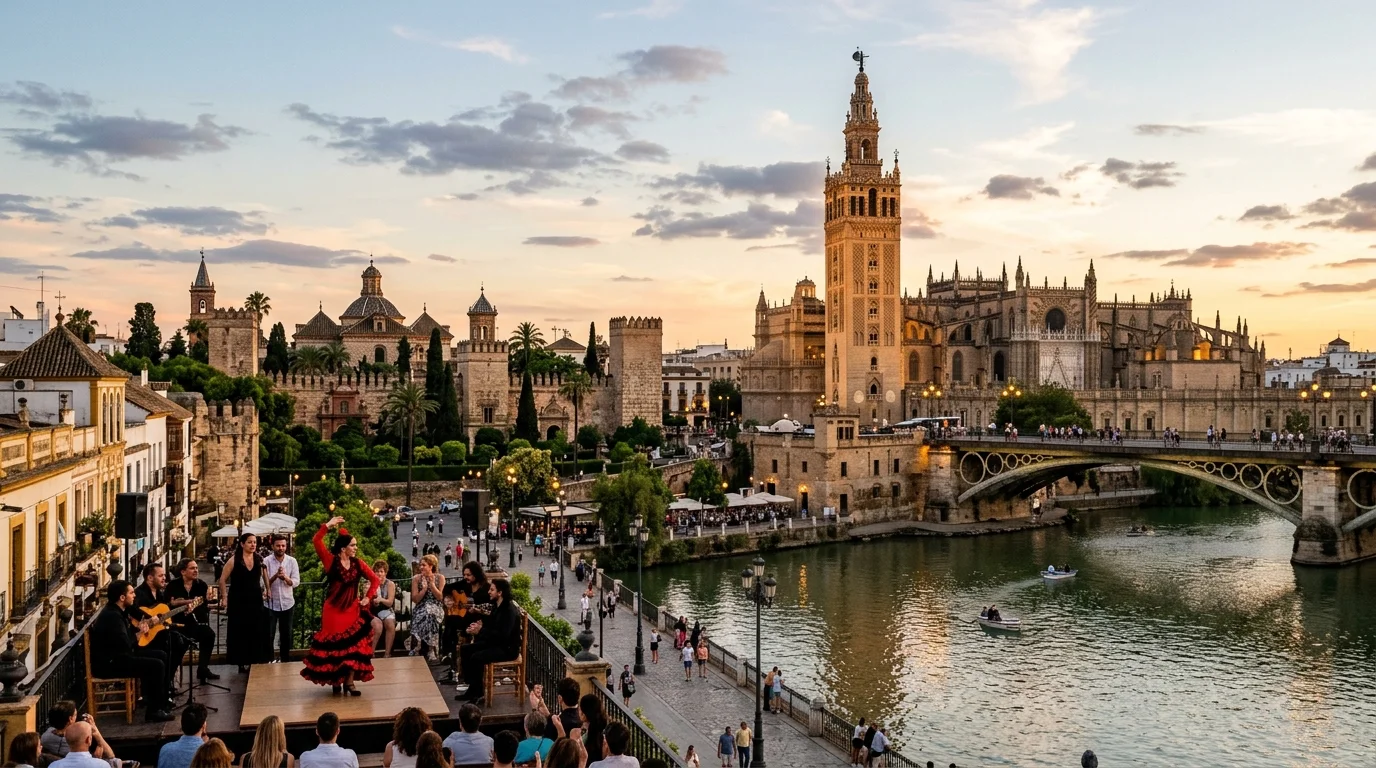
Seville is the capital of Andalusia in southern Spain, situated on the banks of the Guadalquivir River and famous for flamenco dancing, the stunning Real Alcázar palace, and one of the world's largest Gothic cathedrals. It is best known for its Moorish architecture, vibrant tapas culture, and explosive festivals like Semana Santa and the Feria de Abril. Visitors come here for the extraordinary blend of history, architecture, food, and nightlife that makes Seville one of Europe's most captivating and romantic cities.
Table of Contents
- Seville Overview
- Getting There & Around
- Top Attractions & Landmarks
- Neighborhoods & Districts
- Food & Dining
- Nightlife & Entertainment
- Shopping
- Seasonal Events & Festivals
- Accommodation Recommendations
- Practical Information
- Day Trips & Nearby Destinations
- Insider Tips & Hidden Gems
- Money-Saving Tips
- Common Tourist Mistakes to Avoid
- Sample Itineraries
- Frequently Asked Questions
What Is Seville and Why Should You Visit?
Seville is the passionate heart of southern Spain — a city where ancient Moorish palaces, Gothic cathedrals, and orange-blossom-scented plazas come together in a way that feels almost unreal. Located in the Andalusia region on the banks of the Guadalquivir River, Seville is Spain's fourth-largest city and arguably its most romantic.
You should visit Seville because nowhere else in Europe will you find this particular cocktail of experiences: wandering through a UNESCO-listed royal palace that inspired the set design for Game of Thrones, watching a raw and emotional flamenco show in a tiny cave venue, drinking cold sherry at a 200-year-old tapas bar, and watching the sunset turn the Giralda tower golden — all in the same day. The city has an energy and pride that is completely its own.
Seville does get very hot in summer (regularly above 40°C / 104°F) and extremely busy during its two famous festivals. But with some planning, these quirks become part of the charm rather than obstacles. Come with an open mind and comfortable shoes, and Seville will give you memories that last a lifetime.
When Is the Best Time to Visit Seville?
Spring (March–May) — Peak Season: Spring is widely considered the best time to visit Seville. Temperatures are perfect (18–25°C / 64–77°F), the orange trees are in bloom, and this is when the legendary Semana Santa (Holy Week) and Feria de Abril take place. Book accommodation 6–12 months in advance if your visit overlaps with either festival, as prices triple and rooms sell out completely.
Summer (June–August) — Off-Peak for Outdoor Activities: Summers in Seville are brutally hot — July and August regularly hit 42°C (108°F), making it the hottest major city in Europe. However, prices drop significantly, crowds thin at major monuments, and locals have developed an entire culture around beating the heat (late dinners, afternoon siestas, evening paseos). Budget travellers willing to brave the heat can find excellent deals.
Autumn (September–November) — Shoulder Season: September and October offer the best balance: temperatures cool to a manageable 22–28°C (72–82°F), tourist numbers drop, prices are lower than spring, and the light is beautiful. October is particularly lovely — warm enough to sit outside, cool enough to walk around comfortably. This is the smartest time to visit for most travellers.
Winter (December–February) — Quiet Season: Seville's winters are mild by European standards (12–18°C / 54–64°F) and rarely see rain. Christmas lights and decorations are spectacular, crowds are minimal, and accommodation prices are at their lowest. The city is very much alive year-round — this is not a seasonal destination.
How Many Days Do You Need in Seville?
- 1–2 days: You can hit the absolute highlights — the Cathedral, Alcázar, and a flamenco show — but it will feel rushed. Good for stopovers or those on a broader Spain itinerary.
- 3–4 days: The ideal visit for first-timers. You'll have time for all major monuments, a neighbourhood wander, day-trip options, and evenings of tapas and nightlife without feeling overwhelmed.
- 5–7 days: Allows for deep exploration — hidden gems, day trips to Córdoba or Cádiz, cooking classes, flamenco lessons, and properly living at the local rhythm of late lunches and later dinners.
- 1 week+: For genuine Seville enthusiasts. Enough time to find your favourite tapas bar, explore lesser-known barrios, take a flamenco course, and feel like a temporary local.
Quick Facts About Seville
- Population: Approximately 690,000 (city); 1.5 million (metro area)
- Language: Spanish (Castellano); English widely spoken in tourist areas
- Currency: Euro (€)
- Time Zone: Central European Time (CET) — UTC+1; UTC+2 during summer (CEST)
- Country Code: +34 (Spain)
- Area Code: 954 / 955
- Climate: Hot semi-arid (BSk/Csa) — hot dry summers, mild winters
- Altitude: 7 metres (23 feet) above sea level
How Do You Get To and Around Seville?
The easiest way to reach Seville is by flying into Seville Airport (SVQ) or by taking the high-speed AVE train from Madrid (just 2.5 hours) or Málaga (under 2 hours). Once in the city, Seville is wonderfully walkable in the historic centre, with excellent tram, metro, and bus networks for covering greater distances.
Which Airports Serve Seville?
Seville Airport — Aeropuerto de Sevilla (SVQ)
Aeropuerto de Sevilla, Carretera MA-20, 41020 Sevilla, Spain
Located just 10 km (6 miles) northeast of the city centre, Seville Airport handles most international and domestic flights. Airlines serving SVQ include Vueling, Ryanair, easyJet, Iberia, British Airways, and seasonal charters from across Europe. The terminal is compact and easy to navigate.
How Do You Get from the Airport to the City Centre?
Bus (EA Airport Line): The most popular and affordable option. The EA bus runs every 20–30 minutes from the airport to the city centre (stops at Puerta de Jerez and Avenida del Cid). Cost: €4 per person (2026). Journey time: approximately 35 minutes. Tickets are bought from the driver or at the airport bus stop.
Taxi: Official white taxis are available outside arrivals. The fixed fare to the city centre is approximately €22–€28 (2026), depending on the exact destination and time of day. Journey takes 15–20 minutes. Only use official licensed taxis from the designated taxi rank.
Rideshare (Cabify/FreeNow): Apps like Cabify and FreeNow operate in Seville. Expect to pay €15–€22 for an airport-to-centre trip depending on surge pricing. Slightly cheaper than taxis during off-peak hours.
Private Transfer: Pre-booked transfers offer a fixed price (typically €25–€35 for a standard vehicle) with a driver waiting at arrivals. Ideal for groups or travellers with lots of luggage. Book 24 hours in advance.
Rental Car: All major rental companies operate at the airport. However, driving and parking in Seville's historic centre is extremely difficult. Only rent a car if you plan to take day trips.
What Is the Best Way to Get Around Seville?
The best way to get around Seville is on foot in the historic centre, combined with the tram and bus network for longer journeys. The city's main tourist areas — the Cathedral, Alcázar, Barrio Santa Cruz, and the Triana neighbourhood — are all within easy walking distance of each other.
Public Transport System
Seville has a tram (Metro Centro), a metro (4 lines), and an extensive bus network (TUSSAM). The tram runs along the main historic axis from Puerta Jerez to the Plaza Nueva area and is the most useful line for tourists. The metro is more helpful for reaching outlying areas or the bus station. Buses cover the entire city and run until midnight (night buses until 2 AM on weekends).
Tickets & Passes (2026):
- Single ride (bus): €1.40
- Single ride (metro): €1.35–€1.80 depending on zones
- Tarjeta Multiviaje (rechargeable card): €1.50 card fee + load credit — each bus trip costs €0.69 with the card, making it far cheaper for multiple journeys
- Daily pass: Not widely available but some tourist passes cover transport
Cycling
Seville is one of Europe's most cycle-friendly cities — it has over 180 km of dedicated bike lanes. The city's public bike-share scheme, Sevici, has over 260 stations and 2,500 bikes across the city. A 7-day tourist subscription costs €13.33 (2026) and includes unlimited 30-minute journeys. This is an excellent and fun way to explore the flat city centre and reach Triana or María Luisa Park.
Taxis & Rideshare
Official taxis in Seville are white with a yellow stripe. They are metered, reliable, and relatively affordable by Western European standards. A typical trip within the city centre costs €5–€10. Rideshare apps Cabify and FreeNow also operate and are often slightly cheaper than taxis. Uber does not currently operate in Seville (as of 2026).
Walking
Seville's historic centre is one of the most walkable in Europe. The Cathedral, Alcázar, Barrio Santa Cruz, the Triana bridge, and the Alameda de Hércules are all reachable on foot from most central hotels. The terrain is completely flat — no hills — making it easy for all fitness levels. The main challenge in summer is the heat; carry water and seek shade during midday.
Walkability Score: 90/100 for the historic tourist centre. Nearly everything a tourist wants to see is within a 25-minute walk of the Cathedral.
Smart travellers always compare transfer options before booking — prices for the same route can vary by 40% or more. Take 60 seconds to check all options and choose what works best for your arrival.
What Are the Top Attractions and Landmarks in Seville?
Seville's top attractions include the awe-inspiring Cathedral and Giralda tower, the UNESCO-listed Real Alcázar palace, the emblematic Plaza de España, and the Barrio Santa Cruz — making this one of the richest cities for architecture and history in all of Europe.
Seville Cathedral and La Giralda Tower
Avenida de la Constitución, s/n, 41004 Sevilla, Spain
The Catedral de Sevilla is the largest Gothic cathedral in the world and a UNESCO World Heritage Site. Built between 1402 and 1506 on the site of a former Moorish mosque, it is an overwhelming testament to the ambitions of medieval Seville. The interior is staggering — 80 chapels, priceless artworks, and the monumental tomb of Christopher Columbus.
The Giralda, the cathedral's iconic bell tower, was originally built as a minaret for the mosque in the 12th century and converted to a bell tower after the Reconquista. Climbing it is a must — you ascend via ramps (no stairs) built so that the muezzin could ride up on horseback. At the top, the views over Seville are unbeatable.
Why visit: This is simply one of the greatest buildings in the world. The sheer scale, the mixture of Islamic and Gothic architecture, and the historical weight of the place — this is the non-negotiable number one sight in Seville.
Entrance: Adults €13, reduced (students/seniors) €7, children under 14 free; Monday 4:30–6 PM is free but extremely busy (2026)
Best time: Early morning (9–10 AM) or late afternoon (4–5 PM)
Hours: Monday 11 AM–3:30 PM; Tuesday–Saturday 10:30 AM–5 PM (6 PM July–Sept); Sunday 2:30–6 PM
Real Alcázar de Sevilla
Patio de Banderas, s/n, 41004 Sevilla, Spain
The Real Alcázar is a royal palace complex that has been in continuous use for over 1,000 years — it remains an official royal residence of the Spanish royal family today. Originally built as a Moorish fortress in the 10th century, it was dramatically expanded and beautified by successive Christian kings, most notably Pedro I in the 14th century. The result is a breathtaking fusion of Mudéjar, Gothic, Renaissance, and Baroque architecture.
The palace's interiors are extraordinary: intricately tiled walls, carved stucco ceilings, and horseshoe arches that rival the Alhambra in Granada. The gardens — covering 7 hectares of fountains, pavilions, and manicured hedges — are a world unto themselves and perfect for a peaceful afternoon stroll. If this complex looks familiar, it's because it was used as the Water Gardens of Dorne in Game of Thrones.
Why visit: The Real Alcázar is arguably more impressive than Granada's Alhambra for many visitors — it's more intimate, more varied, and the gardens are stunning. Along with the Cathedral, it is the definitive Seville experience.
Entrance: Adults €14.50, reduced €3 (EU students/seniors), children under 16 free (2026)
Best time: Opening time (9:30 AM) to beat crowds; Tuesday evenings in summer (7–9:30 PM) offer a magical after-hours experience
Hours: Daily 9:30 AM–5 PM (October–March), 9:30 AM–7 PM (April–September)
Plaza de España
Av. Isabel la Católica, 41013 Sevilla, Spain
The Plaza de España is one of the most spectacular public squares in Europe — a sweeping semi-circular building with ornate towers, tiled alcoves representing every Spanish province, a large canal with row boats, and magnificent ceramic fountains. It was built for the 1929 Ibero-American Exposition and covers an astonishing 50,000 square metres. The square sits at the north edge of María Luisa Park, Seville's main green lung.
Every province of Spain is represented by a tiled bench alcove, each painted with a map and historical scene — sitting in your home region's alcove (or that of a place you've visited) is a delightful treasure hunt. Rowing boats can be hired on the canal for €6 per person for 35 minutes (2026). The square is entirely free to visit and makes for incredible photographs at any time of day.
Why visit: This is arguably the most photogenic spot in all of Seville and one of the most photogenic public spaces in Spain. Entry is free, it's huge, and it never feels as crowded as you'd expect for something this beautiful.
Entrance: Free (building interior has access restrictions)
Best time: Golden hour (one hour before sunset) for photography; early morning for empty shots
Hours: The square is always accessible; building interior hours vary
Barrio Santa Cruz
Barrio de Santa Cruz, 41004 Sevilla, Spain
Santa Cruz is Seville's old Jewish quarter — a labyrinthine network of narrow whitewashed lanes, hidden courtyards (patios), orange trees, and flower-draped balconies that is almost impossibly picturesque. It was home to Seville's Jewish community for centuries before the 1492 expulsion, and later became the aristocratic quarter of the city. Today it is the historic heart of tourist Seville.
The neighbourhood has no single "attraction" — it is the experience of wandering that is the attraction. Key highlights include the Plaza de Santa Cruz, the Hospital de los Venerables (a gorgeous baroque building with a small art gallery), and the many hidden plaza gardens (the Jardines de Murillo run along its eastern edge). Getting lost here is actively recommended.
Why visit: Santa Cruz is the quintessential Seville experience — charming, atmospheric, and a genuine living neighbourhood as well as a tourist one. It is the natural base for exploring the Cathedral and Alcázar, which are both right on its edge.
Entrance: Free to wander; Hospital de los Venerables €8 adults (2026)
Best time: Morning (9–11 AM) before tour groups arrive; late evening when streets glow with lanterns
Hours: Always accessible
Metropol Parasol (Las Setas)
Pl. de la Encarnación, s/n, 41003 Sevilla, Spain
The Metropol Parasol — universally nicknamed "Las Setas" (The Mushrooms) by locals — is the largest wooden structure in the world. Designed by German architect Jürgen Mayer and completed in 2011, this extraordinary undulating canopy structure towers over the Plaza de la Encarnación in the Alfalfa neighbourhood. It stands 28 metres high, covers an area of 150 x 70 metres, and seems to defy both gravity and common sense.
Beneath the structure lies the Antiquarium Museum, where Roman and Moorish ruins discovered during construction are on display. A panoramic walkway on top of the structure (accessed by lift) offers arguably the best 360° rooftop views in Seville — and unlike the Giralda, you're looking at the entire city skyline rather than just a single perspective. The sunset from the top walkway is spectacular.
Why visit: Las Setas is controversial architecturally (locals have mixed feelings about it), but the rooftop views are superb and the contrast with the ancient city around it is fascinating. It also includes a consumable drink, making the entry fee feel better value.
Entrance: €15 (includes one drink at the top bar, 2026); Antiquarium Museum €2 separately
Best time: Sunset (one hour before) for views; evening for the atmospheric lighting
Hours: Daily 9:30 AM–11 PM (last entry 10:30 PM)
Triana Neighbourhood and the Triana Bridge (Puente de Triana)
Barrio de Triana, 41010 Sevilla, Spain
Triana is Seville's most beloved neighbourhood — the home of flamenco, bullfighters, sailors, and ceramics artisans for centuries. Located across the Guadalquivir River from the historic centre, Triana has long been considered the soul of working-class Seville. Crossing the Puente de Triana (Puente de Isabel II) on foot is a rite of passage for every Seville visitor, with beautiful river views in both directions.
The neighbourhood's main street, Calle Betis, runs along the riverbank and is lined with bars, restaurants, and terraces with stunning views back across the river to the city. The covered Triana Market (Mercado de Triana) is excellent for breakfast or lunch. The neighbourhood is also the place to buy handmade Seville ceramics — the distinctive blue-and-yellow pottery found all over Andalusia is produced here.
Why visit: Triana feels genuinely local in a way that much of the tourist centre doesn't. An evening on Calle Betis with a cold beer and the Cathedral illuminated across the water is one of Seville's defining experiences.
Entrance: Free to explore; Castillo San Jorge museum €2 (2026)
Best time: Morning for the market; evening for the riverside bars
Hours: Always accessible; Mercado de Triana Monday–Saturday 9 AM–3 PM
Archivo General de Indias
Av. de la Constitución, 3, 41004 Sevilla, Spain
Located between the Cathedral and the Alcázar, the Archivo General de Indias is one of the world's most important historical archives — housing over 43,000 files of documents relating to Spain's colonial administration of the Americas, the Philippines, and other territories from the 15th to the 19th centuries. The building itself (the old merchants' exchange, La Lonja) is a magnificent example of Renaissance architecture designed by Juan de Herrera, the same architect who built El Escorial near Madrid.
While casual visitors won't have access to the archive rooms, the public exhibition areas display extraordinary original documents including letters from Christopher Columbus and Ferdinand Magellan, hand-drawn maps, and colonial correspondence. Entry is free, making it exceptional value for history enthusiasts.
Why visit: This is a UNESCO World Heritage Site that most tourists walk past without entering — it's free, beautifully preserved, and contains some of the most historically significant documents in human history. The building alone is worth the visit.
Entrance: Free (2026)
Best time: Weekday mornings when quietest
Hours: Monday–Saturday 9:30 AM–4:45 PM; Sunday 10 AM–2 PM; Closed public holidays
Casa de Pilatos
Pl. de Pilatos, 1, 41003 Sevilla, Spain
Casa de Pilatos is arguably the most beautiful private palace in Spain and one of the most underrated attractions in Seville. Built in the 15th and 16th centuries by the Enríquez de Ribera family (the Dukes of Medinaceli), the palace is a stunning blend of Mudéjar, Gothic, and Italian Renaissance styles. It was incorrectly believed to be a replica of Pontius Pilate's house in Jerusalem — hence the name.
The palace is still owned and partially inhabited by the Medinaceli family today. Visitors can explore the ground floor (featuring an exceptional Roman sculpture collection and some of the finest azulejo tilework in Seville) on a basic ticket, or pay more to access the upper floor with private family apartments and an extraordinary art collection including works by Goya, Ribera, and Pacheco.
Why visit: Casa de Pilatos sees a fraction of the visitors that flock to the Alcázar, yet it rivals it in beauty and surpasses it in intimacy. If you love architecture, tiles, or Roman sculpture, this is essential viewing.
Entrance: Ground floor only €12; Ground + upper floor €19 (2026)
Best time: Mid-morning on weekdays
Hours: Daily 9 AM–7 PM (April–October); 9 AM–6 PM (November–March)
Torre del Oro (Tower of Gold)
Paseo de Cristóbal Colón, s/n, 41001 Sevilla, Spain
The Torre del Oro is a 13th-century Moorish watchtower built by the Almohad dynasty to control river access to Seville. Standing on the bank of the Guadalquivir, the dodecagonal (12-sided) tower was originally part of the city's defensive walls. Its name — "Tower of Gold" — refers either to the golden tiles that once covered its exterior, or to the gold from the Americas that was once stored here.
Today the tower houses a small naval museum (Museo Naval de Sevilla) with maritime charts, ship models, and exhibits on Seville's role in the Spanish maritime empire. The tower itself is more interesting than the museum, and the views from the top over the river and the Triana bridge are excellent. The exterior, particularly when photographed at sunset from the Triana riverbank, is one of Seville's most iconic images.
Why visit: The Torre del Oro is one of Seville's most recognisable landmarks and a short, easy visit. The views from the top are worth the small entrance fee, and the naval museum is a pleasant bonus for history enthusiasts.
Entrance: €3; free on Mondays (2026)
Best time: Late afternoon for photographs from across the river
Hours: Monday–Friday 9:30 AM–6:45 PM; Saturday–Sunday 10:30 AM–6:45 PM
Parque de María Luisa
Paseo de las Delicias, s/n, 41013 Sevilla, Spain
Parque de María Luisa is Seville's largest and most beautiful public park — 34 hectares of shaded paths, exotic plants, fountains, ponds, and pavilions. The park was the grounds of the San Telmo Palace, gifted to the city by the Infanta María Luisa of Bourbon in 1893 for the 1929 Ibero-American Exposition. French landscape architect Jean-Claude Nicolas Forestier redesigned it into the romantic, labyrinthine space it is today.
The park contains the spectacular Plaza de España at its northern edge and several pavilions from the 1929 exposition that now house museums. The Museo Arqueológico (in the Renaissance-style Pabellón de las Bellas Artes) and the Museo de Artes y Costumbres Populares are both worth exploring. The park is also famous for its resident peacocks, ducks, and the shaded benches where locals escape the summer heat.
Why visit: María Luisa Park provides a peaceful green escape from the city's monuments and is essential for any visit of 2+ days. In summer, the dense shade of its trees makes it one of the few comfortable outdoor spaces during the midday heat.
Entrance: Park is free; Museo Arqueológico free for EU citizens, €1.50 for others (2026)
Best time: Morning or late afternoon; avoid midday in summer
Hours: Park open daily 8 AM–midnight
Book your tours and tickets in advance — it saves hours of queuing and often gets you a better price. These two platforms cover different options, so it's worth checking both.
What Are the Best Neighborhoods to Explore in Seville?
Seville's neighbourhoods each have a distinct personality — from the labyrinthine lanes of the old Jewish quarter to the working-class pride of Triana and the bohemian cafés of Alameda. Here are the best ones to explore.
Barrio Santa Cruz
Character: Seville's most famous neighbourhood is a maze of whitewashed lanes, orange trees, hidden courtyards, and flower-draped balconies. Every corner is a postcard. It's pretty but touristy — expect souvenir shops alongside genuine local businesses.
What makes it special: The extraordinary density of beautiful streets and patios within a very small area. Walking here with no particular destination is one of Seville's greatest pleasures. Key streets include Callejón del Agua, Calle Cruces, and the Plaza de Doña Elvira.
Best for: First-time visitors, architecture lovers, romantic getaways, photographers
Must-see in this area: Callejón del Agua, Plaza de Santa Cruz, Jardines de Murillo, Hospital de los Venerables, Plaza de Doña Elvira
How to get there: Walking from the Cathedral (2 minutes); Tram stop Puerta de Jerez (5-minute walk)
Location: Barrio de Santa Cruz, 41004 Sevilla, Spain
Triana
Character: The most beloved neighbourhood in Seville — gritty, proud, and genuinely local. Triana is the historic home of flamenco, ceramics, and bullfighters. It sits across the Guadalquivir from the tourist centre and has a markedly different atmosphere: more residential, more authentic, and slightly more affordable.
What makes it special: The riverbank walk along Calle Betis with its bars and views; the Mercado de Triana covered market; ceramics workshops where you can watch artisans work; and the neighbourhood's fierce local pride that keeps it feeling real despite growing tourism.
Best for: Foodies, nightlife seekers, cultural travellers, those wanting a break from the tourist bubble
Must-see in this area: Calle Betis riverfront, Mercado de Triana, Castillo de San Jorge, ceramic shops on Calle Alfarería, Plaza del Altozano
How to get there: 10-minute walk across the Puente de Isabel II (Puente de Triana) from the Cathedral area
Location: Barrio de Triana, 41010 Sevilla, Spain
El Centro (City Centre)
Character: The commercial heart of Seville — broad shopping streets, bustling plazas, traditional tapas bars, and a lively everyday energy. This is where Sevillanos do their shopping and socialising, and it has a pleasingly "real city" feel between its touristy edges.
What makes it special: The mix of grand department stores, independent shops, and atmospheric old tapas bars that have barely changed in decades. The Plaza de la Encarnación (home of Las Setas) and the Alfalfa neighbourhood sit within or adjacent to El Centro.
Best for: Shoppers, tapas enthusiasts, those wanting a central base with a lived-in feel
Must-see in this area: Metropol Parasol (Las Setas), Plaza del Salvador, Calle Sierpes (main shopping street), Plaza de la Alfalfa
How to get there: Walking distance from all central hotels; tram stops throughout
Location: El Centro, 41004 Sevilla, Spain
Alameda de Hércules
Character: Seville's most bohemian neighbourhood — home to students, artists, LGBTQ+ friendly bars, vintage shops, and the city's most alternative nightlife. The central Alameda promenade is lined with ancient trees and flanked by terraces that fill with locals on warm evenings. This is where Seville's creative class lives and socialises.
What makes it special: The Alameda de Hércules boulevard itself is one of Europe's oldest public promenades (dating from 1574). The neighbourhood around it has a genuinely laid-back, progressive energy that contrasts sharply with the more formal historic centre. Great for independent cafés, natural wine bars, and street art.
Best for: Young travellers, nightlife seekers, LGBTQ+ travellers, those seeking a local rather than tourist experience
Must-see in this area: Alameda de Hércules promenade, Basílica de la Macarena, Calle Feria street market (Thursdays), independent bars and restaurants
How to get there: 15-minute walk from the Cathedral; bus lines C3, C4
Location: Alameda de Hércules, 41002 Sevilla, Spain
El Arenal
Character: The historic riverside district between the Cathedral and the Torre del Oro. El Arenal (The Sandy Shore) was once Seville's main port where ships set sail to the Americas. Today it retains a handsome, prosperous feel with wide riverbank promenades, the famous La Maestranza bullring, and some of Seville's best traditional tapas bars.
What makes it special: The Paseo de Cristóbal Colón riverside walk is beautiful, especially in the evenings when locals stroll and the Torre del Oro glows. La Maestranza — one of the most important bullrings in the world — is architecturally stunning even if you don't attend a bullfight.
Best for: Evening riverside walks, traditional tapas culture, those interested in Seville's maritime history
Must-see in this area: Plaza de Toros de la Maestranza, Torre del Oro, Hospital de la Caridad, Paseo de Cristóbal Colón riverside walk
How to get there: 5-minute walk south from the Cathedral; tram stop Puerta de Jerez
Location: El Arenal, 41001 Sevilla, Spain
Macarena
Character: The traditional working-class neighbourhood north of the historic centre, famous for the beloved Virgen de la Macarena — Seville's most revered religious icon. The Macarena has a raw, unpolished authenticity that feels genuinely unloved by tourism, making it fascinating for visitors who want to see the real Seville beyond the postcard.
What makes it special: The Basílica de la Macarena houses the weeping Madonna that is the object of Seville's most fervent devotion. The neighbourhood's street market (El Jueves, held on Calle Feria every Thursday) is Seville's oldest and most atmospheric. The intact section of the city's ancient Moorish walls runs along the neighbourhood's edge.
Best for: Cultural travellers, market enthusiasts, those seeking off-the-beaten-path Seville
Must-see in this area: Basílica de la Macarena, Murallas Almohades (Moorish walls), Mercado de la Feria, Calle Feria Thursday market
How to get there: 20-minute walk from the Cathedral; bus lines C3, C4, 10
Location: Barrio de la Macarena, 41003 Sevilla, Spain
What Food Should You Try in Seville?
Seville is one of Spain's greatest food cities — the birthplace of tapas culture, home to exceptional sherry (fino and manzanilla), and a city where eating is a serious social ritual conducted with enormous skill and passion. The must-try dishes are jamón ibérico, huevos a la flamenca, pescaíto frito, and the extraordinary tapas tradition that turns a bar crawl into a culinary education.
What Are the Must-Try Local Dishes in Seville?
- Tapas (general) — Seville claims to be the birthplace of tapas, and the tradition here is particularly strong: order a drink in many old bars and a small free tapa arrives with it. The culture of going from bar to bar (de tapas) is fundamental to Seville life.
- Jamón Ibérico de Bellota — Spain's finest cured ham, from acorn-fed black-footed pigs. In Seville you can eat extraordinary jamón at a fraction of what it costs in Madrid or abroad. Try it at any traditional bar — the legs hanging from the ceiling are a good sign.
- Gazpacho & Salmorejo — Both are cold tomato-based soups perfect for the Seville heat. Gazpacho is the lighter, more liquid version with vegetables; salmorejo (Seville's local version) is thick, creamy, and usually topped with chopped jamón and hard-boiled egg. Salmorejo is the more Seville-specific and is extraordinary when done well.
- Huevos a la Flamenca — A hearty baked egg dish with tomato sauce, vegetables, chorizo, and jamón, cooked and served in a clay pot. It's rich, flavourful, and deeply traditional — one of the classic dishes of Seville.
- Pescaíto Frito — Mixed fried fish (small fish, squid, prawns, anchovies) lightly battered and perfectly crispy. This is the signature dish of Andalusia's coast, and Seville does an excellent version. Eat it in a paper cone as a snack or as a tapa with a cold beer.
- Flamenquín — A rolled pork fillet wrapped in jamón, breaded and deep-fried. It sounds simple but when done well it is absolutely delicious — crispy outside, succulent inside, with the salty richness of the ham running through it.
- Montaditos — Small open sandwiches on toasted baguette slices, topped with anything from jamón to anchovies to tortilla española. These are the quintessential bar snack of Seville — cheap, delicious, and endlessly varied.
- Torrijas — Seville's answer to French toast: thick slices of day-old bread soaked in milk and egg, fried until golden, and dusted with cinnamon sugar. Traditionally made at Easter/Semana Santa but available year-round in many bakeries.
Where Should You Eat in Seville?
Budget-Friendly (Under €15 per person)
- Bar El Rinconcillo — Calle Gerona, 40, 41003 Sevilla — Seville's oldest tapas bar (established 1670) and still one of its best. Staff chalk your tab on the bar counter. Try the espinacas con garbanzos (spinach with chickpeas) and the jamón. Budget around €12–15 for a full spread of tapas and drinks.
- Casa Morales — Calle García de Vinuesa, 11, 41001 Sevilla — A wonderful old bodega near the Cathedral that has barely changed in 170 years. The wine is poured from giant clay amphorae embedded in the walls. Tapas are simple, traditional, and delicious. Extremely popular with locals at lunch.
- Mercado de Triana — Plaza del Altozano, s/n, 41010 Sevilla — The covered market in Triana has several excellent market stalls and small restaurants serving fresh fish, grilled meats, and local produce at very reasonable prices. A fantastic breakfast or lunch destination.
Mid-Range (€15–€35 per person)
- Bar Las Teresas — Calle Santa Teresa, 2, 41004 Sevilla — A legendary tapas bar in Santa Cruz with walls plastered in bullfighting memorabilia. Excellent jamón and montaditos. Expect to spend €15–25 for a generous selection of tapas and a couple of glasses of fino sherry.
- Bodeguita Casablanca — Calle Adolfo Rodríguez Jurado, 12, 41001 Sevilla — A tucked-away gem near the Cathedral known for creative modern tapas alongside Andalusian classics. Friendly staff, good wine list, and a menu that changes seasonally.
- La Brunilda — Calle Galera, 5, 41002 Sevilla — One of the most popular modern tapas restaurants in Seville, known for creative small plates and exceptional value. Book ahead (they take reservations) — it fills up fast. Around €20–30 per person for a satisfying meal.
- Taberna del Alabardero — Calle Zaragoza, 20, 41001 Sevilla — A beautifully restored mansion near the bullring, run as a restaurant school. High quality traditional Sevillano cooking at mid-range prices for the quality on offer. The set lunch menu is outstanding value.
Fine Dining (€50+ per person)
- Abantal — Calle Alcalde José de la Bandera, 7, 41003 Sevilla — Seville's most celebrated fine dining restaurant, holder of a Michelin star. Chef Julio Fernández creates contemporary Andalusian cuisine that is rooted in tradition but technically brilliant. Tasting menus from €85 (2026). Book weeks in advance.
- Az-Zait — Calle San Roque, 14, 41001 Sevilla — Sophisticated Andalusian cuisine in an elegant setting near the Cathedral, with a particular focus on high-quality Andalusian olive oil and locally sourced ingredients. Tasting menus from €65 (2026).
What Are the Dining Customs in Seville?
Meal times: Seville runs on a late schedule. Breakfast is 8–10 AM (a coffee and pastry). Lunch is the main meal of the day, taken 2–4 PM. Dinner rarely begins before 9:30–10 PM. Restaurants serving tourists may open earlier, but the atmosphere is much better at local eating times.
Tipping: Tipping is not mandatory in Spain but is appreciated. Leaving €1–2 per person at the end of a meal, or rounding up the bill, is standard. Service charge is not typically included unless specified. At tapas bars, rounding up by 50 cents to €1 is sufficient.
Reservations: Needed for mid-range and fine dining restaurants, especially on weekends. For tapas bars, just walk in — queuing or waiting at the bar is normal and part of the experience.
Dress code: Smart casual for most restaurants; casual for tapas bars; no shorts or flip-flops in upscale restaurants.
What Is the Nightlife Like in Seville?
Seville's nightlife scene is vibrant, late, and deeply social — this is a city where dinner doesn't start until 10 PM and bars don't fill up until midnight. The nights revolve around good company, cold fino sherry or craft beer, and eventually dancing to flamenco, pop, or electronic music until the early hours.
Where Are the Best Areas for Nightlife in Seville?
- Alameda de Hércules: Alameda de Hércules, 41002 Sevilla — The most alternative, bohemian bar scene in the city. Packed with outdoor terraces, craft beer bars, LGBTQ+ friendly venues, and live music spots. Very popular with students and locals in their 20s and 30s. Things warm up from 11 PM.
- El Centro (Alfalfa & Calle Amor de Dios area): Plaza de la Alfalfa, 41004 Sevilla — The beating heart of Seville's mainstream nightlife. The streets around Plaza de la Alfalfa fill up with young Sevillanos from midnight onwards. Lots of cocktail bars, flamenco bars, and clubs within walking distance of each other.
- Triana (Calle Betis): Calle Betis, 41010 Sevilla — The riverside strip is perfect for evening drinks with views across the river to the Cathedral and city. More relaxed than the centre, skews slightly older crowd, excellent for a romantic evening or sunset drinks.
What Are the Best Bars and Clubs in Seville?
Bars & Pubs
- Bar Garlochi — Calle Boteros, 26, 41004 Sevilla — One of the most extraordinary bars in Spain: a campy, over-the-top flamenco/religious kitsch extravaganza. The signature cocktail "Sangre de Cristo" (Blood of Christ) comes in a chalice and is served with theatrical flair. An absolute must-visit experience — not just a bar but a piece of Seville performance art.
- El Garlochi Bar — Calle Boteros, 26, 41004 Sevilla — (Same venue, see above) — unique and unforgettable.
- Bodega Santa Cruz (Las Columnas) — Calle Rodrigo Caro, 1, 41004 Sevilla — One of the most atmospheric outdoor bar terraces in Santa Cruz. Cheap, cheerful, and always packed. Cold beer, simple tapas, and a wonderful setting.
- El Gato Negro — Calle Cuna, 6, 41004 Sevilla — A fantastic traditional wine bar in El Centro specialising in sherries, vermouths, and natural wines. Small, buzzy, and excellent for a sophisticated pre-dinner drink.
Clubs & Dancing
- Fun Club — Alameda de Hércules, 86, 41002 Sevilla — Seville's most iconic music venue and club, a Alameda institution for over 30 years. Live concerts earlier in the night, then DJs playing indie, electronic, and pop until dawn. Cover charge €5–€12 depending on the act (2026). Busiest Thursday–Saturday from midnight.
- Antique Teatro — Matemáticos Rey Pastor y Castro, s/n, 41092 Sevilla — Seville's largest and most famous nightclub, located in a converted industrial space on Isla de la Cartuja. International DJs, spectacular light shows, and a capacity of several thousand. Cover charge €15–€25 (2026). Open Thursday–Sunday from 1 AM.
Live Music & Shows
- Casa de la Memoria — Calle Cuna, 6, 41004 Sevilla — One of Seville's most highly regarded flamenco venues, housed in a beautiful 15th-century palace with an intimate patio setting. Nightly shows at 7:30 PM and 9 PM. Tickets €22 adults (2026). Booking in advance is essential — this frequently sells out.
- Tablao El Arenal — Calle Rodo, 7, 41001 Sevilla — A classic tablao flamenco venue near the bullring that has been presenting professional flamenco shows for decades. Show + dinner packages available (€75+) or show only (€45). More touristy than Casa de la Memoria but consistently high quality performances.
What Family-Friendly Evening Entertainment Is Available?
Seville is very family-friendly in the evenings — Spanish culture is inclusive of children in restaurants and public spaces until quite late. The paseo (evening stroll) along the riverbank or through the Plaza de España is enjoyed by all ages. The Metropol Parasol (Las Setas) rooftop is excellent for a family early-evening outing, and many restaurants welcome children with high chairs until 10 PM.
What and Where Should You Shop in Seville?
The best things to buy in Seville are handmade ceramics, genuine flamenco fans and shawls, olive oil and sherry, and quality leather goods — and the top shopping areas are Calle Sierpes in El Centro and the ceramics shops of Triana.
What Are the Best Shopping Districts in Seville?
- Calle Sierpes & Calle Tetuán: Calle Sierpes, 41004 Sevilla — Seville's main pedestrianised shopping street and the parallel Calle Tetuán together form the most popular shopping corridor in the city. A mix of Spanish chain stores (Zara, Mango, El Corte Inglés nearby), traditional fan shops, sweets stores, and independent boutiques. The classic place to buy Seville mantillas, fans, and confectionery.
- Calle Alfarería, Triana: Calle Alfarería, 41010 Sevilla — The street of the potters (alfareros) in Triana, where you can buy handmade Seville ceramics directly from the workshops that make them. Far better quality and often better prices than tourist shops in Santa Cruz.
- El Corte Inglés (Plaza del Duque): Plaza del Duque de la Victoria, 41002 Sevilla — Spain's iconic department store has a large branch in central Seville with everything from high-end fashion and cosmetics to electronics and Spanish food products. The supermarket in the basement has excellent selections of local food products.
What Markets Should You Visit in Seville?
El Jueves Flea Market — Calle Feria, 41002 Sevilla — Seville's oldest market and one of Spain's most famous flea markets, held every Thursday morning from approximately 9 AM–2 PM. Antiques, vintage clothing, old books, coins, and miscellaneous curiosities spread along Calle Feria in the Macarena neighbourhood. Come early for the best finds.
Mercado de Triana — Plaza del Altozano, s/n, 41010 Sevilla — The covered market in Triana is the most atmospheric food market in Seville. Fresh produce, fish, meat, and several good market restaurants. Open Monday–Saturday 9 AM–3 PM. Also has some small artisan stalls selling local products.
Mercado del Arenal — Calle Pastor y Landero, 41001 Sevilla — A smaller covered market in the Arenal neighbourhood selling fresh produce, local cheeses, meats, and a few small eateries. Less touristy than some other markets and a genuine neighbourhood shopping experience. Open daily.
What Should You Buy in Seville?
- Handmade Ceramics — The blue-and-yellow azulejo tiles and pottery that characterise Andalusian decoration. Buy from Triana workshops for authenticity. Prices from €5 for small tiles to €50+ for decorative plates (2026).
- Flamenco Fan (Abanico) — A quality handmade flamenco fan (not a cheap plastic tourist one) is a beautiful souvenir. Look for fans made with real wood and fabric on Calle Sierpes. Prices €15–€60 for quality versions (2026).
- Manzanilla & Fino Sherry — Seville sits at the heart of sherry country. Buying a bottle of genuine fino or manzanilla from a proper wine shop (try El Corte Inglés food hall or Uvita wine shop) is far better quality than airport purchases. €5–€15 per bottle (2026).
- Extra Virgin Olive Oil — Andalusia produces some of the world's finest olive oil. The El Corte Inglés food hall and artisan food shops stock excellent Sevillano varieties. A quality 500ml bottle costs €8–€20 (2026).
- Mantón de Manila (Embroidered Shawl) — The elaborately embroidered silk shawls worn at the Feria de Abril are one of Seville's most iconic fashion items. Quality originals are expensive (€100–€500+) but beautiful. Reproductions for display purposes are available from €20 (2026).
- Turrones and Local Sweets — Traditional Seville confectionery includes polvorones (shortbread crumbles), mantecados, and the extraordinary yemas de San Leandro (egg yolk sweets made by nuns at the San Leandro Convent). A bag of convent sweets costs €6–€10 (2026).
What Are the Shopping Hours and Customs?
Most shops in Seville open Monday–Saturday 10 AM–2 PM and 5–8:30 PM (the afternoon siesta break is still observed by smaller shops). Larger chain stores and El Corte Inglés stay open 10 AM–9 PM without a break. Most shops are closed Sunday, though some tourist-area shops open Sunday mornings. The best sales (rebajas) happen in January–February and July–August, with discounts of 30–70% on clothing.
Can Non-EU Visitors Claim a VAT Tax Refund in Seville?
Yes — if you are a visitor from outside the European Union (including travellers from the USA, Canada, Australia, the UK, and most of Asia and Latin America), you are entitled to a refund of the VAT (Value Added Tax) included in the price of goods you buy in Spain. VAT in Spain is 21% on most goods, which means this refund can be significant on high-value purchases like clothing, leather goods, jewellery, designer fashion, and electronics.
How to Claim Your VAT Refund — Step by Step
- Spend at least no minimum (Spain has no minimum threshold) in a single shop in a single day. This is the minimum threshold for a VAT refund claim in Spain. It does not apply across multiple shops — the full amount must be spent in one store.
- Look for the "Tax Free" sign. Participating shops display a "Tax Free Shopping," "Global Blue," or "Planet" logo in the window or at the register.
- Ask for the tax refund form at the register before you pay. Present your non-EU passport — the shop will fill out the form with your details and the purchase amount. Keep the form with your receipt.
- Get the form stamped at customs before you leave. Go to the Customs office at Seville Airport (SVQ) before check-in and have an officer stamp your tax refund form. Keep your purchases accessible in hand luggage — do not pack them deep in your checked bags.
- Collect your refund. Hand the stamped form to the Global Blue or Planet desk at the airport. You can receive the refund in cash (minus a processing fee) or as a credit card refund (lower fees, takes a few weeks).
VAT Refund Quick Facts for Seville
- Minimum spend: no minimum (Spain has no minimum threshold) in one shop in one day
- VAT rate on most goods: 21% on most goods
- Typical refund after fees: 10–15% of the purchase price
- Refund processors: Global Blue and Planet (formerly Premier Tax Free) at Seville Airport (SVQ)
- Who qualifies: Anyone with a non-EU passport who is not a resident of an EU country
- UK visitors: British passport holders qualify since Brexit — the UK is no longer in the EU
- Deadline: Purchases must be exported within 3 months of the date of purchase
- Full guide: VAT Refund in Europe — Complete Guide for Non-EU Travelers
What Festivals and Events Happen in Seville?
Seville's biggest festivals are Semana Santa (Holy Week, March/April) and Feria de Abril — two of the most spectacular and emotionally powerful celebrations in Europe. The city's event calendar is packed year-round, with religious, cultural, and musical events in every month.
What Is the Annual Events Calendar for Seville?
| Month | Event Name | Description |
|---|---|---|
| January | Cabalgata de Reyes (Three Kings Parade) | On January 5th, the Three Wise Men parade through Seville's streets throwing sweets to the crowd. One of the most beloved events in the Spanish calendar, celebrated with enormous enthusiasm in Seville. |
| February | Carnival of Seville (Carnaval) | Seville's carnival is smaller than Cádiz's famous version but still lively, with costumed processions, performances, and parties across the city during the week before Lent. |
| March/April | Semana Santa (Holy Week) | The most famous event in Seville — 60+ religious brotherhoods parade enormous float sculptures through the city's streets in candlelit processions over seven days. Emotionally overwhelming and visually extraordinary. Dates vary annually; the city is completely transformed. |
| April/May | Feria de Abril (April Fair) | Two weeks after Semana Santa, Seville's fairground (Real de la Feria in Los Remedios) erupts into six days of flamenco dancing, horse parades, caseta parties, and sherry-drinking that represents the ultimate Seville celebration. Dates vary annually. |
| May | Cruces de Mayo (May Crosses) | Neighbourhood competitions to create the most elaborate flower-decorated cross (cruz de mayo) displayed in Seville's plazas and streets. A beautiful, photogenic tradition taking place throughout May. |
| May | Bienal de Arte Flamenco (alternate years) | Held in even-numbered years, Seville's International Flamenco Biennale is the most important flamenco festival in the world, with performances by the greatest artists of the form at venues across the city for 3–4 weeks. |
| June | Corpus Christi | Religious procession through Seville's historic streets, with the Cathedral at its centre. One of the most solemn and beautiful religious events in the annual calendar. |
| July | Noches en los Jardines del Alcázar | Seville's Royal Alcázar hosts a series of summer night concerts in its illuminated gardens on selected evenings in July and August — one of the most magical settings for music anywhere in Spain. Check the Alcázar website for programme and tickets. |
| August | Velá de Santa Ana (Triana) | Triana's own neighbourhood festival, centred on the Iglesia de Santa Ana and the riverbank. Fairground rides, live music, food stalls, and the Triana bridge beautifully illuminated. One of the most local and genuine festivals in Seville. |
| September | Bienal de Arte Flamenco (alternate years) | Extends into September in even years. Smaller flamenco events and peñas events continue throughout September in odd years. |
| October | Festival de Cine Europeo de Sevilla | Seville's European Film Festival (SEFF) brings international arthouse cinema to the city for one week in late October/early November, with screenings across several city cinemas and free outdoor events. |
| November | Dia de Todos los Santos (All Saints Day) | November 1st sees Sevillanos visiting cemeteries to honour the deceased with flowers. A solemn but beautiful Spanish tradition. Bakeries sell "huesos de santo" (bone-shaped marzipan sweets) in the days before. |
| December | Christmas Markets & Belenes | Seville's Christmas season features elaborate nativity scenes (belenes) displayed in churches and public buildings across the city. The Plaza Nueva hosts a Christmas market (Mercado de Navidad) and the city is spectacularly illuminated throughout December. |
How Do Festivals Affect Hotel Prices and Availability?
Semana Santa and Feria de Abril cause the most dramatic impact on accommodation — prices can triple or quadruple compared to regular rates, and central hotels sell out 6–12 months in advance for these events. Book immediately once you know your dates if visiting in March–May. During the Bienal de Flamenco (even years, October), good flamenco-district accommodation also sells out well in advance.
Where Should You Stay in Seville?
The best neighbourhood to stay in Seville depends on your travel style. Santa Cruz and El Centro are ideal for first-timers who want proximity to all major sites; Triana is perfect for those seeking a more local feel; Alameda suits younger travellers and nightlife enthusiasts.
What Are the Best Neighborhoods to Stay in Seville?
| Neighbourhood | Vibe | Price Range per Night (2026) | Best For |
|---|---|---|---|
| Santa Cruz / Cathedral Area | Charming, historic, touristy | €90–€250 (mid to upscale) | First-timers, romance, convenience |
| El Centro | Lively, central, practical | €60–€180 | All travellers, good transport links |
| Triana | Local, authentic, residential | €50–€140 | Those wanting a neighbourhood feel |
| Alameda de Hércules | Bohemian, young, nightlife | €40–€120 | Budget travellers, nightlife seekers, LGBTQ+ |
| El Arenal / Paseo de Colón | Elegant, riverside, upscale | €100–€400+ | Luxury travellers, riverside views |
What Are the Pros and Cons of Each Area?
Santa Cruz:
Pros: Steps from the Cathedral and Alcázar; magical atmosphere; beautiful streets; good restaurant options nearby.
Cons: Most expensive area; very touristy; noisy at night (narrow lanes echo); streets are confusing for drivers; limited parking.
El Centro:
Pros: Best transport connections; mix of price points; walking distance from everything; good restaurant and shopping variety.
Cons: Can feel less atmospheric than Santa Cruz; some streets are busy with traffic; less "postcard Seville" in feel.
Triana:
Pros: Authentic neighbourhood character; generally lower prices; great river views; excellent tapas bars; good bike access to centre.
Cons: 15-minute walk or 5-minute taxi from Cathedral; can feel isolated for those who don't venture far from monuments.
Alameda de Hércules:
Pros: Cheapest area; best nightlife access; bohemian character; great food and café scene; walkable to centre.
Cons: Can be noisy on weekends; slightly further from tourist monuments; some streets feel a little rough at night.
How Far in Advance Should You Book in Seville?
Outside festival periods, booking 2–4 weeks in advance is generally sufficient for most accommodation types. During Semana Santa and Feria de Abril, the rule is: book as early as possible, ideally 6–12 months ahead. For shoulder season (October, November, February), last-minute deals are often available. Always check the hotel's direct website alongside booking platforms — direct booking sometimes offers better rates or free extras.
What Do You Need to Know Before Visiting Seville?
Here are the essential practical details every visitor to Seville needs to know — from money and safety to visas and cultural customs.
Essential Travel Details for Seville
- Currency: Euro (€); exchange at banks or use ATMs for best rates
- Credit Cards: Widely accepted in hotels, restaurants, and shops; some small tapas bars are cash only
- ATMs: Numerous throughout the city; use bank ATMs (BBVA, CaixaBank, Santander) to avoid high fees; typical withdrawal limit €300/day
- Language: Spanish (Castellano); English widely spoken in tourist areas, hotels, and most restaurants
- Tipping: Not mandatory; €1–2 per person at restaurants, rounding up at bars; taxi drivers appreciate rounding up the fare
- Electrical Plugs: Type F (Europlug), 230V — UK/US/Australian visitors need an adapter
- Emergency Number: 112 (all emergencies — police, ambulance, fire)
- Tourist Police: 091 (National Police); Tourist helpline: 902 102 112
- SIM Cards: Available at the airport and phone shops in the city (Vodafone, Orange, Movistar). A tourist SIM with 15GB data costs approximately €10–15 (2026). EU visitors with EU SIM cards use data at home rates.
- WiFi: Excellent free WiFi in most hotels, cafes, and many public spaces; the city centre has free municipal WiFi zones
- Tap Water: Safe to drink throughout Seville, though the taste is heavily chlorinated — most locals and visitors drink bottled water for taste reasons
Skip the airport queue — order your eSIM before you travel and activate it the moment you land. Prices and data allowances vary, so it pays to compare providers.
How Much Does It Cost to Visit Seville?
| Budget Type | Daily Cost (2026) | What's Included |
|---|---|---|
| Budget Traveller | €45–€75 per day | Hostel dorm (€18–25/night), street food and tapas bars (€12–18/day), public transport card, 1 free attraction (Archivo de Indias or Plaza de España) |
| Mid-Range Traveller | €100–€180 per day | 2–3 star hotel or boutique hostel (€65–100/night), tapas lunches and restaurant dinners (€35–50/day), taxis and transport, Cathedral + Alcázar tickets |
| Luxury Traveller | €250–€500+ per day | 4–5 star hotel or casa palacio (€150–350/night), fine dining (€80–150/meal), private guides, flamenco shows, private transfers, premium experiences |
What Are the Most Useful Phrases in Seville?
- Hello: Hola (OH-la)
- Thank you: Gracias (GRAH-thee-as)
- Please: Por favor (por fa-VOR)
- Excuse me: Perdona / Disculpe (per-DOH-na / dis-COOL-pay)
- How much?: ¿Cuánto cuesta? (KWAN-to KWES-ta)
- Where is...?: ¿Dónde está...? (DON-day es-TA)
- I don't understand: No entiendo (no en-tee-EN-do)
- Help!: ¡Socorro! (so-KOR-oh)
- Bathroom: El baño (el BAN-yo)
- Check, please: La cuenta, por favor (la KWEN-ta por fa-VOR)
Is Seville Safe for Tourists?
Yes, Seville is generally a safe city for tourists. It is one of the more relaxed major Spanish cities in terms of serious crime, and violent crime against tourists is rare. The main safety concerns are pickpocketing and bag snatching, particularly in the Cathedral area, Santa Cruz, and the Plaza de España — these are very common and tourists are the primary targets.
Areas to avoid: Certain peripheral neighbourhoods (Polígono Norte, parts of Las Tres Mil Viviendas) have higher crime rates but are unlikely to be visited by tourists. At night, stick to the well-lit, populated tourist and nightlife areas.
Common scams: (1) Fake flamenco performers who perform uninvited then demand aggressive payment; (2) "Rosemary for luck" — women offering sprigs of rosemary then demanding payment; (3) unofficial "guides" near the Alcázar offering to jump the queue for a fee; (4) taxis taking longer routes; (5) overpriced restaurants on Calle Mateos Gago (one of the most notorious tourist-trap streets in Seville).
Pickpocketing: Very common near the Cathedral, in Santa Cruz, and in crowded bars. Use anti-theft bags, keep phones in front pockets, and never hang bags on the backs of chairs at restaurants.
Solo traveller safety: Seville is very welcoming for solo travellers of all genders. The city has a strong LGBTQ+ community and culture, particularly in the Alameda area. Female solo travellers should be aware that catcalling (piropos) occurs but is generally harmless — ignoring it is the standard approach.
What Are the Cultural Customs in Seville?
- Greetings: Spaniards typically greet friends and acquaintances with two kisses on the cheek (one each side, starting left). A handshake is fine for formal or first meetings. Saying "hola" and making eye contact when entering a shop or bar is considered polite.
- Dress code: Seville is a fashionable city — Sevillanos dress well, especially in the evenings. Shorts and flip-flops are fine during the day but considered inappropriate for evening restaurant meals. For religious sites (Cathedral, churches, Basílica de la Macarena), shoulders and knees must be covered.
- Photography: Ask before photographing people, especially flamenco performers or street artists (payment may be expected). Photography inside the Cathedral has restrictions — check signs. Never photograph people during Semana Santa processions without sensitivity to the religious nature of the event.
- Public behavior: Sevillanos are warm and expressive — don't be surprised by animated conversations or physical affection in public. Queuing is less strictly observed than in Northern Europe. Eating while walking is generally frowned upon in Spain.
- Dining: It is considered rude to rush through a meal — take your time. The waiter will not bring the bill unless you ask for it. Never pour wine for others before your own glass — traditionally the host pours first.
- Gestures to avoid: The thumbs-up gesture is fine in Spain. Avoid the "mano fico" (fist with thumb between index and middle finger) — it is considered obscene.
Do You Need a Visa to Visit Seville?
Citizens of EU/EEA countries, the UK, USA, Canada, Australia, New Zealand, Japan, and most other developed nations do not need a visa to visit Spain for stays up to 90 days within any 180-day period. From 2025, non-EU visitors must register with the European Travel Information and Authorisation System (ETIAS) — this is a simple online authorisation, not a visa, but it must be obtained before travel. Always check the official Spanish Ministry of Foreign Affairs website for current requirements for your nationality.
What Health Precautions Should You Take in Seville?
Vaccinations: No specific vaccinations required for visiting Spain. Routine vaccinations (MMR, tetanus, diphtheria) should be up to date. Tick-borne encephalitis is not a significant risk in urban Seville.
Pharmacies: Pharmacies (farmacias, marked with a green cross) are abundant throughout Seville. Many common medications available in other countries can be purchased over the counter. A 24-hour pharmacy operates on a rotation system — there will always be one open in your area (check the sign on any closed pharmacy for the nearest open one).
Hospitals: Hospital Universitario Virgen del Rocío (Av. Manuel Siurot, s/n, 41013 Sevilla) is the main public hospital. EU citizens with a European Health Insurance Card (EHIC) receive free or subsidised treatment. Non-EU visitors should have comprehensive travel insurance — private hospital treatment is expensive. Hospital Quirónsalud Sagrado Corazón (Calle Jesús del Gran Poder, 36, 41002 Sevilla) offers good private care for visitors.
Common health issues: Heat exhaustion and dehydration are the most common health issues for tourists, particularly in July and August when temperatures exceed 40°C. Drink at least 2–3 litres of water daily, wear SPF 50 sunscreen, and avoid being outside during 1–5 PM in peak summer. Food and water safety are generally excellent in Seville — stomach issues are uncommon.
Do You Need Travel Insurance for Seville?
Yes — and you should buy it before you board your flight, not after. Travel insurance covers the situations that can turn a great trip into a financial disaster: a medical emergency (a single ambulance ride and hospital stay in Europe can cost €3,000–€10,000 without coverage), a cancelled or delayed flight, lost or stolen baggage, or a last-minute trip cancellation. EU citizens with an EHIC or GHIC card receive reciprocal state healthcare, but this does not cover repatriation, trip cancellation, or lost luggage — a full travel policy fills those gaps. Non-EU travellers have no state coverage at all and should never visit without insurance.
Choosing the right policy matters — coverage limits, exclusions, and pre-existing condition terms vary significantly between providers. Read our full guide before you buy: Best Travel Insurance for Europe — Honest Comparison for 2026.
Travel insurance is strongly recommended for Seville — an unexpected medical bill, flight cancellation, or lost luggage can cost far more than the policy. Get covered before you go.
What Are Your Rights If Your Flight to Seville Is Delayed or Cancelled?
Under EU Regulation 261/2004, if your flight to or from Seville is delayed by more than 3 hours or cancelled without sufficient notice, you are entitled to compensation of up to €600 per passenger — regardless of which airline you flew with, and regardless of how long ago it happened (claims can go back up to 6 years in some countries). This applies to all flights departing from an EU airport, and all flights arriving into an EU airport on an EU-based carrier. Most travellers don't realise they are owed money, and airlines rarely volunteer to pay. A claims service handles everything on your behalf and only charges a fee if they win — so there is no risk to you.
Both services check your eligibility for free with no upfront cost — they only charge a commission if they successfully recover your compensation.
Is Seville Accessible for People with Disabilities?
Seville's historic centre presents challenges for wheelchair users — the cobblestone streets and narrow lanes of Santa Cruz are difficult to navigate in a wheelchair. However, the city has invested in accessibility improvements: the tram and most buses are wheelchair accessible, major monuments have lifts or ramp access where possible, and the Plaza de España is fully accessible. The Alcázar and Cathedral have limited wheelchair access — call ahead for specific information.
Is Seville Good for Families with Kids?
Seville is an excellent family destination. Spanish culture is very welcoming of children — restaurants keep high chairs, changing facilities are available in major museums and shopping centres, and the city has excellent family activities including the Parque Zoológico (Seville Zoo), Isla Mágica theme park, boat rides on the Guadalquivir, and horse-drawn carriage rides from the Cathedral. Children are genuinely welcome in restaurants until 10–11 PM without any judgement.
What Are the Best Day Trips from Seville?
The best day trips from Seville include Córdoba (the stunning Mosque-Cathedral), Cádiz (Atlantic beaches and seafood), Granada (the Alhambra), and the sherry town of Jerez de la Frontera — Seville's excellent rail and road connections make all of these very accessible.
Córdoba
Distance: 143 km / 89 miles; 45 minutes by high-speed AVE train
What to see: Córdoba's Mezquita-Catedral (the Mosque-Cathedral) is one of the most extraordinary buildings in the world — a 10th-century mosque of overwhelming beauty, with a Gothic cathedral inserted into its very centre in the 16th century. The surrounding old Jewish quarter (Judería) and the beautifully maintained Roman bridge over the Guadalquivir are equally impressive. The city is smaller and more manageable than Seville in a single day.
How to get there: AVE high-speed train from Santa Justa station, Seville (Av. Kansas City, s/n, 41007 Sevilla). Trains run hourly; adult return approximately €20–€40 depending on booking date (2026). Book in advance at renfe.com for best prices.
Time needed: Full day; an early departure (7:30 AM) allows 8+ hours in Córdoba
Best for: Architecture lovers, history enthusiasts, those who found the Alcázar particularly impressive
Location: Plaza de la Corredera, 14002 Córdoba, Spain
Granada & the Alhambra
Distance: 252 km / 157 miles; approximately 3 hours by train (changing in Antequera) or 2.5 hours by direct bus
What to see: The Alhambra palace complex in Granada is the most visited attraction in Spain and one of the great architectural achievements of human history. The Nasrid Palaces, Generalife gardens, and Alcazaba fortress together represent the pinnacle of Islamic art in Europe. Granada's old Moorish quarter (Albaicín) and the atmospheric Sacromonte neighbourhood (cave flamenco!) are equally rewarding. Note: Alhambra tickets must be booked well in advance — sometimes months ahead.
How to get there: ALSA bus from Seville Prado de San Sebastián (Plaza de San Sebastián, 41004 Sevilla) takes 3 hours; approximately €15–€22 return (2026). Or train via Antequera (slower but more scenic). The bus is usually the most practical option.
Time needed: Full day; consider an overnight stay to do the city justice
Best for: Those who haven't visited Granada before; architecture and Moorish history enthusiasts
Location: Alhambra, 18009 Granada, Spain
Cádiz
Distance: 125 km / 78 miles; 1.5 hours by train
What to see: Cádiz is one of the oldest continuously inhabited cities in Western Europe, jutting into the Atlantic on a narrow peninsula with a magnificent 18th-century old town. It's famous for its fresh seafood, beautiful beaches, extraordinary cathedral (built to celebrate the defeat of the Armada), and the most beloved carnival in Spain. The city has a salt-bleached, sun-drenched beauty quite different from Seville — it feels like the edge of the world.
How to get there: Direct trains from Santa Justa station to Cádiz station, multiple departures daily. Adult return approximately €25–€35 (2026). Journey time approximately 1.5–2 hours.
Time needed: Full day; the old town and beaches can be covered comfortably in a day
Best for: Beach lovers, seafood enthusiasts, those wanting a coastal contrast to Seville's inland heat
Location: Plaza San Juan de Dios, 11005 Cádiz, Spain
Jerez de la Frontera
Distance: 90 km / 56 miles; 1 hour by train
What to see: Jerez is the home of sherry (Jerez = Xérès = sherry in English) and one of the most atmospheric smaller cities in Andalusia. The sherry bodegas (González Byass, Williams & Humbert, Pedro Domecq) offer excellent tours and tastings. The Royal Andalusian School of Equestrian Art hosts spectacular horse shows on select days. The old town has a beautiful cathedral and several flamenco museums and peñas.
How to get there: Direct trains from Santa Justa station, multiple daily departures. Adult return approximately €18–€25 (2026). Journey time 1 hour. Alternatively, the bus from Prado de San Sebastián station takes slightly longer.
Time needed: Half day to full day
Best for: Wine/sherry lovers, equestrian enthusiasts, those seeking a quieter Andalusian town experience
Location: Plaza del Arenal, 11403 Jerez de la Frontera, Spain
Italica Roman Ruins
Distance: 9 km / 6 miles north of Seville; 25–30 minutes by bus
What to see: Italica was one of the most important cities of the Roman Empire — the birthplace of emperors Trajan and Hadrian. The ruins include an enormous amphitheatre (third largest in the Roman world, with capacity for 25,000 spectators), extensive mosaics, and the well-preserved street grid of the ancient city. Game of Thrones fans will recognise the amphitheatre as the Dragonpit from Season 7.
How to get there: Bus M-172A from Plaza de Armas bus station in Seville, running roughly every 30 minutes. Alternatively, a taxi costs approximately €15–€20 each way. Entry to the ruins: €1.50 for non-EU residents, free for EU citizens (2026).
Time needed: Half day
Best for: History enthusiasts, Game of Thrones fans, those wanting a unique half-day add-on without leaving Seville's immediate area
Location: Av. de Extremadura, 2, 41970 Santiponce, Sevilla, Spain
Car rental prices vary significantly between agencies — the same car on the same date can differ by 30–50% depending on where you book. Always compare before confirming.
What Are the Hidden Gems and Insider Tips for Seville?
Beyond the main tourist sites, Seville hides some incredible spots most visitors never find — from secret courtyards and forgotten viewpoints to local bars that have barely changed in a century.
What Are the Best Hidden Gems in Seville?
- Convento de Santa Paula: Calle Santa Paula, 11, 41003 Sevilla — A working convent near the Macarena that has been making and selling artisan sweets (marmalades, jams, and baked goods) for centuries. Ring the bell and the nuns will sell you their products through a rotating hatch. One of Seville's most charming and unique experiences, completely unknown to most tourists.
- Patio de los Naranjos (Orange Tree Courtyard): Avenida de la Constitución, s/n, 41004 Sevilla — The ancient Moorish courtyard attached to the Cathedral was the original ablution yard of the great mosque. Rows of orange trees have stood here since the 10th century, and it offers a quiet, shaded escape from the crowds — yet it can only be accessed from inside the Cathedral (included in your ticket).
- Rooftop of the Centro Comercial Torre Sevilla: Camino de la Découverte, 1, 41092 Sevilla — Seville's only skyscraper (on Isla Cartuja) has a public panoramic bar and terrace on its upper floors with extraordinary 360° views of the entire city — often without the queues or cost of the better-known viewpoints. Particularly striking at sunset.
- Palacio de la Condesa de Lebrija: Calle Cuna, 8, 41004 Sevilla — A private aristocratic palace in El Centro with possibly the finest collection of Roman mosaics in Spain (removed from the Italica ruins in the 18th century and installed as actual floor tiles throughout the palace). Entry €12 (2026). Almost entirely unknown to tourists despite being extraordinary.
- Baños Árabes de la Reina Mora (Moorish Baths): Calle Baños, 1, 41003 Sevilla — The remains of a 12th-century Moorish bathhouse in the Macarena neighbourhood, one of the best-preserved examples in Andalusia and rarely visited. Free entry and fascinating for history lovers.
- Calle Feria on a Thursday Morning: Calle Feria, 41002 Sevilla — The El Jueves flea market on Seville's oldest street is a genuine slice of Sevillano life — antiques dealers, vintage clothing sellers, book stalls, and neighbourhood locals doing their Thursday shopping. Far more authentic than any tourist market.
- Capilla de los Marineros (Chapel of the Sailors), Triana: Calle Pureza, 53, 41010 Sevilla — This small private chapel in Triana houses the Virgen de la Esperanza de Triana, one of the two most beloved religious figures in Seville (the other being the Macarena). It is always open for visitors and is a deeply moving place, particularly for understanding the emotional intensity of Seville's religious culture.
Where Are the Best Photo Spots in Seville?
- Calle Agua (Calleja del Agua): Calle Agua, 41004 Sevilla — The most photogenic lane in Santa Cruz, running along the Alcázar wall with white walls, hanging plants, and an ancient well. Best photographed in the morning when the light hits the white walls directly. Very few tourists find it.
- Puente de Triana at Dawn: Puente de Isabel II, 41001 Sevilla — The old iron bridge over the Guadalquivir with the Cathedral and Giralda in the background. At dawn, the bridge and riverside are empty and the early light is extraordinary. One of the most iconic Seville images.
- Plaza de España at Sunrise: Av. Isabel la Católica, 41013 Sevilla — The semicircular plaza is perfectly golden in the early morning light and completely empty before about 8:30 AM. Sunset is more dramatic but the plaza is packed with photographers at that time.
- Metropol Parasol (Las Setas) Rooftop: Pl. de la Encarnación, s/n, 41003 Sevilla — The best elevated view of Seville's historic rooftops, with the Cathedral and Giralda perfectly framed. Visit 45 minutes before sunset for the best light.
- Calle Betis (Triana Riverbank) at Dusk: Calle Betis, 41010 Sevilla — Looking back across the river at the Torre del Oro, the Puente de Triana, and the illuminated buildings of El Arenal. Find a spot on the pedestrian walkway above the restaurants for an unobstructed view.
What Do Locals Know That Tourists Don't?
How Can You Save Money in Seville?
The biggest way to save money in Seville is to eat like a local — the Menu del Día set lunch at non-tourist restaurants provides extraordinary value, and many traditional bars still serve a free tapa with every drink order.
What Are the Best Money-Saving Strategies for Seville?
- Book Cathedral and Alcázar tickets online in advance — not only does this save the queue, but the Cathedral offers free entry on Monday afternoons (4:30–6 PM, though extremely crowded).
- Get a Tarjeta Multiviaje rechargeable transport card (€1.50 + credit) — each bus journey costs €0.69 vs €1.40 for a single ticket, saving you over 50% on transport.
- Use the Sevici public bike-share scheme (€13.33 for 7 days, 2026) — this covers almost all your local transport for an entire week at a fraction of taxi or bus costs.
- Visit the Archivo General de Indias and the Torre del Oro on free Monday (Torre del Oro is free every Monday) — both are genuinely interesting and between them can fill a morning without spending anything.
- Eat tapas standing at the bar rather than sitting at a table — many Seville bars charge different prices for bar vs table service, with the bar being significantly cheaper.
- Drink manzanilla or fino sherry from the barrel at a Triana bodega — a glass costs €1.50–€2 (2026) and the experience is far more authentic and affordable than beer at tourist bars.
- Shop for ceramics and souvenirs in Triana rather than Santa Cruz — the same (or better) quality products at 20–40% lower prices in the workshops that actually make them.
- Visit Italica Roman ruins (9 km from Seville) for €1.50 — one of the best Roman sites in Spain at a fraction of the cost of major sites elsewhere in Europe.
- Book day trips by public train or bus — the Córdoba return by AVE train can cost as little as €20 booked in advance, vs €80–100+ for a guided day trip from Seville.
- Use ATMs attached to Spanish banks (BBVA, CaixaBank, Santander) rather than independent ATMs — the fees are significantly lower and you'll get the mid-market exchange rate.
- Take the EA airport bus (€4) instead of a taxi (€22–28) — it's comfortable, reliable, and drops you right in the historic centre.
- Visit the Plaza de España, Parque de María Luisa, and Barrio Santa Cruz — all completely free and together they represent some of the most beautiful spaces in the city.
- Book accommodation outside peak festival periods — the same hotel in Santa Cruz can cost 3x more during Semana Santa than in October. The shoulder seasons (October, November, February, early March) offer the best accommodation value.
What Can You Do for Free in Seville?
- Plaza de España: Av. Isabel la Católica, 41013 Sevilla — The most spectacular free attraction in Spain. Walking around the tiled alcoves, rowing on the canal, and admiring the architecture costs nothing.
- Barrio Santa Cruz (wandering): Entirely free to walk through — get lost in the lanes, find hidden patios, and spend as long as you like in one of Europe's most beautiful neighbourhoods.
- Parque de María Luisa: Paseo de las Delicias, s/n, 41013 Sevilla — 34 hectares of beautiful gardens, fountains, and peacocks. Free to enter and wonderful at any time of day.
- Archivo General de Indias: Av. de la Constitución, 3, 41004 Sevilla — Free entry to this UNESCO World Heritage building with extraordinary historical exhibits.
- Torre del Oro (Mondays): Free entry every Monday to the naval museum in this iconic Moorish tower.
- Triana Neighbourhood: The entire neighbourhood is free to explore — the covered market, the riverside walk on Calle Betis, the ceramics workshops (you can browse without buying), and the Capilla de los Marineros.
- Basílica de la Macarena: Calle Bécquer, 1, 41002 Sevilla — Entry to the church and to see the beloved Virgen de la Macarena is free (museum has a small charge). Deeply moving and beautiful.
- Alameda de Hércules (evening promenade): The tree-lined promenade is free to enjoy, with abundant outdoor bar seating and the passing parade of Seville's most diverse neighbourhood.
Are There Any Discount Cards or Passes Worth Buying?
Seville Card: Available at the tourist office and online. Includes entry to various museums and monuments, public transport, and some guided tours. The value depends entirely on which attractions you plan to visit — calculate the individual entry costs first to see if the card saves money for your specific itinerary.
For most visitors doing 3–4 days with the Cathedral, Alcázar, Casa de Pilatos, and a few smaller sites, buying tickets individually works out similarly priced or even cheaper than the card — unless it also includes bus transport, which can tip the balance.
What Are the Budget-Friendly Alternatives?
Instead of the paid Metropol Parasol rooftop (€15), try the free viewpoints from the Puente del Cachorro in Triana or the riverbank parks for excellent Seville skyline views. Instead of a commercial flamenco show (€35–€50), seek out a free peña flamenca performance or neighbourhood festival — the cultural experience is often more authentic. Instead of guided tours of every monument, use the free Rick Steves audio guide (available on his website) for the Cathedral and surrounding area — it's excellent and completely free.
What Mistakes Should You Avoid in Seville?
The biggest mistake tourists make in Seville is not booking the Cathedral and Alcázar tickets in advance — these frequently sell out days or weeks ahead, and arriving without tickets wastes hours in queues or ruins your itinerary entirely.
What Are the Most Common Tourist Mistakes in Seville?
- Mistake: Not booking Cathedral and Alcázar tickets online in advance. → Instead: Book both on their respective official websites the moment your travel dates are confirmed. During spring (March–May) and special events, tickets sell out weeks ahead. Set an alarm for the morning they go on sale if visiting during peak season.
- Mistake: Eating dinner before 9 PM and wondering why restaurants are empty. → Instead: Embrace the Spanish schedule. Have a proper tapas lunch at 2–3 PM, a light evening snack around 7 PM, and dinner no earlier than 9:30–10 PM. You'll find the atmosphere dramatically better and the food fresher at these times.
- Mistake: Eating on Calle Mateos Gago (the most famous street in Santa Cruz). → Instead: This street and the immediate surroundings of the Cathedral are tourist trap territory with inflated prices and mediocre food. Walk 5 minutes in any direction into Santa Cruz or El Centro for far better quality at half the price.
- Mistake: Taking an unlicensed taxi or accepting "help" from unofficial guides at the Alcázar or Cathedral. → Instead: Only use licensed white taxis from official ranks or book via the TeleTaxi Sevilla app. Unofficial guides at attractions are not licensed and their fees are not regulated.
- Mistake: Visiting Seville in late July or August without preparing for extreme heat. → Instead: Carry 1.5L of water at all times, wear a sun hat and SPF 50+, wear light-coloured loose clothing, and never be outside without shade between noon and 5 PM. Plan your itinerary around the heat, not despite it.
- Mistake: Skipping Triana because it "requires crossing the river." → Instead: The Triana bridge is a 10-minute walk from the Cathedral and crossing it is free. Triana is the most local, most atmospheric neighbourhood in Seville and missing it means missing the real city.
- Mistake: Paying for a rosemary sprig or street performance without understanding the social contract. → Instead: Decline politely if someone offers you anything unsolicited (rosemary, a "gift," help with a map). Once you accept, payment becomes expected and often aggressively insisted upon.
- Mistake: Not allowing enough time for the Real Alcázar. → Instead: Book at least 2.5–3 hours for the Alcázar (3 hours is better if you want to explore the gardens thoroughly). Many visitors book 1 hour and feel rushed. The Alcázar is one of the world's great buildings — give it the time it deserves.
- Mistake: Renting a car and trying to drive in the historic centre. → Instead: The historic centre is largely pedestrianised, GPS-unfriendly in its maze of narrow lanes, and almost completely without parking. Use public transport, bikes, and taxis for getting around the city. Only rent a car if specifically doing day trips that require driving.
- Mistake: Assuming everything closes for siesta. → Instead: While some smaller shops do close 2–5 PM, most attractions, major restaurants, and chain shops stay open all day. The siesta culture is real but much reduced in urban Seville compared to smaller towns. Museums in particular stay open continuously.
- Mistake: Overloading the itinerary with too many monuments per day. → Instead: Seville rewards slow travel. Two major sites per day (e.g., Cathedral in the morning, Alcázar in the afternoon) with time for wandering, tapas, and getting lost is far more satisfying than a checklist of 6 attractions.
- Mistake: Not learning a single word of Spanish and expecting everything in English. → Instead: While English is widely spoken in tourist Seville, even a few basic Spanish phrases (hola, gracias, por favor, la cuenta) will dramatically improve your interactions and is deeply appreciated by locals.
What Is the Best Itinerary for Seville?
The best itinerary depends on your time in the city. Here are three options — 1 day, 3 days, and 5–7 days — designed to give you the most Seville for your available time.
What Can You Do in One Day in Seville?
Morning (8:30 AM – 12:00 PM): Start with breakfast at the Mercado de Triana (café con leche and a tostada con tomate — €3–4). Cross the Triana bridge on foot for river views, then head to the Cathedral for your 10:30 AM timed entry (booked in advance). Spend 1.5 hours exploring the cathedral and climbing the Giralda for city views.
Afternoon (12:00 PM – 5:00 PM): Head directly from the Cathedral to the Real Alcázar (pre-booked entry) for 2 hours. Have a tapas lunch at Bar El Rinconcillo (Seville's oldest bar, 5 minutes' walk from the Alcázar) — order the spinach with chickpeas and a glass of fino. Walk through Barrio Santa Cruz in the cool of the afternoon, finding Calleja del Agua and Plaza de Doña Elvira.
Evening (5:00 PM – 10:00 PM): Watch the sunset from the Metropol Parasol (Las Setas) rooftop at 7:30 PM (pre-booked). Then walk to the Alameda de Hércules for dinner at a restaurant (try La Brunilda or a similar creative tapas restaurant). End the evening with a drink at Bar Garlochi for a uniquely Seville experience you'll remember forever.
What Is the Perfect 3-Day Itinerary for Seville?
Day 1: The Monumental Heart
Begin with the Cathedral and Giralda tower (9:30–11:30 AM), then the Real Alcázar (12–2 PM). Have a proper Menu del Día lunch at a local restaurant in the Arenal neighbourhood. In the afternoon, explore Barrio Santa Cruz thoroughly — get deliberately lost. End with dinner in Triana and an evening walk along Calle Betis with views back across the river.
Day 2: Local Seville
Start with breakfast at the Mercado de Triana, then explore the neighbourhood — ceramic workshops on Calle Alfarería, the Castillo de San Jorge museum, the Capilla de los Marineros. After lunch in Triana, take the tram to El Centro and explore Casa de Pilatos in the afternoon. Evening: aperitivo hour on the Alameda de Hércules terraces, then a flamenco show at Casa de la Memoria (booked in advance, 9 PM showing).
Day 3: Views, Markets, and Freedom
Early morning at the Plaza de España and María Luisa Park (before 9 AM for incredible photographs). Visit the Archivo General de Indias (free, opens 9:30 AM). Browse the Mercado del Arenal. Afternoon: Las Setas rooftop, then free time to shop on Calle Sierpes or revisit favourite spots. Final dinner at a traditional sevillano restaurant with the best salmorejo you've eaten all trip.
What Is the Best 5-7 Day Itinerary for Seville?
Days 1–3: Follow the 3-day itinerary above, which covers the essential Seville experiences comprehensively.
Day 4: Day Trip to Córdoba
Take the 7:30 AM AVE from Santa Justa station to Córdoba (45 minutes). Spend the day at the Mezquita-Catedral (book in advance), the Judería old quarter, and the beautiful Roman bridge. Return to Seville by early evening for dinner. Book the Córdoba AVE return at least a week in advance for the best prices.
Day 5: Hidden Gems and Local Seville
Morning: El Jueves flea market on Calle Feria (Thursdays only — plan around this), then the Basílica de la Macarena and the Moorish city walls. Afternoon: Casa de Pilatos upper floor tour (if not done earlier), Palacio de la Condesa de Lebrija (Roman mosaics palace), and the Convento de Santa Paula for convent sweets. Evening: a long, late dinner with wine in a favourite discovered restaurant.
Day 6: Jerez de la Frontera Sherry Day
Take the morning train to Jerez (1 hour). Do a bodega tour and tasting at González Byass or Williams & Humbert (book in advance). Have lunch in Jerez. In the afternoon, visit the Royal Equestrian School or the old town cathedral. Return to Seville for a final evening tapas crawl in El Centro.
Day 7: Slow Morning and Departure
A leisurely final morning — breakfast at a favourite local café, a last walk through Santa Cruz or along the river, picking up final gifts from Triana ceramics shops or Calle Sierpes. Check out time is your guide for the afternoon. Take the EA bus to the airport (remember to allow 1.5 hours before departure).
Ready to Explore Seville?
Seville is the kind of city that people visit once and dream about forever — a place where extraordinary history, passionate culture, incredible food, and genuine human warmth come together in a way that is completely unique in Europe. Whether you come for the flamenco, the monuments, the tapas, or simply to lose yourself in its ancient streets, Seville will give you more than you bargained for.
The city rewards those who slow down, eat late, stay up late, and let themselves be pulled by wherever the evening leads. Book your tickets to the Cathedral and Alcázar the moment your travel dates are confirmed, find a table at a traditional tapas bar on your first night, and let Seville do the rest.
We hope this guide helps you plan the perfect Seville trip. Every journey to this extraordinary city is different, and we'd love to hear about yours. Send us a message with your questions, tips, or favourite Seville memories — we're always happy to help!
Frequently Asked Questions
Yes, Seville is generally a safe city for tourists. Violent crime against visitors is rare, and the city has a welcoming, friendly atmosphere. The main concern is pickpocketing, which is very common in the Cathedral area, Santa Cruz, and Plaza de España. Use anti-theft bags, keep valuables in hotel safes, and stay aware in crowded areas — particularly during festival periods when professional pickpocket gangs operate.
Seville is known for three things above all else: flamenco (the dance was born here), Semana Santa (Holy Week processions widely considered the most spectacular religious celebrations in the world), and the Feria de Abril (the April Fair, six days of dancing, sherry, and horses). Beyond these cultural icons, Seville is famous for the Real Alcázar palace, the world's largest Gothic cathedral, outstanding tapas cuisine, and its role as the port of entry for Spanish colonial wealth from the Americas.
The best time to visit Seville is spring (March–May) for festivals and perfect weather, or autumn (September–October) for excellent temperatures (22–28°C), fewer crowds, and lower prices than spring. October is particularly recommended — warm, sunny, and significantly less busy than the festival season. Avoid July–August if possible due to extreme heat (40°C+), or plan very carefully around the midday heat if visiting in summer.
Three to four days is ideal for a first visit to Seville — enough time for the Cathedral, Alcázar, Barrio Santa Cruz, Triana, a day trip, evenings of tapas and flamenco, and time to wander without feeling rushed. Two days covers the absolute highlights in a compressed itinerary. Five to seven days allows for day trips to Córdoba, Cádiz, or Jerez, plus genuine immersion in the city's neighbourhoods and food scene.
Citizens of EU/EEA countries, the UK, USA, Canada, Australia, and most other developed nations do not need a visa for stays under 90 days in Spain. From 2025, non-EU visitors must apply for the ETIAS travel authorisation (a simple online process, not a full visa) before travel to any Schengen Area country including Spain. Always verify current requirements for your nationality on the official Spanish Foreign Ministry website before travelling.
Walking is the best way to get around Seville's historic centre — the main tourist sights are densely concentrated and mostly flat. For longer journeys, the Sevici public bike-share scheme (€13.33/week, 2026) is excellent and fun. The bus network is comprehensive for reaching outlying areas. Taxis are affordable for late nights or when carrying luggage. Only use official licensed white taxis or pre-booked Cabify/FreeNow.
Budget travellers can manage comfortably on €45–75 per day (hostel dorm, street food and tapas, public transport, free attractions). Mid-range travellers should budget €100–180 per day (3-star hotel or boutique accommodation, restaurant meals, taxis, paid attractions). Luxury travellers spending €250–500+ per day can stay in beautiful casas palacio, dine at Michelin-starred restaurants, and enjoy private tours and transfers.
The must-try dishes in Seville are: salmorejo (thick cold tomato soup with jamón and egg, more Seville-specific than gazpacho), huevos a la flamenca (baked eggs with tomatoes, chorizo and jamón in a clay pot), pescaíto frito (mixed fried fish), jamón ibérico de bellota (Spain's finest cured ham), and flamenquín (breaded and fried rolled pork and jamón). Wash everything down with a glass of local fino or manzanilla sherry — incredibly cheap and perfect with food.
Yes, Seville's tap water is safe to drink and meets all EU health standards. However, the water is heavily chlorinated and many visitors find the taste unpleasant. Most locals and tourists choose to drink bottled water (widely available, €0.50–1 in supermarkets) — but you can safely use the tap for brushing teeth and in an emergency.
English is widely spoken in tourist areas of Seville — at hotels, major attractions, tourist restaurants, and most bars in Santa Cruz and El Centro. Away from the tourist circuit (traditional tapas bars, local markets, the Macarena neighbourhood), English is less common and basic Spanish phrases are helpful and greatly appreciated. Most young Sevillanos under 35 have reasonable English; older residents less so.
Seville is an excellent city for solo travellers. The city is safe, the people are warm and sociable, and the tapas bar culture makes it very easy to meet locals and other travellers — standing at the bar and striking up conversation is completely normal and expected in Seville. Hostels in the Alameda and El Centro areas are lively social hubs. Female solo travellers should be aware of occasional catcalling (standard in southern Spain) but can travel without concern for safety if following basic precautions.
In summer: lightweight, loose, light-coloured clothing (you will sweat in anything else); SPF 50+ sunscreen; a sun hat; sunglasses; a refillable water bottle; and comfortable flat shoes for cobblestones. In spring and autumn: layers are key — mornings can be cool (15°C) and afternoons warm (25°C). In winter: a medium-weight jacket and layers — it rarely gets cold but evenings can be chilly. Year-round: cover-up clothing for cathedral visits (shoulders and knees covered), a crossbody anti-theft bag, and a portable phone charger for long days of sightseeing.