Prague Travel Guide: Everything You Need to Know for 2026
Last Updated: March 2026
Your complete guide to visiting the Golden City — one of Europe's most stunning capitals
Prague is the capital city of the Czech Republic, located in the heart of Central Europe along the banks of the Vltava River. It is best known for its remarkably preserved medieval architecture, the fairytale Prague Castle complex, the iconic Charles Bridge, and its lively Old Town Square. Visitors come to Prague for its rich history, world-class beer culture, vibrant nightlife, excellent cuisine, and the fact that it offers a genuinely magical European city experience at prices far lower than Paris, Rome, or Amsterdam.
Table of Contents
- Prague Overview
- Getting There & Around
- Top Attractions & Landmarks
- Neighborhoods & Districts
- Food & Dining
- Nightlife & Entertainment
- Shopping
- Seasonal Events & Festivals
- Accommodation Recommendations
- Practical Information
- Day Trips & Nearby Destinations
- Insider Tips & Hidden Gems
- Money-Saving Tips
- Common Tourist Mistakes to Avoid
- Sample Itineraries
- Frequently Asked Questions
What Is Prague and Why Should You Visit?
Prague is the capital and largest city of the Czech Republic, a stunning medieval city that survived World War II almost entirely intact, leaving it with one of the best-preserved historic city centers in all of Europe. Often called the "City of a Hundred Spires" or the "Golden City," Prague sits at the crossroads of Central European history, culture, and architecture. Walking through its cobblestone streets feels like stepping inside a fairy tale — Gothic towers, Baroque palaces, Art Nouveau buildings, and Romanesque churches all stand side by side.
What makes Prague truly special is the combination of extraordinary beauty and genuine affordability. Unlike many equally stunning European capitals, Prague remains significantly cheaper for accommodation, food, drink, and entertainment. You can eat a fantastic three-course meal for the price of a coffee in Paris. The city also punches well above its weight for cultural experiences — world-class opera, classical music, theater, and art all thrive here at wallet-friendly prices.
Prague has a population of around 1.3 million people in the city and over 2 million in the metro area, making it a proper European capital with all the infrastructure you would expect — excellent public transport, diverse food scene, and a wide range of accommodation options — while still feeling intimate and walkable in its historic core.
When Is the Best Time to Visit Prague?
Peak Season (June–August): Summer is Prague's busiest season, with long warm days (20–28°C / 68–82°F), all attractions fully open, and outdoor seating everywhere. Crowds are at their heaviest, especially at Charles Bridge and the Old Town Square, and prices for accommodation jump significantly. Book hotels 3–4 months in advance. Despite the crowds, summer evenings in Prague are magical.
Shoulder Season (April–May and September–October): This is when most savvy travelers visit Prague. Spring brings blooming gardens and mild temperatures (10–20°C / 50–68°F), while autumn offers golden colors and a wonderful atmosphere without the crushing summer crowds. Prices are more reasonable, and you will actually be able to enjoy the major sights without queuing for an hour. September and October are arguably the single best months to visit.
Off-Peak Season (November–February, except Christmas/New Year): Prague in winter can be cold (0–5°C / 32–41°F, sometimes dropping below freezing), but it is also dramatically cheaper and far less crowded. The city looks stunning under snow, and there is a cozy, authentic feel when the tourists have gone. January and February especially offer the best prices of the year — sometimes 50% cheaper than summer rates.
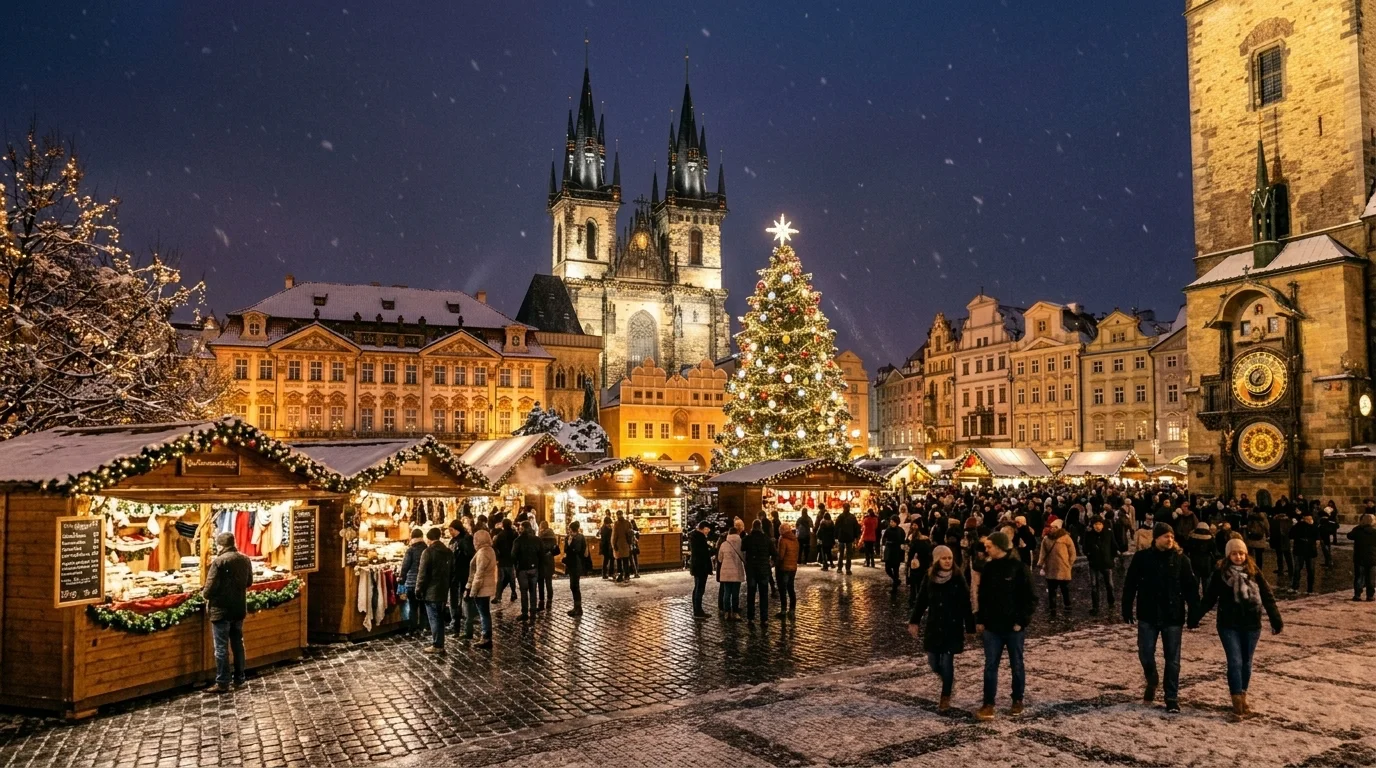
Christmas and New Year (December): Prague's Christmas markets are genuinely among the best in Europe, transforming the Old Town Square and Wenceslas Square into festive wonderlands. This is peak season again — prices spike and crowds return, especially in the week between Christmas and New Year. Book well ahead if you want to experience this magical time.
How Many Days Do You Need in Prague?
- 1–2 days: You can cover the absolute highlights — Old Town Square, Charles Bridge, Prague Castle, and Mala Strana — in a packed two days. Good for a weekend city break or a stopover.
- 3–4 days: The ideal length for a first-time visit. You will cover the main sights comfortably, explore a few neighborhoods, enjoy the food and beer scene, and have time to breathe and soak in the atmosphere.
- 5–7 days: Perfect for deeper exploration — hidden courtyards, Vinohrady and Zizkov neighborhoods, day trips to Cesky Krumlov or Kutna Hora, evening concerts, and getting genuinely off the tourist trail.
- 1 week+: For those who want to live like a local — exploring every district, doing multiple day trips, attending the theater, and truly understanding what makes this city tick beyond its postcard image.
Quick Facts About Prague
- Population: \~1.3 million city / \~2.1 million metro area
- Language: Czech (English widely spoken in tourist areas and by younger locals)
- Currency: Czech Crown (Koruna) — CZK / Kc (note: Prague does NOT use the Euro)
- Time Zone: Central European Time (CET) — UTC+1 (UTC+2 in summer)
- Country Code: +420
- Area Code: 2 (for Prague landlines)
- Climate: Continental — warm summers, cold winters, rain year-round
- Altitude: \~200 meters (656 feet) above sea level
How Do You Get To and Around Prague?
The easiest way to reach Prague is by flying into Vaclav Havel Airport Prague, which is well-connected to most major European cities and several intercontinental routes. Alternatively, Prague is a major hub for international train travel, with excellent rail connections to Vienna, Berlin, Budapest, and Krakow.
Which Airports Serve Prague?
Vaclav Havel Airport Prague (PRG)
K Letisti 6/1019, 160 08 Praha 6, Czech Republic
Located about 17 km (10 miles) west of the city center, Prague's main international airport handles over 17 million passengers per year. Major carriers including Czech Airlines, Ryanair, easyJet, Lufthansa, British Airways, and Emirates operate here. The airport has two terminals — Terminal 1 for non-Schengen flights and Terminal 2 for Schengen flights within Europe. Facilities include currency exchange, ATMs, car rental desks, and plenty of dining options.
How Do You Get from the Airport to the City Center?
Official Taxi / Bolt / Uber: A metered taxi or rideshare app to the city center costs approximately CZK 500–700 (about EUR 20–28) and takes 25–45 minutes depending on traffic. Always use the official taxi rank or book via app — avoid touts who approach you in the arrivals hall.
Public Bus + Metro: The cheapest option at just CZK 40 for a 90-minute ticket (2026 prices). Take bus 119 from the airport to Nadrazi Veleslavin metro station, then catch Line A (green line) into the city center. The whole journey takes about 35–45 minutes. Buy tickets from the yellow machines at the bus stop — they accept cards.
Airport Express Bus (AE): A direct express bus runs from both airport terminals to Prague's main train station (Praha Hlavni Nadrazi) for CZK 100 (about EUR 4). It takes approximately 35–45 minutes and runs every 30 minutes. This is the best balance of price and convenience.
Private Transfer: Pre-booked private transfers cost around CZK 900–1,200 (EUR 35–48) and are great for families, groups, or late arrivals when you have luggage. The driver meets you in arrivals with a name board.
What Is the Best Way to Get Around Prague?
The best way to get around Prague is a combination of walking and Prague's excellent public transport system — one of the best-value and most efficient metro and tram networks in Europe. The historic city center is compact and highly walkable, but trams are fantastic for covering longer distances quickly.
Public Transport System
Prague's public transport (operated by DPP) covers the entire city with 3 metro lines, 26 tram routes (including night trams), and dozens of bus routes. The system runs from around 5:00 AM to midnight, with night trams and buses running through the night. It is clean, reliable, easy to use, and extremely affordable by European standards.
Tickets and Passes (2026 prices):
- Single 30-minute ride: CZK 30
- Single 90-minute ride: CZK 40
- 24-hour pass: CZK 120
- 3-day pass: CZK 330
- Prague Card (tourist pass including transport + attractions): from CZK 1,590 for 2 days
- Rechargeable Litacka card: CZK 40 one-time fee (available at metro stations)
Taxis and Rideshare
Bolt is the dominant rideshare app in Prague and is generally reliable and fairly priced — a typical short city ride costs CZK 100–200. Uber also operates but is slightly pricier. Official yellow taxis are fine but ensure the meter is running. Always avoid accepting rides from people who approach you at tourist spots — these unofficial drivers often overcharge significantly.
Walking
Walking is genuinely one of the best ways to experience Prague — the historic center is compact, and the streets themselves are part of the attraction. The Old Town, Mala Strana, and parts of Nove Mesto are best explored on foot. Be aware that the cobblestone streets are beautiful but uneven, and some areas around Prague Castle involve significant uphill walking. Wear comfortable, flat-soled shoes.
Walkability Score: 88/100 for the tourist center. Charles Bridge to Old Town Square is a 5-minute walk; Old Town Square to Wenceslas Square is 10 minutes; the castle district requires about 20–30 minutes of uphill walking from the Old Town.
Smart travellers always compare transfer options before booking — prices for the same route can vary by 40% or more. Take 60 seconds to check all options and choose what works best for your arrival.
What Are the Top Attractions and Landmarks in Prague?
Prague's top attractions include Prague Castle, Charles Bridge, the Old Town Square with the Astronomical Clock, the Jewish Quarter, Vysehrad fortress, and Petrin Hill — together making up one of the richest concentrations of historic sights in Europe.
Prague Castle (Prazsky hrad)
Hradcany, 119 08 Praha 1, Czech Republic
Prague Castle is the largest ancient castle complex in the world, covering an astonishing 70,000 square meters on a hill overlooking the city. Built in the 9th century, it has served as the seat of Bohemian kings, Holy Roman Emperors, and today houses the Czech president's offices. The complex contains palaces, churches, galleries, gardens, and historic buildings spanning over a thousand years of architecture.
The crown jewel of the castle complex is St. Vitus Cathedral — a breathtaking Gothic masterpiece that took nearly 600 years to complete. Inside you will find the tombs of Bohemian kings, stunning stained glass windows including one designed by Alfons Mucha, and the Czech crown jewels on rare public display. The Old Royal Palace, St. George's Basilica, the Golden Lane, and the castle gardens are all worth exploring.
Why visit: Prague Castle is the single most iconic sight in the city — the views of Prague from the castle hill at sunset are unforgettable, and the sheer scale and history of the complex is overwhelming in the best possible way.
Entrance: Circuit B (most popular) — Adults CZK 250 / Children 6-15 CZK 150 / Under 6 free (2026)
Best time: Early morning (opens 9:00 AM) or late afternoon to avoid tour groups
Hours: Castle grounds open daily 6:00 AM–10:00 PM; historic buildings 9:00 AM–5:00 PM (April–October), 9:00 AM–4:00 PM (November–March)
Charles Bridge (Karluv Most)
Karluv most, 110 00 Praha 1, Czech Republic
Charles Bridge is Prague's most famous landmark — a medieval stone bridge spanning the Vltava River, lined with 30 Baroque statues of saints, and offering spectacular views of Prague Castle in one direction and the Old Town towers in the other. Construction began in 1357 under King Charles IV and was completed in the early 15th century. It was Prague's only river crossing for four centuries.
The bridge stretches 516 meters (1,693 feet) and is guarded at each end by impressive Gothic bridge towers — the Old Town Bridge Tower on the east is considered one of the finest civil Gothic structures in Central Europe. The statues lining the bridge are mostly 17th and 18th century copies, with the most famous being the statue of St. John of Nepomuk, polished shiny by generations of touching tourists.
Why visit: Charles Bridge is one of Europe's most beautiful bridges and the quintessential Prague experience — crossing it at dawn with mist rising from the river and the castle lit up above is a moment you will never forget.
Entrance: Bridge is free; Old Town Bridge Tower: Adults CZK 130, Children CZK 90 (2026)
Best time: 6:00–7:00 AM for near-empty bridge; after 10:00 AM becomes very crowded
Hours: Bridge open 24 hours; towers generally 10:00 AM–10:00 PM (summer)
Old Town Square (Staromestske namesti) and Astronomical Clock
Staromestske nam., 110 00 Praha 1, Czech Republic
Old Town Square is the heart of historic Prague — a magnificent medieval square surrounded by Gothic churches, Baroque palaces, and pastel-colored townhouses. At its center stands the Jan Hus Memorial, and on the south side of the square is the Old Town Hall with the famous Astronomical Clock (Orloj), which has been ticking since 1410, making it the world's oldest working astronomical clock still in its original location.
Every hour on the hour from 9:00 AM to 11:00 PM, crowds gather to watch the clock's animated show — skeletons ring a bell, the 12 apostles parade past two small windows, and a rooster crows. The Old Town Hall tower offers panoramic views over the square and rooftops of Prague for CZK 250 (2026).
Why visit: The Old Town Square is simply one of the most beautiful public spaces in Europe — day or night, summer or winter, it never disappoints. The Christmas markets held here each December are among the finest in the world.
Entrance: Square is free; Old Town Hall Tower: Adults CZK 250, Children CZK 150 (2026)
Best time: Early morning or evening for photos without crowds; any hour to watch the clock
Hours: Square open 24 hours; Tower: Monday 11:00 AM–9:00 PM, Tuesday–Sunday 9:00 AM–9:00 PM
Jewish Quarter (Josefov)
Josefov, 110 00 Praha 1, Czech Republic
Josefov is one of the best-preserved Jewish quarters in Europe — a compact neighborhood just north of the Old Town Square containing six historic synagogues, the Old Jewish Cemetery, and a Jewish Town Hall. The quarter dates back to the 13th century and was the heart of Prague's Jewish community for hundreds of years. Remarkably, Hitler ordered its preservation as a museum, which is how it survived when so much else was destroyed.
The Jewish Museum in Prague manages the major sites in Josefov and operates as a single combined ticket. The Old Jewish Cemetery — where up to 12 layers of graves are stacked due to limited space — is one of the most haunting and moving places in all of Europe. The Pinkas Synagogue bears the names of 80,000 Czech Jewish Holocaust victims inscribed on its walls.
Why visit: Josefov is a profoundly moving and historically significant site — essential for understanding European Jewish history and the Holocaust. Allow yourself enough time to absorb the weight of what you are seeing.
Entrance: Combined ticket (all synagogues + cemetery): Adults CZK 500, Students CZK 350, Children under 6 free (2026). Old-New Synagogue sold separately: CZK 230
Best time: Weekday mornings for fewer crowds
Hours: Sunday–Friday 9:00 AM–6:00 PM (April–October), 9:00 AM–4:30 PM (November–March); closed Saturday and Jewish holidays
Vysehrad
V Pevnosti 159/5b, 128 00 Praha 2, Czech Republic
Vysehrad is a historic fort and rocky promontory on the Vltava River, south of the city center — and one of Prague's most underrated attractions. According to legend, it is where Prague was founded. Today it is a peaceful park with stunning views, medieval ramparts, a Neo-Gothic cathedral (Basilica of St. Peter and St. Paul), and a cemetery containing the graves of Antonin Dvorak, Bedrich Smetana, Alphonse Mucha, and other Czech luminaries.
Unlike the castle, Vysehrad is rarely overrun with tourists, especially on weekdays. The grounds are free to walk through and locals come here to jog, walk dogs, and relax on the grass while enjoying views over the river valley. The rotunda of St. Martin, the oldest surviving intact Romanesque building in Bohemia, stands quietly in the park.
Why visit: Vysehrad offers everything Prague Castle has — panoramic views, ancient history, stunning architecture — but without the crowds and at far lower cost. It is where Prague residents actually go to relax.
Entrance: Grounds are free; Basilica interior: Adults CZK 60; Casements (underground tunnels): Adults CZK 120 (2026)
Best time: Any time; sunrise for photographers
Hours: Grounds open 24 hours; Basilica: Monday–Saturday 10:00 AM–6:00 PM, Sunday 11:00 AM–6:00 PM
Wenceslas Square (Vaclavske namesti)
Vaclavske nam., 110 00 Nove Mesto, Czech Republic
Wenceslas Square is more of a grand boulevard than a traditional square — a 750-meter-long pedestrian-friendly avenue lined with Art Nouveau and Cubist buildings, shops, hotels, restaurants, and cafes. At the top stands the imposing Neo-Renaissance National Museum and the equestrian statue of St. Wenceslas. This is Prague's main commercial hub and one of the most historically significant locations in modern Czech history.
Wenceslas Square has been the site of major historical events — the declaration of Czechoslovak independence in 1918, Jan Palach's self-immolation in 1969 protesting the Soviet invasion, and the 1989 Velvet Revolution, when hundreds of thousands gathered here peacefully to end communist rule.
Why visit: Wenceslas Square is essential context for understanding modern Czech history — and it is also a great place to eat, shop, and observe local life away from the medieval tourist bubble of the Old Town.
Entrance: Free to walk; National Museum: Adults CZK 250 (2026)
Best time: Evening when the cafes and bars come alive
Hours: Open 24 hours; National Museum: 10:00 AM–6:00 PM daily
Petrin Hill and Petrin Lookout Tower
Petrin, 118 00 Praha 1, Czech Republic
Petrin Hill is a large green park on the left bank of the Vltava, rising steeply above Mala Strana and offering some of the best panoramic views over Prague's rooftops. On top of the hill sits the Petrin Lookout Tower — a smaller replica of the Eiffel Tower built in 1891 for the Prague Jubilee Exhibition. It stands 63.5 meters tall but sits high enough on the hill to feel just as dramatic.
Getting to the top of Petrin is itself an adventure — you can hike up via lovely forest paths, or take the historic funicular railway from Ujezd station using a regular public transport ticket. The hill also contains the Mirror Maze (Bludiste), the Rose Garden, the Church of St. Lawrence, and the Stefanik Observatory offering stargazing sessions.
Why visit: Petrin offers a perfect blend of nature, history, views, and playful attractions at very reasonable prices — plus it is a beloved local green space that gives a glimpse of real Prague life beyond the tourist sites.
Entrance: Hill is free; Tower: Adults CZK 150, Children CZK 100; Mirror Maze: Adults CZK 150; Funicular: Regular transport ticket (CZK 40)
Best time: Clear days for views; golden hour for photos
Hours: Hill open 24 hours; Tower: 10:00 AM–10:00 PM (summer), 10:00 AM–6:00 PM (winter); Funicular runs 9:00 AM–11:30 PM
The National Gallery Prague — Trade Fair Palace (Veletrzni palac)
Dukelskeych hrdinu 530/47, 170 00 Praha 7, Czech Republic
The Trade Fair Palace is Prague's premier modern and contemporary art museum, housed in a monumental 1920s Functionalist building in the Holesovice district. It holds the Czech Republic's largest collection of modern art, including works by Picasso, Monet, Klimt, Miro, and a superb collection of Czech modern masters. The building itself is a work of art — one of the most important examples of Functionalist architecture in Central Europe.
This is the perfect destination if you want to escape the crowds of the Old Town and explore a genuinely world-class art collection that most tourists completely miss. The permanent collection spans five floors, covering everything from 19th-century Impressionism to Czech Cubism, postwar abstraction, and contemporary installations.
Why visit: World-class art in a remarkable building, with virtually no queues and a fraction of the visitor numbers you would find at comparable museums in London or Paris.
Entrance: Adults CZK 300, Students CZK 200, Under 6 free (2026). Free entry on the first Wednesday of each month
Best time: Weekday mornings
Hours: Tuesday–Sunday 10:00 AM–6:00 PM, closed Monday
Book your tours and tickets in advance — it saves hours of queuing and often gets you a better price. These two platforms cover different options, so it's worth checking both.
What Are the Best Neighborhoods to Explore in Prague?
Prague's neighborhoods each have a distinct character, from the medieval grandeur of Hradcany to the bohemian energy of Zizkov — here are the best ones to explore on foot.
Stare Mesto (Old Town)
Character: The medieval heart of Prague — cobblestone streets, Gothic spires, Baroque churches, and pastel townhouses dating back centuries. It is the most visited neighborhood in the city and the one that appears on every postcard.
What makes it special: Old Town Square, the Astronomical Clock, the Jewish Quarter (Josefov), Tyn Church, and dozens of hidden courtyards and passageways. The architecture is astonishing at every turn, and some of the best restaurants in the city have opened here in recent years.
Best for: First-time visitors, history lovers, architecture enthusiasts, and anyone who wants to be right in the center of everything
Must-see in this area: Old Town Square, Astronomical Clock, Josefov, Tyn Church, Celetna Street, Ungelt Courtyard
How to get there: Metro Line A to Staromestska, or walk from any central point
Location: Staromestske nam., 110 00 Praha 1, Czech Republic
Mala Strana (Lesser Town)
Character: The elegant, romantic neighborhood beneath Prague Castle on the left bank of the Vltava. Mala Strana is full of beautiful Baroque palaces, embassy gardens, hidden monasteries, and some of the city's best restaurants and cafes tucked into 17th-century buildings.
What makes it special: Its hilly, winding streets feel genuinely like stepping back in time. The John Lennon Wall is here, along with Kampa Island (Prague's "Little Venice") and the stunning Wallenstein Garden.
Best for: Romantic couples, architecture lovers, photographers, and anyone wanting a slightly quieter alternative to the Old Town
Must-see in this area: Nerudova Street, Kampa Island, John Lennon Wall, Wallenstein Garden, Church of St. Nicholas
How to get there: Metro Line A to Malostranska, or walk across Charles Bridge
Location: Malostranske nam., 118 00 Praha 1, Czech Republic
Vinohrady
Character: A beautiful, leafy residential neighborhood southeast of the New Town, lined with grand 19th-century Neo-Renaissance and Art Nouveau apartment buildings. Vinohrady is where Prague's young professionals and expats actually live — it has a wonderful local atmosphere with great restaurants, wine bars, and parks.
What makes it special: Namesti Miru (Peace Square) with its stunning Neo-Gothic church, Riegrovy Sady park with an outdoor beer garden and the best views of the castle from the east, and a thriving food and dining scene far better value than the tourist center.
Best for: Repeat visitors, food lovers, those wanting a more authentic local experience, LGBTQ+ travelers (it is Prague's most LGBTQ+ friendly neighborhood)
Must-see in this area: Namesti Miru, Riegrovy Sady beer garden, Vinohradska Street
How to get there: Metro Line A to Namesti Miru or Jiriho z Podebrad
Location: nam. Miru, 120 00 Praha 2, Czech Republic
Zizkov
Character: Prague's most bohemian and alternative neighborhood — historically a working-class area with a fiercely independent spirit, now home to an incredible concentration of bars, independent galleries, and creative spaces. It is edgy, slightly rough around the edges, and totally authentic.
What makes it special: The Zizkov Television Tower (Prague's most controversial piece of architecture, with giant crawling baby sculptures by David Cerny), a legendary bar scene, and the vast Olsanske Hrbytovy cemetery which is hauntingly beautiful.
Best for: Night owls, alternative travelers, budget travelers, and anyone who wants to drink cheap beer with locals
Must-see in this area: Zizkov Television Tower, Seifertova Street bar scene, Vitkov National Memorial
How to get there: Tram 5, 9, or 15 to Lipanska or Husineska
Location: Seifertova, 130 00 Praha 3, Czech Republic
Holesovice
Character: Prague's most rapidly gentrifying neighborhood — a former industrial district north of the center that has transformed into the city's hippest area over the last decade. Think converted warehouses, craft beer bars, street art, vintage markets, and some of the best new restaurants in Prague.
What makes it special: The Prague Market (Prazska trznice) — a vast indoor market complex in old industrial halls hosting food vendors, vintage shops, and regular pop-up events. The National Gallery's Trade Fair Palace is here, along with the DOX Centre for Contemporary Art.
Best for: Food lovers, design fans, contemporary art enthusiasts, and those wanting to see Prague's creative future rather than just its medieval past
Must-see in this area: Prague Market (Prazska trznice), Trade Fair Palace, DOX Centre, Letenskey zamecek beer garden with castle views
How to get there: Tram 1, 12, or 17 to Veletrzni or Prazska trznice
Location: Dukelskeych hrdinu, 170 00 Praha 7, Czech Republic
Hradcany
Character: The most elevated neighborhood in Prague, sitting at the top of the castle hill and home to the castle complex itself, the Archbishop's Palace, the Loreto Shrine, and the Strahov Monastery. It is quieter and more dignified than the rest of the city.
What makes it special: Hradcanske namesti (the main castle square) is one of the most beautiful squares in Europe. The Novy Svet ("New World") area — a small, perfectly preserved lane of colorful cottages — is one of Prague's most magical hidden spots.
Best for: History buffs, those visiting the castle, photography enthusiasts, and anyone who wants to escape the crowds of the lower city
Must-see in this area: Prague Castle complex, Novy Svet lane, Strahov Monastery and Library, Loreto Shrine, Hradcanske namesti
How to get there: Tram 22 to Pohorelec or Prazsky hrad
Location: Hradcanske nam., 119 08 Praha 1, Czech Republic
What Food Should You Try in Prague?
Prague is famous for its hearty Czech cuisine — roasted meats, rich stews, dumplings, and some of the finest beer in the world, all at prices that feel shockingly affordable compared to most European capitals.
What Are the Must-Try Local Dishes in Prague?
- Svickova na smetane — The national dish of the Czech Republic. Slow-braised beef sirloin in a creamy root vegetable sauce, served with bread dumplings (knedliky), a wedge of lemon, and a dollop of whipped cream. Do not leave Prague without trying it.
- Vepro-knedlo-zelo — Roasted pork with bread dumplings and braised sauerkraut. Simple, comforting, and deeply Czech. Available in virtually every traditional restaurant.
- Gulash (Czech Goulash) — Czech beef goulash is thicker and richer than Hungarian versions, served with bread dumplings. A perfect cold-weather meal with a pint of dark beer.
- Smazeny syr — Deep-fried Edam or Hermelin cheese, served with tartar sauce and bread. It is fast food here — available at street stands and pubs everywhere, and absolutely delicious.
- Trdlenik — A hollow chimney-cake of sweet dough wrapped around a spit, grilled and rolled in cinnamon sugar. A popular street food in the tourist areas.
- Knedliky (Dumplings) — Czech bread dumplings are dense, steamed loaves of bread sliced into thick rounds. They come with almost every main dish and are perfect for mopping up sauces.
- Svarek (Mulled Wine) — Especially popular in winter and at the Christmas markets. CZK 40–60 from market stands.
- Czech Beer (Pivo) — Absolutely essential. Prague produces some of the finest lager in the world. Pilsner Urquell, Kozel, Bernard, and Budvar are the major names. A half-liter in a good local pub costs CZK 30–50 (about EUR 1.20–2).
Where Should You Eat in Prague?
Budget-Friendly (Under CZK 200 per meal)
- Lokal Hamburk — Namesti Miru 9, 120 00 Praha 2 — Part of the famous Lokal group in Vinohrady. Czech classics done perfectly, tank-fresh Pilsner Urquell, great value lunch specials. CZK 150–200 for a full meal.
- Nase Maso — Dlouha 727/39, 110 00 Praha 1 — A butcher shop and deli with a tiny standing lunch counter. Order beef tartare, smazeny syr, or a roast meat plate. Excellent quality at rock-bottom prices.
- U Sadlu — Klimentska 2, 110 00 Praha 1 — A medieval-themed Czech pub popular with locals and tourists alike. Excellent svickova, goulash, and the best lard (skvarkovey tuk) on bread you will ever eat. Mains from CZK 150–250.
Mid-Range (CZK 300–600 per meal)
- Cafe Savoy — Vitezna 124/5, 150 00 Praha 5 — One of Prague's most beautiful restaurant interiors — a stunning Viennese-style cafe with original Neo-Renaissance ceiling. Perfect for a long lunch or weekend brunch. Exceptional pastries from their in-house bakery.
- Eska — Pernerova 49, 186 00 Praha 8 — One of Prague's most acclaimed contemporary Czech restaurants in the Karlin neighborhood. Award-winning sourdough bread, innovative takes on Czech classics, and a fantastic brunch menu. Reservation recommended.
- Manifesto Market — Namesti Miru 9, 120 00 Praha 2 — A pop-up container food market (open spring and summer) with a rotating cast of street food vendors. Good for trying multiple cuisines and having a relaxed outdoor meal.
Fine Dining (CZK 1,000+ per person)
- Field Restaurant — U Milosrdnych 12, 110 00 Praha 1 — One of Prague's top fine dining establishments — Michelin-starred Czech contemporary cuisine near the Jewish Quarter. Tasting menus from CZK 2,500. Book weeks ahead.
- La Degustation Boheme Bourgeoise — Hastalska 749/18, 110 00 Praha 1 — A Michelin-starred restaurant serving tasting menus inspired by historic Czech recipes. Worth the splurge for serious food lovers. Reservations essential, book weeks in advance.
What Are the Dining Customs in Prague?
Meal times: Czechs eat lunch between noon and 2:00 PM. Many restaurants offer set lunch menus (polední menu) that are excellent value. Dinner typically starts around 7:00–8:00 PM.
Tipping: Tipping is customary in Prague. Rounding up the bill or leaving 10% is standard in restaurants. Tell the server the total you want to pay when they come with the bill — do not leave cash on the table.
Reservations: Essential for the better restaurants, especially on Friday and Saturday evenings. Book online via Restu.cz or directly by phone.
Dress code: Prague restaurants are generally relaxed about dress — smart casual is fine even for higher-end restaurants.
What Is the Nightlife Like in Prague?
Prague's nightlife scene is legendary — the city genuinely does not sleep, with bars staying open until 4:00–6:00 AM, clubs running until dawn, and a bar-to-resident ratio that rivals any city in Europe. Things get going later than in most cities, with bars filling up from 9:00 PM and clubs not really starting until midnight.
Where Are the Best Areas for Nightlife in Prague?
- Zizkov (Praha 3): Seifertova and surrounding streets — the most authentically Czech nightlife district, full of cheap, unpretentious local pubs where Czechs actually drink. No dress codes, cheap beer, and a refreshingly local atmosphere.
- Vinohrady (Praha 2): Namesti Miru and Manesova Street — a more sophisticated drinking scene with wine bars, cocktail bars, and upscale pubs. Popular with local young professionals and the expat community. LGBTQ+ bars are concentrated here.
- Nove Mesto / Wenceslas Square area: The most tourist-heavy nightlife zone — larger bars, clubs, and entertainment venues. Fine for a wild night out but prices are higher and the atmosphere is more international than local.
What Are the Best Bars and Clubs in Prague?
Bars and Pubs
- Lokal Dlouhaaaa — Dlouha 33, 110 00 Praha 1 — Arguably the best traditional Czech beer hall in the city. Tank-conditioned Pilsner Urquell served at the perfect temperature, great Czech food, and an authentic atmosphere. Busy every night — arrive early or book.
- AnonymouS Bar — Lazarska 5, 120 00 Praha 2 — Hacker-themed cocktail bar with extraordinary attention to detail. Brilliant cocktails and a genuinely unique atmosphere.
- Hemingway Bar — Karoliny Svetle 26, 110 00 Praha 1 — One of the best cocktail bars in Central Europe in a beautiful Art Deco space. Expensive by Prague standards but worth it for a special occasion. Reservations strongly advised.
Clubs and Dancing
- Klub 007 Strahov — Chaloupeckeho 7/1069, 169 00 Praha 6 — A legendary student club in the basement of a university dorm near the castle. Totally unpretentious, cheap beer, and eclectic music from metal to house. Cover charge CZK 50–150.
- Cross Club — Plynrni 1096/23, 170 00 Praha 7 — One of the most visually extraordinary clubs in Europe — a steampunk labyrinth of metal sculptures and moving parts in Holesovice. Multiple floors with different music, an outdoor terrace, and a genuinely creative atmosphere.
Live Music and Shows
- Jazz Dock — Janackovo nabrezi 2, 150 00 Praha 5 — Prague's best jazz club, beautifully situated on the riverbank below Smichov. Live jazz every night, excellent cocktails, stunning river views. Tickets from CZK 150–300.
- Rock Cafe Prague — Narodni 20, 110 00 Praha 1 — A central live music venue hosting local and international rock, punk, and indie acts. One of the longest-running rock venues in the city.
What Family-Friendly Evening Entertainment Is Available?
Prague has excellent family-friendly evening options. The National Marionette Theatre (Zatecka 1, Praha 1) performs Mozart's Don Giovanni with puppets — a uniquely Czech experience that older children love. Evening river cruises on the Vltava depart from the quay near the National Theatre and are wonderful for families. In summer, the open-air cinema at Svetozor (Vodickov 41) is a lovely option.
What and Where Should You Shop in Prague?
The best things to buy in Prague are Bohemian crystal and glass, handmade wooden toys, Czech garnets, Alfons Mucha prints, and locally produced food and spirits — and the top shopping areas range from the elegant Parizska Street to bustling neighborhood markets in Holesovice.
What Are the Best Shopping Districts in Prague?
- Parizska Street: Parizska, 110 00 Praha 1 — Prague's most glamorous shopping street, running from the Old Town Square to the Vltava river through the Jewish Quarter. Lined with flagship stores of every major luxury brand — Chanel, Louis Vuitton, Hermes, Cartier.
- Na Prikope and Wenceslas Square: Na Prikope, 110 00 Praha 1 — The mainstream commercial center with high-street brands, shopping malls (Palladium, Kotva), and department stores. Good for everyday shopping and electronics.
- Mala Strana side streets: Nerudova 222/14, Praha 1 — The best area for quality Czech crafts, local art, and authentic souvenirs. Choose shops on the side streets rather than the main tourist drag for better quality and fairer prices.
What Markets Should You Visit in Prague?
Prague Market (Prazska trznice) — Bubenske nabrezi 306, 170 00 Praha 7 — Open Friday to Sunday, this vast indoor market in Holesovice covers everything from vintage clothing and antiques to fresh food, street food, and handmade crafts. Saturday morning is the sweet spot when it is busy but not yet overwhelming.
Naplavka Farmers Market — Rasinovo nabrezi, 120 00 Praha 2 — A beloved riverside farmers market along the Vltava embankment, operating on Saturdays from 8:00 AM to 2:00 PM (April to November). Fresh local produce, Czech cheeses, artisan breads, and street food.
Havelske Trziste (Havel's Market) — Havelska 13, 110 00 Praha 1 — A traditional covered market in the Old Town operating daily since the Middle Ages. Best for flowers, seasonal produce, and souvenir crafts.
What Should You Buy in Prague?
- Bohemian Crystal and Glass — Czech glass-making has a centuries-old tradition and the quality is exceptional. Look for pieces by Moser (Male namesti 11, Praha 1) for top-end crystal. Avoid the cheap tourist glass on the main streets.
- Czech Garnets (Granaty) — Deep red Bohemian garnets are mined exclusively in northwest Bohemia. Buy only from certified retailers like Turnov Granat (Dlouha 28-30, Praha 1) to ensure genuine stones.
- Alfons Mucha Prints and Art Nouveau Items — Czech-born Mucha is one of the most beloved artists in Art Nouveau. High-quality prints and reproductions are widely available — the Mucha Museum shop (Panska 7, Praha 1) sells authenticated reproductions.
- Becherovka — A herbal liqueur from Karlovy Vary that every Czech drinks as a digestive. Buy a bottle at the airport duty-free or in any supermarket for CZK 250–300 for one liter.
- Czech Absinthe — The Czech Republic has a strong absinthe tradition. Hill's Liquere and various craft absinthes are great value and impossible to find elsewhere.
- Handmade Wooden Toys — Czech handmade wooden toys and marionettes are excellent quality and make perfect gifts for children. Look for shops in Mala Strana rather than the plastic toy sellers near the clock.
What Are the Shopping Hours and Customs?
Most shops in Prague's tourist center open Monday–Saturday 10:00 AM–8:00 PM and Sunday 11:00 AM–6:00 PM. Bargaining is not typical in Czech shops — prices are generally fixed. VAT refund (DPH) is available for non-EU citizens on purchases over CZK 2,001 from participating stores — ask for a Tax Free Shopping form at the point of sale.
Can Non-EU Visitors Claim a VAT Tax Refund in Prague?
Yes — if you are a visitor from outside the European Union (including travellers from the USA, Canada, Australia, the UK, and most of Asia and Latin America), you are entitled to a refund of the VAT (Value Added Tax) included in the price of goods you buy in Czech Republic. VAT in Czech Republic is 21% on most goods, which means this refund can be significant on high-value purchases like clothing, leather goods, jewellery, designer fashion, and electronics.
How to Claim Your VAT Refund — Step by Step
- Spend at least CZK 2,001 (approximately €80) in a single shop in a single day. This is the minimum threshold for a VAT refund claim in Czech Republic. It does not apply across multiple shops — the full amount must be spent in one store.
- Look for the "Tax Free" sign. Participating shops display a "Tax Free Shopping," "Global Blue," or "Planet" logo in the window or at the register.
- Ask for the tax refund form at the register before you pay. Present your non-EU passport — the shop will fill out the form with your details and the purchase amount. Keep the form with your receipt.
- Get the form stamped at customs before you leave. Go to the Customs office at Prague Václav Havel Airport (PRG) before check-in and have an officer stamp your tax refund form. Keep your purchases accessible in hand luggage — do not pack them deep in your checked bags.
- Collect your refund. Hand the stamped form to the Global Blue or Planet desk at the airport. You can receive the refund in cash (minus a processing fee) or as a credit card refund (lower fees, takes a few weeks).
VAT Refund Quick Facts for Prague
- Minimum spend: CZK 2,001 (approximately €80) in one shop in one day
- VAT rate on most goods: 21% on most goods
- Typical refund after fees: 10–15% of the purchase price
- Refund processors: Global Blue and Planet (formerly Premier Tax Free) at Prague Václav Havel Airport (PRG)
- Who qualifies: Anyone with a non-EU passport who is not a resident of an EU country
- UK visitors: British passport holders qualify since Brexit — the UK is no longer in the EU
- Deadline: Purchases must be exported within 3 months of the date of purchase
- Full guide: VAT Refund in Europe — Complete Guide for Non-EU Travelers
What Festivals and Events Happen in Prague?
Prague's biggest festivals include the Christmas Markets in December, Prague Spring International Music Festival in May and June, Signal Festival of light in October, and Prague Pride in August — together creating a city with something special happening almost every month of the year.
What Is the Annual Events Calendar for Prague?
| Month | Event Name | Description |
|---|---|---|
| January | New Year's Concert | Classical music concerts throughout the city. The Czech Philharmonic often performs special New Year programs. Fireworks over the Vltava on January 1. |
| February | Masopust (Czech Carnival) | Traditional Czech pre-Lenten carnival celebrations, especially lively in Zizkov. Processions, costumes, and traditional foods. Usually mid-February. |
| March | One World Human Rights Film Festival | Europe's largest human rights documentary film festival, held across multiple Prague cinemas. Free and paid screenings. Usually late March. |
| April | Prague Easter Markets | Traditional Easter markets on the Old Town Square and other squares. Handmade crafts, traditional food, decorated eggs, and folk performances. Usually two weeks before Easter. |
| May | Prague Spring International Music Festival | One of the world's most prestigious classical music festivals, running from May 12 through early June. Concerts in palaces, churches, and Dvorak Hall. Book tickets well in advance at festival.cz. |
| June | Prague Beer Festival | One of the largest beer festivals in Central Europe — 150+ Czech beers to try, live music, and Czech food in Letany. Entry CZK 200 with tasting glass. Usually runs for three weeks in late May and June. |
| July | Prague Fringe Festival | A performing arts festival with theater, comedy, and music acts across the city. Free and paid events throughout July. |
| August | Prague Pride | Prague's LGBTQ+ Pride festival, running for a week in mid-August culminating in a large parade from Vinohrady to the Old Town. Events, concerts, and film screenings throughout. |
| September | Dvorak Prague Festival | A classical music festival dedicated to Czech composer Antonin Dvorak. Concerts in Rudolfinum and other venues. Also Prague Design Week in September. |
| October | Signal Festival | Prague's stunning international festival of light, projection, and sound art — incredible light installations transform landmarks across the city for four nights in mid-October. Free to walk the mapped route. |
| November | Velvet Revolution Anniversary (November 17) | The anniversary of the 1989 Velvet Revolution is a national holiday. Commemorative marches along Narodni trida and events throughout the city. A meaningful and emotionally powerful day to be in Prague. |
| December | Prague Christmas Markets | Prague's Christmas markets are among the finest in Europe — Old Town Square and Wenceslas Square transform with wooden stalls, lights, mulled wine, and traditional crafts. Run from late November through December 26. |
How Do Festivals Affect Hotel Prices and Availability?
Prague Spring (May–June), the Christmas Markets period (late November–December), and New Year's Eve are the events that most significantly drive up accommodation prices and reduce availability. During these events, hotel prices can increase by 50–100% compared to regular shoulder season rates. For any visit coinciding with these events, book accommodation at least 2–3 months in advance. The Signal Festival in October is growing in popularity but has not yet caused major accommodation price spikes.
Where Should You Stay in Prague?
The best neighborhood to stay in Prague depends on your travel style — the Old Town is perfect for first-timers who want to be central, while Vinohrady offers better value and a more local feel for those on a second or longer visit.
What Are the Best Neighborhoods to Stay in Prague?
| Neighborhood | Vibe | Price Range (per night, 2026) | Best For |
|---|---|---|---|
| Stare Mesto (Old Town) | Historic, tourist, lively 24/7 | CZK 2,000–8,000 (EUR 80–320) | First-time visitors, those who want everything walkable |
| Mala Strana (Lesser Town) | Romantic, quiet, beautiful | CZK 2,500–7,000 (EUR 100–280) | Couples, those visiting the castle, photographers |
| Nove Mesto (New Town) | Central, practical, mixed | CZK 1,500–5,000 (EUR 60–200) | Business travelers, those wanting transport links |
| Vinohrady | Residential, leafy, local feel | CZK 1,200–4,000 (EUR 48–160) | Repeat visitors, food lovers, LGBTQ+ travelers |
| Holesovice / Karlin | Trendy, up-and-coming, creative | CZK 1,000–3,500 (EUR 40–140) | Budget travelers, design fans, hip neighborhood seekers |
What Are the Pros and Cons of Each Area?
Old Town (Stare Mesto):
Pros: You are in the middle of everything — Charles Bridge, the Astronomical Clock, restaurants, and nightlife are literally minutes from your door. Incredibly atmospheric, especially at night.
Cons: The most expensive area, and the cobblestone streets mean suitcases and strollers are challenging. It can be noisy at night from bar crowds.
Vinohrady:
Pros: Excellent value for money, beautiful streets, fantastic local restaurant and bar scene, very safe, easy metro and tram connections to the center in 5–10 minutes.
Cons: You will need to use transport to reach the main sights — not ideal if you want to roll out of bed and be at Charles Bridge in 3 minutes.
How Far in Advance Should You Book in Prague?
For summer travel (June–August), book at least 2–3 months ahead, especially for quality hotels in the Old Town. For Christmas and New Year, 3–4 months minimum. Shoulder seasons (April–May, September–October) require 4–6 weeks advance booking for the best options. January–March has excellent last-minute availability.
What Do You Need to Know Before Visiting Prague?
Here are the essential practical details every visitor to Prague needs to know — from currency (it is NOT the Euro) to safety, customs, and staying connected.
Essential Travel Details for Prague
- Currency: Czech Crown (Koruna ceska) — CZK / Kc. Prague does NOT use the Euro despite being in the EU. Exchange at banks or ATMs — avoid the green Exact Change booths and airport exchange desks.
- Credit Cards: Widely accepted in hotels, restaurants, and shops. Visa and Mastercard are universal; Amex less so. Some small pubs and market stalls are cash only.
- ATMs: Widely available. Use bank ATMs (Komercni banka, CSOB, Ceska sporitelna) rather than standalone ATMs in tourist areas. Always withdraw in CZK, not EUR.
- Language: Czech. English is very widely spoken in tourist areas and by most people under 40.
- Tipping: 10% is standard in restaurants; round up in pubs. Tell the server the total you want to pay when they bring the bill — do not leave cash on the table.
- Electrical Plugs: Type E/F (European round two-pin), 230V/50Hz. UK and US visitors need adapters.
- Emergency Number: 112 (European emergency number). Police: 158, Ambulance: 155, Fire: 150.
- Tourist Police: +420 974 851 750 (tourist police line with English speakers)
- SIM Cards: Buy prepaid SIM cards at the airport or at T-Mobile, O2, or Vodafone shops. A tourist SIM with 10GB data costs approximately CZK 300–500 (2026).
- WiFi: Excellent free WiFi in most hotels, cafes, and restaurants. Prague's main metro stations have free WiFi.
- Tap Water: Safe to drink — Prague's tap water quality is high and monitored. Buying bottled water is unnecessary.
Skip the airport queue — order your eSIM before you travel and activate it the moment you land. Prices and data allowances vary, so it pays to compare providers.
How Much Does It Cost to Visit Prague?
| Budget Type | Daily Cost (2026) | What's Included |
|---|---|---|
| Budget Traveler | CZK 800–1,500 (EUR 32–60) | Hostel dorm bed, street food and pub lunches, public transport, free attractions and walking tours |
| Mid-Range Traveler | CZK 2,500–5,000 (EUR 100–200) | 3-star hotel, mix of local restaurants and mid-range dining, occasional taxis, paid attractions and one tour |
| Luxury Traveler | CZK 8,000–20,000+ (EUR 320–800+) | 4–5 star hotel, fine dining, private transport, guided tours, concerts, premium experiences |
What Are the Most Useful Phrases in Prague?
- Hello (informal): Ahoj (ah-hoy)
- Hello (formal): Dobry den (dob-ree den)
- Thank you: Dekuji (dyeh-koo-yee) — or just "Diky" informally
- Please / You're welcome: Prosim (pro-seem)
- Excuse me: Prominnte (pro-meen-teh)
- How much?: Kolik to stoji? (ko-lik to sto-yee)
- Where is...?: Kde je...? (gdeh yeh)
- I don't understand: Nerozumim (neh-ro-zoo-meem)
- Help!: Pomoc! (po-mots)
- Bathroom: Toaleta / WC (to-ah-leh-tah)
- Check, please: Zaplatim (zah-plah-teem)
- One beer, please: Jedno pivo, prosim (yed-no pee-vo, pro-seem)
Is Prague Safe for Tourists?
Prague is generally very safe for tourists — violent crime against visitors is rare, and the city regularly ranks as one of the safer European capitals. The main risks are property crime (pickpocketing) and tourist-targeted scams rather than anything more serious.
Areas to avoid: The very bottom of Wenceslas Square late at night can feel uncomfortable. The area around Hlavni Nadrazi (main train station) after dark warrants extra awareness. These are not dangerous in a violent sense but are best avoided by solo travelers at night.
Common scams: Fake police officers asking to check your wallet; taxi drivers without working meters; currency exchange booths with terrible rates; bars that overcharge massively; someone "finding" a ring and asking for money.
Pickpocketing: The most common crime against tourists in Prague. Charles Bridge, Old Town Square, and crowded trams (especially tram 22 near the castle) are the main hotspots. Use front pockets or a hidden money belt.
Solo traveler safety: Prague is excellent for solo travelers of all genders. The LGBTQ+ community is welcomed, especially in Vinohrady.
What Are the Cultural Customs in Prague?
- Greetings: A handshake is standard on first meeting. First names are generally used only after an invitation to do so in formal situations.
- Dress code: Prague is generally casual, but smart casual is appreciated in nicer restaurants. For churches and synagogues, shoulders and knees should be covered.
- Photography: Ask permission before photographing individuals. Photography is prohibited in some museum areas and at certain synagogues in Josefov.
- Public behavior: Czechs are generally reserved in public — loud behavior on public transport is frowned upon. Eating on the metro is considered impolite.
- Dining: It is normal to share tables in busy pubs. The waiter tracks your drinks on a slip of paper on the table — do not lose it.
- Gestures to avoid: Waving "no" with a wagging finger is impolite. Pointing with your finger is considered rude — use an open hand instead.
Do You Need a Visa to Visit Prague?
Citizens of the EU, USA, UK, Canada, Australia, New Zealand, Japan, and most other Western countries do not need a visa to visit Prague (Czech Republic) for stays up to 90 days within any 180-day period. The Czech Republic is a member of the Schengen Area, so your 90-day allowance applies to the entire Schengen Zone. For stays longer than 90 days, or for citizens of other countries, check the official Czech immigration website (mzv.gov.cz) for current requirements.
What Health Precautions Should You Take in Prague?
Vaccinations: No specific vaccinations are required for Prague. Routine vaccinations (tetanus, hepatitis A and B, MMR) should be up to date as for any European destination.
Pharmacies: Pharmacies (Lekarna) are common throughout the city and well-stocked. Over-the-counter medicines are available without prescription. 24-hour pharmacies include Lekarna Palladium (Na Prikope 845/23, Praha 1).
Hospitals: Prague has excellent medical facilities. The Motol University Hospital (V Uvalu 84, Praha 5) and Na Homolce Hospital (Roentgenova 2, Praha 5) have English-speaking international patient departments. Travel insurance is strongly recommended.
Common health issues: Prague's tap water is safe. The main health concern for tourists is excessive alcohol consumption — Prague's cheap, excellent beer makes over-drinking easy. Heat in summer (July–August can reach 35C) is a growing concern — stay hydrated.
Do You Need Travel Insurance for Prague?
Yes — and you should buy it before you board your flight, not after. Travel insurance covers the situations that can turn a great trip into a financial disaster: a medical emergency (a single ambulance ride and hospital stay in Europe can cost €3,000–€10,000 without coverage), a cancelled or delayed flight, lost or stolen baggage, or a last-minute trip cancellation. EU citizens with an EHIC or GHIC card receive reciprocal state healthcare, but this does not cover repatriation, trip cancellation, or lost luggage — a full travel policy fills those gaps. Non-EU travellers have no state coverage at all and should never visit without insurance.
Choosing the right policy matters — coverage limits, exclusions, and pre-existing condition terms vary significantly between providers. Read our full guide before you buy: Best Travel Insurance for Europe — Honest Comparison for 2026.
Travel insurance is strongly recommended for Prague — an unexpected medical bill, flight cancellation, or lost luggage can cost far more than the policy. Get covered before you go.
What Are Your Rights If Your Flight to Prague Is Delayed or Cancelled?
Under EU Regulation 261/2004, if your flight to or from Prague is delayed by more than 3 hours or cancelled without sufficient notice, you are entitled to compensation of up to €600 per passenger — regardless of which airline you flew with, and regardless of how long ago it happened (claims can go back up to 6 years in some countries). This applies to all flights departing from an EU airport, and all flights arriving into an EU airport on an EU-based carrier. Most travellers don't realise they are owed money, and airlines rarely volunteer to pay. A claims service handles everything on your behalf and only charges a fee if they win — so there is no risk to you.
Both services check your eligibility for free with no upfront cost — they only charge a commission if they successfully recover your compensation.
Is Prague Accessible for People with Disabilities?
Prague is improving but remains challenging for visitors with mobility impairments due to the cobblestone historic center. The metro has lifts at most stations, and many trams are low-floor accessible. Prague Castle and some Old Town sights have accessible routes — check individual attraction websites in advance. Major hotels in the center generally have accessible rooms.
Is Prague Good for Families with Kids?
Prague is very family-friendly. The Petrin Hill funicular and Petrin Tower are huge hits with children. The National Technical Museum (Kostelni 42, Praha 7) has hands-on exhibits kids love. Prague Zoo (U Trojskeho zamku 3/120, Praha 7) is genuinely one of the best zoos in Europe. Strollers struggle on cobblestones in the Old Town — a baby carrier is far more practical.
What Are the Best Day Trips from Prague?
The best day trips from Prague include the fairy-tale town of Cesky Krumlov, the haunting Kutna Hora bone church, the spa town of Karlovy Vary, and the beautiful Bohemian Switzerland national park — all within 1–3 hours of the city.
Cesky Krumlov
Distance: 170 km (105 miles) / approximately 2.5–3 hours by bus or car
What to see: Cesky Krumlov is arguably one of the most beautiful small towns in all of Europe — a UNESCO World Heritage Site built on a rocky promontory in a bend of the Vltava river, crowned by a spectacular Renaissance castle. The town's medieval old town is extraordinarily well-preserved, with winding streets, colorful houses, and a theatrical Baroque theater in the castle that is one of only three surviving examples in the world. The castle gardens offer stunning views and there are excellent options for river rafting in summer.
How to get there: Student Agency / RegioJet buses depart Prague's Florenc bus station roughly every 1–2 hours and take about 3 hours. Tickets from CZK 150–250 each way. Driving takes 2.5 hours via the D3 motorway.
Time needed: Full day — or better, an overnight stay to experience the town after the day-trippers leave
Best for: History lovers, architecture enthusiasts, families, romantic couples
Location: Namesti Svornosti, 381 01 Cesky Krumlov, Czech Republic
Kutna Hora
Distance: 70 km (43 miles) / approximately 1 hour by train
What to see: Kutna Hora is a UNESCO World Heritage town that was once one of the richest cities in Central Europe due to its silver mines. The main draw is the extraordinary Sedlec Ossuary (the "Bone Church") — a small chapel whose interior is decorated entirely with the bones of 40,000–70,000 people, including a chandelier containing every bone in the human body. Beyond the Bone Church, the spectacular Gothic Cathedral of Saint Barbara and the charming historic town center make this a genuinely fascinating day out.
How to get there: Direct trains from Praha Hlavni Nadrazi to Kutna Hora Mesto take about 1 hour, with multiple departures daily. Tickets from CZK 120 each way. The Bone Church is a 2 km walk or short taxi ride from the main station.
Time needed: Half day to full day
Best for: History lovers, those interested in unusual or macabre sites, silver mining history enthusiasts
Location: Zamecka 127, 284 01 Kutna Hora, Czech Republic (Sedlec Ossuary)
Karlovy Vary (Carlsbad)
Distance: 130 km (81 miles) / approximately 2 hours by bus
What to see: Karlovy Vary is Czechia's most famous spa town — a beautiful valley filled with colonnaded promenades, elegant Belle Epoque hotels, and 12 natural thermal springs you can actually drink from using a special porcelain spa cup. The town has been a resort for European royalty and celebrities for centuries. Today you can take the spa waters, relax in thermal pools, eat the famous Karlovarsky wafer biscuits, and sip Becherovka liqueur (invented here). The town also hosts the Karlovy Vary International Film Festival in early July.
How to get there: Student Agency buses depart from Prague Florenc bus station roughly every 30–60 minutes. Journey takes approximately 2 hours. Tickets CZK 200–350 each way.
Time needed: Full day
Best for: Those seeking relaxation and wellness, architecture fans, film festival visitors in early July
Location: Colonnade, Lazenska 1, 360 01 Karlovy Vary, Czech Republic
Bohemian Switzerland National Park
Distance: 130 km (81 miles) / approximately 2 hours by train
What to see: Bohemian Switzerland (Ceske Svycarsko) is a stunning national park in northwest Czechia, featuring dramatic sandstone rock formations, deep gorges, and forest-covered plateaus. The highlight is the Pravcicka brana — the largest natural sandstone arch in Europe. The Kamenice Gorge offers unforgettable boat rides through narrow canyon passages. Hiking trails range from easy riverside walks to more challenging cliff-top routes.
How to get there: Train from Praha Hlavni Nadrazi to Decin, then local bus or taxi to the park entrance. Total journey about 2 hours. Alternatively, join a guided day tour from Prague which handles all transport.
Time needed: Full day — an overnight stay allows you to experience the park at dawn before tourists arrive
Best for: Hikers, nature lovers, photographers, families with older children
Location: Hrensko 1, 407 17 Hrensko, Czech Republic
Konopiste Castle
Distance: 45 km (28 miles) / approximately 45 minutes by train plus short bus ride
What to see: Konopiste Castle was the beloved home of Archduke Franz Ferdinand of Austria — whose assassination triggered World War I. The castle's perfectly preserved interiors are stuffed with his extraordinary hunting trophies (over 100,000 animals), weapons collection, and personal memorabilia. The surrounding English-style park is beautiful in any season, and the rose garden is spectacular in June.
How to get there: Train from Praha Hlavni Nadrazi to Benesov u Prahy (45 minutes, CZK 80 each way), then a 20-minute walk or local bus to the castle.
Time needed: Half day to full day
Best for: History enthusiasts, WWI history buffs, families, those wanting a quick and easy day trip
Location: Konopiste 1, 256 01 Benesov, Czech Republic
Car rental prices vary significantly between agencies — the same car on the same date can differ by 30–50% depending on where you book. Always compare before confirming.
What Are the Hidden Gems and Insider Tips for Prague?
Beyond the main tourist sites, Prague hides some incredible spots most visitors never find — secret courtyards, forgotten passages, local beer gardens, and neighborhoods where real Prague life happens far from the tour groups.
What Are the Best Hidden Gems in Prague?
- Novy Svet (New World) Lane: Novy Svet, 118 00 Praha 1 — A tiny, perfectly preserved laneway of colorful 17th-century cottages in Hradcany, just around the corner from Prague Castle but visited by almost no tourists. It looks like something from a fairy tale. Former residents include the court astronomer Tycho Brahe.
- Kampa Island and the Certovka "Devil's Stream": Kampa Island, 118 00 Praha 1 — A small island in Mala Strana separated from the mainland by a narrow millstream. The medieval water mills, footbridges, and weeping willows make this one of Prague's most romantic corners — and remarkably few tourists make it here.
- Wallenstein Garden (Valdstejnska zahrada): Letenska 4, 118 00 Praha 1 — A magnificent hidden Baroque garden tucked behind the Wallenstein Palace in Mala Strana. It is free to enter, features peacocks walking freely, a stunning loggia, bizarre stalactite grotto, and bronze statues — and most tourists walk right past the unmarked entrance gate.
- Letenskey zamecek Beer Garden: Letenske sady 341, 170 00 Praha 7 — Arguably Prague's best beer garden, hidden in Letna Park with an incredible panoramic view over the Vltava and the Old Town skyline. Popular with locals, especially on warm evenings. Cheap beer and one of the best views in the city.
- Vrtba Garden (Vrtbovska zahrada): Karmelitska 373/25, 118 00 Praha 1 — A UNESCO-listed Baroque terraced garden in Mala Strana, one of the finest examples of Baroque garden architecture in Central Europe. Tucked behind an unassuming courtyard gate, it offers stunning views up to the castle. CZK 90 entrance (2026).
- Strahov Monastery Library: Strahovsky nadrazi 1/132, 118 00 Praha 1 — The most beautiful library in Central Europe. Two enormous Baroque halls with floor-to-ceiling painted frescoes and ornate wooden bookcases. The Strahov Picture Gallery next door is also superb. CZK 150 entry.
- Riegrovy Sady Park (Vinohrady): Blankicka, 120 00 Praha 2 — A peaceful hilltop park in Vinohrady with a wonderful old-school beer garden (open April to October) and the best view of Prague Castle from the east. Locals come here to picnic, play beach volleyball, and enjoy the view. Completely free.
Where Are the Best Photo Spots in Prague?
- Charles Bridge at Sunrise: Karluv most, Praha 1 — The most iconic shot in Prague. Arrive at 6:00–6:30 AM in summer for the golden light on the castle with empty cobblestones. Worth losing sleep over.
- Old Town Hall Tower: Staromestske nam. 1/3, Praha 1 — The rooftop viewing platform offers the best overhead view of the Old Town Square and the red-roofed medieval cityscape. Best in mid-morning light.
- Letenskey zamecek Viewpoint: Letenske sady, Praha 7 — The terrace of Letna Park offers the most dramatic panoramic view of Prague's bridges, riverside, and skyline. Magical at sunset. Free to access.
- Vysehrad at Sunset: V Pevnosti, Praha 2 — The ramparts of Vysehrad facing west catch the late afternoon sun perfectly, with views down the Vltava toward the bridges and the city skyline.
- Novy Svet Lane: Novy Svet, Praha 1 — Narrow colored cottages with lanterns create one of the most photogenic streetscapes in Prague. Best in early morning before tourists arrive.
What Do Locals Know That Tourists Don't?
How Can You Save Money in Prague?
The biggest way to save money in Prague is simple: eat and drink where locals eat and drink, not where tourist signs are printed in 12 languages. Prices in restaurants and pubs two blocks from the major sights are frequently 50–60% lower for identical quality.
What Are the Best Money-Saving Strategies for Prague?
- Always pay in Czech crowns (CZK), never in euros — vendors and ATMs that offer to charge in euros apply a terrible exchange rate.
- Use the "poledni menu" (set lunch menu) at Czech restaurants between 12:00–2:00 PM for a two or three-course meal for CZK 120–180.
- Buy a 24-hour or 3-day public transport pass (CZK 120–330) rather than individual tickets if you plan to use transport more than 3 times per day.
- Drink beer instead of cocktails — a half-liter Czech lager in a local pub costs CZK 30–50, while cocktails at tourist bars can cost CZK 200–400 each.
- Get a Prague Card if you plan to visit many paid attractions — it includes transport and entry to 50+ sights (from CZK 1,590 for 2 days in 2026).
- Visit the National Gallery's Trade Fair Palace on the first Wednesday of each month, when entry is free.
- Prague Castle's St. Vitus Cathedral nave is free to enter — you only pay for the paid circuit when you want to see the treasury, tower, and other areas.
- Many churches in Prague are free to enter and architecturally stunning — Tyn Church, St. Nicholas in Mala Strana, and the Church of Our Lady of Loreto are highlights.
- Stay in Vinohrady or Zizkov rather than the Old Town — accommodation is 30–50% cheaper for equivalent quality and you are still only 5–10 minutes from everything by tram.
- Use Bolt rather than taxis — rideshare is typically 30–40% cheaper than street taxis in Prague.
- Shop for souvenirs at the Prazska trznice market in Holesovice (open weekends) rather than tourist shops near Charles Bridge — quality is often better and prices are far lower.
- Book flights well in advance — Prague is well-served by budget airlines (Ryanair, easyJet, Wizz Air) from across Europe, often with flights under EUR 50 each way from major hubs.
- Visit in January or February for the lowest accommodation prices of the year — sometimes 50% below summer rates.
What Can You Do for Free in Prague?
- Charles Bridge: Karluv most, Praha 1 — Crossing the bridge itself is completely free. Walk it at sunrise for the finest free experience in the city.
- Old Town Square: Staromestske nam., Praha 1 — Free to visit and wander. The Astronomical Clock show is free from ground level.
- Vysehrad Grounds: V Pevnosti, Praha 2 — The entire park and ramparts are free to walk. Only the Basilica interior and Casements cost money.
- Wallenstein Garden: Letenska 4, Praha 1 — Free entry (open weekdays and weekends, April to October).
- Letna Park and Beer Garden: Letenske sady, Praha 7 — Free park with outstanding views. Beer is affordable but not free.
- Prague Castle Grounds: Hradcany, Praha 1 — You can walk through the castle courtyards and enjoy the views for free — only the buildings inside the complex require a paid ticket.
- Free Walking Tours: Daily from Old Town Square at 10:30 AM and 2:30 PM — tips-based but genuinely no obligation. A great way to orient yourself.
- Naplavka Riverbank: Rasinovo nabrezi, Praha 2 — A beautiful waterfront promenade, especially lively on weekends. Free farmers market on Saturday mornings.
Are There Any Discount Cards or Passes Worth Buying?
Prague Card: From CZK 1,590 (2-day), CZK 1,990 (3-day), CZK 2,390 (4-day) (2026 prices) — includes unlimited public transport AND free entry to 50+ attractions including Prague Castle Circuit B, Petrin Tower, Mucha Museum, and many more. Works out well if you plan to visit 4–5 paid attractions during your stay. Buy at the airport, tourist offices, or online at prague.eu/card.
What Are the Budget-Friendly Alternatives?
Instead of the paid restaurant at the top of the Old Town Hall Tower, walk to Letna Park for equally good views and cheaper beer. Instead of an expensive river cruise, walk the Naplavka embankment and admire the river for free. Instead of the priciest walking tour companies, join the free (tip-based) walking tour from the Old Town Square. Instead of eating at restaurants on the tourist square, walk 3 minutes to Dlouha Street or Stefanikova Street in Smichov for dramatically better value.
What Mistakes Should You Avoid in Prague?
The biggest mistake tourists make in Prague is not realizing the city uses Czech crowns, not euros — and ending up at a predatory exchange booth that takes 15–20% commission. The second biggest mistake is spending your entire trip in the Old Town without venturing into the neighborhoods where Prague's real character lives.
What Are the Most Common Tourist Mistakes in Prague?
- Mistake: Exchanging money at the airport or tourist-area "Exact Change" booths. Instead: Use a bank ATM to withdraw Czech crowns directly at the real exchange rate.
- Mistake: Paying in euros when asked by vendors or ATMs. Instead: Always pay in CZK and decline dynamic currency conversion — it always costs you more.
- Mistake: Taking an unmetered taxi from the train station, airport, or tourist sites. Instead: Use Bolt or Uber, or only use official metered taxis where you confirm the meter before entering.
- Mistake: Only seeing the Old Town and castle and missing the real city. Instead: Spend at least half a day in Vinohrady, Zizkov, or Holesovice to experience contemporary Prague beyond the medieval postcard.
- Mistake: Visiting Charles Bridge between 10:00 AM and 8:00 PM in summer. Instead: Wake up early and visit at sunrise — the bridge is empty, the light is magical, and it is one of the greatest free experiences in Europe.
- Mistake: Skipping Vysehrad because it is not in the guidebook highlights. Instead: Make time for Vysehrad — it offers almost everything the castle does, with a fraction of the crowds and genuine local atmosphere.
- Mistake: Booking accommodation in peak season without reserving well in advance. Instead: Book 2–3 months ahead for summer, 3–4 months for Christmas markets and New Year.
- Mistake: Not validating your public transport ticket. Instead: Always validate your ticket in the yellow machines when boarding — plainclothes transport inspectors issue on-the-spot fines of CZK 1,500 (2026) for unvalidated tickets, even if you bought one.
- Mistake: Assuming everyone takes euros. Instead: Prague uses Czech crowns (CZK) exclusively. Always use CZK.
- Mistake: Trying to see Prague Castle, Charles Bridge, Old Town, and Josefov in a single morning. Instead: These four areas easily fill two full days — spread them out and you will enjoy each far more.
- Mistake: Ignoring the lesser-known churches and free sites in favor of paid attractions. Instead: Dozens of Prague's most beautiful spaces are free to enter — Tyn Church, the Wallenstein Garden, the castle courtyard, and many more.
- Mistake: Buying souvenirs at the first tourist shop near Charles Bridge. Instead: Wait until you find shops in Mala Strana's side streets or at the Holesovice market for far better quality and prices.
What Is the Best Itinerary for Prague?
The best itinerary for Prague depends on your available time — here are three options for one day, three days, and five to seven days, all designed to balance the iconic sights with genuine local experiences.
What Can You Do in One Day in Prague?
Morning (7:00 AM – 12:00 PM): Start with sunrise on Charles Bridge (arrive by 7:00 AM to beat the crowds). Walk across into Mala Strana and grab breakfast at a local cafe on Mostecka Street. Head up to Prague Castle via the Zamecke schody stairs — arrive before the tour groups. Spend 2–3 hours exploring the castle complex including St. Vitus Cathedral and the Golden Lane. Enjoy views over the city from the ramparts.
Afternoon (12:00 PM – 5:00 PM): Walk back down through Mala Strana to Charles Bridge, crossing it for the second time. Head to the Old Town Square for a look at the Astronomical Clock — time your arrival for a full hour. Have lunch at Lokal Dlouhaaaa (Dlouha 33) — book ahead if possible. Spend the afternoon exploring the Old Town's lanes and pop into the Church of Our Lady Before Tyn. Stroll through Josefov (the Jewish Quarter exterior).
Evening (5:00 PM – 10:00 PM): Walk to Wenceslas Square and explore the Art Nouveau arcades. Have dinner in Vinohrady (take Metro Line A to Namesti Miru). Head to Riegrovy Sady park at sunset for incredible castle views with a cold beer from the garden bar. End the evening in one of Vinohrady's wine bars or return to the Old Town for a nightcap with views of the illuminated buildings.
What Is the Perfect 3-Day Itinerary for Prague?
Day 1: The Castle Hill and Mala Strana
Wake up early and walk Charles Bridge at sunrise (6:30–7:00 AM). Grab breakfast in Mala Strana. Spend the morning exploring Prague Castle comprehensively — allow 3–4 hours for the castle circuit, St. Vitus Cathedral, and the Strahov Monastery (a 20-minute walk from the castle). After lunch, walk down through Mala Strana, discovering the John Lennon Wall, Kampa Island, and the hidden Wallenstein Garden. Evening dinner in Mala Strana at Cafe Savoy.
Day 2: Old Town, Jewish Quarter, and New Town
Start at the Old Town Square by 9:00 AM before tour groups arrive. Climb the Old Town Hall Tower for rooftop views. Spend 2–3 hours in Josefov (book tickets in advance). Have a traditional Czech lunch with the poledni menu at a restaurant on Dlouha Street. Afternoon: explore Wenceslas Square, the Lucerna Passage, and the National Museum. Evening: walk Naplavka riverside embankment, dinner in Vinohrady, evening beer at Riegrovy Sady park.
Day 3: Vysehrad, Holesovice, and Hidden Prague
Morning at Vysehrad — walk the ramparts, visit the Basilica, and pay respects at the Slavin cemetery. Head to Holesovice for lunch at the Prazska trznice market (if a weekend) or at Eska restaurant. Afternoon: explore the DOX Centre for Contemporary Art and the Trade Fair Palace gallery. Evening: Cross Club or Jazz Dock for live music, or a traditional Zizkov pub crawl to finish the trip on a genuinely local note.
What Is the Best 5-7 Day Itinerary for Prague?
Days 1–3: Follow the 3-day itinerary above, covering the castle, Old Town, Josefov, and Vysehrad comprehensively.
Day 4: Day Trip to Cesky Krumlov — Take the early bus from Florenc (departs around 8:30 AM) and spend the full day in this fairy-tale UNESCO town. Explore the castle, the old town, and if the season is right, rent a canoe on the river. Return to Prague by evening bus.
Day 5: Day Trip to Kutna Hora and Petrin Hill Evening — Morning train to Kutna Hora for the Bone Church and Cathedral of St. Barbara (allow 3–4 hours). Return to Prague for a late afternoon walk up Petrin Hill — take the funicular up, walk to the tower for views, then stroll back down through the orchards to Mala Strana. Evening dinner in one of Mala Strana's restaurants.
Day 6: Neighborhood Exploration — Vinohrady, Zizkov, and Karlin — A full day exploring Prague's most dynamic residential neighborhoods. Morning coffee and brunch in Vinohrady. Walk through Zizkov to see the Television Tower. Afternoon in Karlin — Prague's newest food hotspot, with Eska bakery-restaurant and numerous excellent cafes. Evening: book a classical music concert at the Rudolfinum or the Municipal House.
Day 7: Revisit Favorites, Slow Morning, and Departure — A gentle final morning revisiting your favorite corner of Prague — perhaps a last sunrise on Charles Bridge, a coffee in Cafe Savoy, or a walk through Kampa Island. Visit any museum you have not reached yet. Head to the airport via the AE express bus from Hlavni Nadrazi.
Ready to Explore Prague?
Prague is one of those rare cities that genuinely exceeds expectations — the architecture is more beautiful, the beer is better, the history is deeper, and the whole experience is more affordable than almost anywhere else in Europe. Whether you come for a long weekend or a full week, you will leave already planning your return trip.
From the golden light hitting Charles Bridge at sunrise to a late evening in a Zizkov beer hall with locals who have been drinking here for decades — Prague has a way of getting under your skin. Book that trip. You will not regret it.
Have a question about Prague, or want to share your own experience? Send us a message — we love hearing from travelers!
Frequently Asked Questions
Yes, Prague is generally very safe for tourists. Violent crime against visitors is rare and the city ranks as one of the safer European capitals. The main risks are pickpocketing (especially on Charles Bridge, the Old Town Square, and crowded trams), taxi scams, and currency exchange fraud. Taking normal precautions — keeping valuables secure, using apps for transport, and avoiding unofficial money exchange — will keep almost all risks at bay.
Prague is known for its extraordinarily well-preserved medieval architecture — particularly Prague Castle, Charles Bridge, and the Old Town Square with its 600-year-old Astronomical Clock. It is also famous for producing some of the finest beer in the world (Czech lager is the original), its rich musical heritage (Mozart, Dvorak, and Smetana all have deep connections to the city), and its unique position at the crossroads of Central European history including the 1989 Velvet Revolution.
The best time to visit Prague is during the shoulder seasons of April–May or September–October. These months offer mild, pleasant weather, dramatically fewer crowds than summer, and better accommodation prices. September is widely considered the single best month. The Christmas market season (late November to December 26) is also magical, though prices spike significantly.
Most first-time visitors find that 3–4 days gives a satisfying, comprehensive introduction to Prague. Three days allows you to cover the main sights comfortably without feeling rushed, with time for local neighborhoods and good food. If you want to include day trips to Kutna Hora or Cesky Krumlov, plan for at least 5 days. One or two days gives a highlight reel but can feel rushed.
Citizens of the EU, USA, UK, Canada, Australia, New Zealand, and most other Western countries do not need a visa for stays up to 90 days in the Czech Republic (which is in the Schengen Area). This 90-day limit applies to the entire Schengen Zone, not just Czechia. Citizens of other countries should check current requirements at the Czech Ministry of Foreign Affairs website (mzv.gov.cz) well in advance of travel, as requirements can change.
The best way to get around Prague is a combination of walking and the city's excellent public transport system — metro, trams, and buses. The historic center is compact and very walkable, but trams are perfect for covering longer distances quickly and cheaply. A 24-hour transport pass (CZK 120) or 3-day pass (CZK 330) offers the best value. Use Bolt for late-night travel or when you have luggage.
Budget travelers can manage on CZK 800–1,500 per day (EUR 32–60), covering a hostel bed, street food and pub lunches, public transport, and free attractions. Mid-range travelers spending CZK 2,500–5,000 per day (EUR 100–200) can enjoy a comfortable hotel, good restaurants, and several paid attractions. Luxury travelers should budget CZK 8,000–20,000+ (EUR 320–800+) per day for top hotels, fine dining, and private tours.
The must-try dishes in Prague are svickova (braised beef in cream sauce with dumplings) — the Czech national dish; vepro-knedlo-zelo (roast pork with dumplings and sauerkraut); beef goulash (gulash) served with bread dumplings; and smazeny syr (deep-fried cheese). Czech beer is also essential — a half-liter of tank-fresh Pilsner Urquell or Kozel in a proper Czech pub for CZK 35–50 is one of the greatest food and drink experiences in Europe.
Yes, Prague's tap water is safe to drink and of very high quality — it is regularly tested and meets strict European standards. There is no need to buy bottled water in Prague. Carry a refillable water bottle and use it freely at any tap.
English is widely spoken in Prague's tourist areas, hotels, restaurants, and by most people under 40. In the city center you will have no difficulty communicating in English. Away from the tourist areas and with older locals, English proficiency drops significantly. Learning a few basic Czech phrases (Dobry den, Diky, Prosim) is always appreciated by locals and will earn you a warm reception.
Prague is an excellent destination for solo travelers. The city is safe, easy to navigate, English-friendly, and has a vibrant social scene centered around pubs, free walking tours, and hostels with social atmospheres. Solo women travelers should take standard urban precautions at night — use apps for transport and stick to lit areas. The LGBTQ+ community is particularly well-served in the Vinohrady neighborhood.
For summer (June–August), pack light clothing plus a layer for evenings and comfortable flat-soled shoes — cobblestones destroy heels quickly. For spring and autumn, layers are essential as temperatures vary significantly between morning and afternoon. For winter, bring a warm coat, hat, gloves, and waterproof footwear. Year-round essentials: a European plug adapter, comfortable walking shoes, a daypack for city exploring, and a refillable water bottle.