Pisa Travel Guide: Everything You Need to Know for 2026
Last Updated: March 2026
Your complete guide to visiting Pisa — the Tuscan city famous for its iconic Leaning Tower, stunning Romanesque architecture, and authentic Italian character beyond the tourist postcards.
Pisa is a historic city in the Tuscany region of central Italy, sitting on the banks of the Arno River in the province of Pisa. It is best known for the Leaning Tower of Pisa, the stunning Piazza dei Miracoli UNESCO World Heritage Site, and its prestigious university, one of the oldest in Europe. Visitors come here for world-class medieval architecture, authentic Tuscan food, a relaxed local atmosphere, and easy access to Florence, Lucca, and the Cinque Terre.
Table of Contents
- Pisa Overview
- Getting There & Around
- Top Attractions & Landmarks
- Neighborhoods & Districts
- Food & Dining
- Nightlife & Entertainment
- Shopping
- Seasonal Events & Festivals
- Accommodation Recommendations
- Practical Information
- Day Trips & Nearby Destinations
- Insider Tips & Hidden Gems
- Money-Saving Tips
- Common Tourist Mistakes to Avoid
- Sample Itineraries
- Frequently Asked Questions
What Is Pisa and Why Should You Visit?
Pisa is a beautiful medieval city in Tuscany, Italy, sitting along the Arno River about 10 km (6 miles) from the Tyrrhenian Sea. While most tourists visit just for the Leaning Tower, the city rewards those who stay longer with stunning architecture, world-class museums, vibrant student life, and an authentic Italian atmosphere that Florence — far more touristy — often lacks.
Pisa is a city of real contrasts. On one side you have the UNESCO-listed Piazza dei Miracoli — one of the most jaw-dropping public spaces in the world — and on the other, a buzzing university town with great local restaurants, medieval streets, and a riverside promenade that locals stroll every evening. It is genuinely one of Italy's most underrated cities.
The city does get very busy around the Tower, but step a few streets away and Pisa quickly becomes a calm, authentic Tuscan city with very few tourists in sight. That contrast is exactly what makes it so enjoyable to explore.
When Is the Best Time to Visit Pisa?
Spring (April–June): This is the most popular and arguably the best time to visit Pisa. Temperatures are warm and pleasant (18–25°C / 64–77°F), flowers are blooming, and the city is lively without the punishing summer heat. Book accommodation at least 2–3 months in advance during this period.
Summer (July–August): Summer is hot (30–35°C / 86–95°F), very crowded at the Tower, and hotels are at peak prices. That said, summer evenings in Pisa are magical — long, warm nights with outdoor dining and buzzing piazzas. Beat the heat by visiting major sights early in the morning before 9:00 AM.
Autumn (September–October): Shoulder season is arguably the smartest time to visit. Temperatures are still warm (20–27°C in September), crowds thin out after mid-September, and prices drop noticeably. Autumn light on the white marble of the Duomo is stunning for photography.
Winter (November–March): Pisa in winter is quiet, affordable, and charming in a low-key way. Temperatures hover between 5–12°C (41–54°F) with some rain. Most attractions stay open. The city's Christmas lights and markets (December) are delightful and very local in feel.
How Many Days Do You Need in Pisa?
- Half day to 1 day: Enough to see the Piazza dei Miracoli, climb the Tower, and have lunch — suits visitors on a day trip from Florence or the Cinque Terre.
- 2 days: Ideal for first-time visitors who want to explore the medieval center, walk the Lungarno riverfront, visit the Museo Nazionale and a few churches, and enjoy local dining.
- 3–4 days: Perfect for a deeper experience — day trips to Lucca or the coast, exploring hidden neighborhoods, attending a local market, and truly relaxing into the Italian pace.
- 5 days+: Great as a Tuscany base for day trips to Florence, Siena, San Gimignano, the Cinque Terre, and the Versilia coast.
Quick Facts About Pisa
- Population: Approx. 90,000 (city); 200,000 (metro area)
- Language: Italian (English widely spoken in tourist areas and by university students)
- Currency: Euro (€)
- Time Zone: Central European Time (CET) — UTC+1; UTC+2 in summer (CEST)
- Country Code: +39
- Area Code: 050
- Climate: Mediterranean — hot dry summers, mild wet winters
- Altitude: 4 metres (13 feet) above sea level
How Do You Get To and Around Pisa?
The easiest way to reach Pisa is by flying into Pisa International Airport (PSA), which is just 2 km from the city center — one of the most conveniently located airports in Italy. Pisa is also on major rail lines connecting it to Florence (1 hour), Rome (3 hours), and the Italian Riviera.
Which Airports Serve Pisa?
Galileo Galilei International Airport (PSA)
Via dell'Aeroporto, 56121 Pisa PI, Italy
Pisa's main airport is located just 2 km south of the city center — a genuinely rare convenience. It serves destinations across Europe with Ryanair, easyJet, Voloterra, and others. The terminal is modern, efficient, and easy to navigate. Many travellers visiting Tuscany find it a much simpler arrival point than Florence.
How Do You Get from the Airport to the City Center?
PisaMover (Automated People Mover): The best option — a 5-minute automated shuttle connecting the airport to Pisa Centrale train station. Fare: €5 per person (2026). Runs every few minutes, 6:00 AM to midnight. Extremely convenient and reliable.
Taxi: Official taxis cost approximately €10–€15 to the city center or Piazza dei Miracoli. Takes about 10 minutes. Use only licensed taxis from the official rank outside arrivals. Always insist on the meter being used.
Rideshare: Uber operates in Pisa but is less common than in large cities. MyTaxi (FREE NOW app) connects you to licensed local taxis and is recommended over hailing off the street.
Walking: The Leaning Tower area (Piazza dei Miracoli) is actually within a 20–25 minute walk from the airport — a genuinely pleasant stroll if you are travelling light and the weather is good.
What Is the Best Way to Get Around Pisa?
The best way to get around Pisa is on foot — the historic center is compact and almost entirely walkable, with the main tourist sites within comfortable walking distance of each other. For trips further afield, the city bus network (CPT Pisa) is affordable and well-organised.
Public Transport — City Buses (CPT Pisa)
Pisa's bus network covers the city and surroundings well. The most useful tourist routes are LAM Rossa (connecting the train station to Piazza dei Miracoli) and LAM Verde (for the south side of the city). Buses run 6:00 AM to midnight, with reduced night services.
Tickets & Passes:
- Single ride (70 minutes): €1.70 (2026)
- Daily pass: €5.00
- Tickets must be purchased at tabacchi shops, newsstands, or ticket machines before boarding — not on the bus.
Taxis & Rideshare
Official taxis are white and metered. The main taxi rank is at Piazza della Stazione (outside Pisa Centrale). Typical short city rides cost €8–€12. Use the FREE NOW or itTaxi app to book official licensed taxis easily. Avoid unofficial drivers offering rides near the Tower — these are almost always overpriced.
Cycling
Pisa is a flat, bike-friendly city and locals love cycling. Several rental shops near the train station rent bikes for approximately €8–€15 per day. It is a wonderful way to explore the city and reach the riverfront, university quarter, and outlying neighborhoods easily.
Walking
Pisa's compact historic center is extremely walkable. The Piazza dei Miracoli to Piazza dei Cavalieri takes about 15 minutes on foot through lovely medieval streets. The flat terrain makes walking easy in any season. Walkability Score: 88/100 for the tourist center. The entire medieval core from the Tower to the riverfront is easily covered on foot in a single morning.
Smart travellers always compare transfer options before booking — prices for the same route can vary by 40% or more. Take 60 seconds to check all options and choose what works best for your arrival.
What Are the Top Attractions and Landmarks in Pisa?
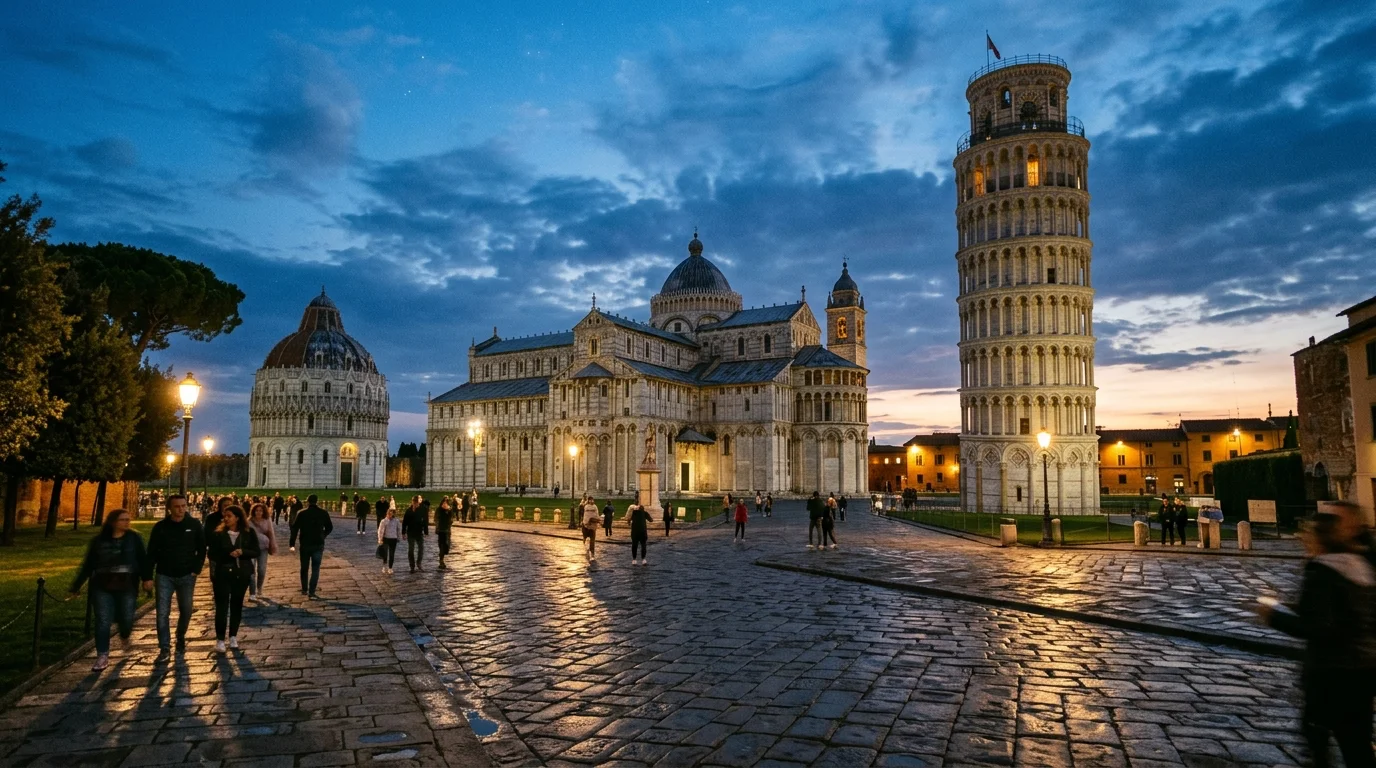
Pisa's top attractions are anchored by the incomparable Piazza dei Miracoli — home to the Leaning Tower, the Duomo, the Baptistery, and the Camposanto — but the city has far more to offer, from medieval squares and riverside promenades to fascinating museums and ancient churches.
The Leaning Tower of Pisa (Torre Pendente)
Piazza del Duomo, 56126 Pisa PI, Italy
The Leaning Tower of Pisa is the freestanding bell tower (campanile) of the Cathedral of Pisa, and one of the most recognisable structures on Earth. Construction began in 1173 and took nearly 200 years due to the tower settling into the soft ground — creating the famous tilt that was actually an engineering mistake. The tower leans at approximately 3.97 degrees following stabilisation work completed in 2001, which corrected about 18 inches of tilt while preserving the iconic lean.
The tower has eight storeys and stands 55.86 metres (183 feet) tall on its low side. Visitors can climb all 294 steps to the top for panoramic views across Pisa and the surrounding Tuscan landscape. The interior staircase is slightly dizzying — the lean is very noticeable as you climb — making it an experience unlike any other monument in the world.
Why visit: Standing at the base and looking up is genuinely awe-inspiring. Climbing to the top rewards you with beautiful views and the strange physical sensation of being inside a leaning building. It is one of those rare monuments that lives up to — and even exceeds — its reputation.
Entrance: Adults €20 (2026); children under 8 not admitted; students with ID €13
Best time: Early morning (8:00–9:30 AM) or late afternoon (5:00–7:00 PM) for fewer crowds
Hours: Daily 8:00 AM – 8:00 PM (April–September); 9:00 AM – 7:00 PM (October–March); closed on specific maintenance days
Pisa Cathedral (Duomo di Pisa / Cattedrale di Santa Maria Assunta)
Piazza del Duomo, 56126 Pisa PI, Italy
The Pisa Cathedral is a masterpiece of Romanesque architecture and, many argue, the most beautiful building in the entire Piazza dei Miracoli. Construction began in 1063 under architect Buscheto, and the result is a dazzling structure of white and grey marble with a four-tiered façade, blind arcades, and intricate carvings. The interior contains remarkable art including Giovanni Pisano's magnificent carved pulpit (1302–1311), considered one of the greatest sculptures of the medieval era.
The cathedral is enormous — 95 metres (312 feet) long — and the interior richly decorated with columns, mosaics, and artwork collected over centuries. Galileo Galilei, who was born in Pisa, allegedly studied the movement of the cathedral's bronze chandelier to develop his theory of the pendulum.
Why visit: The Duomo is genuinely one of Italy's finest churches, yet many visitors spend all their time looking at the Tower and barely step inside. The interior alone is worth at least 45 minutes of careful exploration — do not miss the Pisano pulpit.
Entrance: Free with a Piazza dei Miracoli combined ticket, or €5 standalone (2026)
Best time: Morning on weekdays to avoid tour groups
Hours: Daily 10:00 AM – 8:00 PM (summer); 10:00 AM – 7:00 PM (winter)
Pisa Baptistery (Battistero di San Giovanni)
Piazza del Duomo, 56126 Pisa PI, Italy
The Pisa Baptistery is the largest baptistery in Italy, standing 54.86 metres (180 feet) tall and 107.25 metres (352 feet) in circumference. Construction began in 1152 and took over 200 years, which explains the blend of Romanesque and Gothic styles visible on its exterior. Inside, the remarkable acoustics are famous — the circular interior creates a beautiful natural reverb that allows a single voice to produce a full chord effect.
The interior contains Nicola Pisano's pulpit (1260), often considered the earliest masterpiece of Italian Gothic sculpture and a pivotal work in the history of Western art. The baptismal font, carved by Guido Bigarelli in 1246, is also extraordinary. Staff members sometimes demonstrate the famous acoustics for visitors.
Why visit: The acoustic demonstration alone makes this a must-visit. When a guard sings a single note inside the Baptistery, the sound builds into a haunting, beautiful chord effect that visitors consistently describe as one of the most memorable moments of their entire Italy trip.
Entrance: €9 standalone; included in combined Piazza dei Miracoli ticket (2026)
Best time: Mid-morning when acoustic demonstrations are most frequent
Hours: Daily 9:00 AM – 8:00 PM (April–September); 10:00 AM – 5:00 PM (November–February)
Camposanto Monumentale (Monumental Cemetery)
Piazza del Duomo, 56126 Pisa PI, Italy
The Camposanto is one of the most atmospheric and moving sites in Pisa — a vast white marble cloister that served as a cemetery from the 13th century onward. According to legend, Archbishop Ubaldo Lanfranchi brought back soil from Golgotha (the hill of the Crucifixion in Jerusalem) after the Crusades, and this holy ground became the burial site for Pisa's most important citizens over the centuries. The cloistered courtyard contains Roman sarcophagi, medieval tomb slabs, and extraordinary frescoes.
In World War II, Allied bombing in 1944 caused the lead roof to melt and drip burning metal onto the famous 14th-century frescoes by Buonamico Buffalmacco, severely damaging them. The damaged frescoes — including the haunting "Triumph of Death" — are now displayed in a dedicated museum room and show both the original brilliance and the tragic destruction. The restoration story is fascinating in its own right.
Why visit: The Camposanto is one of the most under-visited and rewarding sites in the Piazza dei Miracoli. It is quiet, beautiful, and deeply moving — especially the WWII-damaged frescoes and the ancient Roman sarcophagi lining the cloistered walls.
Entrance: €7 standalone; included in combined ticket (2026)
Best time: Afternoon when other sites are busier
Hours: Daily 9:00 AM – 8:00 PM (summer); 10:00 AM – 5:00 PM (winter)
Piazza dei Cavalieri (Knights' Square)
Piazza dei Cavalieri, 56126 Pisa PI, Italy
Piazza dei Cavalieri is the second most important square in Pisa and was the political heart of the medieval city. Today it is dominated by the Scuola Normale Superiore — one of Italy's most prestigious universities — housed in the magnificent Palazzo della Carovana, whose facade is decorated with sgraffito panels designed by Giorgio Vasari. The square also contains the Church of Santo Stefano dei Cavalieri and the famous Palazzo dell'Orologio.
The Palazzo dell'Orologio is where, according to Dante's Inferno, Count Ugolino della Gherardesca was imprisoned and starved to death along with his sons in 1289 — one of the most chilling episodes of medieval Pisan history. The square comes alive in the evenings when university students fill the outdoor cafes and the local bars.
Why visit: This is the authentic heart of Pisa that most tourists miss entirely. The architecture is outstanding, the atmosphere is local and lively in the evenings, and it offers a perfect counterpoint to the tourist intensity of the Piazza dei Miracoli.
Entrance: Free (outdoor square)
Best time: Evening, when students gather and the square fills with local life
Hours: Always open (outdoor square)
Lungarno — Pisa's Riverfront Promenade
Lungarno Mediceo, 56127 Pisa PI, Italy
The Lungarno is Pisa's beautiful riverfront promenade running along both banks of the Arno River through the city center. The stretch between Ponte di Mezzo and Ponte della Fortezza offers some of the most beautiful urban views in Tuscany — colourful medieval palaces reflected in the Arno, elegant bridges, and a relaxed atmosphere that is pure Italy. This is where Pisans come for their evening passeggiata (the traditional Italian evening stroll).
The northern bank (Lungarno Mediceo) passes the Museo Nazionale di San Matteo and several beautiful Renaissance palaces. The southern bank (Lungarno Gambacorti) is lined with outdoor cafes, restaurants, and gelato shops. The best time to walk the Lungarno is at golden hour — the setting sun lights up the riverside palaces in extraordinary colours.
Why visit: The Lungarno is free, beautiful, and gives you the real feeling of Pisa that no tourist site can replicate. Walking both banks at sunset is one of the best free experiences in all of Tuscany.
Entrance: Free
Best time: Sunset (golden hour)
Hours: Always accessible
Museo Nazionale di San Matteo
Piazza San Matteo in Soarta, 1, 56127 Pisa PI, Italy
The Museo Nazionale di San Matteo is Pisa's finest art museum, housed in a former Benedictine convent along the Lungarno. The collection spans medieval and Renaissance art from Pisa and the surrounding region, including extraordinary works by Giovanni and Nicola Pisano, Cimabue, Masaccio, and Donatello. It is one of the most important repositories of medieval Italian art in existence and is surprisingly little-visited by tourists.
The museum's highlights include Masaccio's "Saint Paul" (1426), Simone Martini's "Polyptych" from 1320, and a magnificent collection of Pisan marble sculptures. The building itself — with its graceful Gothic cloisters — is beautiful to explore even for those with limited interest in fine art.
Why visit: This is the secret cultural gem of Pisa. While thousands of visitors crowd around the Tower, only a handful find their way to this superb museum. The collection is genuinely world-class and the lack of crowds makes for an intimate, wonderful experience.
Entrance: Adults €7; EU citizens under 18 free; students €3.50 (2026)
Best time: Weekday mornings
Hours: Tuesday–Saturday 9:00 AM – 7:00 PM; Sunday 9:00 AM – 2:00 PM; closed Monday
Palazzo Blu (Museum and Cultural Centre)
Lungarno Gambacorti, 9, 56125 Pisa PI, Italy
Palazzo Blu is Pisa's premier cultural centre and temporary exhibition space, housed in a magnificent 14th-century palace painted in a striking shade of Prussian blue on the southern Lungarno. The palazzo hosts major international art exhibitions throughout the year — past shows have featured Leonardo da Vinci, Frida Kahlo, and Impressionist masters. There is also a permanent collection showcasing Pisan art and artifacts from the 14th to 20th centuries.
The interior of the palace itself is beautifully restored, with frescoed ceilings, original period furnishings in several rooms, and views over the Arno. Even when there is no major exhibition, the permanent collection and the stunning building make it well worth a visit.
Why visit: Palazzo Blu brings world-class art to Pisa's doorstep and the setting — a Renaissance palace on the riverfront — is spectacular. Check the schedule at palazzoblu.it before your trip to see what exhibition is on during your visit.
Entrance: Varies by exhibition — typically €10–€14 for major shows (2026)
Best time: Weekday afternoons
Hours: Monday–Friday 10:00 AM – 7:00 PM; Saturday–Sunday 10:00 AM – 8:00 PM
Santa Maria della Spina
Lungarno Gambacorti, 56125 Pisa PI, Italy
Santa Maria della Spina is one of the most beautiful and distinctive small Gothic churches in all of Italy. Built in the early 14th century right on the bank of the Arno, this tiny white marble jewel box was constructed to house a thorn (spina) said to be from Christ's crown of thorns, brought back from the Holy Land. The church's exterior is encrusted with pinnacles, gabled tabernacles, and statues by the Pisano school of sculptors — it looks like a miniature Gothic cathedral.
The church was dismantled brick by brick in 1871 and reassembled slightly higher on the riverbank to protect it from flooding — an extraordinary feat of medieval preservation. Today the interior is often used for temporary art exhibitions.
Why visit: Santa Maria della Spina is one of the most photographed small buildings in Tuscany and absolutely deserves its fame. Seeing it in real life — especially from across the Arno at golden hour — is genuinely magical.
Entrance: €1.50 (2026)
Best time: Evening, photographed from across the river
Hours: Thursday–Saturday 11:00 AM – 1:30 PM and 2:30 PM – 5:00 PM; check locally as hours vary seasonally
Piazza delle Vettovaglie (Market Square)
Piazza delle Vettovaglie, 56127 Pisa PI, Italy
Piazza delle Vettovaglie is Pisa's most lively and authentic market square, located in the medieval heart of the city near the university. The covered market building dates from the early 19th century and each morning fills with fresh produce vendors, cheese sellers, butchers, and fishmongers. Around the square, small bars and trattorias cater almost exclusively to locals and university students — this is where you go for a cheap, authentic Pisan breakfast or lunch.
The square comes alive every weekday morning and is also the hub of Pisa's aperitivo hour in the early evenings, when locals gather for a spritz or Campari at outdoor tables. It is the most "un-touristy" central spot in the whole city.
Why visit: This is where real Pisa happens. The morning market buzz, the casual bars, the student crowd, and the extraordinary medieval setting make this square more enjoyable to many visitors than the tourist-heavy Piazza dei Miracoli.
Entrance: Free
Best time: Weekday mornings (market) or late afternoon (aperitivo hour)
Hours: Market: Monday–Saturday 7:00 AM – 1:30 PM
Book your tours and tickets in advance — it saves hours of queuing and often gets you a better price. These two platforms cover different options, so it's worth checking both.
What Are the Best Neighborhoods to Explore in Pisa?
Pisa's neighborhoods each have a distinct character, from the monumental grandeur of the Piazza dei Miracoli area to the bohemian student quarter and the authentic residential streets south of the Arno. Here are the best areas to explore.
Piazza dei Miracoli Area (Northside / Tourist Center)
Character: Grand, monumental, heavily visited — this is ground zero for Pisa tourism. The streets immediately around the Piazza dei Miracoli are lined with souvenir shops and tourist restaurants, but the actual square itself is breathtakingly beautiful and worth every visitor's time.
What makes it special: The concentration of medieval architecture in this small area is unmatched anywhere in Italy. Beyond the tourist shops, the area has several beautiful quiet streets and the old city walls that are perfect for walking.
Best for: First-time visitors, architecture lovers, history enthusiasts
Must-see in this area: The Leaning Tower, the Duomo, the Baptistery, the Camposanto, and the Museo delle Sinopie
How to get there: 20-minute walk from Pisa Centrale station; Bus LAM Rossa from the station
Location: Piazza del Duomo, 56126 Pisa PI, Italy
Centro Storico (Historic Center / University Quarter)
Character: Lively, youthful, authentic — the medieval heart of Pisa is dominated by the University of Pisa, one of the oldest universities in the world (founded 1343). The streets buzz with students, independent cafes, bookshops, and local bars. Architecture ranges from medieval towers to elegant Renaissance palaces.
What makes it special: The Piazza dei Cavalieri is here — Pisa's second great square and genuinely beautiful. This area feels completely different from the tourist crowds of the Tower, yet is only a 10-minute walk away. The morning market at Piazza delle Vettovaglie is the best street experience in the city.
Best for: Culture seekers, foodies, travellers wanting authentic local life
Must-see in this area: Piazza dei Cavalieri, Piazza delle Vettovaglie market, Via Santa Maria, Borgo Stretto
How to get there: 10-minute walk from Pisa Centrale or from the Tower area
Location: Piazza dei Cavalieri, 56126 Pisa PI, Italy
Lungarno (Riverfront District)
Character: Elegant, atmospheric, and undeniably romantic — the riverside district of Pisa is one of the most beautiful urban environments in Tuscany. Both banks of the Arno are lined with medieval and Renaissance palaces, cafes with outdoor seating, and lovely bridges. This is where locals come for their evening passeggiata.
What makes it special: The combination of colourful historic buildings, river reflections, Santa Maria della Spina, and Palazzo Blu makes the Lungarno one of Pisa's great unexpected pleasures. The views at golden hour are genuinely spectacular.
Best for: Couples, photographers, evening strollers, art lovers
Must-see in this area: Santa Maria della Spina, Palazzo Blu, Ponte di Mezzo, the evening light on the river
How to get there: 10-minute walk from the train station; central location easily reached from anywhere in the city
Location: Lungarno Mediceo, 56127 Pisa PI, Italy
Borgo Stretto and Via Oberdan
Character: Charming, arcaded, and local — Borgo Stretto is Pisa's main shopping street, a beautiful medieval road lined with porticoed arcades sheltering boutiques, cafes, and local businesses. It feels genuinely Italian and is largely free of tourist kitsch.
What makes it special: The medieval arches and porticos make Borgo Stretto one of the prettiest shopping streets in Tuscany. The mix of fashion boutiques, pastry shops, and traditional businesses makes for wonderful window shopping. Nearby Via Oberdan has excellent independent restaurants and wine bars.
Best for: Shoppers, foodies, those wanting authentic local street life
Must-see in this area: The arcaded walkway itself, Pasticceria Federico Salza (historic pastry shop), local boutiques
How to get there: 5-minute walk from Piazza dei Cavalieri; easy walking distance from any central location
Location: Borgo Stretto, 56127 Pisa PI, Italy
Quartiere di San Martino (South of the Arno)
Character: Quiet, residential, and genuinely local — the area south of the Arno around Via San Martino and Piazza Sant'Omobono is where Pisa's residents live their daily lives, largely untouched by tourism. Streets are narrow, laundry hangs between buildings, and small traditional trattorias serve working-class lunches to locals.
What makes it special: This is the most authentic residential neighbourhood you can explore in central Pisa. The contrast with the Tower area just across the river is striking. Some of the best value trattorias in the city are here.
Best for: Off-the-beaten-track explorers, those seeking authentic local life, budget-conscious travellers
Must-see in this area: Piazza Sant'Omobono, Mercato delle Vettovaglie, the quiet streets around Via San Martino
How to get there: 5-minute walk south from Ponte di Mezzo
Location: Via San Martino, 56125 Pisa PI, Italy
What Food Should You Try in Pisa?
Pisa is part of the Tuscany region, so the food is excellent — simple, honest, and ingredient-driven, with a strong emphasis on local produce, grilled meats, fresh pasta, and outstanding olive oil. The must-try dishes here draw from both the broader Tuscan tradition and a few distinctly Pisan specialties.
What Are the Must-Try Local Dishes in Pisa?
- Cecina (or Farinata) — Pisa's most distinctive street food: a thin, crispy pancake made from chickpea flour, olive oil, and salt, baked in a wood-fired oven. Eaten on its own or stuffed inside soft focaccia bread (called "cinque e cinque" — meaning "five and five," referring to the old price of five lire each). Find it at any local forno or bakery. Absolutely unmissable.
- Ribollita — A thick, hearty Tuscan bread soup made with cannellini beans, cavolo nero (black kale), stale bread, and vegetables. The name means "re-boiled" — it was traditionally made by reheating leftover minestrone. Rich, warming, and deeply satisfying, especially in cooler months.
- Pappa al Pomodoro — Another Tuscan classic: a thick, bread-thickened tomato soup made with ripe tomatoes, stale Tuscan bread, garlic, basil, and excellent olive oil. Simple but extraordinary when made well.
- Bistecca alla Fiorentina — Though technically from Florence, T-bone steaks from Chianina cattle are a staple across Tuscany and excellent in Pisa's better restaurants. Ordered by weight (per 100g), cooked rare, and served simply with olive oil and lemon. A carnivore's dream.
- Pici al Ragù — Pici are thick, hand-rolled spaghetti — like a fat, rustic pasta unique to Tuscany. They are served with wild boar ragù (cinghiale), classic meat ragù, or simple cacio e pepe. This is the quintessential Tuscan pasta experience.
- Crostini Toscani — The classic Tuscan antipasto: toasted bread topped with a smooth chicken liver pâté (fegatini), sometimes mixed with capers and anchovy. It sounds challenging but tastes extraordinary — earthy, rich, and deeply savoury.
- Cantucci with Vin Santo — The traditional Tuscan dessert experience: hard almond biscotti (cantucci) dipped into a small glass of sweet dessert wine (Vin Santo). Offered at the end of meals in virtually every restaurant.
- Gelato Artigianale — Pisa has several excellent artisan gelato makers. Look for shops where the gelato is stored in covered metal containers rather than piled high in fluorescent mounds — the covered storage indicates authentic, preservative-free gelato made fresh daily.
Where Should You Eat in Pisa?
Budget-Friendly (Under €15 per meal)
- Pizzeria Il Montino — Vicolo del Monte, 1, 56126 Pisa PI. A beloved local institution serving cecina and pizza al taglio (by the slice) to generations of Pisan students. Cash only, no tourists, incredibly cheap and delicious. The cecina here is considered the best in the city.
- Trattoria Da Matteo — Via l'Arancio, 46, 56127 Pisa PI. A no-frills family trattoria in the university quarter serving Tuscan classics to local workers and students at lunch. The ribollita and daily pasta are outstanding for the price (€9–€13 for a full meal).
- Mercato delle Vettovaglie Food Stalls — Piazza delle Vettovaglie, 56127 Pisa PI. The market's surrounding bars and small food stalls serve cheap panini, cecina, and the Pisan "cinque e cinque" sandwich. This is the authentic local breakfast and lunch spot.
Mid-Range (€20–€40 per meal)
- Osteria dei Cavalieri — Via San Frediano, 16, 56126 Pisa PI. One of Pisa's most consistently recommended restaurants, serving traditional Tuscan food with excellent local wines in a warm, rustic setting. Excellent pici al ragù and the local fish dishes. Book ahead for dinner.
- Ristorante Beny — Via Santa Cecilia, 26, 56127 Pisa PI. A reliable mid-range option in the city center serving classic Tuscan dishes with good quality ingredients. Friendly service and a genuine local clientele make it a pleasure.
- La Grotta — Via Santa Cecilia, 46, 56127 Pisa PI. A well-regarded family restaurant with vaulted ceilings and a menu focusing on fresh pasta, Tuscan grilled meats, and seasonal vegetables. Good value for the quality.
- Ristorante Galileo — Via Santa Maria, 26, 56126 Pisa PI. Located near the Tower area, this is one of the few genuinely good restaurants in the tourist zone. Tuscan classics executed well, with a pleasant terrace.
Fine Dining (€60+ per meal)
- Ristorante V. Baldovino — Largo Chiara Gambacorti, 56125 Pisa PI. Pisa's most elegant dining option with creative takes on Tuscan ingredients and a refined atmosphere on the Lungarno. Reservations essential, smart casual dress.
- Il Campano — Via Cavalca, 19, 56127 Pisa PI. A historic Pisan restaurant with a beautiful medieval interior, excellent wine list, and sophisticated Tuscan cooking. One of the city's most atmospheric dining rooms.
What Are the Dining Customs in Pisa?
Meal times: Italians eat lunch between 12:30–2:00 PM and dinner from 7:30–9:30 PM. Restaurants outside tourist areas often do not open for dinner before 7:30 PM. Eating at 6:00 PM will mark you immediately as a tourist.
Tipping: Tipping is not obligatory in Italy and locals rarely tip more than rounding up the bill. A 10% tip for excellent service is generous and genuinely appreciated. Check if a coperto (cover charge, typically €1.50–€3 per person) has been added — this is standard and not a scam.
Reservations: Required for most mid-range and all fine dining restaurants, especially on weekends. Book via phone or email at least 24–48 hours ahead. Many restaurants close between 2:30–7:30 PM.
Dress code: Smart casual for mid-range restaurants; no shorts or flip flops for fine dining. Jeans are acceptable almost everywhere except the most formal establishments.
What Is the Nightlife Like in Pisa?
Pisa's nightlife is shaped by its large student population — lively, affordable, and spread across the university quarter rather than in a single dedicated district. Bars fill up from around 7:00 PM for aperitivo hour, and the city stays active until midnight on weekdays and 2:00–3:00 AM on weekends.
Where Are the Best Areas for Nightlife in Pisa?
- Piazza delle Vettovaglie and surroundings: Via delle Belle Torri, 56127 Pisa PI — The most concentrated nightlife zone in the city, particularly popular with students. Dozens of bars and wine bars on and around the market square come alive from aperitivo hour onward. Casual, cheap, and very local in feel.
- Borgo Stretto and Via Oberdan: Borgo Stretto, 56127 Pisa PI — The elegant arcaded street and its surroundings have wine bars and cocktail bars that attract a slightly older, more sophisticated crowd. Good for a stylish evening drink.
- Lungarno (Riverside): Lungarno Gambacorti, 56125 Pisa PI — Several bars with outdoor seating on the southern bank of the Arno are beautiful for warm-evening drinks with views of the illuminated riverside palaces and Santa Maria della Spina.
What Are the Best Bars and Clubs in Pisa?
Bars & Wine Bars
- Bazeel — Lungarno Pacinotti, 1, 56126 Pisa PI — A stylish bar right on the northern Lungarno with an excellent aperitivo buffet. Very popular with young professionals and students. Outdoor terrace with river views is spectacular in summer.
- Sottobosco — Via delle Belle Torri, 10, 56127 Pisa PI — A charming natural wine bar in the university quarter with an excellent selection of Tuscan and Italian natural wines, craft beers, and aperitivo snacks. Intimate and genuinely lovely.
- Keith Bar — Piazza Cavalca, 11, 56127 Pisa PI — One of the most beloved student bars in Pisa, near Piazza delle Vettovaglie, with cheap drinks, a relaxed atmosphere, and a loyal local following.
Clubs & Dancing
- Borderline Club — Via Vernagalli, 2, 56125 Pisa PI — Pisa's best-known live music and DJ venue. A converted space hosting indie, electronic, and alternative music nights. Cover charge typically €5–€10. Busiest on Friday and Saturday nights from midnight onwards.
- Nautilus Club — Near the Marina di Pisa area (seasonal, summer only) — Pisa's beach club and disco scene is mostly located along the Versilia coast, 15 minutes by car from the city. In summer, locals head to the Lido di Camaiore and Forte dei Marmi beach clubs for dancing.
Live Music & Shows
- Teatro Verdi — Via Palestro, 40, 56127 Pisa PI — Pisa's beautiful main theatre hosts opera, classical concerts, and ballet throughout the season (October–May). A magnificent 19th-century interior. Tickets from €15–€60 depending on performance. Book at teatrodipisa.it.
- Lumiq Studios — Various Pisan venues — An arts collective that organises jazz, world music, and electronic performances in various city venues. Check the programme at lumiqstudios.it for current listings.
What Family-Friendly Evening Entertainment Is Available?
Pisa is very family-friendly in the evenings. The Lungarno promenade is perfect for an evening stroll with children, gelaterias are open until 10:00–11:00 PM, and the Piazza dei Miracoli is beautifully illuminated at night for a magical after-dinner walk. The Torre di Pisa is lit at night and is even more photogenic in the dark.
What and Where Should You Shop in Pisa?
The best things to buy in Pisa are Tuscan food products (olive oil, wine, truffles, biscuits), artisan crafts, and leather goods. The top shopping areas are Borgo Stretto, Via Oberdan, and the covered Piazza delle Vettovaglie market.
What Are the Best Shopping Districts in Pisa?
- Borgo Stretto: Borgo Stretto, 56127 Pisa PI — The main shopping street with its beautiful medieval arcades. Mix of Italian fashion boutiques, shoe shops, jewellers, and cafes. More upscale and elegant than the tourist souvenir shops near the Tower.
- Via Oberdan and Via Santa Maria: Via Oberdan, 56127 Pisa PI — Local clothing shops, independent bookstores, and food specialty shops. A good mix of everyday Italian shopping and interesting independent stores.
- Near Piazza dei Miracoli (tourist shopping): Via Santa Maria, 56126 Pisa PI — Wall-to-wall souvenir shops selling Leaning Tower replicas in every size imaginable. Most products are mass-produced, but you will find a few good-quality ceramic and olive wood shops if you look carefully.
What Markets Should You Visit in Pisa?
Mercato di Piazza delle Vettovaglie — Piazza delle Vettovaglie, 56127 Pisa PI — Monday to Saturday mornings, 7:00 AM – 1:30 PM. The covered morning market sells fresh local produce, cheese, salumi, bread, fish, and flowers. This is the beating culinary heart of the city. No bargaining expected — prices are clearly marked and very fair.
Mercato dell'Antiquariato (Antiques Market) — Piazza delle Vettovaglie and surrounding streets — Second Sunday of each month. Antiques, vintage items, books, coins, prints, and curiosities from vendors across Tuscany. A wonderful browse even if you do not plan to buy.
Saturday Market (Porta a Mare area) — Via Cesare Battisti, 56125 Pisa PI — Every Saturday morning, a large general market with clothing, household items, and street food stretches along this area south of the Arno. Very local, very cheap, and entertaining.
What Should You Buy in Pisa?
- Extra Virgin Olive Oil — Tuscany produces some of Italy's finest olive oil. Buy it from specialist food shops or the market rather than tourist shops. Look for "DOP Toscano" on the label. A good 500ml bottle costs €12–€20.
- Vin Santo — Tuscany's beloved sweet dessert wine. A perfect gift that travels well. Buy from enoteche (wine shops) for €15–€35 per bottle of quality Vin Santo.
- Cantucci Biscotti — Tuscan almond biscotti in beautiful gift tins. Available everywhere, but best quality from established pastry shops rather than tourist shops. Federico Salza on Borgo Stretto is the most historic option.
- Truffles and Truffle Products — Tuscany is truffle country. Truffle salt, truffle oil, and jarred truffle paste make excellent gifts. Quality varies enormously — buy from specialist food shops, not tourist stores.
- Ceramics — Tuscan ceramics in traditional white and blue patterns make beautiful souvenirs. Look for items made in nearby Montelupo Fiorentino or Deruta for the best quality.
- Leaning Tower Replicas — Yes, they are kitschy, but a well-made resin or marble replica can be a genuinely nice keepsake. Avoid the cheapest plastic versions and look for heavier, better-quality models from shops with more curated stock.
What Are the Shopping Hours and Customs?
Most shops in Pisa open Monday–Saturday 9:30 AM – 1:00 PM and 3:30 PM – 7:30 PM. Many still close for the traditional afternoon riposo (rest). Larger stores and those in tourist areas often stay open continuously. Sunday shopping is limited — most local shops are closed, though tourist-zone shops and some supermarkets open. Bargaining is not customary in shops; it is acceptable at markets.
Can Non-EU Visitors Claim a VAT Tax Refund in Pisa?
Yes — if you are a visitor from outside the European Union (including travellers from the USA, Canada, Australia, the UK, and most of Asia and Latin America), you are entitled to a refund of the VAT (Value Added Tax) included in the price of goods you buy in Italy. VAT in Italy is 22% on most goods; 10% on some food items, which means this refund can be significant on high-value purchases like clothing, leather goods, jewellery, designer fashion, and electronics.
How to Claim Your VAT Refund — Step by Step
- Spend at least €154.94 in a single shop in a single day. This is the minimum threshold for a VAT refund claim in Italy. It does not apply across multiple shops — the full amount must be spent in one store.
- Look for the "Tax Free" sign. Participating shops display a "Tax Free Shopping," "Global Blue," or "Planet" logo in the window or at the register.
- Ask for the tax refund form at the register before you pay. Present your non-EU passport — the shop will fill out the form with your details and the purchase amount. Keep the form with your receipt.
- Get the form stamped at customs before you leave. Go to the Customs office at Pisa Galileo Galilei Airport (PSA) before check-in and have an officer stamp your tax refund form. Keep your purchases accessible in hand luggage — do not pack them deep in your checked bags.
- Collect your refund. Hand the stamped form to the Global Blue or Planet desk at the airport. You can receive the refund in cash (minus a processing fee) or as a credit card refund (lower fees, takes a few weeks).
VAT Refund Quick Facts for Pisa
- Minimum spend: €154.94 in one shop in one day
- VAT rate on most goods: 22% on most goods; 10% on some food items
- Typical refund after fees: 10–15% of the purchase price
- Refund processors: Global Blue and Planet (formerly Premier Tax Free) at Pisa Galileo Galilei Airport (PSA)
- Who qualifies: Anyone with a non-EU passport who is not a resident of an EU country
- UK visitors: British passport holders qualify since Brexit — the UK is no longer in the EU
- Deadline: Purchases must be exported within 3 months of the date of purchase
- Full guide: VAT Refund in Europe — Complete Guide for Non-EU Travelers
What Festivals and Events Happen in Pisa?
Pisa's biggest festival is the Luminara and Gioco del Ponte in June — a spectacular nighttime event that is one of the most beautiful celebrations in all of Italy. The city also maintains a rich calendar of cultural events, markets, and traditional celebrations throughout the year.
What Is the Annual Events Calendar for Pisa?
| Month | Event Name | Description |
|---|---|---|
| January | Epiphany (La Befana) | January 6th is the Italian gift-giving holiday. Pisa celebrates with special events, sweet shops selling traditional candy, and a relaxed local atmosphere as Christmas decorations come down. |
| February | Carnevale Pisano | Pisa's small but charming pre-Lent carnival with a children's parade through the historic center, colourful costumes, and traditional sweets. Less famous than Viareggio's nearby carnival but genuine and local. |
| March | Capodanno Pisano (Pisan New Year) | March 25th — Pisa celebrates its own historical New Year, which used to be the start of the year in the old Pisan calendar. Street events, historical costume processions, and special restaurant menus mark the day. |
| April | Easter Celebrations | Holy Week processions through the medieval center, special church services in the Duomo, and traditional Tuscan Easter foods (colomba cake, hard-boiled eggs). The city is particularly beautiful decorated for Easter. |
| May | Pisa Book Festival | A growing literary festival held across various city venues celebrating Italian and international literature. Author talks, book signings, and readings in beautiful historic settings. |
| June | Luminara di San Ranieri & Gioco del Ponte | THE great event of the Pisan year — June 16th sees the entire city illuminated by thousands of candles placed on every building along the Arno, creating a magical reflection in the river. June 17th brings the Gioco del Ponte — a spectacular medieval battle on the Ponte di Mezzo between two teams of costumed knights. Not to be missed. |
| July | Pisa Jazz Festival | International jazz artists perform in outdoor venues across the city throughout July. Free and ticketed events in beautiful historic settings including the cloisters of the Camposanto. |
| August | Ferragosto Events | August 15th (Ferragosto) is a national holiday. Pisa has special outdoor events, but be aware that many local businesses close for 1–2 weeks around mid-August as Italians take their summer holidays. |
| September | Pisa Fair (Fiera di San Sisto) | A traditional fair in mid-September with food stalls, crafts, and entertainment. One of the oldest fairs in Tuscany, celebrating the city's patron saint. |
| October | Toscana in Bocca Food Festival | A celebration of Tuscan food and wine with tastings, cooking demonstrations, producer markets, and special restaurant menus throughout the city. Excellent for food lovers. |
| November | All Saints & Autumn Cultural Season | November marks the opening of Pisa's winter cultural season — the Teatro Verdi programme begins, museums have new exhibitions, and the city takes on a quieter, more intimate character. |
| December | Christmas Markets and Nativity | Pisa sets up Christmas markets in Piazza dei Cavalieri and other squares, with crafts, seasonal food, and mulled wine. The live nativity scene in the Piazza dei Miracoli is a beloved tradition attracting locals and visitors alike. |
How Do Festivals Affect Hotel Prices and Availability?
The Luminara di San Ranieri (June 16–17) is the single biggest event that affects accommodation. Hotels within walking distance of the Arno fill up months in advance, and prices can double or triple. Book at least 3–4 months ahead if you want to attend this event. Other major dates to book early include Easter weekend, August, and the Christmas market period (late November–early January).
Where Should You Stay in Pisa?
The best neighborhood to stay in Pisa depends on your travel style. The historic center near Piazza dei Cavalieri offers the most authentic experience; the Lungarno area is the most romantic; and the area near the train station is the most convenient for transport connections.
What Are the Best Neighborhoods to Stay in Pisa?
| Neighborhood | Vibe | Price Range/Night (2026) | Best For |
|---|---|---|---|
| Near Piazza dei Miracoli | Monumental, touristy | €80–€200 | First-timers, convenience to Tower |
| Historic Center (university area) | Local, lively, authentic | €60–€160 | Culture seekers, foodies, young travellers |
| Lungarno (Riverfront) | Romantic, elegant | €90–€250 | Couples, special occasions |
| Near Pisa Centrale Station | Practical, busy | €50–€130 | Budget travellers, transit visitors |
| South of the Arno | Local, quiet, residential | €45–€100 | Authentic local experience, budget |
What Are the Pros and Cons of Each Area?
Near Piazza dei Miracoli:
Pros: Walk to the Tower in minutes; wake up to one of the world's great views; most concentrated historic sights within reach on foot.
Cons: Extremely touristy daytime atmosphere; restaurants nearby are poor value; quieter (almost deserted) after 7 PM when day-trippers leave.
Historic Center / University Quarter:
Pros: Most authentic local atmosphere; best restaurants and bars; buzzing student nightlife; central and walkable to everything.
Cons: Can be noisy on weekend nights due to the student bar scene around Piazza delle Vettovaglie.
Lungarno / Riverside:
Pros: Beautiful views; romantic atmosphere; excellent bars and restaurants on the river; central location.
Cons: Can be expensive; some traffic noise from the riverside roads.
How Far in Advance Should You Book in Pisa?
For travel in June (Luminara period), Easter, August, and major holiday weekends, book at least 3–4 months in advance. For shoulder season (April–May and September–October), 4–6 weeks ahead is generally sufficient. In winter, you can often book a week or less ahead and find excellent rates. Always check the cancellation policy carefully — flexible cancellation is worth a small premium in case plans change.
What Do You Need to Know Before Visiting Pisa?
Here are the essential practical details every visitor to Pisa needs to know — from money and language to safety, health, and cultural customs.
Essential Travel Details for Pisa
- Currency: Euro (€). Exchange at banks or use ATMs for the best rates. Avoid airport and hotel exchange desks.
- Credit Cards: Widely accepted at hotels, restaurants, and most shops. Some small trattorias and market vendors are cash only — always carry some euros.
- ATMs (Bancomat): Widely available throughout the city center. Use bank-branded ATMs rather than private exchange-machine ATMs to avoid high fees. Daily withdrawal limits typically €250–€500.
- Language: Italian. English is widely spoken in tourist areas, hotels, and by university students. Basic Italian phrases are warmly appreciated.
- Tipping: Not obligatory. Round up the bill or leave 5–10% for good service. Coperto (cover charge) of €1.50–€3 per person is normal and expected at sit-down restaurants.
- Electrical Plugs: Type F (European two-pin round). Voltage: 230V. US visitors need an adaptor and possibly a voltage converter.
- Emergency Number: 112 (all emergencies — police, ambulance, fire)
- Tourist Police: 055 203 911 (Tuscany region tourist police line)
- SIM Cards: Available at airport, train station, and phone shops (TIM, Vodafone, WindTre). A tourist SIM with 10–15GB data costs approximately €15–€20 for 30 days. You need your passport to register.
- WiFi: Good quality free WiFi available at most hotels, cafes, and restaurants. The city has some public WiFi in tourist areas.
- Tap Water: Safe and good to drink throughout Pisa and Tuscany. Public water fountains (fontanelle) around the city offer free fresh water — look for them and use them.
Skip the airport queue — order your eSIM before you travel and activate it the moment you land. Prices and data allowances vary, so it pays to compare providers.
How Much Does It Cost to Visit Pisa?
| Budget Type | Daily Cost (2026) | What's Included |
|---|---|---|
| Budget Traveller | €60–€90 per day | Hostel/budget B&B, street food and market lunches, local buses, free sights and one paid attraction |
| Mid-Range Traveller | €100–€180 per day | 3-star hotel or good B&B, mix of trattorias and markets, taxis occasionally, 2–3 paid attractions |
| Luxury Traveller | €200–€400+ per day | 4-5 star hotel, fine dining, private transport, guided tours, full Piazza dei Miracoli ticket, day trips |
What Are the Most Useful Phrases in Pisa?
- Hello / Good morning: Ciao (informal) / Buongiorno (formal)
- Thank you: Grazie
- Please: Per favore
- Excuse me: Scusi (formal) / Scusa (informal)
- How much?: Quanto costa?
- Where is...?: Dov'è...?
- I don't understand: Non capisco
- Help!: Aiuto!
- Bathroom: Il bagno
- Check, please: Il conto, per favore
Is Pisa Safe for Tourists?
Yes — Pisa is generally a very safe city for tourists. Violent crime is rare and the city is well-policed, particularly in tourist areas. The main risks are petty theft and pickpocketing, particularly in crowded tourist spots and on public transport.
Areas to avoid: The areas around Pisa Centrale station late at night can feel less safe, as can some streets east of the center after midnight. These are not genuinely dangerous, but normal urban caution applies.
Common scams: (1) The "friendship bracelet" scam — someone ties a bracelet on your wrist, then demands money. Firmly say "no" and walk away. (2) Overpriced taxis from unlicensed drivers near the Tower. Always use white official taxis. (3) Restaurants that do not display prices outside — always check the menu with prices before sitting down. (4) "Charity collection" approaches on the street, where someone asks you to sign a petition and then pressures you for money.
Pickpocketing: Most common in the crowded area around the Leaning Tower, on busy buses, and in the market. Use a money belt or keep valuables in a front pocket. Do not leave bags on restaurant chairs.
Solo traveller safety: Pisa is excellent for solo travellers of all genders. The student population and compact, walkable city make it easy and safe to explore independently. LGBTQ+ travellers will find Pisa tolerant and welcoming — Italy has become significantly more open in recent years, and university cities in particular are relaxed and accepting.
What Are the Cultural Customs in Pisa?
- Greetings: Italians greet with a firm handshake for new acquaintances; friends exchange air-kisses on both cheeks. "Buongiorno" (good morning/day) is used until around 4 PM, then "Buonasera" (good evening).
- Dress code: Smart casual is the norm for restaurants. For churches — including the Duomo — shoulders and knees must be covered. Carry a scarf or light layer for impromptu church visits. Shorts are fine everywhere outdoors.
- Photography: Photography is permitted in most outdoor sites. Inside the Duomo, photography without flash is permitted but tripods are not. Always ask before photographing people at the market.
- Public behavior: Italians are warm but not boisterous in public. Keep voices moderate in restaurants and churches. Locals queue patiently — do the same.
- Dining: Do not ask for substitutions or modifications to dishes in traditional trattorias — it is considered rude. Cappuccino is a morning drink only; ordering one after a meal will raise eyebrows. Espresso is the correct post-meal coffee.
- Gestures to avoid: The "thumbs up" is generally positive in Italy, but be aware that some traditional gestures differ from the UK or US. Avoid pointing directly at people.
Do You Need a Visa to Visit Pisa?
Citizens of EU member states, the USA, Canada, Australia, New Zealand, the UK, and most Western nations do not need a visa for stays under 90 days in Italy. Italy is part of the Schengen Area — the 90-day limit applies across all Schengen countries combined in any 180-day period. From 2025, visitors from visa-exempt countries need to register via the ETIAS (European Travel Information and Authorisation System) online before travel — check the latest requirements at ec.europa.eu/home-affairs/etias.
What Health Precautions Should You Take in Pisa?
Vaccinations: No specific vaccinations are required for Italy. Standard up-to-date routine vaccinations (MMR, tetanus) are recommended. Italy has excellent public health standards.
Pharmacies (Farmacie): Pharmacies are widespread — look for the green cross sign. Many are open 8:30 AM – 12:30 PM and 3:30 PM – 7:30 PM on weekdays. Pharmacies display night/weekend duty schedules on their doors for emergency access.
Hospitals: Azienda Ospedaliero-Universitaria Pisana (AOUP), Via Paradisa, 2, 56124 Pisa — Pisa's main public hospital with a 24-hour emergency room. EU citizens with a valid EHIC/GHIC card receive treatment on the same terms as Italian citizens. Non-EU visitors are strongly advised to take out comprehensive travel insurance.
Common health issues: Tap water is safe everywhere. In summer, heat exhaustion is a real risk — drink plenty of water, use sun protection, and rest during the hottest part of the day (1–4 PM). Mosquitoes can be present near the river in summer — pack repellent for evening outdoor dining.
Do You Need Travel Insurance for Pisa?
Yes — and you should buy it before you board your flight, not after. Travel insurance covers the situations that can turn a great trip into a financial disaster: a medical emergency (a single ambulance ride and hospital stay in Europe can cost €3,000–€10,000 without coverage), a cancelled or delayed flight, lost or stolen baggage, or a last-minute trip cancellation. EU citizens with an EHIC or GHIC card receive reciprocal state healthcare, but this does not cover repatriation, trip cancellation, or lost luggage — a full travel policy fills those gaps. Non-EU travellers have no state coverage at all and should never visit without insurance.
Choosing the right policy matters — coverage limits, exclusions, and pre-existing condition terms vary significantly between providers. Read our full guide before you buy: Best Travel Insurance for Europe — Honest Comparison for 2026.
Travel insurance is strongly recommended for Pisa — an unexpected medical bill, flight cancellation, or lost luggage can cost far more than the policy. Get covered before you go.
What Are Your Rights If Your Flight to Pisa Is Delayed or Cancelled?
Under EU Regulation 261/2004, if your flight to or from Pisa is delayed by more than 3 hours or cancelled without sufficient notice, you are entitled to compensation of up to €600 per passenger — regardless of which airline you flew with, and regardless of how long ago it happened (claims can go back up to 6 years in some countries). This applies to all flights departing from an EU airport, and all flights arriving into an EU airport on an EU-based carrier. Most travellers don't realise they are owed money, and airlines rarely volunteer to pay. A claims service handles everything on your behalf and only charges a fee if they win — so there is no risk to you.
Both services check your eligibility for free with no upfront cost — they only charge a commission if they successfully recover your compensation.
Is Pisa Accessible for People with Disabilities?
Pisa's historic center has some accessibility challenges — uneven cobblestone streets, steps into churches and museums, and limited dropped curbs in older areas. However, the main tourist sites (Piazza dei Miracoli, the Duomo, the Camposanto) all have accessible entrances. The Leaning Tower interior is not accessible due to the spiral staircase, but the ground-level exterior is fully accessible. The PisaMover shuttle from the airport to the station is wheelchair accessible, and most buses have wheelchair ramps.
Is Pisa Good for Families with Kids?
Pisa is an excellent family destination. The flat terrain, compact walkable center, and iconic landmarks that children love (particularly the Tower with its extraordinary tilt) make it very manageable with younger visitors. Note that children under 8 cannot climb the Tower for safety reasons. The green lawns of the Piazza dei Miracoli are perfect for letting young children run around. Gelaterias are everywhere. The Lungarno promenade is wide, flat, and safe for pushchairs.
What Are the Best Day Trips from Pisa?
The best day trips from Pisa include the walled city of Lucca (20 minutes away), Florence (1 hour), the dramatic villages of the Cinque Terre (1.5 hours), and the medieval hills of San Miniato and Volterra. Pisa's excellent rail connections and proximity to major Tuscan attractions make it one of the best bases in the region.
Lucca
Distance: 22 km / 14 miles; 30 minutes by train (€4–€6 each way)
What to see: Lucca is one of the most enchanting cities in Italy — a perfectly preserved medieval walled city with intact Renaissance ramparts you can walk or cycle on top of. Inside the walls, the city has beautiful medieval towers, the stunning Piazza dell'Anfiteatro (built on a Roman amphitheatre), the Cathedral of San Martino, and dozens of wonderful independent shops and restaurants. It is quieter and less touristy than Florence while being arguably just as beautiful.
How to get there: Direct trains from Pisa Centrale every 30 minutes. Also reachable by regional bus from Piazza Sant'Antonio, Pisa.
Time needed: Full day (but a half day is sufficient for a taste)
Best for: Everyone — particularly couples, cyclists, history lovers, and families
Location: Piazza Napoleone, 55100 Lucca LU, Italy
Florence (Firenze)
Distance: 80 km / 50 miles; 50–75 minutes by fast train (€9–€18 each way)
What to see: Florence is the capital of Tuscany and one of the greatest art cities in the world — home to Michelangelo's David, Botticelli's Birth of Venus, the Uffizi Gallery, the Duomo and Brunelleschi's dome, the Ponte Vecchio, and extraordinary Renaissance architecture at every turn. A day trip only scratches the surface, so choose 2–3 priorities and book tickets well in advance.
How to get there: Frequent fast trains from Pisa Centrale (Italo and Trenitalia). The train is by far the most convenient option — Florence's city centre is walkable from Santa Maria Novella station.
Time needed: Full day; consider an overnight if seeing multiple museums
Best for: Art lovers, culture seekers, first-time Italy visitors
Location: Piazza della Repubblica, 50123 Firenze FI, Italy
Cinque Terre
Distance: 100 km / 62 miles; approximately 1.5–2 hours by train (€20–€30 return with Cinque Terre Card)
What to see: Five spectacularly colourful fishing villages (Monterosso, Vernazza, Corniglia, Manarola, and Riomaggiore) clinging to dramatic clifftops above the Ligurian Sea. Hike the coastal trails between villages, swim in clear water, eat fresh seafood and pesto pasta, and take in views that genuinely look like a painting. UNESCO World Heritage Site.
How to get there: Train from Pisa Centrale toward La Spezia, then local Cinque Terre trains between villages. Buy a Cinque Terre Card (€18–€29 for 2 days) for unlimited train travel and trail access.
Time needed: Full day; an overnight in one of the villages is highly recommended
Best for: Hikers, beach lovers, photographers, couples
Location: Via Roma, 19016 Monterosso al Mare SP, Italy
San Miniato
Distance: 35 km / 22 miles; 20–35 minutes by train (€4–€6 each way)
What to see: San Miniato is a beautiful medieval hilltop town overlooking the Arno valley, famous for its white truffles (tartufo bianco) — some of the most prized in the world. The town has a remarkable Norman tower, a beautiful cathedral, and wonderful views across Tuscany. The truffle festival in November is one of Tuscany's great food events.
How to get there: Train from Pisa Centrale to San Miniato-Fucecchio station, then local bus or taxi (4 km) up the hill to the town. Also reachable by car in about 30 minutes.
Time needed: Half day to full day
Best for: Foodies, truffle lovers, Tuscany landscape enthusiasts
Location: Piazza del Popolo, 56028 San Miniato PI, Italy
Volterra
Distance: 50 km / 31 miles; approximately 1.5 hours by bus (€6–€8 each way via CPT bus from Pisa)
What to see: One of Tuscany's most dramatically situated medieval cities, perched on a high plateau above deep ravines. Volterra was an important Etruscan city and its Museo Etrusco Guarnacci holds one of the finest collections of Etruscan artifacts in Italy. The intact medieval walls, the beautiful Piazza dei Priori, alabaster workshops, and extraordinary scenery make it one of Tuscany's most rewarding smaller towns.
How to get there: CPT bus from Pisa to Volterra (change at Pontedera). Having a car makes the trip much easier. Alternatively, book a guided day tour from Pisa.
Time needed: Full day
Best for: History enthusiasts, archaeology lovers, travellers seeking an off-the-beaten-path Tuscan experience
Location: Piazza dei Priori, 56048 Volterra PI, Italy
Car rental prices vary significantly between agencies — the same car on the same date can differ by 30–50% depending on where you book. Always compare before confirming.
What Are the Hidden Gems and Insider Tips for Pisa?
Beyond the main tourist sites, Pisa hides some incredible spots that most visitors never find — from rooftop viewpoints to secret courtyards, atmospheric local bars, and experiences that reveal the real character of this ancient Tuscan city.
What Are the Best Hidden Gems in Pisa?
- Orto Botanico dell'Università di Pisa: Via Luca Ghini, 13, 56126 Pisa PI — One of the oldest botanical gardens in the world (founded 1543), hidden behind a wall near the university. Beautiful, tranquil, and almost completely tourist-free. A wonderful escape from the crowds. Entrance is just €3.
- The Walls of Pisa (Le Mura di Pisa): Via delle Mura, 56122 Pisa PI — Pisa's massive medieval city walls, built from the 12th to 14th centuries, offer a free walking path along their upper ramparts on the northern side of the city. Extraordinary views of rooftops, the Tower, and the surrounding countryside. Almost no tourists come here.
- Piazza Dante and the "Borgo Largo" area: Piazza Dante Alighieri, 56126 Pisa PI — A quiet medieval piazza and the streets around Via Ulisse Dini offer some of the most photogenic and untouristy medieval streetscapes in the city. Locals drink coffee at the bar on the corner as if no one else has ever discovered their secret.
- The old Jewish Ghetto (Via delle Mura Antiche area): Via del Campuccio, 56126 Pisa PI — Pisa had a flourishing Jewish community and the historic ghetto area near the city walls retains a quiet, ancient atmosphere with beautiful arched streets and old inscriptions.
- Museo delle Sinopie: Piazza del Duomo, 56126 Pisa PI — An undervisited museum directly opposite the Baptistery containing the original preparatory sketches (sinopie) for the Camposanto frescoes. Remarkably moving to see these medieval master drawings revealed beneath the destroyed frescoes. Quiet, uncrowded, and genuinely fascinating.
- Chiesa di San Paolo all'Orto: Via San Zeno, 56127 Pisa PI — A beautiful small Romanesque church in the university quarter that is rarely open but worth seeking out when it is. The exterior's blind arcading and the quiet piazza in front are quintessentially Pisan.
- Arno at Dawn: Ponte di Mezzo, 56127 Pisa PI — Walk to the Ponte di Mezzo bridge at sunrise for a completely different Pisa. The city is silent, the river mist hangs in the air, and the riverside palaces glow in early morning light. No tourists, just the occasional Pisan jogging past. Truly magical.
Where Are the Best Photo Spots in Pisa?
- South-west lawn of Piazza dei Miracoli: Piazza del Duomo, 56126 Pisa PI — The classic perspective for Leaning Tower photos. Best at sunrise (7:00 AM in summer) when the light is warm and the square is empty. The full width of the lawn, about 50 metres back, gives the best depth for people-holding-up-the-Tower shots.
- Ponte di Mezzo at golden hour: Ponte di Mezzo, 56127 Pisa PI — The most photogenic bridge in Pisa gives a sweeping view up and down the Arno, with the coloured riverfront palaces on both sides. The 30 minutes before sunset produces extraordinary warm light on the facades.
- Santa Maria della Spina from the north bank: Lungarno Mediceo, 56127 Pisa PI — Cross to the northern bank of the Arno and photograph the tiny Gothic church from across the river. The reflection in the water doubles the beauty. Best in early morning or at golden hour.
- Piazza dei Cavalieri at night: Piazza dei Cavalieri, 56126 Pisa PI — The square illuminated at night, with the Palazzo della Carovana's sgraffito facade lit beautifully, is one of the least-photographed but most dramatic night scenes in Pisa.
- Inside the Baptistery looking up: Piazza del Duomo, 56126 Pisa PI — The circular interior and the ornate dome seen from directly below create a stunning architectural photograph. Come at mid-morning when light enters from the upper windows.
What Do Locals Know That Tourists Don't?
How Can You Save Money in Pisa?
The biggest way to save money in Pisa is to eat where locals eat rather than in tourist restaurants near the Tower — you will pay 30–50% less for dramatically better food. Pisa is already one of Italy's more affordable cities, and a few smart choices make it genuinely budget-friendly.
What Are the Best Money-Saving Strategies for Pisa?
- Buy a combined ticket (Opera del Duomo ticket) for the Piazza dei Miracoli sites — combining the Tower, Duomo, Baptistery, Camposanto, and Museo delle Sinopie saves significantly over individual entry prices. Check opapisa.it for current packages.
- Eat the menù del giorno (daily set menu) at local trattorias for lunch — typically €12–€18 for a full two-course meal with bread and water, which is extraordinary value for Tuscan cooking.
- Buy your bus tickets from tabacchi shops before boarding — buying on the bus (where possible) costs more, and not having a valid ticket risks a €50+ fine.
- Use the free public water fountains (fontanelle) around Pisa rather than buying bottled water. The tap water is excellent and completely safe to drink.
- Visit the Piazza dei Miracoli early morning (before 9:00 AM) or evening (after 7:00 PM) — it is free to enter the square itself and walk around the exterior of all monuments. Only interior access and the Tower climb require tickets.
- Stay in the historic center or near the station rather than directly next to the Tower — accommodation is 20–40% cheaper and you are still only a 10–15 minute walk from everything.
- Take advantage of aperitivo hour (6:30–8:30 PM) at bars that include a free buffet with your drink purchase — effectively getting a light meal for the price of one drink (€6–€8).
- Visit museums on the first Sunday of the month — Italian state museums are free of charge on the first Sunday of each month under the Domenica al Museo initiative.
- Walk everywhere in the historic center — Pisa is compact and flat, and almost everything of interest is within a 20-minute walk, making taxi costs largely unnecessary.
- Shop for food souvenirs at Conad or Esselunga supermarkets rather than tourist shops — the same olive oil, wine, and biscotti cost 30–60% less.
- Book Tower tickets directly at opapisa.it rather than through third-party booking platforms, which add fees. The official website is straightforward to use.
- Eat cecina from a forno rather than from restaurant menus — the street food version is about €1.50 per slice and is the authentic experience.
What Can You Do for Free in Pisa?
- Walk the Piazza dei Miracoli: Entering the square and admiring the Tower, Duomo, and Baptistery from outside is completely free and beautiful.
- Stroll the Lungarno: The riverside promenade is one of the most beautiful free walks in Tuscany.
- Explore the Medieval Streets: The historic center, Piazza dei Cavalieri, Borgo Stretto, and Piazza delle Vettovaglie cost nothing to explore.
- Visit the City Walls: The ancient fortifications and the walkable rampart section near Porta Santa Maria offer free views and a genuine historical experience.
- Orto Botanico (partial free access): The outer grounds are free; there is a small charge for the main garden. Even the free areas are beautiful.
- Watch the Evening Passeggiata: The Italian tradition of an evening stroll is free to participate in — join the Pisans along the Lungarno at sunset.
- Enter Free Churches: Many of Pisa's beautiful Romanesque churches are free to enter — San Michele in Borgo, San Paolo all'Orto, San Frediano, and Santa Caterina are all worth visiting and admission-free.
Are There Any Discount Cards or Passes Worth Buying?
Opera Primaziale Pisana (OPA) Combined Ticket: €27–€38 (2026, price varies by number of sites included) — Covers entry to the Tower climb, Duomo, Baptistery, Camposanto, and Museo delle Sinopie. The Tower-only ticket is €20, so adding all the other monuments for just €7–€18 more is genuinely excellent value. Available at opapisa.it or at ticket offices in the Piazza dei Miracoli.
What Are the Budget-Friendly Alternatives?
Instead of expensive restaurant dinners near the Tower, have a picnic on the lawn of the Piazza dei Miracoli with food from the market — incredible setting for almost no cost. Instead of guided tours, download the free Rick Steves Audio Europe app which has free walking tours of Pisa. Instead of private airport transfers, the €5 PisaMover shuttle is faster and cheaper than any taxi.
What Mistakes Should You Avoid in Pisa?
The biggest mistake tourists make in Pisa is treating it purely as a day trip destination — visiting only the Tower and leaving — and thereby missing one of Italy's most genuinely rewarding and underrated cities. Here are the most common errors and how to avoid them.
What Are the Most Common Tourist Mistakes in Pisa?
- Mistake: Not booking Tower tickets in advance. → Instead: Book online at opapisa.it as soon as you know your travel dates. Slots sell out weeks ahead in summer.
- Mistake: Eating at restaurants immediately adjacent to the Leaning Tower. → Instead: Walk 10 minutes south into the university quarter where food is dramatically better and cheaper. The tourist restaurants near the Tower are widely considered among Italy's worst value.
- Mistake: Visiting only the Tower and leaving. → Instead: Spend at least a full day — explore the historic center, the Lungarno, Piazza dei Cavalieri, and the Museo Nazionale for a genuinely rewarding experience.
- Mistake: Taking an unofficial taxi from unlicensed drivers near the Tower. → Instead: Use only official white taxis from the rank, or book via the FREE NOW app.
- Mistake: Forgetting to cover shoulders and knees before entering the Duomo. → Instead: Carry a light scarf or wrap — you can pick them up for €5–€10 at any souvenir shop if you forget.
- Mistake: Not validating your bus ticket before or immediately upon boarding. → Instead: Always validate your ticket in the yellow machine. Inspectors do check and the fine (€50+) is not negotiable.
- Mistake: Ordering cappuccino after a meal. → Instead: In Italian culture, cappuccino is a morning drink. Order espresso (caffè) after lunch or dinner. It is a very small thing that Italians notice and appreciate.
- Mistake: Buying food souvenirs from shops near the Tower. → Instead: Buy olive oil, wine, and food products from the Piazza delle Vettovaglie market or a local supermarket for much better quality at much lower prices.
- Mistake: Visiting Pisa only in the middle of the day in summer. → Instead: Visit the Tower first thing in the morning or in the late afternoon to avoid the worst heat and the densest crowds.
- Mistake: Assuming Pisa has nothing to offer beyond the Tower. → Instead: The Piazza dei Cavalieri, the Lungarno, Santa Maria della Spina, Palazzo Blu, and the Museo Nazionale are genuinely world-class attractions that most visitors miss completely.
- Mistake: Skipping the Baptistery to "save time." → Instead: The acoustic demonstration inside the Baptistery is consistently described by visitors as one of their most memorable Italian experiences. Never skip it.
- Mistake: Sitting on the lawn of the Piazza dei Miracoli or eating/drinking there. → Instead: Sitting and eating on the lawns of the Piazza dei Miracoli carries a fine of up to €500. Enjoy the space standing or use the designated benches at the edges.
What Is the Best Itinerary for Pisa?
The best itinerary depends on your time in Pisa. Here are three options — half a day, two full days, and a 5-day Tuscany base itinerary — to suit different travel styles and time constraints.
What Can You Do in One Day in Pisa?
Morning (8:00 AM – 12:30 PM): Begin at the Piazza dei Miracoli as early as possible (8:00 AM opening). Start with your pre-booked Tower climb (30–45 minutes), then explore the Duomo interior (free with any ticket), followed by the Baptistery — time your visit for the acoustic demonstration. Finish the morning at the Camposanto Monumentale. Take the iconic lawn photo before the tour groups arrive.
Afternoon (12:30 PM – 5:00 PM): Walk south through medieval streets to the university quarter. Stop for lunch at Pizzeria Il Montino for cecina and pizza (cheap, local, delicious). Spend the afternoon exploring Piazza dei Cavalieri and the surrounding streets, then head to the Lungarno for a riverside walk, stopping at Santa Maria della Spina and Palazzo Blu if exhibitions are on.
Evening (5:00 PM – 9:00 PM): Aperitivo hour (6:30 PM) at a Lungarno bar or in Piazza delle Vettovaglie. Dinner at Osteria dei Cavalieri (book ahead). Return to the Piazza dei Miracoli at dusk for the magical illuminated Tower. Head back to your hotel or onwards to your next destination.
What Is the Perfect 2-Day Itinerary for Pisa?
Day 1: The Piazza dei Miracoli and the Historic Center
Spend the morning at the Piazza dei Miracoli (8:00 AM – 12:00 PM) — Tower climb, Duomo, Baptistery, and Camposanto. After lunch in the university quarter (recommend Trattoria Da Matteo for a cheap local meal), spend the afternoon exploring Piazza dei Cavalieri and the Museo Nazionale di San Matteo on the Lungarno. Evening stroll along the Lungarno and dinner at a local restaurant in the historic center. Do not miss the acoustic demonstration in the Baptistery and the Camposanto's extraordinary WWII-damaged frescoes.
Day 2: The Lungarno, Hidden Gems, and Local Life
Start with breakfast at the Piazza delle Vettovaglie market — cecina, coffee, and the authentic morning buzz of Pisa. Explore Palazzo Blu (check current exhibition), walk the medieval city walls, and visit the Orto Botanico. Afternoon in the Borgo Stretto shopping area and quiet side streets of the university quarter. End with a long, leisurely aperitivo on the Lungarno at sunset, followed by dinner at a restaurant on Via Oberdan. Return to the Piazza dei Miracoli after dark for the illuminated Tower experience.
What Is the Best 5-7 Day Itinerary for Pisa?
Days 1–2: Follow the 2-day Pisa itinerary above — thoroughly explore the city itself.
Day 3: Day Trip to Lucca
Take the 30-minute train to Lucca. Rent a bicycle at the station and spend the morning cycling along the top of the city walls. Explore the medieval center — Piazza dell'Anfiteatro, the Cathedral, the Torre Guinigi (a tower with oak trees growing from the top). Lunch at a Luchese trattoria (try farro soup, a local specialty). Return to Pisa by 6:00 PM for aperitivo.
Day 4: Day Trip to Cinque Terre
Early start — take the 7:30 AM train from Pisa Centrale toward La Spezia, changing for the local Cinque Terre service. Spend the day in Vernazza (most beautiful village) and Monterosso (best beach and restaurants). Hike the Monterosso–Vernazza trail (90 minutes, dramatic sea views) if fitness allows. Return to Pisa by 7:00 PM. This is a long but extraordinary day.
Day 5: Florence
Take the 50-minute fast train to Florence. Pre-book tickets for the Uffizi Gallery (Botticelli) and/or the Accademia (Michelangelo's David). Walk the historic center — Duomo, Piazza della Signoria, Ponte Vecchio, Oltrarno neighborhood. Lunch at a local Florence trattoria. Return to Pisa by evening.
Day 6: Volterra or San Miniato
Choose a smaller Tuscan hill town for a slower day. Volterra (Etruscan history, alabaster, dramatic scenery) or San Miniato (truffles, lovely small-town atmosphere). Both reward visitors who take the time to explore at a leisurely pace.
Day 7: Pisa at Your Own Pace and Departure
Revisit favourite spots from the week, do any last shopping, enjoy a final cecina breakfast at Il Montino, and savour a last espresso on the Lungarno before heading to the airport. The Piazza dei Miracoli is just 20 minutes on foot from the departure terminal.
Ready to Explore Pisa?
Pisa is one of Italy's most rewarding cities — not just for the iconic Tower, but for the full experience of a living, breathing Tuscan city with extraordinary medieval architecture, fantastic food, a lively university culture, and a genuine Italian character that many larger tourist cities have lost. Whether you come for a single day or use it as your Tuscany base for a week, Pisa will leave you with memories that go far beyond a single tilted monument.
This is the Italy that many travellers dream of — beautiful, authentic, affordable, and full of surprises around every corner. Book your trip, pre-book that Tower ticket, and discover why Pisa is so much more than just the Leaning Tower. Buon viaggio!
Have questions about Pisa or want to share your own experience visiting this wonderful Tuscan city? Send us a message — we'd love to hear from you!
Frequently Asked Questions
Yes, Pisa is generally a very safe city for tourists. Violent crime is rare and the city is well-policed. The main risks are petty theft and pickpocketing in crowded tourist areas, particularly around the Leaning Tower. Take normal precautions — use a money belt, keep bags in front of you in crowds, and be aware of distraction scams near the Tower. Pisa's large student population contributes to a lively but safe atmosphere throughout the city.
Pisa is best known for the Leaning Tower of Pisa and the Piazza dei Miracoli — a UNESCO World Heritage Site containing the Tower, Cathedral, Baptistery, and Camposanto. Beyond this famous complex, Pisa is known for being home to one of Italy's oldest and most prestigious universities (University of Pisa, founded 1343), as the birthplace of Galileo Galilei, for excellent Tuscan food, and for the beautiful Luminara di San Ranieri festival in June.
The best time to visit Pisa is during the shoulder seasons — April to June and September to October. Spring offers warm, pleasant weather, blooming landscapes, and manageable crowds. Autumn brings beautiful golden light, fewer tourists than summer, and lower hotel prices. June 16–17 is special for the spectacular Luminara festival but requires advance booking. Summer (July–August) is hot and very crowded; winter is quiet and affordable.
Most travellers can see the highlights in 1–2 full days. One day is enough to visit the Piazza dei Miracoli, explore the historic center, and enjoy the Lungarno. Two days allows a more relaxed and complete experience including hidden gems, the Museo Nazionale, and an evening passeggiata. Three to five days is ideal for using Pisa as a base for day trips to Lucca, Florence, and the Cinque Terre.
Citizens of the EU, USA, Canada, Australia, New Zealand, the UK, and most Western nations do not need a visa for stays under 90 days in Italy. From 2025, most visa-exempt visitors must register via the ETIAS online system before travel to any Schengen country. Always check the current requirements for your nationality at the official Italian government or ETIAS website before booking your trip.
Walking is by far the best way to get around Pisa — the historic center is compact, flat, and extremely walkable. Almost all tourist attractions are within a 20-minute walk of each other. For trips to the airport or further neighborhoods, the city bus network (CPT Pisa) is affordable and reliable, with the LAM Rossa line being the most useful for tourists. Cycling is also popular in this flat city.
Budget travellers can manage on €60–€90 per day (hostel, street food, market lunches, public transport, one paid attraction). Mid-range travellers should expect €100–€180 per day (good hotel or B&B, mix of trattorias and one nicer dinner, occasional taxi, 2–3 attractions). Luxury travellers spending on fine dining, 4-5 star hotels, and private tours should budget €200–€400+ per day.
The must-try dishes in Pisa are cecina (a thin chickpea pancake, Pisa's signature street food), cinque e cinque (cecina stuffed inside focaccia bread), pici pasta (thick hand-rolled Tuscan spaghetti with wild boar or meat ragù), ribollita (hearty Tuscan bean and bread soup), bistecca alla Fiorentina (T-bone steak Tuscan-style), crostini toscani (chicken liver pâté on toast), and cantucci biscotti dipped in Vin Santo for dessert.
Yes — tap water in Pisa and throughout Tuscany is safe, clean, and good to drink. There are also free public water fountains (fontanelle) around the city. Save money and reduce plastic waste by refilling a reusable bottle rather than buying bottled water.
English is widely spoken in Pisa's tourist areas, hotels, and most restaurants. The large university population means many young locals speak good English. Outside tourist zones, particularly in smaller local restaurants and shops, Italian is the norm. Learning a few basic Italian phrases (buongiorno, grazie, per favore, scusi) will be warmly appreciated and makes interactions much more pleasant.
Pisa is an excellent destination for solo travellers. The compact, walkable historic center is easy and safe to explore independently. The large student population creates a welcoming, sociable atmosphere in bars and cafes. The city's hostel scene is small but friendly, and solo dining is accepted without issue in Italian culture. LGBTQ+ solo travellers will find Pisa tolerant and welcoming.
For spring and autumn visits, bring layers — warm days and cool evenings mean versatility is key. Include a light scarf or wrap for church visits where shoulders and knees must be covered. In summer, light breathable clothing, sunscreen, a hat, and comfortable walking shoes are essential. Comfortable, well-worn walking shoes are important year-round — Pisa's historic center has some cobblestone streets. A small daypack for sightseeing and a reusable water bottle are highly recommended.