Munich Travel Guide: Everything You Need to Know for 2026
Last Updated: March 2026
Your complete guide to visiting Munich — Bavaria's magnificent capital city of beer gardens, royal palaces, world-class museums, and one of Europe's most livable cities.
Munich (München in German) is the capital city of Bavaria and the third-largest city in Germany, located in the southeast of the country near the Austrian Alps. It is best known for Oktoberfest, its stunning baroque and neoclassical architecture, the English Garden, and a thriving arts and museum scene. Visitors come here for the extraordinary blend of Bavarian tradition and cosmopolitan sophistication — a city where you can drink a liter of beer in a centuries-old beer hall in the afternoon and enjoy a Michelin-starred dinner the same evening.
Table of Contents
- Munich Overview
- Getting There & Around
- Top Attractions & Landmarks
- Neighborhoods & Districts
- Food & Dining
- Nightlife & Entertainment
- Shopping
- Seasonal Events & Festivals
- Accommodation Recommendations
- Practical Information
- Day Trips & Nearby Destinations
- Insider Tips & Hidden Gems
- Money-Saving Tips
- Common Tourist Mistakes to Avoid
- Sample Itineraries
- Frequently Asked Questions
What Is Munich and Why Should You Visit?
Munich is the proud capital of Bavaria, Germany's largest and most culturally distinctive state, sitting gracefully in the foothills of the Alps with a personality all its own. This is a city that manages to be both deeply traditional and strikingly modern — where centuries-old beer halls stand next to cutting-edge design galleries, and where locals wear lederhosen to the same festivals their grandparents attended. Few European cities pack as much character, beauty, and sheer livability into one place.
Visitors come to Munich for an extraordinary variety of reasons. History lovers explore the city's complex past at the Deutsches Museum and the Documentation Centre for the History of National Socialism. Art lovers drift between world-class institutions like the Alte Pinakothek, Neue Pinakothek, and Pinakothek der Moderne. Foodies indulge in hearty Bavarian classics like Weisswurst, Schweinshaxe, and Obatzda in century-old beer halls. And of course, the entire world descends upon the city every September and October for the legendary Oktoberfest.
Munich also benefits from a remarkable setting. On clear days, the Alps are visible from the city, and within an hour you can be hiking in the mountains, swimming in pristine alpine lakes, or exploring fairy-tale castles. It is the perfect base for Southern Germany and the wider alpine region.
When Is the Best Time to Visit Munich?
Peak Season (June–August): Summer is warm and sunny, with temperatures reaching 25–30°C (77–86°F). The beer gardens are in full swing, outdoor festivals abound, and the city is buzzing with energy. Expect larger crowds and higher hotel prices — book accommodation at least 2–3 months in advance. Days are long and evenings are magical.
Shoulder Season (April–May and September–October): Spring brings blooming parks and fewer crowds, with temperatures ranging from 10–20°C (50–68°F). September and early October are spectacular — the city is warm, the beer gardens are packed, and of course Oktoberfest runs from late September through the first weekend of October. Prices spike dramatically during Oktoberfest itself, so book months ahead if you plan to attend.
Off-Peak Season (November–March): Winter in Munich is cold (often below freezing) but genuinely charming. The Christmas markets from late November through Christmas Eve are among the best in Europe. Museum visits are crowd-free, prices drop significantly, and the city takes on a cozy, intimate atmosphere. February brings Fasching (carnival), which is another lively local tradition.
Festival Season: Beyond Oktoberfest, Munich celebrates Fasching in February/March, Frühlingsfest (Spring Festival) in April/May, the Tollwood Summer Festival in June/July, and countless smaller neighborhood festivals throughout the year. The Christmas Market season in December is arguably the city's most magical time.
How Many Days Do You Need in Munich?
- 1–2 days: Hit the Marienplatz, Englischer Garten, Nymphenburg Palace exterior, and at least one traditional beer hall. Best for transit visitors or those passing through Germany.
- 3–4 days: The ideal first visit — covers the major museums, key neighborhoods, day trip to Neuschwanstein or the Alps, and proper time in the beer gardens. Most first-timers find this satisfying.
- 5–7 days: Time for deeper exploration — hidden neighborhoods, multiple day trips, the full museum circuit, evening concerts, and truly living like a local in a biergarten.
- 1 week+: For enthusiasts who want to go deep — attend a FC Bayern football match, explore Dachau Memorial, cycle through the countryside, visit Salzburg and the Austrian lakes, and completely absorb Bavarian culture.
Quick Facts About Munich
- Population: Approximately 1.56 million (city); 2.9 million (metro area)
- Language: German (English is widely spoken in tourist areas and by most younger residents)
- Currency: Euro (€)
- Time Zone: Central European Time (CET) — UTC+1; Central European Summer Time (CEST) — UTC+2 (March–October)
- Country Code: +49
- Area Code: 089 (Munich)
- Climate: Humid continental (Dfb) — warm summers, cold winters, moderate precipitation year-round
- Altitude: 519 metres (1,703 feet) above sea level
How Do You Get To and Around Munich?
The easiest way to reach Munich is by flying into Munich Airport (MUC), one of Europe's most modern and efficient airports, which connects to hundreds of destinations worldwide. Alternatively, Munich is superbly connected by high-speed rail to major German and European cities. Once in Munich, the city's outstanding public transport system — combining U-Bahn (subway), S-Bahn (suburban rail), trams, and buses — makes getting around cheap, fast, and straightforward.
Which Airports Serve Munich?
Munich Airport Franz Josef Strauss (MUC)
Nordallee 25, 85356 München, Germany
Munich's main international airport is located approximately 28 km (17 miles) northeast of the city centre. It is one of the busiest airports in Europe, serving over 100 airlines including Lufthansa (which uses it as a major hub), British Airways, Emirates, Qatar Airways, Singapore Airlines, and numerous low-cost carriers. The airport has two terminals connected by a central area called the MAC Forum, along with extensive duty-free shopping, restaurants, and a dedicated Biergarten — where you can have your first Bavarian beer before even reaching the city.
How Do You Get from the Airport to the City Center?
S-Bahn (Suburban Train — S1 or S8): The best value option. The S1 and S8 lines run directly between the airport and Munich city centre (Marienplatz/Munich Central Station) approximately every 10 minutes. Journey time is about 40–45 minutes. Single ticket costs €13.60 (2026) for adults; €4.50 for children aged 6–14. The S8 is slightly faster and more direct if you're heading to the east side of the city.
Lufthansa Express Bus: Coaches depart every 20 minutes from both terminals to Munich Central Station (Hauptbahnhof). Journey time is approximately 45 minutes depending on traffic. Adult ticket costs €13.00 one-way (2026). Comfortable and easy, though slower than S-Bahn during rush hour.
Official Taxi: Taxis are available from designated ranks outside arrival halls. Expect to pay €65–€80 for the roughly 40-minute journey to the city centre (2026 prices). Only use marked, metered taxis from official ranks.
Rideshare (Uber/FREENOW): Both Uber and the FREENOW app operate in Munich. A rideshare from the airport to the city centre typically costs €50–€70 (2026) depending on traffic and demand. Book via the app before you leave baggage claim.
Private Transfer: Pre-booked private transfers offer comfort and door-to-door service, ideal for groups or those with heavy luggage. Prices start around €75–€100 (2026) for a sedan.
What Is the Best Way to Get Around Munich?
The best way to get around Munich is the city's excellent MVV public transport network, which comprises U-Bahn (underground), S-Bahn (suburban rail), tram (Tram), and bus lines that together cover the entire city and surrounding region. Munich's public transport is clean, punctual, safe, and runs until well past midnight (with night buses and trams on weekends).
Public Transport System (MVV)
The MVV network is divided into fare zones, with Zone M (Innenraum) covering all major tourist attractions in the city centre. Trains and trams run from approximately 4:00 AM to 1:00 AM on weekdays, with all-night service on Friday and Saturday nights. The system is extremely intuitive — most stations have clear English signage and electronic displays.
Tickets & Passes (2026 prices):
- Single ride (Zone M): €3.90 (adults); €1.80 (children)
- Day Ticket (Tageskarte, Zone M): €9.20 (1 person); €17.80 (up to 5 people — Group Day Ticket, excellent value for families)
- Rechargeable IsarCard week pass: €21.40 per week
- Partner Day Ticket (Zone M): €17.80 for up to 5 adults — best value for groups
- Munich City Tour Card: Combines unlimited transport with museum discounts — 1 day (€17.80), 3 days (€37.40), 5 days (€52.20)
Taxis & Rideshare
Munich taxis are cream-coloured with a yellow "TAXI" sign and are reliable, safe, and metered. The base fare starts at €4.80, with a rate of approximately €2.00 per km (2026). FREENOW (formerly myTaxi) is the dominant rideshare app in Munich. Uber also operates but is slightly less common. Both are safe and convenient for late-night trips when public transport has reduced service.
Cycling
Munich is one of Germany's most bike-friendly cities, with an extensive network of dedicated cycle lanes covering most major routes. The MVG Rad bike-sharing scheme offers short-term rentals from €1 for 30 minutes. Cycling is particularly pleasant in the Englischer Garten, along the Isar River, and through the quieter residential neighborhoods like Schwabing and Haidhausen. Helmets are recommended though not legally required for adults.
Walking
The historic Altstadt (Old Town) is very walkable, and most of the central attractions — Marienplatz, the Residenz, Viktualienmarkt, the four main art museums — are within easy walking distance of each other. However, districts like Nymphenburg, the Olympic Park, and the English Garden's northern reaches require transport.
Walkability Score: 85/100 for the tourist centre. The Altstadt, Maxvorstadt, and Schwabing areas are highly walkable, while outer districts are better served by U-Bahn or tram.
Smart travellers always compare transfer options before booking — prices for the same route can vary by 40% or more. Take 60 seconds to check all options and choose what works best for your arrival.
What Are the Top Attractions and Landmarks in Munich?
Munich's top attractions include world-class museums, spectacular royal palaces, a stunning central square, Germany's most famous beer hall, an enormous urban park, and a fascinating memorial site — making it one of the most diverse and rewarding cities in Europe for sightseers.
Marienplatz & the Neues Rathaus (New Town Hall)
Marienplatz 8, 80331 München, Germany
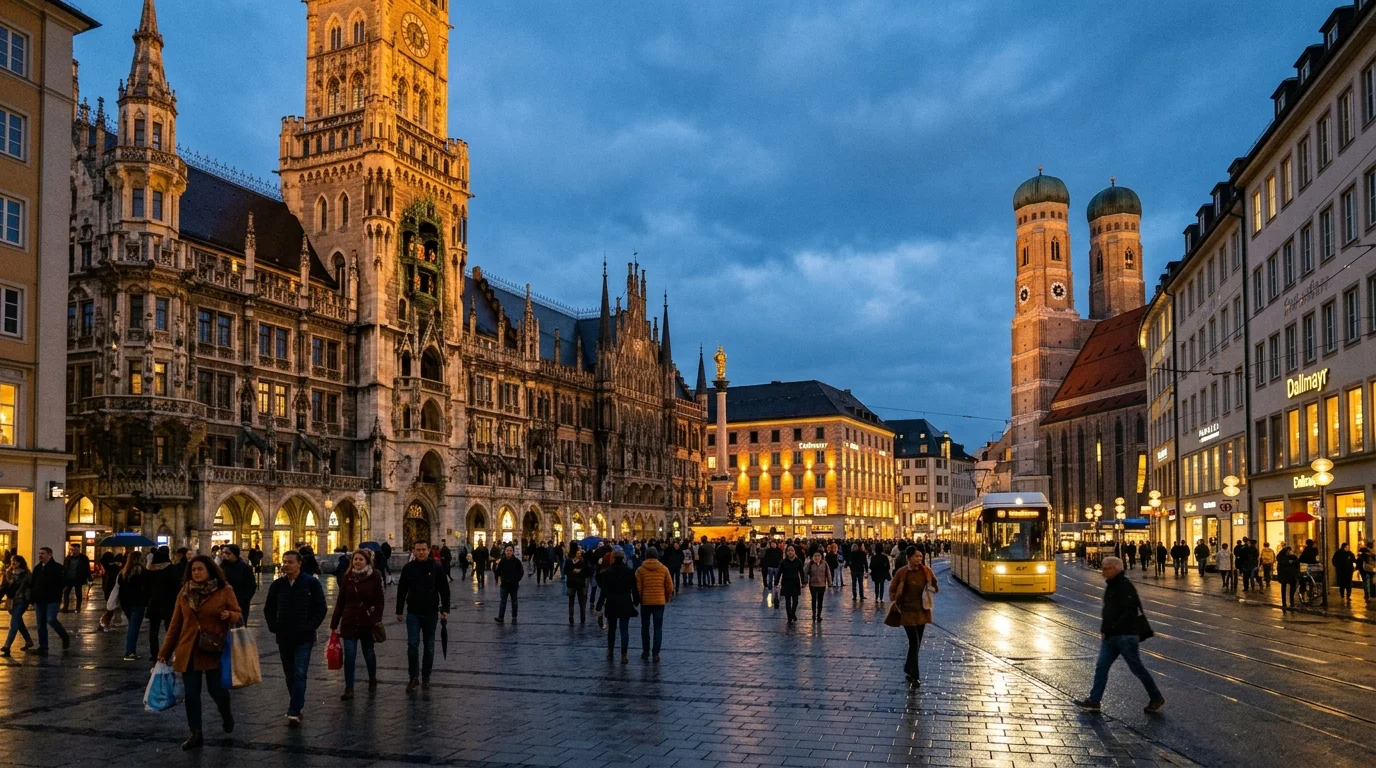
Marienplatz is the historic heart of Munich, a vast pedestrian square that has been the city's main gathering place for over 850 years. Dominating its north side is the magnificent Neues Rathaus (New Town Hall), a stunning neo-Gothic masterpiece completed in 1909, whose ornate 85-metre tower is one of the most photographed sights in Germany. The square is framed on the east side by the older Altes Rathaus (Old Town Hall) and on the south by shops and cafés.
The tower's famous Glockenspiel — a carillon with 43 bells and 32 life-size figures — performs daily at 11:00 AM, 12:00 PM, and (from March to October) at 5:00 PM. The 12-minute show depicts two stories from Munich's history: the marriage of Duke Wilhelm V in 1568, and the coopers' dance celebrating the end of a plague epidemic. It's touristy but genuinely charming, especially with the backdrop of the elaborate stone façade.
Why visit: This is Munich's undisputed centrepiece and the natural starting point for any visit. The view from the tower observation deck (accessible by lift) is spectacular, offering panoramic views over the Altstadt rooftops toward the Alps on clear days.
Entrance: Square is free; Tower lift: €6.50 adults, €5.50 reduced, free for children under 6 (2026)
Best time: Early morning for fewer crowds; arrive 5 minutes before Glockenspiel times
Hours: Square always open; Tower: Mon–Fri 10:00 AM–7:00 PM, Sat–Sun 10:00 AM–7:00 PM (seasonal variations)
Englischer Garten (English Garden)
Englischer Garten, 80538 München, Germany
The Englischer Garten is one of the world's largest urban parks, stretching 3.7 km (2.3 miles) through the heart of Munich and covering 3.7 square kilometres — significantly larger than New York's Central Park or London's Hyde Park. Created in 1789, it was designed in the English landscape style (hence the name) and remains the green soul of Munich, beloved by locals and visitors alike. The park contains four beer gardens, several lakes and streams, a Chinese Pagoda, a Japanese Tea House, and vast meadows where Müncheners sunbathe, cycle, and picnic in the warmer months.
One of the park's most unexpected attractions is the Eisbach river surf wave near the Prinzregentenstraße entrance — a standing wave where expert surfers perform impressive tricks year-round, even in winter, drawing crowds of bemused onlookers. The park's northern end features the Kleinhesseloher See lake, where you can rent rowing boats in summer, and the elegant Monopteros temple, which offers one of the best views over Munich's skyline.
Why visit: This is where Munich truly comes to life — locals use it as an extension of their living rooms, and there is no better place to soak up authentic Bavarian leisure culture, enjoy a beer at the Chinese Tower Biergarten, or simply watch the surfers on the Eisbach.
Entrance: Free
Best time: Sunny afternoons in summer; the park is open 24 hours
Hours: Always open
Schloss Nymphenburg (Nymphenburg Palace)
Schloß Nymphenburg 1, 80638 München, Germany
Nymphenburg Palace is the largest baroque palace in Germany and the summer residence of the Wittelsbach dynasty — the family that ruled Bavaria for nearly 750 years. The original central structure was built in 1664, and the palace was expanded over the following century into an impressive complex stretching 632 metres across. The palace's interiors are lavish, featuring the Great Hall with ceiling frescoes, the "Gallery of Beauties" commissioned by King Ludwig I (36 portraits of women he found beautiful, from noblewomen to a shoemaker's daughter), and the extraordinary Marstallmuseum with its collection of royal carriages and sleighs.
The palace gardens are equally spectacular — 180 hectares of baroque formal gardens, English landscape parks, lakes, canals, and four small garden palaces (Amalienburg, Badenburg, Pagodenburg, and Magdalenenklause), each worth exploring in their own right. The Amalienburg hunting lodge in particular is a masterpiece of Rococo decoration. The park is free to enter and is a popular destination for Munich families year-round.
Why visit: Nymphenburg is one of Europe's finest baroque palaces and a stunning contrast to central Munich's urban buzz. The combination of palace, grounds, and four pavilions makes for a full half-day of exploration, and the ornate Rococo decorations inside Amalienburg alone make the visit worthwhile.
Entrance: Palace + Marstallmuseum + Garden Palaces Combined Ticket: €15.00 adults, €12.00 reduced (2026); Palace only: €8.00; Park: Free
Best time: Weekday mornings; gardens especially beautiful in spring (April–May)
Hours: Apr–15 Oct: 9:00 AM–6:00 PM daily; 16 Oct–Mar: 10:00 AM–4:00 PM daily
Deutsches Museum
Museumsinsel 1, 80538 München, Germany
The Deutsches Museum is the world's largest science and technology museum, spread across a dedicated island in the Isar River with over 73,000 exhibits across 79 departments. Founded in 1903 and opened to the public in 1925, it covers virtually every field of human technology and natural science — from ancient mining to space travel, from musical instruments to nuclear physics. The museum is a genuine marvel of curation and scale, with full-sized ships, aircraft, railway locomotives, and even a reconstructed coal mine you can walk through underground.
Highlights include the aviation hall (with historic aircraft from the Wright Brothers era to early jets), the planetarium, the interactive chemistry and physics galleries, and the extraordinary telecommunications and information technology sections. The museum underwent major renovations in recent years; many new galleries have opened with modern, interactive displays. Children absolutely love it, but adult visitors easily spend a full day here.
Why visit: This is one of the world's great museums — genuinely world-class in scope and fascinating for visitors of all ages. Science-curious visitors can easily lose an entire day here. Even those not normally interested in technology will find something mesmerising in the vast collection.
Entrance: €15.00 adults, €8.00 children aged 6–17, free for children under 6 (2026)
Best time: Weekday mornings — it gets busy on weekends, especially with school groups
Hours: Daily 9:00 AM–5:00 PM (closed on major public holidays — check website)
Residenz München (Munich Residenz)
Residenzstraße 1, 80333 München, Germany
The Munich Residenz is the former royal palace of the Wittelsbach monarchs and one of the most important palatial complexes in Europe. With 130 rooms open to visitors, it is the largest city palace in Germany. Construction began in 1385, and over four centuries the palace grew to encompass 10 interconnected courtyards, three museums, and centuries of accumulated royal art and furnishings. Despite heavy damage during World War II, the Residenz was painstakingly restored and today looks spectacular.
The complex comprises three separate ticketed sections: the Residenz Museum (the palace rooms), the Schatzkammer (Treasury), and the Cuvilliés Theatre. The Schatzkammer alone houses one of Europe's finest collections of royal jewels, crowns, swords, and ceremonial objects. The Antiquarium — a 66-metre-long hall lined with ancient busts — is breathtaking in its scale. The Cuvilliés Theatre, designed in Rococo style, is considered one of the finest historic theatres in the world and is still used for performances today.
Why visit: The Residenz is Munich's most concentrated collection of art, history, and palatial grandeur. The Schatzkammer treasury alone justifies the entrance fee, and the Antiquarium is one of the most extraordinary rooms in any European palace. This is essential Munich.
Entrance: Residenz Museum + Schatzkammer (Treasury) combined: €17.00 adults, €13.00 reduced (2026); Cuvilliés Theatre: €5.00 adults. Combined day ticket for all three: €21.00
Best time: Open year-round; Tuesday morning is typically quieter
Hours: Daily 9:00 AM–6:00 PM (Apr–Oct); 10:00 AM–5:00 PM (Nov–Mar)
Hofbräuhaus München
Platzl 9, 80331 München, Germany
The Hofbräuhaus is the world's most famous beer hall, a Munich institution founded in 1589 by Duke Wilhelm V as a royal brewing house. Today it accommodates up to 3,500 guests across its vast ground floor hall, first-floor gallery, and large beer garden, and serves approximately 10,000 guests per day in high season. The main hall is a spectacular sight — long wooden tables stretching the length of the room, blue-and-white painted vaulted ceilings, the smell of roasting pretzels and spit-roasted pork, and an oompah band playing Bavarian folk music. Mozart once lived in the adjacent building.
The Hofbräuhaus serves only its own HB (Hofbräu) beer in traditional one-litre Masskrug steins. The food menu features classic Bavarian dishes — Weisswurst with sweet mustard and a pretzel, Schweinshaxe (roasted pork knuckle), Obatzda (Bavarian cheese dip), and Leberkäse (Bavarian meatloaf). Despite its tourist-friendly reputation, the atmosphere is genuinely fun and the beer is excellent. Locals still come here, especially in the beer garden.
Why visit: Whatever you think about touristy attractions, the Hofbräuhaus is a genuine piece of Munich history and a wonderfully boisterous, convivial experience. Sitting at a long communal table with strangers, clinking stone mugs, and singing along to an oompah band is quintessentially Munich and worth experiencing at least once.
Entrance: Free entry; 1L beer (Masskrug): €13.80 (2026); meals from €15–€25
Best time: Weekday evenings for authentic atmosphere; avoid peak tourist hours (12 PM–2 PM) if you want a seat quickly
Hours: Daily 9:00 AM–11:30 PM
Alte Pinakothek
Barer Str. 27, 80333 München, Germany
The Alte Pinakothek is one of the oldest and most important art galleries in the world, housing the Wittelsbach royal family's extraordinary collection of European Old Master paintings. Built between 1826 and 1836 in a neo-Renaissance style by Leo von Klenze, the building itself is architecturally remarkable. The collection spans European paintings from the 14th to 18th centuries, with particular strength in German, Dutch, Flemish, and Italian Renaissance works. Among the treasures are major works by Dürer, Raphael, Rubens, Rembrandt, da Vinci, Botticelli, and El Greco.
The gallery is part of the Kunstareal (Art Quarter) district of Maxvorstadt, where it stands alongside the Neue Pinakothek (19th century art), the Pinakothek der Moderne (modern and contemporary art), the Museum Brandhorst, and several other world-class galleries — all within easy walking distance of each other. This is one of Europe's greatest concentrations of art per square kilometre.
Why visit: The Alte Pinakothek's collection is genuinely one of the finest collections of Old Masters anywhere in the world. Even visitors who are not art specialists will find the sheer quality of the works here astonishing — this is the real deal, not tourist-grade attractions.
Entrance: €10.00 adults, €7.00 reduced (2026); every Sunday: €1.00 for all visitors
Best time: Tuesday–Thursday mornings for fewest crowds; Sunday for best value (€1 entry)
Hours: Tue 10:00 AM–8:00 PM; Wed–Sun 10:00 AM–6:00 PM; closed Monday
Olympiapark München (Olympic Park)
Spiridon-Louis-Ring 21, 80809 München, Germany
Built for the 1972 Summer Olympics, Munich's Olympic Park is a masterpiece of modern landscape design and innovative architecture. The centrepiece is the Olympiastadion (Olympic Stadium), famous for its sweeping transparent acrylic roof supported by web-like steel cables — an engineering marvel when completed in 1972. The park covers 85 hectares around the Olympiaberg hill (built from World War II rubble), artificial Olympiasee lake, and numerous sports venues now used for concerts, events, and fitness. The nearby 291-metre tall Olympiaturm (Olympic Tower) offers Munich's best panoramic views.
The park is still very much alive and active — it hosts major international concerts (the Rolling Stones, Coldplay, and others have performed here), sporting events, and public festivals. The Rock Museum inside the stadium is worth a visit for music lovers. Adventure seekers can try the Rock 'n' Roll Roof Run along the famous tent roof of the Olympiastadion — a guided climb across the iconic structure with spectacular city views.
Why visit: The Olympic Park is a beautifully maintained piece of modern architectural history with real ongoing vitality. The Olympiaturm TV tower view is better value than the Neues Rathaus tower, and the park itself is a lovely place to spend an afternoon, especially on sunny days when the lake reflects the stadium's iconic roof.
Entrance: Park: Free; Olympiaturm (Tower): €11.00 adults, €8.00 reduced (2026); Roof Run: €59.00
Best time: Sunny afternoons for the lake view; check the event calendar
Hours: Park always open; Olympiaturm: Daily 9:00 AM–11:00 PM
KZ-Gedenkstätte Dachau (Dachau Concentration Camp Memorial)
Pater-Roth-Str. 2a, 85221 Dachau, Germany
The Dachau Concentration Camp Memorial is one of the most important and sobering historical sites in Germany. Dachau was the first concentration camp established by the Nazi regime, opened in March 1933, and served as a model for all subsequent camps. It operated for 12 years and held over 200,000 prisoners from across Europe. More than 41,500 people died here. Today the site is preserved as a memorial and museum, with reconstructed barracks, original guard towers and gates, the crematorium, and a powerful museum that documents the history of the camp and the broader Nazi persecution program.
The memorial is designed to be confronting and educational, not sensational. The approach is careful and dignified. A visit typically takes 2–4 hours to do justice to the museum and grounds. Several international religious memorial chapels — Catholic, Protestant, Jewish, and Russian Orthodox — stand within the grounds. Despite being a difficult experience, it is a profoundly important one that provides essential historical context for understanding 20th-century Europe.
Why visit: A visit to Dachau is one of the most important things you can do as a visitor to Munich. Understanding this history is essential to understanding modern Germany and Europe, and the memorial does a genuinely powerful and thoughtful job of presenting it. Many visitors rate it the most meaningful experience of their entire trip.
Entrance: Free (audio guide: €4.50; guided tours: €4.50 per person)
Best time: Weekday mornings for fewer crowds; avoid arriving after 2:00 PM as it gets busy
Hours: Tue–Sun 9:00 AM–5:00 PM; closed Monday and some holidays
Viktualienmarkt
Viktualienmarkt 3, 80331 München, Germany
The Viktualienmarkt is Munich's beloved daily outdoor food market, operating on the same central site since 1807. Today it is one of the finest and most picturesque open-air markets in Europe, with around 140 stalls selling fresh produce, flowers, cheese, sausages, baked goods, international specialties, and more. The market is a sensory delight and a genuine part of daily Munich life — chefs from the city's best restaurants shop here every morning. At the centre of the market stands a traditional Maypole decorated in blue and white Bavarian stripes, and a beloved outdoor Biergarten operates year-round (weather permitting).
The market's atmosphere changes beautifully with the seasons — mountains of white asparagus in spring, strawberries in early summer, wild mushrooms in autumn, and the sweet smell of mulled wine and gingerbread in December. Stalls run by the same families for generations give the market a warm, authentic feel that distinguishes it from tourist markets elsewhere. Grab a fresh Leberkäse sandwich on a crispy roll (Semmeln), a coffee, and find a spot at one of the outdoor benches to watch Munich's morning unfold around you.
Why visit: The Viktualienmarkt is one of the most charming places in Munich and a wonderful introduction to Bavarian food culture. The experience of eating a freshly made Weisswurst with sweet mustard and a Weizenbier at the open-air Biergarten among Munich locals is genuinely memorable.
Entrance: Free
Best time: Weekday mornings (8:00–10:00 AM) for the freshest produce and local atmosphere
Hours: Mon–Fri 8:00 AM–8:00 PM; Sat 8:00 AM–6:00 PM; closed Sunday
Book your tours and tickets in advance — it saves hours of queuing and often gets you a better price. These two platforms cover different options, so it's worth checking both.
What Are the Best Neighborhoods to Explore in Munich?
Munich's neighborhoods each have a wonderfully distinct character — from the medieval grandeur of the Altstadt to the artsy cafés of Haidhausen and the green boulevards of Schwabing. Here are the best districts to explore during your visit.
Altstadt-Lehel (Old Town)
Character: Munich's medieval heart, centred on Marienplatz, featuring neo-Gothic town halls, baroque churches, the Residenz palace, and the bustling pedestrian zone. Architecture spans Gothic, baroque, and neo-Gothic styles, with a generally grand and imperial feeling.
What makes it special: This is where the most iconic Munich experiences are concentrated — the Glockenspiel, Viktualienmarkt, Hofbräuhaus, Residenz, and the Frauenkirche twin-tower cathedral are all within easy walking distance. Despite the tourist traffic, the area retains genuine daily life in its quieter streets and courtyards.
Best for: First-time visitors, history lovers, photographers, families
Must-see in this area: Marienplatz, Viktualienmarkt, Frauenkirche, Hofbräuhaus, Residenz, Sendlinger Tor
How to get there: U-Bahn lines U3/U6 to Marienplatz; S-Bahn to Marienplatz; tram 19 to Nationalmuseum/Haus der Kunst
Location: Marienplatz 8, 80331 München, Germany
Maxvorstadt (The Museum Quarter)
Character: Elegant neoclassical boulevards designed by court architect Leo von Klenze in the 19th century. This is Munich's intellectual and artistic heartland — home to three of the world's great art museums (the Pinakothek trio), the main university campus, the Technical University, and some of the city's best cafés and bookshops.
What makes it special: Maxvorstadt is where Munich's cultural and intellectual life is most concentrated. The Kunstareal (Art Quarter) on Barer Straße and Brienner Straße is one of the densest clusters of world-class museums anywhere in Europe. The streets between the museums are leafy and pleasant, and the student population brings a lively, affordable café and bar scene.
Best for: Art and culture lovers, architecture enthusiasts, students and academics
Must-see in this area: Alte Pinakothek, Neue Pinakothek, Pinakothek der Moderne, Museum Brandhorst, NS-Dokumentationszentrum, Königsplatz
How to get there: U2 to Königsplatz or Josephsplatz; Tram 27 to Pinakotheken
Location: Barer Str. 27, 80333 München, Germany (Alte Pinakothek as reference point)
Schwabing (Bohemian Quarter)
Character: Munich's famous bohemian district, once home to artists including Kandinsky, Klee, and Rilke. Today Schwabing blends its artistic heritage with upmarket boutiques, independent restaurants, lively bars, and gorgeous tree-lined streets. It borders the English Garden and has a more relaxed, intellectual atmosphere than the tourist-heavy Altstadt.
What makes it special: Schwabing is one of Munich's most pleasant neighborhoods to simply wander — the streets around Schellingstraße and Leopoldstraße have excellent independent bookshops, vintage clothing stores, wine bars, and neighbourhood restaurants where locals actually eat. The area feels authentically Munich without the tour groups.
Best for: Independent travellers, culture lovers, those who want an authentic local neighbourhood experience
Must-see in this area: Englischer Garten (northern sections), Leopoldstraße boulevard, Münchner Freiheit square, historic cafés on Schellingstraße
How to get there: U3/U6 to Münchner Freiheit or Giselastraße; Tram 27 to Leopoldstraße
Location: Münchner Freiheit 1, 80802 München, Germany
Haidhausen (East Side Village)
Character: One of Munich's most charming and liveable districts, on the east bank of the Isar River. Haidhausen has a village-like atmosphere with cobblestone streets, Gründerzeit (late 19th century) apartment buildings painted in pastels and ochres, independent cafés, artisan food shops, and an excellent neighbourhood restaurant scene. It has a strong community feel and is popular with young professionals and families.
What makes it special: Haidhausen feels like the "real Munich" that tourists rarely experience. The Wiener Platz market square is surrounded by independent shops and excellent brunch cafés. The Isar riverbanks nearby are a popular spot for locals to barbecue and swim in summer. The Müllersches Volksbad — a magnificent art nouveau public swimming bath — is a hidden gem.
Best for: Those seeking an authentic local neighbourhood, foodies, design and architecture lovers
Must-see in this area: Wiener Platz, Müllersches Volksbad, Isar riverbanks, Gasteig cultural centre, Rosenheimer Platz
How to get there: S-Bahn or U-Bahn to Rosenheimer Platz; Tram 18 to Weißenburger Platz
Location: Wiener Platz, 81667 München, Germany
Neuhausen-Nymphenburg
Character: A spacious, upmarket residential district in the west of Munich, anchored by the spectacular Nymphenburg Palace and its vast park. The neighbourhood has broad tree-lined streets, excellent local restaurants and bakeries, the beautifully renovated Rotkreuzplatz square, and a relaxed, family-friendly atmosphere entirely different from the tourist centre.
What makes it special: Beyond the palace, Neuhausen has some of Munich's most charming independent shops and neighbourhood restaurants along Nymphenburger Straße and around Rotkreuzplatz. The Nymphenburg Palace canal in winter is one of the most magical spots in Munich. The district is also home to the Museum Mensch und Natur (Nature and People) inside the palace grounds.
Best for: Families, those wanting a quieter Munich experience, palace and garden lovers
Must-see in this area: Nymphenburg Palace and Park, Rotkreuzplatz, Nymphenburger Straße shopping, Löwenbräu Keller
How to get there: U1 to Rotkreuzplatz; Tram 17 to Schloss Nymphenburg
Location: Schloß Nymphenburg 1, 80638 München, Germany
Glockenbachviertel (LGBT+ & Creative Quarter)
Character: Munich's most progressive and creative neighbourhood, located just south of the Altstadt. Glockenbachviertel is the heart of Munich's LGBT+ community and is known for its diverse, colourful street life, independent boutiques, vintage shops, organic cafés, and a vibrant bar and nightlife scene. The area around Müllerstraße and Hans-Sachs-Straße has a relaxed, inclusive atmosphere unlike anywhere else in Munich.
What makes it special: The Glockenbach has Munich's best brunch scene, most interesting independent shops, and the city's liveliest café culture. It genuinely feels like Berlin's Prenzlauer Berg or Amsterdam's De Pijp transported to Munich. The Isar River banks are a short walk away and a favourite local gathering spot in summer.
Best for: LGBT+ travellers, young adults, creatives, those interested in independent culture
Must-see in this area: Hans-Sachs-Straße, Müllerstraße, Gärtnerplatz theatre square, Isar riverbanks at Wittelsbacher Brücke
How to get there: U1/U2 to Fraunhoferstraße; U3/U6 to Sendlinger Tor; Tram 16 to Müllerstraße
Location: Gärtnerplatz 6, 80469 München, Germany
What Food Should You Try in Munich?
Munich is the undisputed capital of Bavarian cuisine — one of Germany's most distinctive regional food cultures, characterised by hearty meat dishes, pretzels, white sausages, dumplings, strong cheese, and of course extraordinary beer. The must-try dishes are Weisswurst, Schweinshaxe, Leberkäse, and Obatzda, all best enjoyed in one of the city's legendary beer halls or garden restaurants.
What Are the Must-Try Local Dishes in Munich?
- Weisswurst (White Sausage) — The quintessential Bavarian speciality: pale white veal sausages seasoned with parsley, lemon, mace, and cardamom, gently simmered in hot water and served with sweet mustard (süßer Senf) and a pretzel (Brezel). By tradition, Weisswurst should be eaten before noon (before they "hear the midday bell"). Eat them by "zuzeln" — sucking the meat from the skin — or cutting them open. Non-negotiable Munich food experience.
- Schweinshaxe (Roasted Pork Knuckle) — A massive roasted pork knuckle with crackling skin and tender, falling-off-the-bone meat, served with potato dumplings (Kartoffelknödel) and sauerkraut or cabbage salad. One portion is easily enough for two. Find the best version at Haxnbauer or Augustiner-Keller.
- Obatzda (Bavarian Cheese Dip) — A creamy, paprika-seasoned blend of aged Camembert or Brie, butter, cream cheese, and onions, traditionally served with dark bread and radishes as a beer garden snack. It's addictively good and pairs perfectly with a cold Weizenbier.
- Leberkäse (Bavarian Meatloaf) — Despite its name (literally "liver cheese"), traditional Leberkäse contains neither liver nor cheese — it's a smooth, loaf-shaped mix of corned beef, pork, and bacon baked until the exterior is golden-brown and the interior is incredibly juicy. Served hot on a white roll (Semmel) with sweet mustard from street market stalls, it's Munich's favourite quick lunch.
- Brezn (Soft Pretzel) — Munich pretzels are larger, chewier, and more deeply flavoured than most you'll find elsewhere, with a distinctive deep-brown, lye-baked crust and a generous sprinkling of coarse salt. They are served warm in every Biergarten and beer hall as a necessary accompaniment to beer.
- Weizenbier (Wheat Beer) — Not technically food, but Weizenbier (wheat beer) is so central to Munich's food culture it belongs on this list. Brewed from wheat malt, it has a distinctive cloudy, golden appearance and a banana-clove aroma from the fermentation. Munich's top wheat beers are Augustiner, Paulaner, Hofbräu, and Franziskaner. Always order it in a half-litre (Halbe) or one-litre (Masskrug) tall glass, never a pint glass.
- Kartoffelknödel (Potato Dumplings) — Large, round dumplings made from grated raw and cooked potato, boiled until fluffy. They accompany most traditional meat dishes and are denser and more flavourful than Italian gnocchi. The proper way to eat them is to pull them apart with two forks — never cut with a knife.
- Kaiserschmarrn (Emperor's Mess) — A sweet dessert pancake — thick, fluffy, torn into irregular pieces, caramelised with sugar and butter, and dusted with icing sugar. Served with plum compote or apple sauce, it's one of Bavaria's most beloved desserts and worth saving room for.
Where Should You Eat in Munich?
Budget-Friendly (Under €15 per meal)
- Der Pschorr (Biergarten / Beer Hall) — Viktualienmarkt 15, 80331 München — An excellent mid-range beer hall right at the Viktualienmarkt, serving classic Bavarian food at honest prices. The outdoor seating area is particularly pleasant. Try the Leberkäse Semmel and a Masskrug for under €15.
- Eataly Munich — Schrannenhalle, Blumenstraße 4, 80331 München — The covered Schrannenhalle market adjacent to the Viktualienmarkt has several affordable food counters and a great Italian food hall where pasta dishes start around €8–€12.
- Stadtcafé im Stadtmuseum — St.-Jakobs-Platz 1, 80331 München — The café inside the Munich City Museum serves simple, high-quality lunches in a beautifully converted historic building. Lunch specials around €10–€12.
Mid-Range (€20–€45 per meal)
- Augustiner-Keller — Arnulfstraße 52, 80335 München — One of Munich's best and most beloved traditional beer halls, run by the independent Augustiner brewery. The food is excellent (the Schweinshaxe here is legendary) and the atmosphere is genuinely local rather than touristy. Great beer garden in summer. Mains €16–€28.
- Zum Franziskaner — Residenzstraße 9, 80333 München — One of Munich's oldest restaurants (established 1363), right next to the Residenz. Impeccably prepared traditional Bavarian food in a beautiful, wood-panelled setting. The Weisswurst here is among the best in the city. Mains €18–€32.
- Tantris DNA — Johann-Fichte-Straße 7, 80805 München — The more casual sibling of the legendary Tantris restaurant, serving creative Bavarian-inspired cuisine in a beautiful space. Excellent for a special dinner that doesn't require a months-in-advance reservation. Mains €25–€45.
Fine Dining (€70+ per meal)
- Tantris — Johann-Fichte-Straße 7, 80805 München — Munich's most iconic fine dining destination, with two Michelin stars and a legendary 1970s interior that has become a design landmark in its own right. The cuisine is contemporary French-international with strong Bavarian influences. Tasting menus from €195 per person (2026). Book months in advance.
- Schwarzreiter — Maximilianstraße 17, 80539 München — The fine dining restaurant of the Four Seasons Hotel Munich, serving one-Michelin-starred contemporary Bavarian cuisine in an elegant setting. Thoughtful wine pairings and exceptional service. Tasting menus from €130 per person (2026).
What Are the Dining Customs in Munich?
Meal times: Breakfast (Frühstück) is typically 7:00–9:00 AM; lunch (Mittagessen) runs 12:00–2:00 PM and is traditionally the main meal; dinner (Abendessen) is 6:30–9:00 PM in restaurants. Beer halls often serve food all day.
Tipping: Service charges are not included in Munich restaurant bills. Tipping 10% is standard and appreciated; in beer halls and casual restaurants, rounding up to the nearest euro is acceptable. Tell the server the total including tip when paying — saying "Stimmt so" means "keep the change."
Reservations: Essential for Michelin-starred restaurants (book months ahead), and recommended for popular traditional restaurants on weekend evenings. Beer halls generally don't accept reservations for small groups.
Dress code: Most Munich restaurants are fairly casual. Traditional beer halls are decidedly casual — lederhosen and dirndl are always welcome. Fine dining restaurants expect smart casual; some require jacket and tie.
What Is the Nightlife Like in Munich?
Munich's nightlife scene is lively, diverse, and surprisingly late — bars typically fill up from 10:00 PM, clubs don't really get going until midnight or later, and many venues stay open until 4:00 AM or beyond on weekends. The city has something for everyone, from refined cocktail bars and wine cellars to underground techno clubs and live jazz venues.
Where Are the Best Areas for Nightlife in Munich?
- Glockenbachviertel: Hans-Sachs-Straße, 80469 München — Munich's LGBT+-friendly quarter is also the city's most vibrant bar district, with a high density of excellent cocktail bars, wine bars, and relaxed neighbourhood pubs. The atmosphere is inclusive and the crowd is young, diverse, and creative. Best for bar-hopping any night of the week.
- Maxvorstadt / Theresienstraße: Augustenstraße, 80333 München — The student quarter has Munich's most affordable nightlife, with basement bars, live music venues, and late-night kebab shops. The area around Augustenstraße and Theresienstraße is consistently busy on weekends.
- Haidhausen / Ostbahnhof: Rosenheimer Straße, 81667 München — The east side around the Ostbahnhof has evolved into a vibrant club district, with several of Munich's best electronic music clubs and a generally younger, more alternative crowd.
What Are the Best Bars and Clubs in Munich?
Bars & Pubs
- Bar Centrale — Ledererstraße 23, 80331 München — A sophisticated Italian-style wine and cocktail bar just off Marienplatz, beloved by locals and tourists alike. Excellent Negronis and a fantastic selection of natural wines. Lively but not noisy. Drinks from €10–€14.
- Schumann's Bar — Odeonsplatz 6-7, 80539 München — Munich's most famous cocktail bar, located on elegant Odeonsplatz. Charles Schumann is one of Germany's legendary bartenders, and the bar has been a Munich institution since 1982. Arrive before 9:00 PM to guarantee a seat. Cocktails from €14–€18.
- Trachtenvogl — Reichenbachstraße 47, 80469 München — A wonderfully eclectic, always-packed neighbourhood bar in the heart of Glockenbach. Mismatched furniture, kitschy décor, affordable drinks, and a genuinely mixed, friendly crowd. Beer from €5; cocktails from €9.
Clubs & Dancing
- Blitz Club — Museumsinsel 1, 80538 München — Munich's most internationally respected techno club, located in a basement beneath the Deutsches Museum. Attracts top international DJs and a serious, music-focused crowd. Cover charge €10–€20; doors open 11 PM, gets going after 1 AM.
- Harry Klein — Sonnenstraße 8, 80331 München — A legendary small Munich club known for combining live electronic music with impressive video art projections. The intimate space creates an extraordinarily intense atmosphere. International bookings, long queues, arrive early. Cover €12–€18.
Live Music & Shows
- Jazzclub Unterfahrt — Einsteinstraße 42, 81675 München — Munich's premier jazz club, presenting live jazz, blues, and world music almost every night of the year in a beautiful brick basement venue. Tickets typically €15–€25; Sunday jam sessions are free before 9 PM.
- Muffatwerk — Zellstraße 4, 81667 München — A large, versatile cultural venue in a converted power station on the Isar River, hosting concerts, club nights, theatre, and large events. Check the programme at muffatwerk.de.
What Family-Friendly Evening Entertainment Is Available?
Munich offers excellent evening options for families — the Deutsches Museum Planetarium has evening shows, the Olympic Tower observation deck is spectacular at night, and many beer gardens welcome families (children can order food and non-alcoholic drinks). The Bavarian State Opera performs family-appropriate programming, and the Residenz hosts evening concerts in its magnificent halls. The Marienplatz area is also beautiful illuminated at night and very safe for evening strolls.
What and Where Should You Shop in Munich?
The best things to buy in Munich are Bavarian food and drink specialities (beer steins, local beer, Lebkuchen gingerbread), traditional clothing (Tracht — lederhosen and dirndl), quality German design and kitchenware, and unique handcrafts from local independent boutiques. The top shopping areas are the pedestrian Kaufingerstraße/Neuhauser Straße zone, the upmarket Maximilianstraße, and the eclectic boutiques of Schwabing and Haidhausen.
What Are the Best Shopping Districts in Munich?
- Kaufingerstraße & Neuhauser Straße (Pedestrian Zone): Kaufingerstraße, 80331 München — Munich's main pedestrian shopping zone, running from Marienplatz to Stachus (Karlsplatz). This is where you'll find all the major international chains (H&M, Zara, Apple, C&A) plus department stores like Ludwig Beck and the Kaufhof. High footfall but not particularly unique — best for mainstream brands and tourist-oriented souvenirs.
- Maximilianstraße (Luxury Shopping): Maximilianstraße, 80539 München — Munich's answer to the Champs-Élysées or Via Montenapoleone. This grand boulevard between the National Theatre and the Maximilianeum houses boutiques for Hermès, Chanel, Prada, Gucci, Bulgari, Louis Vuitton, and every major luxury brand. The architecture of the street itself (19th century neo-Gothic palace buildings) makes it worth strolling even if you're not shopping.
- Schwabing / Leopoldstraße (Independent Boutiques): Leopoldstraße, 80802 München — The best area for independent fashion boutiques, vintage clothing shops, design stores, and bookshops. The side streets off Leopoldstraße — particularly Schellingstraße, Theresienstraße, and Türkenstraße — have a wonderful density of small, individual shops you won't find anywhere else.
What Markets Should You Visit in Munich?
Viktualienmarkt — Viktualienmarkt 3, 80331 München — Munich's famous daily food market (Mon–Fri 8:00 AM–8:00 PM; Sat 8:00 AM–6:00 PM). The best place to buy Bavarian food specialities — local cheeses, sausages, honey, preserves, and seasonal produce — as proper gifts or to eat at the market. Prices are fair (not cheap, but excellent quality).
Flohmarkt Riem (Flea Market) — Messegelände, 81829 München — One of Europe's largest flea markets, held every Saturday and the first Sunday of the month from 7:00 AM to 4:00 PM. Over 2,000 vendors sell antiques, vintage clothing, furniture, books, records, and curiosities. Take the U2 to Messestadt West.
Christkindlmarkt (Christmas Market) — Marienplatz, 80331 München — Munich's legendary Christmas Market runs from late November to December 24. The Marienplatz market is the main event — around 100 decorated wooden stalls selling Lebkuchen, wooden ornaments, mulled wine (Glühwein), and handmade Christmas decorations around the magnificent backdrop of the Neues Rathaus. Smaller, more local Christmas markets operate in Schwabing (Münchner Freiheit) and Haidhausen (Weißenburger Platz).
What Should You Buy in Munich?
- Tracht (Traditional Bavarian Clothing) — Lederhosen (leather shorts/breeches for men) and Dirndl (the women's traditional dress with apron) are popular and genuinely worn by locals at Oktoberfest and other festivals. Quality varies enormously — buy from Trachten Angermaier (Kaufingerstraße 24) or Loden-Frey (Maffeistraße 7) for authentic, durable garments. Expect €80–€300+ for a decent lederhosen; €80–€250+ for a dirndl.
- Bavarian Beer Steins (Masskrug) — The traditional one-litre ceramic or glass beer mugs are the ultimate Munich souvenir. Authentic Masskrug from established producers start around €25–€50; the cheap ones from souvenir shops for €5 are low quality. Buy from the Hofbräuhaus shop or dedicated Tracht stores for proper versions.
- Lebkuchen (Bavarian Gingerbread) — Nuremberg may be Germany's most famous Lebkuchen city, but Munich's bakers produce exceptional versions. Lebkuchen Schmidt (available at the Viktualienmarkt) makes some of the finest in Bavaria. Decorated tin boxes make excellent, long-lasting gifts.
- Local Beer (in bottles) — A selection of Munich's six major breweries (Augustiner, Paulaner, Hofbräu, Hacker-Pschorr, Spaten, Löwenbräu) makes a wonderful edible souvenir. Buy from any supermarket (Edeka, Rewe) for great prices — a 0.5L bottle of Augustiner Helles costs around €0.90–€1.10 at the supermarket.
- German Design & Kitchenware — Munich has excellent home design shops. Rosenthal, WMF, and Fissler cookware are genuinely high quality and often better priced here than abroad. For more contemporary design, check the shops around the Maxvorstadt museum quarter.
What Are the Shopping Hours and Customs?
Standard Munich shop hours are Monday–Saturday 9:00/10:00 AM to 8:00 PM. Almost all shops (with rare exceptions like pharmacies, petrol stations, and some tourist-area shops) are closed on Sundays — this is a strong German tradition protected by law. Sales (Schlussverkauf) happen in January and July. VAT refunds (Tax Free Shopping) are available for non-EU visitors on purchases over €50.01 — ask for a Tax Free form in participating shops and present it at the airport customs desk when departing.
Can Non-EU Visitors Claim a VAT Tax Refund in Munich?
Yes — if you are a visitor from outside the European Union (including travellers from the USA, Canada, Australia, the UK, and most of Asia and Latin America), you are entitled to a refund of the VAT (Value Added Tax) included in the price of goods you buy in Germany. VAT in Germany is 19% on most goods, which means this refund can be significant on high-value purchases like clothing, leather goods, jewellery, designer fashion, and electronics.
How to Claim Your VAT Refund — Step by Step
- Spend at least €50 in a single shop in a single day. This is the minimum threshold for a VAT refund claim in Germany. It does not apply across multiple shops — the full amount must be spent in one store.
- Look for the "Tax Free" sign. Participating shops display a "Tax Free Shopping," "Global Blue," or "Planet" logo in the window or at the register.
- Ask for the tax refund form at the register before you pay. Present your non-EU passport — the shop will fill out the form with your details and the purchase amount. Keep the form with your receipt.
- Get the form stamped at customs before you leave. Go to the Customs office at Munich Airport (MUC) before check-in and have an officer stamp your tax refund form. Keep your purchases accessible in hand luggage — do not pack them deep in your checked bags.
- Collect your refund. Hand the stamped form to the Global Blue or Planet desk at the airport. You can receive the refund in cash (minus a processing fee) or as a credit card refund (lower fees, takes a few weeks).
VAT Refund Quick Facts for Munich
- Minimum spend: €50 in one shop in one day
- VAT rate on most goods: 19% on most goods
- Typical refund after fees: 10–15% of the purchase price
- Refund processors: Global Blue and Planet (formerly Premier Tax Free) at Munich Airport (MUC)
- Who qualifies: Anyone with a non-EU passport who is not a resident of an EU country
- UK visitors: British passport holders qualify since Brexit — the UK is no longer in the EU
- Deadline: Purchases must be exported within 3 months of the date of purchase
- Full guide: VAT Refund in Europe — Complete Guide for Non-EU Travelers
What Festivals and Events Happen in Munich?
Munich's biggest festivals are Oktoberfest (September–October), the Christmas Markets (late November–December 24), the Spring Festival Frühlingsfest (April–May), and the Tollwood Summer Festival (June–July). The city has a rich calendar of events year-round that makes almost any month a good time to visit.
What Is the Annual Events Calendar for Munich?
| Month | Event Name | Description |
|---|---|---|
| January | Fasching Season Begins | Bavarian carnival season officially starts on January 7 (Dreikönigstag). Costume balls and carnival events begin — a lively season culminating in Fasching itself in February/March. |
| February/March | Fasching (Carnival) | Munich's carnival tradition features elaborate costume balls, street processions, and general revelry in the days leading up to Ash Wednesday. Particularly lively around Viktualienmarkt and in Schwabing. |
| April–May | Frühlingsfest (Spring Festival) | Munich's "Little Oktoberfest," held on the Theresienwiese (same grounds as Oktoberfest). Two weeks of beer tents, fairground rides, and traditional food — with smaller crowds and more relaxed atmosphere than the autumn festival. Typically the last two weeks of April into May. |
| May | Maibaumaufstellen (Maypole Festival) | On May 1, traditional Bavarian villages and Munich's own market squares erect decorated maypoles to great ceremony, music, and beer drinking. Particularly atmospheric in Viktualienmarkt and village squares. |
| June/July | Tollwood Summer Festival | A major international festival of music, theatre, circus, and art, held on the Olympiapark grounds for about four weeks from mid-June. The festival also features an excellent market of organic food and ethically made crafts. Free entry to most areas; paid concerts and shows. |
| June/July | Munich Opera Festival | The Bavarian State Opera hosts its annual Opera Festival with special productions, many held in the stunning Residenz courtyard under the stars. One of Europe's finest opera festivals. Tickets from €25–€200+. |
| July/August | Various Beer Garden Festivals | Summer is peak beer garden season with informal festivals at most major beer gardens (Augustiner Keller, Hirschgarten, Chinese Tower). The Hirschgarten, the world's largest beer garden, hosts its own regular summer events. |
| September–October | Oktoberfest | The world's largest folk festival, held on the Theresienwiese for 16–18 days from the penultimate Saturday of September through the first Sunday of October. In 2026, Oktoberfest runs from approximately September 19 to October 4. Massive beer tents, fairground rides, traditional food, and costumes. Book accommodation 6–12 months in advance. |
| October | Starkbierfest (Strong Beer Festival) | A quieter but charming local festival celebrating the seasonal release of Märzen and strong dark beers. The Löwenbräukeller's Starkbierfest is particularly beloved among locals. Much less crowded than Oktoberfest. |
| November | Tollwood Winter Festival | A smaller but magical winter festival held from late November on the Theresienwiese, featuring international arts, music performances, and a wonderful organic market. A wonderful alternative to the main Christmas markets. |
| Late November–December 24 | Christkindlmarkt (Christmas Markets) | Munich's legendary Christmas markets open across the city — the main Marienplatz market is iconic, but smaller markets in Schwabing, Haidhausen, and Maxvorstadt are more local in character. The Mittelaltermarkt (medieval market) at Wittelsbacherplatz is particularly atmospheric. |
| December 31 | New Year's Eve | The Marienplatz and English Garden host informal New Year's celebrations. Fireworks are launched from high points across the city. There is no centrally organised fireworks show — private fireworks are sold and launched by individuals across the city. |
How Do Festivals Affect Hotel Prices and Availability?
Oktoberfest has the most dramatic effect on Munich accommodation — prices can increase by 300–500% during the festival's opening weekend and remain elevated throughout. For Oktoberfest, book accommodation 6–12 months in advance. Budget options near the Theresienwiese will sell out first; central city hotels hold prices longer but still need booking 3–6 months ahead. During the Christmas market season (late November–late December), prices rise modestly by 20–40% but availability is generally more manageable with 2–3 months' notice.
Where Should You Stay in Munich?
The best neighbourhood to stay in Munich depends on your travel style and what matters most — proximity to attractions, nightlife access, local atmosphere, or budget. Here's a clear breakdown to help you choose.
What Are the Best Neighborhoods to Stay in Munich?
| Neighbourhood | Vibe | Price Range per Night (2026) | Best For |
|---|---|---|---|
| Altstadt-Lehel | Historic, central, vibrant | €120–€400+ | First-time visitors wanting everything walkable |
| Maxvorstadt | Elegant, intellectual, cultural | €90–€200 | Art lovers, culture enthusiasts, longer stays |
| Schwabing | Bohemian, green, relaxed | €80–€180 | Independent travellers, those wanting a local neighbourhood |
| Haidhausen | Village-like, authentic, charming | €70–€160 | Budget-conscious travellers who want a real neighbourhood |
| Near Hauptbahnhof | Convenient, mixed, busy | €60–€150 | Transit visitors, budget travellers, those arriving by train |
What Are the Pros and Cons of Each Area?
Altstadt-Lehel:
Pros: Walking distance to every major attraction; atmospheric streets; excellent restaurant and café options; best choice for short (1–3 day) visits.
Cons: Most expensive accommodation; busy and noisy especially near Marienplatz; can feel very touristy; limited parking for those arriving by car.
Maxvorstadt:
Pros: Walking distance to the three Pinakothek museums, university area, and Englischer Garten; elegant streets; excellent café culture; feels authentically local despite proximity to the centre.
Cons: A 15–20 minute walk from Marienplatz (fine for most, but some prefer to be right in the historic centre); limited late-night entertainment nearby.
Schwabing:
Pros: Bordering the Englischer Garten; beautiful residential streets; excellent local restaurants and bars; more affordable than the Altstadt; very safe and pleasant.
Cons: Requires U-Bahn or Tram to reach Marienplatz (about 15–20 minutes); fewer hotel options (more apartments/guesthouses); can feel quiet in the evening.
Haidhausen:
Pros: Authentic neighbourhood atmosphere; excellent restaurant scene; lovely streets for walking; close to Isar riverbanks; S-Bahn to centre is fast (10 minutes).
Cons: Fewer large hotels (primarily small guesthouses and apartments); slightly further from major western attractions like Nymphenburg; less central feel.
Near Hauptbahnhof (Central Station):
Pros: Excellent transport connections to airport and all city destinations; widest range of budget accommodation; very convenient for those arriving/departing by train.
Cons: The area immediately around the station (especially the northern side) is rough around the edges with adult entertainment venues; not particularly atmospheric; some streets require caution late at night.
How Far in Advance Should You Book in Munich?
For regular periods, booking 4–8 weeks in advance is sufficient for mid-range accommodation. For summer (June–August), book 2–3 months ahead. For Oktoberfest, book 6–12 months in advance for any decent options — the best hotels near the Theresienwiese are typically fully booked a year before the festival. Christmas market season (late November–December) requires 6–8 weeks' advance booking for central hotels.
What Do You Need to Know Before Visiting Munich?
Here are the essential practical details every visitor to Munich needs to know before arriving — from currency and cards to safety and cultural customs.
Essential Travel Details for Munich
- Currency: Euro (€); exchange at banks or official exchange offices (Reisebank at the Hauptbahnhof); avoid airport currency exchange kiosks for the best rates
- Credit Cards: Widely accepted in hotels, restaurants, and larger shops, but many smaller restaurants, market stalls, and bakeries remain cash-only. Always carry some cash (€50–€100).
- ATMs (Geldautomaten): Abundant throughout the city; Sparkasse, Deutsche Bank, and Commerzbank ATMs are most common. Avoid private ATMs in tourist areas that charge high fees. Most ATMs give €50 maximum per transaction without surcharge for foreign cards.
- Language: German (Bavarian dialect); English is widely spoken in tourist areas, hotels, and by most people under 50; learn a few basic German phrases — locals appreciate the effort
- Tipping: 10% at restaurants; round up at bars and taxis; tell the server the total amount including tip when paying
- Electrical Plugs: Type F (Schuko) plugs; 230V/50Hz; UK and US visitors need adapters
- Emergency Number: 112 (EU standard — police, ambulance, fire)
- Police (non-emergency): 110
- SIM Cards: Available at Telekom, Vodafone, O2, and Aldi stores; tourist SIMs start from €10–€15 for 15GB data (2026); alternatively, international eSIMs (Airalo, etc.) can be activated before arrival
- WiFi: Free WiFi in all hotels, most cafés, the airport, the Hauptbahnhof, and most public areas. Coverage is excellent throughout the city.
- Tap Water: Safe to drink everywhere in Munich — Munich's tap water is sourced from the Alps and is considered among the finest tap water in Europe. There is absolutely no need to buy bottled water.
Skip the airport queue — order your eSIM before you travel and activate it the moment you land. Prices and data allowances vary, so it pays to compare providers.
How Much Does It Cost to Visit Munich?
| Budget Type | Daily Cost (2026) | What's Included |
|---|---|---|
| Budget Traveler | €60–€90 | Hostel dorm bed, street food and market lunches, public transport day ticket, free attractions (parks, squares, markets) |
| Mid-Range Traveler | €130–€200 | 3-star hotel, 2 restaurant meals per day, public transport, 1–2 paid attractions, occasional taxi |
| Luxury Traveler | €350–€600+ | 4–5 star hotel, fine dining, private transfers or taxis, guided tours, premium experiences, shopping |
What Are the Most Useful Phrases in Munich?
- Hello: Hallo (formal: Guten Tag) / Bavarian greeting: Servus or Grüß Gott
- Thank you: Danke schön
- Please: Bitte
- Excuse me: Entschuldigung
- How much?: Wie viel kostet das?
- Where is...?: Wo ist...?
- I don't understand: Ich verstehe nicht
- Help!: Hilfe!
- Bathroom: Die Toilette / WC (pronounced: "vay-tsay")
- Check, please: Die Rechnung, bitte (dee RECH-nung BIT-teh)
- One beer, please: Ein Bier, bitte (always gets a smile)
- Cheers! Prost! (or the full Bavarian: "Ein Prosit der Gemütlichkeit!")
Is Munich Safe for Tourists?
Yes — Munich is consistently ranked among the safest major cities in Europe and the world. The German city safety index regularly places Munich at the top. Violent crime rates are very low, police are visible and responsive, and the city infrastructure is excellent. The vast majority of visitors have completely trouble-free experiences.
Areas to use extra caution: The area immediately north and west of the Hauptbahnhof (Central Station) around Arnulfstraße and the Bahnhofsviertel has higher drug activity and adult entertainment venues — avoid walking alone late at night in this specific zone, though it is generally not dangerous.
Common scams: 1) Distraction scams at ATMs (someone "helps" while an accomplice steals). 2) Taxis from the airport not using meters (always insist on the meter). 3) Unofficial tour guides near the Residenz and Marienplatz charging inflated prices. 4) Overpriced drinks at bars in the immediate Marienplatz tourist zone — check prices before ordering.
Pickpocketing: Occurs occasionally at Oktoberfest, in the U-Bahn, and in busy tourist areas like Marienplatz. Keep valuables in a front pocket or money belt, especially during crowded festival events.
Solo traveller safety: Munich is excellent for solo travellers — both for women and for LGBT+ visitors. The city is genuinely inclusive and internationally minded. Women travelling alone report feeling very safe in Munich both during the day and at night in most districts.
What Are the Cultural Customs in Munich?
- Greetings: A firm handshake is the standard greeting for first meetings. The Bavarian "Grüß Gott" (literally "greet God") is the regional greeting and locals will appreciate you using it. Friends typically embrace and kiss on the cheek.
- Dress code: Munich is fairly relaxed about dress in general. However, smart-casual is expected in nicer restaurants. At churches, shoulders and knees should be covered. At Oktoberfest, wearing Tracht (traditional costume) is actively encouraged and welcomed — don't be shy about dressing up.
- Photography: Most public spaces are fine to photograph. Ask permission before photographing individuals at markets or events. Photography in some museum sections may be restricted — follow posted signs carefully.
- Public behaviour: Germans generally appreciate quiet and order in public spaces. Loud behaviour on public transport or in residential streets late at night is frowned upon. Jaywalking (crossing on a red pedestrian light) is technically illegal and actively frowned upon — Müncheners will give you disapproving looks.
- Dining: It is standard practice to share tables (Stammtisch culture) in beer halls — don't be surprised if strangers join your table. Always make eye contact when clinking glasses and saying Prost — breaking eye contact is considered bad luck (and will result in 7 years of bad sex, according to local legend).
- Gestures to avoid: The "OK" gesture (index finger and thumb in a circle) is not offensive in Germany. However, wagging your index finger at someone is condescending. Never put your feet on furniture in public spaces.
Do You Need a Visa to Visit Munich?
Citizens of EU/EEA countries and Switzerland can enter Germany (and Munich) without a visa or passport — just a national identity card. Citizens of the USA, Canada, Australia, New Zealand, Japan, South Korea, and many other countries can visit Germany visa-free for up to 90 days within a 180-day period. UK citizens can visit visa-free for up to 90 days (post-Brexit rules). Citizens of some other countries require a Schengen visa — check the official German Federal Foreign Office website (auswaertiges-amt.de) for current requirements based on your nationality.
What Health Precautions Should You Take in Munich?
Vaccinations: No special vaccinations are required for visiting Germany. Standard vaccines (tetanus, MMR, etc.) should be up to date. No malaria risk.
Pharmacies (Apotheken): Munich has an excellent network of pharmacies throughout the city. Many common medications available in other countries can be purchased over the counter. A rotating 24-hour pharmacy is always available (the address is posted on every pharmacy door and available at muenchen.de). Look for the green cross sign.
Hospitals: Munich has world-class medical facilities. The main hospitals include Klinikum der Universität München (LMU) and Technische Universität Klinikum. EU citizens with a valid EHIC (European Health Insurance Card) receive free or reduced-cost treatment. Non-EU visitors should have comprehensive travel insurance. Private travel insurance is strongly recommended for all visitors.
Common health issues: Munich's tap water is safe and excellent. Food safety standards are very high. The main seasonal issue is winter cold — dress in proper layers. Altitude (519m) is not a concern for healthy adults.
Do You Need Travel Insurance for Munich?
Yes — and you should buy it before you board your flight, not after. Travel insurance covers the situations that can turn a great trip into a financial disaster: a medical emergency (a single ambulance ride and hospital stay in Europe can cost €3,000–€10,000 without coverage), a cancelled or delayed flight, lost or stolen baggage, or a last-minute trip cancellation. EU citizens with an EHIC or GHIC card receive reciprocal state healthcare, but this does not cover repatriation, trip cancellation, or lost luggage — a full travel policy fills those gaps. Non-EU travellers have no state coverage at all and should never visit without insurance.
Choosing the right policy matters — coverage limits, exclusions, and pre-existing condition terms vary significantly between providers. Read our full guide before you buy: Best Travel Insurance for Europe — Honest Comparison for 2026.
Travel insurance is strongly recommended for Munich — an unexpected medical bill, flight cancellation, or lost luggage can cost far more than the policy. Get covered before you go.
What Are Your Rights If Your Flight to Munich Is Delayed or Cancelled?
Under EU Regulation 261/2004, if your flight to or from Munich is delayed by more than 3 hours or cancelled without sufficient notice, you are entitled to compensation of up to €600 per passenger — regardless of which airline you flew with, and regardless of how long ago it happened (claims can go back up to 6 years in some countries). This applies to all flights departing from an EU airport, and all flights arriving into an EU airport on an EU-based carrier. Most travellers don't realise they are owed money, and airlines rarely volunteer to pay. A claims service handles everything on your behalf and only charges a fee if they win — so there is no risk to you.
Both services check your eligibility for free with no upfront cost — they only charge a commission if they successfully recover your compensation.
Is Munich Accessible for People with Disabilities?
Munich has made significant investments in accessibility over recent decades. Most U-Bahn and S-Bahn stations have lifts and tactile paving. The Marienplatz area is pedestrianised and largely wheelchair-accessible. Major museums including the Deutsches Museum and Pinakothek trio have excellent wheelchair access and facilities. Some historic sites like the Residenz have limited accessibility in older sections. The city's official "Munich for all" (München für alle) programme provides detailed accessibility information at muenchen.de.
Is Munich Good for Families with Kids?
Munich is an excellent family destination. The Deutsches Museum is world-class for children of all ages and often named the best family museum in Germany. The Englischer Garten has vast playgrounds and safe spaces for children to run. Nymphenburg Palace gardens are wonderful for family picnics. The Tierpark Hellabrunn (Munich Zoo), located in a beautiful riverside park, is one of Germany's finest. The public transport system is stroller-friendly, with lifts at most major stations. Most restaurants welcome children, high chairs are standard, and Munich's parks and playgrounds are excellent.
What Are the Best Day Trips from Munich?
The best day trips from Munich include the fairy-tale Neuschwanstein Castle in the Bavarian Alps, the stunning alpine lakes of Starnberger See and Chiemsee, the historic city of Salzburg in Austria, the university city of Augsburg, and the charming lakeside town of Garmisch-Partenkirchen at the foot of Germany's highest peak. Munich's excellent train connections make all of these easy and accessible.
Neuschwanstein Castle
Distance: 130 km / 81 miles southwest of Munich; approximately 2 hours by public transport or 1 hour 45 minutes by car.
What to see: The world's most famous fairy-tale castle, built by the eccentric King Ludwig II of Bavaria between 1869–1886 on a dramatic rocky outcrop above the Schwangau valley. The interior is a fantastically over-the-top Romantic Gothic creation — enormous painted murals, a Singers' Hall inspired by Bayreuth's opera house, and Wagner-inspired décor throughout. The view from the Marienbrücke bridge above the castle is the iconic postcard shot seen worldwide. The nearby, slightly older Hohenschwangau Castle is also worth visiting.
How to get there: Train from Munich Hauptbahnhof to Füssen (2 hours, RegionalExpress, approximately €27–€35 return with Bayern Ticket); then bus 73/78 to Hohenschwangau (10 minutes, €2.50). Pre-book castle tickets online at schloesser.bayern.de — tickets sell out weeks ahead in summer.
Time needed: Full day (8–9 hours round trip including travel)
Best for: Architecture lovers, history enthusiasts, photographers, families, romantics
Location: Neuschwansteinstraße 20, 87645 Schwangau, Germany
Salzburg, Austria
Distance: 150 km / 93 miles southeast of Munich; approximately 1 hour 30 minutes by high-speed train.
What to see: Birthplace of Wolfgang Amadeus Mozart and one of the best-preserved baroque cities in Europe, Salzburg is dramatically set between the Salzach River and the Hohensalzburg fortress atop a rocky hill. The historic Altstadt is a UNESCO World Heritage Site packed with baroque churches, Mozart's Geburtshaus, the magnificent Residenzplatz, and charming narrow lanes (Getreidegasse). The Sound of Music filming locations attract visitors from around the world. The fortress itself offers spectacular views over the city and surrounding Alps.
How to get there: Direct trains from Munich Hauptbahnhof to Salzburg Hauptbahnhof run frequently (approximately every 30–60 minutes). Travel time 1 hour 25 minutes. Return tickets from approximately €35–€60 (2026). The Bayern-Österreich Ticket covers this journey and is excellent value for groups.
Time needed: Full day; could also be an overnight stop
Best for: Culture lovers, Mozart fans, architecture enthusiasts, families, foodies (Salzburg has outstanding pastry shops)
Location: Mozartplatz 5, 5020 Salzburg, Austria
Starnberger See (Lake Starnberg)
Distance: 30 km / 19 miles south of Munich; approximately 35–40 minutes by S-Bahn (S6 line).
What to see: Bavaria's second-largest lake, ringed by picturesque villages, aristocratic villas, and views of the Alps to the south. The lake is popular for sailing, swimming, cycling (a 49 km lakeside cycle path circles the entire lake), and lakeside cafés in the charming towns of Starnberg, Tutzing, and Seeshaupt. The lake is also historically significant — King Ludwig II drowned here mysteriously in 1886 in circumstances that remain unexplained. A votive chapel marks the spot.
How to get there: S-Bahn S6 from Munich Hauptbahnhof or Marienplatz to Starnberg — approximately €9.20 one way (or included in a Munich day ticket extending to Zone 4). Trains run every 20 minutes.
Time needed: Half day to full day
Best for: Those seeking a relaxing escape from the city, swimmers, cyclists, families, nature lovers
Location: Bahnhofsplatz, 82319 Starnberg, Germany
Garmisch-Partenkirchen & Zugspitze
Distance: 85 km / 53 miles south of Munich; approximately 1 hour 20 minutes by train.
What to see: A charming twin town at the foot of the Alps, with beautiful traditional painted Lüftlmalerei houses and the gateway to Germany's highest peak — the Zugspitze (2,962 m / 9,718 ft). Take the Zahnradbahn (rack railway) or cable car to the summit for extraordinary panoramic views across Austria, Germany, and Switzerland. In winter, Garmisch is one of Germany's premier ski resorts. In summer, hiking trails through the dramatic Partnachklamm gorge are spectacular. The Olympic Ski Stadium from the 1936 Winter Olympics is nearby.
How to get there: Regional trains from Munich Hauptbahnhof to Garmisch-Partenkirchen approximately every hour. Travel time approximately 1 hour 20 minutes. Return tickets from €25–€35 (2026). Zugspitze summit ticket (cable car/railway): €73 adults (2026) — include in your budget planning.
Time needed: Full day
Best for: Outdoor enthusiasts, mountain lovers, winter sports fans, families, adventure seekers
Location: Bahnhofstraße 60, 82467 Garmisch-Partenkirchen, Germany
Augsburg
Distance: 70 km / 43 miles northwest of Munich; approximately 30–40 minutes by train.
What to see: One of Germany's oldest cities (founded by the Romans in 15 BC), Augsburg has a beautifully preserved Renaissance Altstadt that is largely overlooked by international tourists despite being one of Bavaria's most interesting cities. Highlights include the magnificent Town Hall (Rathaus) with its Golden Hall, the Renaissance fountains along Maximilianstraße, St. Ulrich and Afra Basilica, and the extraordinary Fuggerei — the world's oldest social housing complex, still inhabited since 1521. Annual rent in the Fuggerei is still just 88 cents — the same as in 1521.
How to get there: Fast IC trains from Munich Hauptbahnhof to Augsburg Hauptbahnhof (29 minutes). Frequent services throughout the day. Return tickets from €18–€28 (2026); covered by Bayern Ticket for groups.
Time needed: Half day to full day
Best for: History lovers, those looking to escape tourist crowds, architecture enthusiasts
Location: Rathausplatz 2, 86150 Augsburg, Germany
Car rental prices vary significantly between agencies — the same car on the same date can differ by 30–50% depending on where you book. Always compare before confirming.
What Are the Hidden Gems and Insider Tips for Munich?
Beyond the main tourist sites, Munich hides some incredible spots and experiences that most visitors never discover — from a surfing wave in an urban park to a Roman-era beer cellar, secret roof terraces, and free concert series in baroque courtyards.
What Are the Best Hidden Gems in Munich?
- The Eisbach Surfers (Year-Round): Eisbach River, near Prinzregentenstraße, Englischer Garten, 80538 München — A permanent standing wave on the Eisbach stream at the entrance to the English Garden where expert surfers perform incredible tricks year-round in ice-cold river water. The rotating queue of about 8–10 surfers means you can watch continuously. It's one of Munich's most extraordinary and unexpected sights and completely free. Visit any time — surfers are there every single day regardless of weather or season.
- Müllersches Volksbad (Art Nouveau Swimming Pool): Rosenheimer Str. 1, 81669 München — A spectacular public swimming bath built in 1901 in magnificent Jugendstil (Art Nouveau) style, with ornate ceramic tiles, elaborate ironwork, and a grand domed ceiling over the main pool. You can actually swim here — entry costs just €5.00 (2026). It's genuinely one of Munich's most beautiful buildings and almost no tourists visit it.
- Monopteros Temple in the English Garden: Englischer Garten, near Veterinärstraße, 80539 München — A small circular Greek temple on a gentle hill in the southern English Garden, offering the single best view of Munich's skyline with the Frauenkirche's twin towers as the centrepiece. The hill is grassy and popular with locals for picnics and sunset views. Almost no organised tours come here despite it being spectacular.
- Asamkirche (Asam Church): Sendlinger Str. 32, 80331 München — Perhaps the most astonishing interior of any small church in Germany. Built between 1733–1746 by the Asam brothers as their private chapel, this tiny Rococo masterpiece is packed so tightly with gilded stucco, painted ceilings, twisted columns, and illusionistic architecture that it borders on sensory overload. Entirely free to enter. Most visitors walk right past it on busy Sendlinger Straße.
- Nymphenburger Porzellanmanufaktur (Porcelain Manufactory): Nördliches Schloßrondell 8, 80638 München — The historic royal porcelain manufactory next to Nymphenburg Palace has been producing some of Germany's finest porcelain since 1747. The factory shop sells seconds at reduced prices (€15–€40 for pieces that cost €100+ in regular shops), and a small museum shows the production process. A wonderful, very local experience that almost no tourists know about.
- Alter Simpl Bar (Historic Literary Café): Türkenstraße 57, 80799 München — One of Munich's oldest and most charming bars, open since 1903. This was the meeting place of the 20th-century Munich literary and artistic scene (Thomas Mann drank here). Today it's a wonderfully unpretentious neighbourhood bar with excellent beer, simple food, and walls covered in old cartoons from the satirical magazine "Simplicissimus." Locals only — exactly zero tourist coaches stop here.
- Isar River Barbecue Spots: Flaucher park, Isarauen, 81379 München — The Isar River south of the city centre (around Flaucher park) has beautiful gravel banks where Munich locals bring portable grills on summer evenings for spontaneous barbecues, swimming, and socialising. This is the authentic version of Munich summer life and completely free. Take the U3 to Brudermühlstraße.
Where Are the Best Photo Spots in Munich?
- Marienplatz at 5:00 AM: Marienplatz 8, 80331 München — The central square is utterly deserted in the very early morning. The neo-Gothic Neues Rathaus bathed in golden sunrise light with no tourists or market stalls in sight is one of the most dramatic cityscapes in Germany. Worth setting an alarm.
- Monopteros Greek Temple: Englischer Garten, southern section — The Munich skyline framed between the columns of the hilltop Monopteros temple is the classic Munich shot. Best at golden hour (approximately 7:00–8:30 PM in summer) when warm light falls on the Frauenkirche towers.
- Marienbrücke over Nymphenburg Canal: Nördliches Schloßrondell, 80638 München — The view from this bridge in winter (when the canal may be frozen) or in morning mist is particularly beautiful. The canal extends in a perfect line towards the palace, flanked by neoclassical pavilions.
- Olympiastadion Roof at Dusk: Spiridon-Louis-Ring 21, 80809 München — The Olympic Stadium's remarkable tent roof reflected in the Olympiasee lake at dusk creates an extraordinary architectural photograph. Best in late September/October when the light turns golden.
- Viktualienmarkt Maypole: Viktualienmarkt 3, 80331 München — The decorated Bavarian maypole surrounded by flower stalls, with the Heiliggeistkirche tower in the background, is one of the most colourful and characterful urban scenes in Munich. Best in morning when stallholders are setting up.
What Do Locals Know That Tourists Don't?
How Can You Save Money in Munich?
The biggest way to save money in Munich is to leverage the city's exceptional free attractions (the Englischer Garten alone is worth a day of exploration at zero cost) and to visit the state museums on Sundays when admission drops to just €1. Munich can be done on a surprisingly modest budget with the right strategy.
What Are the Best Money-Saving Strategies for Munich?
- Buy a Group Day Ticket (Gruppen-Tageskarte) for the MVV transport network — it covers up to 5 people for one day at €17.80 (2026), versus €9.20 per person for individual day tickets. For any group of 3+ people, this is significantly cheaper per person.
- Visit all Pinakothek museums on Sunday for €1 admission (normal price €10–€15 each) — arrive at opening time to beat crowds.
- Use the München City Tour Card (€17.80/day, 2026) if visiting multiple paid attractions — it covers unlimited public transport PLUS discounts of up to 50% at over 80 museums, palaces, and attractions.
- Buy beer at supermarkets (Edeka, Rewe, Aldi) — a 0.5L bottle of Augustiner Helles costs €0.90–€1.10 in a supermarket versus €5–€7 in a bar. Take it to the Englischer Garten for a picnic.
- Eat Leberkäse Semmel (€2.50–€3.50) from market stalls for lunch — genuinely excellent and far cheaper than any restaurant. The Viktualienmarkt butchers and the Wiener Platz market in Haidhausen are the best sources.
- Have a Weisswurst breakfast (€8–€12 all-in) instead of breakfast at your hotel — and count it as a tourist experience.
- Book accommodation in Haidhausen or Schwabing instead of the Altstadt — save 30–50% on the same quality of accommodation with a pleasant 10–15 minute tram or U-Bahn ride to the centre.
- Use the Bayern Ticket (€27 for 1 person; €51 for up to 5) for day trips — covers all regional trains in Bavaria for an entire day and makes days to Salzburg, Augsburg, Garmisch, or the alpine lakes extremely affordable.
- The Dachau Concentration Camp Memorial is entirely free to visit (€0 entrance). Rent the audio guide for €4.50 to get the full experience — still exceptional value for one of the most important historical sites in Germany.
- Nymphenburg Palace gardens are free to enter — spend a half day here at zero cost. Only pay for the palace interior and garden pavilions (€15 combined) if you want to go inside.
- The Englischer Garten is completely free and offers a full day of activities — cycling, swimming (in designated areas in summer), picnicking, watching the Eisbach surfers, the Chinese Tower beer garden, and the Monopteros view.
- Buy public transport tickets from MVV ticket machines, not from drivers — driver tickets carry a surcharge on some routes.
- Many of Munich's best music performances — opera rehearsals, lunchtime concerts in churches, free summer concerts in the Residenz courtyard — are free or heavily discounted. Check muenchen.de for the current programme.
What Can You Do for Free in Munich?
- Marienplatz and the Altstadt: Munich's historic centre is entirely free to walk and explore. The Glockenspiel performance, the Mariensäule column, the Frauenkirche façade, and the atmosphere of the medieval street plan cost nothing.
- Englischer Garten: Entirely free. World-class urban park covering 3.7 km² — bigger than Central Park — with beer gardens, lakes, deer, and surfers.
- Nymphenburg Palace Park: The 180-hectare baroque park around the palace is free to enter. Only the palace interiors and garden pavilions cost money.
- Eisbach Surfing: Watching the surfers at the Eisbach is free and genuinely extraordinary — one of Munich's most memorable experiences at zero cost.
- Marienbrücke Canal View and Palace Exterior: The view of Nymphenburg Palace from across the canal costs nothing. On winter days when the canal is frozen and locals are ice-skating, it's absolutely magical and free.
- Olympic Park: The park itself, the lake, and the grounds are entirely free. Only the Olympic Tower costs money (€11).
- Viktualienmarkt: Free to walk through and browse. A living, breathing market experience in the heart of the old city at zero entry cost.
- Asamkirche Interior: One of Germany's most spectacular Rococo interiors — entirely free to enter.
Are There Any Discount Cards or Passes Worth Buying?
München City Tour Card: €17.80 (1 day), €37.40 (3 days), €52.20 (5 days) — Unlimited public transport in the MVV core zone PLUS discounts at 80+ attractions. If you plan to visit 2+ paid museums per day, this card pays for itself very quickly. Buy at MVV ticket machines, tourist offices, or online at mvv-muenchen.de.
Bayern Ticket: €27 (1 person), €51 (up to 5 people) — All-day unlimited regional train travel throughout Bavaria. Essential for any day trip. Buy at DB ticket machines or the DB Navigator app.
What Are the Budget-Friendly Alternatives?
Instead of the Olympic Tower (€11), climb the Neues Rathaus tower (€6.50) or the Alter Peter church tower (€5) — both offer excellent views for less money. Instead of a formal beer hall dinner (€25–€40), eat at a supermarket deli counter or market stall for €5–€8. Instead of guided city tours (€15–€30), use the free Munich Walk free tour (tip-based, departing from Marienplatz) or simply explore with a good map — Munich's main attractions are very closely grouped and very walkable.
What Mistakes Should You Avoid in Munich?
The biggest mistake tourists make in Munich is trying to cram too much into too short a time — rushing from the Deutsches Museum to Nymphenburg Palace to the Hofbräuhaus to Oktoberfest in two days and exhausting themselves without truly experiencing any of them. Munich rewards slower, more focused exploration.
What Are the Most Common Tourist Mistakes in Munich?
- Mistake: Only visiting the Hofbräuhaus and missing authentic beer halls. → Instead: Visit the Augustiner-Keller, Löwenbräukeller, or Hirschgarten for a more local experience with equally excellent beer and better food at lower prices.
- Mistake: Not looking at the Glockenspiel performance time before arriving at Marienplatz — and missing it entirely or arriving too late. → Instead: Check the times (11 AM, noon, and 5 PM from March–October) and arrive 10 minutes early.
- Mistake: Not pre-booking Neuschwanstein Castle tickets. → Instead: Book online at schloesser.bayern.de weeks in advance — the castle sells out in summer, and on-site ticket queues can be over 2 hours. Without a timed ticket, you may simply not get in.
- Mistake: Drinking too much at Oktoberfest and missing the experience. → Instead: Pace yourself — the Masskrug (1 litre) steins are stronger than they look, food in the tents is essential, and the real fun is the singing, dancing, and community atmosphere, not the quantity of beer consumed.
- Mistake: Paying tourist prices for traditional clothing (Tracht) at souvenir stalls. → Instead: Buy authentic, quality Tracht at Trachten Angermaier or Loden-Frey — the price is similar but the quality is dramatically better and will last for years.
- Mistake: Ignoring the S-Bahn and paying for taxis unnecessarily. → Instead: Munich's S-Bahn and U-Bahn are extremely fast, clean, and reliable. A day ticket (€9.20) gives unlimited travel across the city and is almost always faster than a taxi in traffic.
- Mistake: Visiting the Deutsches Museum without a strategy. → Instead: Get a map at the entrance, pick 3–4 exhibits that interest you most, and focus on those. Trying to see everything results in rushing through 79 departments and retaining nothing.
- Mistake: Assuming everywhere accepts credit cards. → Instead: Always carry €50–€100 in cash — many small restaurants, bakeries, market stalls, and beer garden stalls are still cash-only, including some of the best ones.
- Mistake: Jaywalking at pedestrian crossings. → Instead: Wait for the green signal even if no cars are coming — it's illegal in Germany and locals will give you withering looks. It sounds minor but it's a genuine cultural norm that marks you instantly as a tourist.
- Mistake: Going to the Marienplatz area for dinner expecting good value. → Instead: Walk 10–15 minutes into Maxvorstadt, Schwabing, or Haidhausen for dramatically better food at lower prices in restaurants where locals actually eat.
- Mistake: Not validating your public transport ticket before boarding. → Instead: Always stamp your ticket at a blue validation machine (Entwertungsautomat) before boarding — ticket inspectors (Kontrolleure) are frequent and the fine for travelling without a valid stamped ticket is €60 (2026), payable immediately.
- Mistake: Visiting Munich and never leaving the tourist zone. → Instead: Spend at least one half-day in a neighbourhood like Haidhausen, Schwabing, or Glockenbach — this is where Munich's real character, best neighbourhood restaurants, and genuine daily life are found.
What Is the Best Itinerary for Munich?
The best itinerary depends on your time available. Here are three well-tested options — a one-day sprint, a satisfying three-day first-timer itinerary, and a complete five-to-seven-day deep dive into everything Munich has to offer.
What Can You Do in One Day in Munich?
Morning (8:00 AM – 12:00 PM): Start early with a Weisswurst breakfast at Zum Franziskaner (Residenzstraße 9, opens 8:00 AM). Walk to Marienplatz and climb the Neues Rathaus tower for the panoramic view. Watch the 11:00 AM Glockenspiel performance. Browse the Viktualienmarkt — try a Leberkäse Semmel and a coffee at the outdoor tables. Walk to the Residenz and spend 90 minutes in the Schatzkammer (Treasury).
Afternoon (12:00 PM – 5:00 PM): Lunch at the Augustiner-Keller beer hall (Arnulfstraße 52) — try the Schweinshaxe and a Masskrug Augustiner Helles. Walk to the southern entrance of the Englischer Garten and see the Eisbach surfers. Walk north through the garden to the Monopteros temple for city views. Head to the Hofbräuhaus for a quick afternoon beer (it's worth seeing, even briefly).
Evening (5:00 PM – 10:00 PM): Walk back through the Glockenbachviertel neighbourhood for a cocktail at Trachtenvogl or Bar Centrale. Dinner at a neighbourhood restaurant in Haidhausen — try Joseph Brauerei or one of the local taverns around Wiener Platz. Evening walk back through the illuminated Marienplatz for the full atmosphere before heading back to your hotel.
What Is the Perfect 3-Day Itinerary for Munich?
Day 1: The Historic Heart
Start with a Weisswurst breakfast at Zum Franziskaner, then explore Marienplatz thoroughly — Glockenspiel (aim for the 11:00 AM show), Frauenkirche interior, and the Neues Rathaus tower view. Spend the afternoon at the Munich Residenz (Treasury + Palace rooms — 3 hours). Evening in the Hofbräuhaus for the authentic beer hall experience, followed by exploring the charming streets between Marienplatz and Isartor at dusk.
Day 2: Green Spaces and Modern Art
Morning in the Englischer Garten — watch the Eisbach surfers, rent a bike at Radius Bike Rental, and cycle through the park to the Chinese Tower Biergarten for a mid-morning beer and pretzel. After lunch in Schwabing, spend the afternoon at either the Alte Pinakothek (Old Masters), the Deutsches Museum (science), or the Pinakothek der Moderne (modern art) — choose based on your interests. Evening in Schwabing — dinner at one of the neighbourhood restaurants along Leopoldstraße or in the side streets.
Day 3: Royal Palaces and Day Trip Option
Morning at Nymphenburg Palace — explore the palace interior, Marstallmuseum, and especially the Amalienburg pavilion in the gardens. Take the tram back and have lunch at the Viktualienmarkt. Afternoon: choose between the Olympic Park (Olympiaturm tower, walking the park) or a brief trip to the Glockenbachviertel for shopping and café culture. Final dinner at Augustiner-Keller with its famous beer garden if the weather allows — the perfect Munich farewell.
What Is the Best 5-7 Day Itinerary for Munich?
Days 1–3: Follow the 3-day itinerary above for the essential Munich highlights — historic centre, museums and parks, and the royal palaces.
Day 4: Alpine Day Trip — Neuschwanstein Castle
Take the early train from Hauptbahnhof to Füssen (7:00 AM recommended, 2 hours). Visit Neuschwanstein Castle with your pre-booked timed ticket. Have lunch in Füssen town or at the castle visitor centre. Walk to the Marienbrücke bridge for the famous aerial castle view. Return train to Munich in the late afternoon (arrive back 6:30–7:00 PM). Casual dinner at a neighbourhood restaurant.
Day 5: Deep Munich — Dachau, Haidhausen & Hidden Gems
Morning: Visit the Dachau Concentration Camp Memorial (S2 train, 40 minutes). Budget 3 hours for the memorial — take the audio guide. This is a profound and important experience. Return to Munich by lunchtime. Afternoon: Explore Haidhausen neighbourhood — Wiener Platz, the Müllersches Volksbad, and the Isar riverbanks. Evening: Jazzclub Unterfahrt for live jazz (check programme online).
Day 6: Salzburg Day Trip or Munich Leisure
Take the morning train to Salzburg, Austria (1 hour 30 minutes). Explore the historic Altstadt — Getreidegasse, Mozart's Geburtshaus, Residenzplatz, and the Hohensalzburg fortress. Lunch at one of Salzburg's excellent café-restaurants. Return to Munich by early evening. Final evening: splurge on dinner at a quality Munich restaurant — consider Tantris DNA for special occasion dining.
Day 7: Revisit Favourites & Departure Preparation
Morning: Return to any favourite spots — a final beer garden breakfast, a last walk through the Englischer Garten, or the Kunstareal museum quarter if you missed anything. Visit the Nymphenburg Porzellanmanufaktur factory shop for last-minute gifts. Late morning: Souvenir shopping at Viktualienmarkt and a final Leberkäse Semmel lunch. Afternoon: head to the airport via S8 — allow 90 minutes from the city centre.
Ready to Explore Munich?
Munich is a city that genuinely delivers on its reputation — and then exceeds it. The beer halls are every bit as atmospheric as you imagined, the museums are world-class, the palaces are magnificent, and the people are warm, funny, and proud of their city in the best possible way. But beyond the famous attractions, it's the city's extraordinary quality of life — the gorgeous parks, the neighbourhood cafés, the alpine backdrop, the sheer Gemütlichkeit (cosiness and conviviality) of the place — that makes visitors fall in love and start planning their return trip before they've even left.
Whether you have one day or one month, Munich will reward every moment you give it. Go. You won't regret it. And when you do visit, send us a message to share your own Munich stories — we'd love to hear what surprised you, what you loved, and which hidden gem you discovered.
Frequently Asked Questions
Yes — Munich is consistently ranked one of the safest major cities in Europe. Violent crime rates are very low, the police are visible and responsive, and the infrastructure is excellent. The most common issue for tourists is pickpocketing at Oktoberfest and in crowded tourist areas. Take standard precautions with valuables and you will almost certainly have a completely trouble-free visit. The only area requiring a little extra caution late at night is the immediate vicinity of the Hauptbahnhof (central station).
Munich is world-famous for Oktoberfest — the planet's largest folk festival held annually from late September to early October. Beyond beer culture, Munich is renowned for its extraordinary museums (including the world's largest science museum, the Deutsches Museum), its magnificent royal Residenz and Nymphenburg Palace, the English Garden urban park, and FC Bayern München football club. It is also the capital of Bavaria and custodian of a distinctive regional culture with its own cuisine, dialect, and traditions.
The best time for most visitors is the shoulder season: May–June or September–October. These months offer pleasant weather, fewer crowds than peak summer, and either spring freshness or autumn golden light. September (outside Oktoberfest) is particularly beautiful. If experiencing Oktoberfest is your goal, plan for late September/early October but book accommodation 6–12 months ahead. Summer (July–August) is warm and lively but more crowded and expensive. Winter (November–March) is cold but magical during Christmas market season (late November–December 24).
Three to four days is the ideal first visit to Munich, covering the major sights comfortably without feeling rushed. Two days is enough for the highlights if time is limited. Five to seven days allows for day trips to Neuschwanstein, Salzburg, or the Alps, plus genuinely exploring the city's neighbourhoods and culture at a relaxed pace. Munich is also a destination people return to repeatedly — there is enough to fill two to three weeks of exploration.
Citizens of EU/EEA countries, Switzerland, the USA, Canada, Australia, New Zealand, Japan, South Korea, and many other countries do not need a visa for short stays in Germany (up to 90 days within a 180-day period). UK citizens can visit visa-free for up to 90 days post-Brexit. Citizens of some countries require a Schengen visa — check current requirements at the official German Federal Foreign Office website (auswaertiges-amt.de) well in advance of travel, as regulations can change.
The best way to get around Munich is the MVV public transport network — a well-integrated system of U-Bahn (subway), S-Bahn (suburban rail), trams, and buses that is fast, clean, reliable, and covers the entire city and airport. A day ticket (€9.20 for one person; €17.80 for groups of up to 5) provides unlimited travel for the day and is the best value option. The tourist city centre is also very walkable, with most major attractions within 20–30 minutes on foot from Marienplatz.
Budget travellers can manage on €60–€90 per day (hostel, street food, public transport, free attractions). Mid-range travellers should budget €130–€200 per day (comfortable hotel, restaurant meals, paid attractions, occasional taxi). Luxury travellers should budget €350–€600+ per day (premium hotels, fine dining, private tours, shopping). During Oktoberfest, accommodation costs often double or triple these estimates across all budget levels.
The unmissable Bavarian food experiences in Munich are: Weisswurst (white veal sausages with sweet mustard and a pretzel — eaten before noon by tradition), Schweinshaxe (slow-roasted pork knuckle with crackling skin), Obatzda (creamy paprika-seasoned Bavarian cheese spread with dark bread), Leberkäse Semmel (Bavarian meatloaf on a crusty roll — the city's favourite quick lunch), and Kaiserschmarrn (a sweet torn pancake dessert). All should be washed down with a Masskrug of freshly poured Augustiner Helles in a proper Biergarten.
Absolutely yes — Munich's tap water is among the finest in Europe, sourced from the Alps and meeting the highest quality standards. There is no need whatsoever to buy bottled water in Munich. Many locals carry reusable water bottles specifically to take advantage of the excellent tap water quality. Drinking from the tap is completely normal and recommended.
English is widely spoken in Munich, particularly by younger residents, hotel and restaurant staff, museum personnel, and anyone working in tourist-facing industries. In hotels, major restaurants, and tourist areas, you will have no difficulty communicating in English. In smaller neighbourhood shops, bakeries, and with older residents, German is preferred — learning a few key phrases (Bitte, Danke, Guten Tag, Entschuldigung) is genuinely appreciated and gets a warm response. Overall, English speakers will find Munich very accessible and easy to navigate.
Munich is excellent for solo travellers of all kinds. The city is safe, easy to navigate, and the communal table culture of beer halls and biergartens makes meeting other travellers and locals naturally easy. The Hofbräuhaus and Englischer Garten in particular are great places to start conversations and meet people. There is an excellent hostel scene for budget solo travellers. Women travelling alone consistently report feeling very safe in Munich. LGBT+ travellers are well catered for — the Glockenbachviertel is the friendly and vibrant LGBT+ quarter with excellent bars and a welcoming atmosphere.
For summer (June–August): light clothing for days (temperatures 20–30°C), a light jacket or cardigan for evenings (Munich evenings can be cool even in summer), comfortable walking shoes, sunscreen and sunglasses. For spring/autumn: layers are essential as temperatures vary widely — expect 10–20°C by day but potentially 5°C at night; a waterproof jacket is wise. For winter: a proper warm coat, hat, gloves, and waterproof boots are essential (temperatures regularly fall below freezing). Year-round essentials: power adapter (Type F plug), travel insurance documentation, and a small day bag for sightseeing. During Oktoberfest, traditional Bavarian Tracht (lederhosen or dirndl) is enthusiastically welcomed but optional.