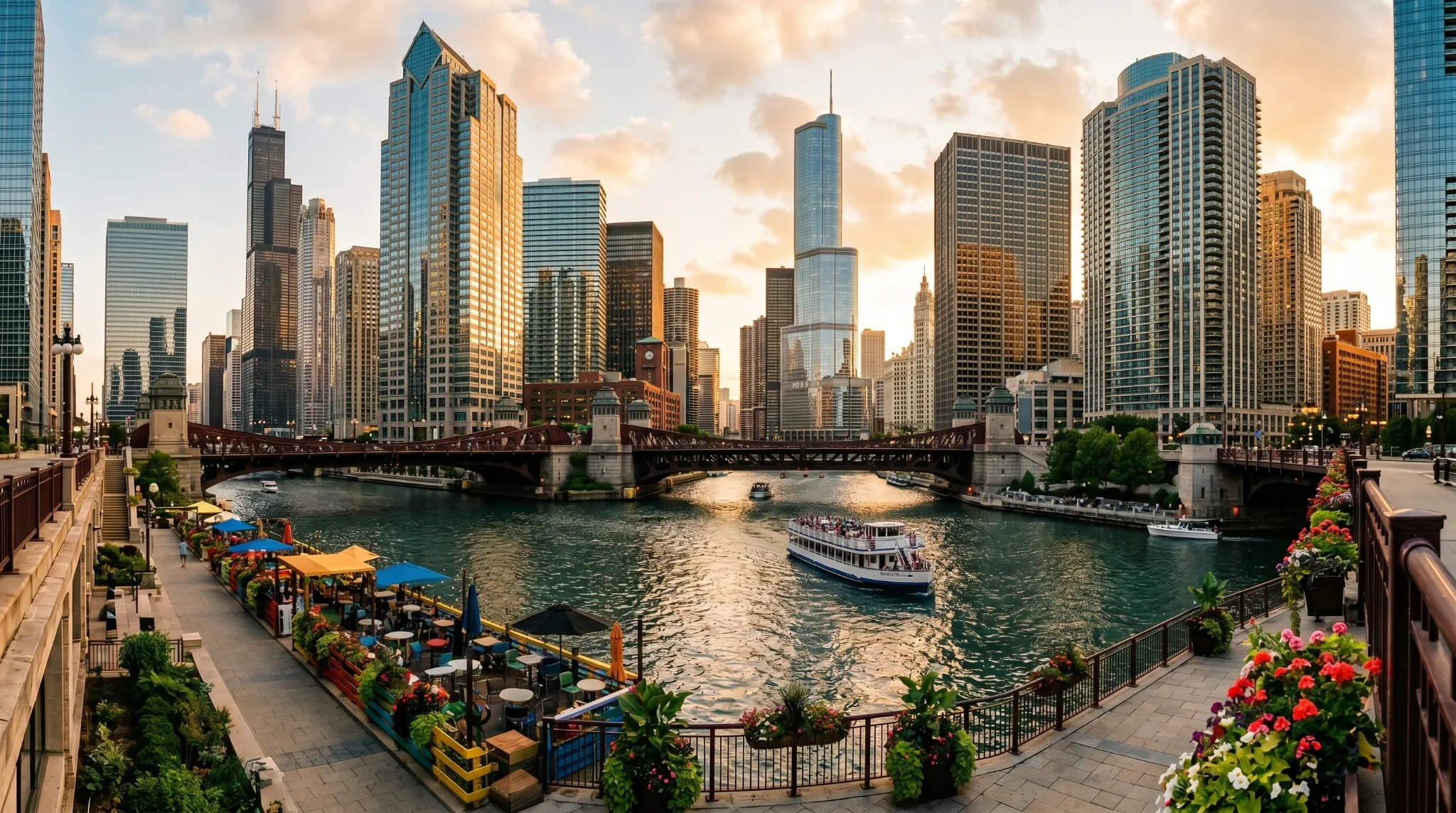
I stood on a bridge over the Chicago River and closed my eyes. Below me, patios full of flowers, people laughing with their beers like they had decided — collectively — that life was meant to be enjoyed right now. The sound rose off the water and hit me somewhere I wasn't expecting. Not one other American city has done that to me.
I've been twice. I still think about the deep dish pizza we couldn't finish. I still think about the architecture boat tour I liked so much I did it a second time. And I still think about that river.
Chicago Travel Guide: Everything You Need to Know for 2026
Last Updated: June 2026
Table of Contents
- What Is Chicago and Why Should You Visit?
- How Do You Get To and Around Chicago?
- What Are the Top Attractions in Chicago?
- What Are the Best Neighborhoods in Chicago?
- What Is the Nightlife Like in Chicago?
- What Food Should You Try in Chicago?
- Where Should You Shop in Chicago?
- What Festivals and Events Happen in Chicago?
- Where Should You Stay in Chicago?
- What Do You Need to Know Before Visiting Chicago?
- What Are the Best Day Trips from Chicago?
- What Did I Learn After Two Trips to Chicago?
- How Can You Save Money in Chicago?
- Frequently Asked Questions About Chicago
What Is Chicago and Why Should You Visit?
Chicago is not what most people expect before they arrive. I expected a big American city. What I found was something closer to a European capital — structured, stylish, historically layered, with a river running through the center and bridges that actually lift and close to let boats pass underneath. That detail alone — the drawbridges moving over the water while people watch from bar patios on either side — tells you something important about how this city was built and how it lives.
The first thing Chicago did to me was stop me mid-step on a bridge over the river. Below me, bar patios covered in flowers, people laughing with their beers on a Tuesday afternoon like they had collectively decided that life was meant to be enjoyed right now. The sound rose off the water and hit me somewhere I wasn't expecting. I took a breath, closed my eyes, and stood there. When I opened them I felt full — not of food or wine, but of something harder to name. Joy, I think. Real joy. Not one other American city has done that to me. The closest comparison I have is Milan — that same European ease, that sense that the people around you have made a decision about how to live and are simply getting on with it.
What pulled me back for a second visit was the combination of things that are genuinely hard to find together. The skyline has real color and variety — it does not look like one era of architecture stamped out endlessly. The streets are clean in a way that surprises you for a city this size. And the style — the clothes in the windows, the store design, the way restaurants present themselves — everything has a sharpness to it. After New York, I believe Chicago is the most stylish and fashionable city in North America.
I stayed near Museum Campus both visits — Shedd Aquarium, the Field Museum, the Adler Planetarium all within walking distance, the lakefront right there. It is one of the best-positioned parts of the city to base yourself and I would choose it again without thinking twice.
When Is the Best Time to Visit Chicago?
June through September is when Chicago is fully alive — but if I am choosing, late May and early September hit the sweet spot between good weather and manageable crowds.
Best months: June and September — The lakefront is genuinely beautiful, outdoor festivals are running, restaurant patios are full, and you can walk between neighborhoods without being either frozen or overwhelmed by heat. September specifically has some of the best weather of the year and noticeably thinner crowds than peak summer.
Avoid: January and February — Chicago earned its wind reputation honestly. The cold off Lake Michigan in winter is not a normal cold. It is a physical thing that hits you and keeps hitting you. I have been in February and spent most of my time finding reasons to stay indoors. Unless you have a specific reason to go in winter, do not.
Budget season: November through March — Hotel prices drop significantly, the museums are quieter, and the Christmas markets in late November and December are genuinely charming if you dress properly for it.
- Spring (April–May): Warming up, occasional rain, good hotel rates, the city coming back to life — worth considering for anyone who wants to avoid peak prices
- Summer (June–August): Peak season, festivals everywhere, hot and humid but the lake saves you — plan and book well ahead
- Fall (September–October): My personal favorite — perfect temperatures, beautiful light, crowds thinning, the lakefront at its most photogenic
- Winter (November–March): Cold and windy but the cheapest rates of the year, festive in December, excellent for anyone who loves museums over outdoor activities
How Many Days Do You Need in Chicago?
Three days is the absolute minimum — four to five days is what I actually recommend for a first visit, and I say that as someone who has done both.
3 to 4 days — You can cover the Loop, Millennium Park, the architecture tour, one or two major museums, the Magnificent Mile, a neighborhood deep dive, and enough meals to understand what Chicago food is actually about. This is the minimum I would book.
5 to 7 days — This is where the trip gets genuinely good. You have time for Hyde Park and the University of Chicago campus, a full day in Wicker Park or Logan Square, a day trip to the Indiana Dunes or Milwaukee, and you can eat your way through the West Loop properly without rushing.
One week or more — For anyone who loves cities deeply, Chicago rewards a long stay. The neighborhoods alone could take two weeks to properly explore, and you still would not have finished.
Quick Facts About Chicago
- Language: English — no language barrier anywhere in the city
- Currency: US Dollar (USD)
- Time Zone: Central Time (UTC-6, UTC-5 during daylight saving)
- Climate: Humid continental — hot summers, brutally cold winters, genuinely beautiful spring and fall
- Best airport: O'Hare International (ORD) for most international flights; Midway (MDW) for budget domestic
- Getting around: CTA L train, buses, rideshare, and walking in the center
- Emergency number: 911
How Do You Get To and Around Chicago?
I want to tell you something about arriving in Chicago with a car. We drove in on one trip, which felt convenient until we needed to park. What followed was an amount of time I do not want to admit spent circling and reading confusing signs. The moment we finally found parking in the hotel garage, we made a decision — the car stays here. We did not move it for the entire trip. We walked, took the L, flagged taxis. It was one of the best decisions of that visit.
Which Airports Serve Chicago?
Chicago has two main airports. O'Hare International (ORD) handles most international and major domestic flights — it is one of the busiest airports in the world and genuinely enormous, which means give yourself time when connecting through it. Midway Airport (MDW) is smaller, closer to the city center, and primarily serves budget domestic carriers. For most international visitors, you will arrive at O'Hare.
How Do You Get from the Airport to the City?
From O'Hare, the Blue Line L train is what I recommend without hesitation for solo travelers or couples traveling light. It runs directly from the airport to downtown in about 45 minutes and costs $5 USD regardless of time of day. Buy a Ventra card at the airport the moment you arrive — it works on every L line and bus in the city.
Blue Line L train: Trains run frequently, the journey is direct, and you arrive right in the heart of the Loop. The only honest caveat is that with large luggage on a crowded rush hour train it can be uncomfortable. Outside rush hour it is easy and completely stress-free.
Rideshare (Uber/Lyft): Budget $35 to $55 from O'Hare depending on traffic and time of day. Split between two or three people with luggage it becomes reasonable, and door-to-door convenience after a long flight is genuinely worth something.
Official taxi: Taxi stands are well marked at O'Hare. Expect around $40 to $55 to the Loop plus tip. Agree on the metered fare only — never accept a flat rate offered by someone approaching you at arrivals.
I use Wise for all my travel spending — no hidden exchange rate fees and I pay in USD at the real mid-market rate. Set it up before you leave home.
I always compare transfer options before booking — prices for the same route vary more than you would expect.
What Is the Best Way to Get Around Chicago?
The CTA L train is the backbone of getting around and I use it for almost everything in the central city. It is fast, runs around the clock on most lines, and a single ride costs $2.50 with a Ventra card. The city makes sense from the L in a way it does not always from street level.
CTA L train: Eight color-coded lines covering the Loop, all major tourist neighborhoods, both airports, and most of the inner city. A single fare is $2.50 with a Ventra card. Day passes ($10) and 3-day passes ($20) are worth it if you are riding more than three times a day — they pay for themselves quickly.
Rideshare (Uber/Lyft): Readily available everywhere. Useful for late nights or neighborhoods where the L is less convenient. Expect $10 to $20 for most inner-city trips. Surge pricing applies on weekend nights and during large events.
Walking: The Loop, River North, Millennium Park, the Magnificent Mile, and the Riverwalk are all extremely walkable and closer together than a map suggests. I have easily covered 20,000 steps a day in Chicago without trying. Wear comfortable shoes — the Chicago sidewalks and pavement will punish you otherwise, and unlike Rome's cobblestones which ruin you in a beautiful way, Chicago pavement just ruins you.
I never arrive in a new country or city without an eSIM already active on my phone. Airalo takes five minutes to set up before your flight and saves you the stress of finding a SIM card when you land exhausted.
What Are the Top Attractions and Landmarks in Chicago?
What I noticed about Chicago's attractions across two visits is that they do not feel managed for tourists. The river with its moving bridges and bar patios is not a tourist installation — it is how Chicago lives. The architecture tour takes you past buildings that Chicagoans walk past every morning on the way to work and are still visibly proud of. That ownership of the city's beauty makes every attraction feel more real than it does in cities that exist primarily to be visited.
Is the Chicago Architecture River Cruise Worth It?
Chicago Riverwalk, 112 W Wacker Dr, Chicago, IL 60601
The first time I booked this I did it because a friend who knows Chicago well told me it was non-negotiable. She was right. You float down the Chicago River with a guide pointing out which building is which — when it was built, who designed it, what it replaced, why it mattered — and by the end the whole city has changed. What was just an impressive skyline becomes a readable story.
I liked it so much that on my second visit I brought Arman and did it again. It held up completely. On the second trip I noticed different things — buildings I had walked past all week that suddenly made sense from the water. The views looking up at the skyline from river level are unlike anything you see from street level or from above.
Why visit: It is genuinely the best orientation to Chicago you can get. Everything else in the city makes more sense after ninety minutes on that boat. Do it on day one.
Entrance: Around $47 to $55 USD (2026) — book online
Best time: Morning departure for the best light
Hours: Multiple daily departures, April through November
What Is Cloud Gate and Why Does Everyone Go to Millennium Park?
Millennium Park, 201 E Randolph St, Chicago, IL 60602
I went to Millennium Park slightly prepared to be underwhelmed. I had seen the photos of Cloud Gate a hundred times and assumed I knew what it was. Then I got close to it and understood. It is 33 feet tall, made of polished stainless steel, and it reflects a distorted panoramic view of the entire skyline and everyone standing around you simultaneously. Photographs cannot explain what it actually does to your sense of space.
Millennium Park itself is enormous, beautifully maintained, and free. The Crown Fountain, the Lurie Garden, and the Jay Pritzker Pavilion are all worth exploring. Summer concerts at the Pavilion are free and regularly feature genuinely excellent performers — not tribute acts, real concerts.
Why visit: It is free, it is beautiful, and it is one of the best urban green spaces in North America. There is no reason not to spend at least an hour here every day you are in Chicago.
Entrance: Free
Best time: Early morning for fewer crowds and better reflections
Hours: Park open 6am to 11pm daily
Is the Art Institute of Chicago Worth the Entry Price?
111 S Michigan Ave, Chicago, IL 60603
I went to the Art Institute expecting to spend two hours and stayed for almost five. I say this as someone who visits a lot of museums in a lot of cities — this is a genuinely world-class collection, not a regional museum doing its best. The Impressionist and Post-Impressionist collection alone would justify the entry price. Seurat's A Sunday on La Grande Jatte is here in person and it is staggering in scale. Grant Wood's American Gothic is here. Edward Hopper's Nighthawks is here.
If any of those names mean anything to you, this museum is not optional. If none of them do, go anyway — you will leave knowing exactly why they matter.
Why visit: This is one of the top five art museums in North America. Even travelers who do not think of themselves as museum people tend to be surprised by how much they respond to it.
Entrance: $35 USD adults (2026) — book online for timed entry
Best time: Weekday mornings for the thinnest crowds
Hours: Thursday to Monday 11am–5pm, Thursday until 8pm; closed Tuesday and Wednesday
Is the Starbucks Reserve Roastery on Michigan Avenue Worth Visiting?
646 N Michigan Ave, Chicago, IL 60611
I want to tell you about the moment I first saw this building. I was walking along Michigan Avenue when I looked up and noticed people standing on a rooftop above me, holding cups, looking out over the street. I stood on the sidewalk trying to figure out what I was looking at. Then I saw the sign. It was a Starbucks. Six floors of Starbucks, with a rooftop where people drink coffee above one of the most famous shopping streets in America.
I am not someone who normally puts a coffee chain on a must-visit list. But this is not a coffee chain — it is a building. The roastery has its own bakery, a cocktail bar on the upper floors, a viewing area for the actual roasting equipment, and more coffee options than most people know exist. I went in curious and stayed much longer than I planned.
Why visit: The rooftop view of Michigan Avenue is free once you have your drink in hand, and the building itself is genuinely unlike any other Starbucks on earth. Worth it purely for the experience of standing up there.
Entrance: Free to enter — pay for what you order
Best time: Mid-morning on a weekday before the tourist crowds build
Hours: Daily 7am to 11pm
What Is Museum Campus and Is It Worth a Full Day?
Museum Campus Dr, Chicago, IL 60605
Museum Campus is where I stayed on both visits and I cannot recommend it highly enough as a base. Three world-class institutions sit together on the lakefront — Shedd Aquarium, the Field Museum, and Adler Planetarium — with Soldier Field next to them and the lake stretching out behind. On a clear day the view from Museum Campus looking back at the skyline is one of the best in Chicago.
The Shedd Aquarium is exceptional — one of the finest inland aquariums in the world. The Field Museum is a natural history institution of genuine global importance. The Adler Planetarium is excellent for anyone with any interest in space. You cannot do all three in one day and do any of them justice. Pick the one that interests you most and give it proper time.
Why visit: Even if you only walk the lakefront path along Museum Campus without entering any of the buildings, the views and the scale of the setting are worth the trip from downtown.
Entrance: Shedd Aquarium around $40 USD; Field Museum around $30 to $40 USD (2026)
Best time: Weekday mornings
Hours: Daily 9am to 5pm or 6pm depending on institution
What Is the Chicago Riverwalk and Why Is It Different at Night?
Chicago Riverwalk, W Wacker Dr to Lake St, Chicago, IL 60601
The second time I walked the Riverwalk I went alone in the early evening while Arman stayed at the hotel. I had no plan — just started walking west from the lake end as the sun dropped. The bridge lights came on one by one while I was still walking. I stopped at a railing somewhere in the middle, looked down at the water, and stayed there longer than I can explain. There was music coming from somewhere. The city was doing what it does at that hour — settling into the evening, filling up, becoming itself. I missed it before I even left. That is the Riverwalk at dusk. Walk it at least once without a destination and stay until the lights are on.
What I did not expect was how different it feels in the evening. The bridge lights come on, the restaurants fill up, and the whole stretch transforms into something that genuinely rivals the most beautiful urban waterfronts I have seen anywhere. I walked it once in the middle of the day and again on a Thursday evening and they felt like completely different places. Go at both times if you can.
Why visit: It is free, it is beautiful, it connects several major sights, and it shows you Chicago as residents actually experience it rather than as a tourist attraction packaged for visitors.
Entrance: Free
Best time: Late afternoon into evening in summer — stay until the bridge lights come on
Hours: Always accessible; businesses open seasonally
Is the Chicago Cultural Center Worth Visiting?
78 E Washington St, Chicago, IL 60602
The Chicago Cultural Center is one of the most beautiful buildings I have walked into anywhere and it is completely free. The building was originally the city's main public library, opened in 1897, and the interior has two Tiffany glass domes that stop you when you look up at them. Most tourists walk right past it on their way to Millennium Park without knowing it exists.
It hosts rotating exhibitions of contemporary art and photography that are frequently excellent — free to enter, no booking required. I went in expecting to spend fifteen minutes and stayed for well over an hour. That has happened to me twice now in this building.
Why visit: Free entry, world-class Tiffany glass interior, quality exhibitions. There is no reason not to at least look inside when you are already in the Loop.
Entrance: Free
Best time: Any weekday
Hours: Monday to Thursday 10am–7pm, Friday 10am–6pm, Saturday 10am–5pm, Sunday 10am–3pm
What Are the Best Neighborhoods to Explore in Chicago?
What makes Chicago's neighborhoods worth exploring is that they genuinely have distinct personalities. This is not one of those cities where every area looks like the last one painted a different color. The shift from the Loop to Lincoln Park to Pilsen is as pronounced as going to a different city entirely. I discovered this on my second visit when I spent an afternoon in a neighborhood I had not planned to go to and ended up staying for most of the day.
Why Is the Loop and River North the Best Base for First Visits?
The Loop is Chicago's downtown core — the financial district, the theater district, and the starting point for almost everything a first-time visitor wants to see. River North sits just north of the river and has better restaurant density in the evening, with more nightlife options and some of the city's best hotels. I passed through River North constantly on both visits and the energy there — particularly on warm evenings — reminded me of the best parts of any European city center I have spent time in.
Best for: First-time visitors, anyone who wants to walk to major attractions, travelers who want the city to reveal itself gradually
Must experience: The Riverwalk at sunset, Theater District in the evening, Millennium Park in the morning before the crowds, deep dish on East Ohio Street
Getting there: Directly accessible from O'Hare on the Blue Line; every L line passes through here
Why Is Lincoln Park One of Chicago's Most Livable Neighborhoods?
Lincoln Park runs north of the city along the lakefront and is one of the most beautiful residential neighborhoods I have walked through anywhere in North America. The free Lincoln Park Zoo, the Conservatory, and some of the best restaurant blocks in the city are here. It has a human scale that the Loop does not — tree-lined streets, brownstone buildings, the lake at the end of almost every east-facing road. I spent a full afternoon walking between Clark Street and the lakefront path and it was one of my favorite days of either trip.
Best for: Families, food lovers, anyone who wants a quieter lakefront base with genuine neighborhood character
Must experience: Free Lincoln Park Zoo, Armitage Avenue restaurants, the lakefront path north toward Wrigleyville on a clear afternoon
Getting there: Brown or Red Line to Armitage or Fullerton stations
What Makes Wicker Park Worth a Full Afternoon?
Wicker Park is where Chicago's independent creative scene lives — vintage shops, excellent coffee, craft cocktail bars, and restaurants that are not trying to impress anyone except the locals who eat there every week. It is about 15 minutes from the Loop on the Blue Line and it feels like a completely different city when you step off the train. The Milwaukee Avenue strip has the kind of stores you find yourself going into without planning to and leaving with something you did not need but genuinely want.
Best for: Independent shopping, anyone tired of tourist-area dining, travelers who want to see Chicago without a tourist filter
Must experience: Milwaukee Avenue from end to end, the craft cocktail bars around Division Street, Sunday morning coffee at any neighborhood café
Getting there: Blue Line to Damen station
Should You Visit Hyde Park and the University of Chicago?
Hyde Park sits on the South Side about 30 minutes from the Loop and is home to the University of Chicago — one of the most architecturally dramatic campuses in the world — and the Museum of Science and Industry. The Obama Presidential Center is being developed here. It is worth a dedicated half day on any trip longer than four nights. The campus alone is worth the journey — the Gothic stone buildings and the quads feel like Oxford arrived in the American Midwest and decided to stay.
Best for: Architecture lovers, families, anyone interested in American intellectual or political history
Must experience: University of Chicago campus walk, Museum of Science and Industry, Medici on 57th for coffee afterward
Getting there: Metra Electric Line from Millennium Station, or about $20 rideshare from the Loop
What Is Pilsen and Why Do Serious Travelers Go There?
Pilsen is Chicago's historically Mexican neighborhood on the Lower West Side and it has some of the most authentic Mexican food in the United States alongside murals covering entire building facades that stop you on the street. The National Museum of Mexican Art is here and it is free and genuinely excellent. I have eaten tacos in Pilsen that I still think about — a place with four tables, no decor, no sign you could read from the street, and food that made everything I thought I knew about tacos feel approximate.
Best for: Food lovers, anyone interested in public art, travelers who want Chicago beyond the tourist circuit
Must experience: 18th Street murals and taquerias, National Museum of Mexican Art, weekend community market
Getting there: Pink Line to 18th Street station
What Is the Nightlife Like in Chicago?
I want to tell you about a night in Wicker Park that I still think about. A small jazz room above a bar, music starting at 11pm, by midnight the room so warm and full of sound that you stopped thinking about anything else. No tourist atmosphere, no performance for visitors — just a room of people who love music gathered around musicians who play like they cannot help it. That is the Chicago night I would describe to anyone asking whether the city's music scene is real. It is very real.
Where Are the Best Areas for Nightlife in Chicago?
River North is the most concentrated nightlife district — the most bars, the most clubs, the most options within walking distance of each other, and the most accessible from downtown hotels. Wicker Park is for anyone who prefers craft cocktails and live music over bottle service. The Wrigleyville neighborhood around Wrigley Field is loud and sports-bar-centric and is genuinely fun on game nights in a way that is hard to replicate anywhere else.
What Are the Best Bars and Clubs in Chicago?
Bars and Pubs
- The Violet Hour — 1520 N Damen Ave, Wicker Park — One of the best craft cocktail bars in the United States. No sign on the door, curtains across the windows, serious cocktails made by people who understand what they are doing. Dress to at least make an effort.
- Three Dots and a Dash — 435 N Clark St, River North — Hidden tiki bar in a basement accessible through an alley. The cocktails are exceptional and the atmosphere is completely unique for Chicago. Go early or expect a wait.
- Hopleaf Bar — 5148 N Clark St, Andersonville — Belgian beer list of over 50 beers, excellent mussels and frites, a neighborhood pub that has been doing things right for decades without needing anyone's approval.
Clubs and Dancing
- Spybar — 646 N Franklin St, River North — Chicago's best underground house and techno club, open Thursday through Saturday. The sound system is exceptional and the room is serious about music.
- Smart Bar — 3730 N Clark St, Wrigleyville — Legendary Chicago underground club that has been running since 1982. Proper dance music, no attitude, serious nights from people who have been coming here for years.
Live Music and Blues
- BLUES — 2519 N Halsted St, Lincoln Park — The real thing. Live Chicago blues seven nights a week in a room small enough that you feel the music in your chest. This is one of the most authentic music experiences in North America and I say that without qualification.
- Kingston Mines — 2548 N Halsted St, Lincoln Park — Two stages running simultaneously, which means continuous music and you can move between rooms all night. Stays open until 4am on weekends. This is the full Chicago blues experience.
- Andy's Jazz Club — 11 E Hubbard St, River North — Jazz lunch and dinner shows starting at noon. One of the longest-running jazz venues in the city and one of the most accessible for anyone new to live jazz.
What Family-Friendly Evening Entertainment Is Available?
Second City — the famous comedy club that launched more careers than anywhere else in American comedy — offers shows most evenings and is genuinely excellent even if you are not a comedy obsessive. The Chicago Symphony Orchestra performs regularly at Symphony Center. Free summer concerts at Millennium Park's Jay Pritzker Pavilion are family-friendly, world-class, and cost nothing beyond the price of getting there.
What Food Should You Try in Chicago?
I need to tell you something about Chicago food before we go any further. I did not fully understand what this city eats until I was sitting at a counter at 1pm on a Tuesday with an Italian beef sandwich in both hands, the bread soaked completely through with beef juice, falling apart before it reached my mouth, and I stopped thinking about anything else entirely. That is the real Chicago food experience. Not always refined. Always honest. Always worth it.
How Do Chicagoans Actually Eat?
Chicagoans eat late by American standards and they have strong opinions about food that border on personal. Nobody here is neutral about which pizza place is best, which hot dog stand is worth the trip, which Italian beef spot is the real one. These are not preferences — they are convictions. Ask any local where to eat for whatever you are craving and they will give you an answer with real certainty and real reasons.
The food culture is deeply neighborhood-based. The best meals I ate in Chicago were not at famous restaurants. They were at counter places and neighborhood spots that a friend pointed me toward, where there was no decor worth mentioning and the food required nothing but your full attention.
What Are the Must-Try Dishes in Chicago?
- Deep Dish Pizza — The defining Chicago food, and I want to give you one honest warning: if you do not love a lot of cheese, order carefully. Three of us sat down and ordered one pizza between us. It was enormous. The cheese alone was thicker than a normal pizza entire. We ate until we could not, and there was still pizza on the table. This is not a meal — it is an event. Budget 45 minutes, order it in advance by phone so it is ready when you sit down, and do not make plans for two hours afterward.
- Italian Beef Sandwich — Thinly sliced seasoned beef on Italian bread, dipped in the cooking juices. Order it wet. Top it with giardiniera. This is what I think about when I leave Chicago — not the architecture, not the skyline. The beef sandwich.
- Chicago-Style Hot Dog — Vienna Beef frank on a poppy seed bun with yellow mustard, onion, relish, tomato, pickle, sport peppers, and celery salt. No ketchup. This is a rule, not a preference. Chicagoans will notice and they will have feelings about it.
- Garrett Popcorn Chicago Mix — Caramel and cheddar popcorn combined in a way that sounds wrong and tastes extraordinary. I bring a large tin home every visit. The line at the Michigan Avenue shop moves quickly.
- Tavern-Style Thin Crust Pizza — The pizza most Chicago locals actually eat regularly — thin, crispy, cut in squares not slices. Not what tourists think of as Chicago pizza but arguably what residents love more. Try both styles and understand why the city has two entirely distinct pizza identities.
- Jibarito — A Chicago original — sandwich made with flattened fried plantains instead of bread, filled with steak or chicken, garlic mayo, and cheese. Humboldt Park is where it originated. Genuinely unlike anything else.
Where Should You Eat in Chicago?
Budget — Under $15 USD per meal
- Al's Beef — 1079 W Taylor St, Little Italy — The original Italian beef stand. Counter service, plastic seating, perfect sandwich. Order it wet. This is a non-negotiable Chicago experience.
- Portillo's — Multiple locations including 100 W Ontario St, River North — Italian beef, Chicago dogs, cheese fries. Loud, cafeteria-style, completely satisfying and completely Chicago.
Mid-Range — $20 to $60 USD per meal
- Lou Malnati's — Multiple locations including 439 N Wells St, River North — The deep dish benchmark. Order the Malnati Chicago Classic, call ahead so it is ready when you arrive, and do not rush.
- Pequod's Pizza — 2207 N Clybourn Ave, Lincoln Park — Caramelized cheese edge on the deep dish that becomes a crispy crust. Many Chicagoans argue this is the best deep dish in the city. The argument is reasonable.
- Girl and the Goat — 800 W Randolph St, West Loop — Stephanie Izard's flagship on Restaurant Row. Share plates, wood-fired everything, a room full of Chicagoans eating very well. Book well in advance.
Fine Dining — $100 USD+ per meal
- Alinea — 1723 N Halsted St, Lincoln Park — Three Michelin stars. One of the most creative dining experiences in the world. Reservations open 60 days in advance and sell out within hours. Check the website regularly for cancellation spots.
- Smyth — 177 N Ada St, West Loop — Two Michelin stars, farm-focused tasting menu, one of Chicago's best fine dining experiences at a price point below Alinea.
What Are the Dining Customs in Chicago?
Americans eat dinner between 6pm and 8pm, which is earlier than most of the world. Reservations at popular restaurants are essentially mandatory, especially in the West Loop on weekends. Walk-in culture exists at casual spots and counter places — which are often where the best food is anyway.
Meal times: Breakfast 7am to 10am, lunch 11:30am to 2pm, dinner 5:30pm to 10pm (later on weekends)
Tipping: 18 to 20 percent at sit-down restaurants — this is not optional in American dining culture, it is how servers are paid
Ordering: Water is always free and automatically brought. Splitting bills is commonly and cheerfully accommodated.
Chicago’s food culture is deeply neighborhood-specific — the best Italian beef spot, the right deep dish place, the tavern pizza that locals actually eat. A guided food tour cuts through the noise and puts you in the right rooms. Book a Chicago food tour →
Where Should You Shop in Chicago?
What Are the Best Shopping Areas in Chicago?
I want to say something honest about Chicago shopping before listing the areas. I have traveled to a lot of cities and shopped in a lot of places. Chicago's Michigan Avenue stopped me more times per block than almost anywhere I have been outside of Milan or Paris. The clothes in the windows, the store design, the way people dress walking down that street on an ordinary weekday — it has a level of style that most cities simply do not reach. I noticed it immediately and I noticed it again on the second visit.
- The Magnificent Mile — Michigan Avenue from the river to Oak Street: Louis Vuitton, Apple, Nordstrom, Bloomingdale's, Zara, and every major international brand on one of the most beautifully designed shopping streets in North America. Clean, organized, walkable, and genuinely impressive even as a non-shopping experience.
- Oak Street: One block from the Mag Mile — Hermès, Prada, Barneys, and high-end boutiques in a quieter, more rarefied setting. Chicago's luxury corridor.
- Milwaukee Avenue, Wicker Park: Independent boutiques, vintage clothing shops, record stores, bookshops, and things you have never seen before. My personal favorite shopping street in Chicago — you find things here rather than buying things.
- Armitage Avenue, Lincoln Park: Independent home goods, clothing boutiques, and specialty stores on a beautiful tree-lined street. The neighborhood version of the Magnificent Mile, without the crowds or the flagship stores.
What Should You Buy in Chicago?
- Garrett Popcorn Chicago Mix — The caramel and cheddar combination is a Chicago original and you cannot find it this good anywhere else. Buy a large tin and carry it home carefully.
- Vintage vinyl records — Chicago has a serious vinyl culture. Reckless Records in Wicker Park and the Loop is the benchmark.
- Chicago sports merchandise — Bears, Bulls, Blackhawks, Cubs, White Sox — the team stores in Chicago are better than typical tourist merchandise shops because the city actually cares about these teams.
- Architecture books and prints — The Chicago Architecture Center bookshop has the best selection of Chicago architecture books anywhere. Worth browsing even if you only buy one.
What Festivals and Events Happen in Chicago?
What Is the Annual Events Calendar for Chicago?
| Month | Event | What to Expect |
|---|---|---|
| January | Chicago Restaurant Week | Fixed-price menus at hundreds of restaurants — the best value way to eat at Chicago's top tables |
| March | St. Patrick's Day — Chicago River Dyeing | The river is dyed green with vegetable dye — a genuinely bizarre and wonderful Chicago tradition that has been happening since 1962 |
| April | Chicago Cubs Opening Day | Wrigley Field season opener — the entire Wrigleyville neighborhood comes alive in a way that is worth experiencing even if you do not follow baseball |
| June | Chicago Blues Festival | Free three-day festival in Grant Park — the world's largest free blues festival and one of the best reasons to visit Chicago in early summer |
| July | Taste of Chicago | Five days in Grant Park with dozens of Chicago restaurants — free entry, food purchased with tickets, the best way to eat across multiple cuisines in one afternoon |
| July | Pitchfork Music Festival | Three-day indie music festival in Union Park — one of the best-curated lineups in the United States |
| August | Lollapalooza | Four-day mega festival in Grant Park with 170+ artists — the biggest summer event in Chicago and the one that causes the biggest hotel price spike of the year |
| September | Chicago Jazz Festival | Free four-day festival in Millennium Park — exceptional programming, real jazz, and one of the best free cultural events in North America |
| October | Chicago Marathon | One of the six World Marathon Majors — the city genuinely transforms around it |
| November–December | Christkindlmarket | German-style Christmas market in Daley Plaza — the oldest and largest in North America, genuinely charming if you dress for the cold |
How Do Festivals Affect Hotel Prices and Availability?
Lollapalooza on the first weekend of August causes the biggest hotel price spike of the year — rates can double or triple from the week before. Book at least three months in advance if your visit overlaps with it. The Chicago Marathon weekend in October is the second biggest spike.
Where Should You Stay in Chicago?
Here is something I learned about Chicago accommodation that nobody told me before my first visit. The hotel taxes in Chicago are among the highest in the United States — often 17 to 22 percent on top of the quoted room rate. A hotel that looks cheaper than another option can end up more expensive once taxes are calculated. Always check the total price with taxes before comparing. I made this mistake once and paid more than I expected to.
What Are the Best Areas to Stay in Chicago?
For first-time visitors: River North or the Loop. For anyone who wants lakefront access and a quieter base: Museum Campus or Lincoln Park. For repeat visitors who want to go deeper into Chicago: Wicker Park.
| Area | Best For | Price Range (per night, 2026) | Transport |
|---|---|---|---|
| River North | First-time visitors, nightlife access, restaurant density | $180 to $400 USD | Red Line, Brown Line, walk to Loop |
| The Loop | Business travelers, transit access, central location | $150 to $320 USD | All major L lines converge here |
| Museum Campus / South Loop | Lakefront access, quieter evenings, families | $140 to $300 USD | Bus or rideshare to Loop; walkable to Museum Campus |
| Lincoln Park | Families, lakefront, neighborhood character | $160 to $350 USD | Red Line to Fullerton or Armitage |
| Wicker Park | Independent travelers, arts and food scene | $130 to $280 USD | Blue Line to Damen |
What Should You Expect at Different Price Points?
Budget — under $120 USD: Hostels in Wicker Park and Lincoln Park are clean and well-run. Budget hotels in the Loop exist but tend to be older properties — read recent reviews from the last three months carefully before booking.
Mid-range — $150 to $300 USD: Excellent options throughout River North, the Loop, and Lincoln Park. The Virgin Hotels Chicago, Hotel Julian, and 21c Museum Hotel are all good mid-range choices with genuine character rather than generic business hotel feel.
Luxury — $350 USD+: The Peninsula, Waldorf Astoria on the Gold Coast, and Four Seasons on the Magnificent Mile are the standard-bearers. The views from the upper floors of these hotels looking out over Lake Michigan are extraordinary.
What Should You Know Before Booking in Chicago?
Book hotels with free cancellation — Chicago's weather and event calendar can change your plans and the flexibility is worth the small premium over non-refundable rates. Book accommodation with parking confirmed in writing if you are driving — not all downtown hotels have it, and nearby garages charge $40 to $60 per day.
I always book accommodation with free cancellation — plans change and flexibility is worth the small extra cost.
What Do You Need to Know Before Visiting Chicago?
How Should You Handle Money in Chicago?
Chicago is almost entirely card-friendly — I rarely use cash for anything beyond smaller food stands, markets, and tipping hotel staff. Most street vendors and food trucks now accept card. That said, keeping $50 USD cash on hand is always useful in any American city for situations where card is not accepted.
I use Wise for all my travel spending — no hidden exchange rate fees and I pay in USD at the real mid-market rate when traveling from Canada. Set it up before you leave home.
How Do You Get Data or a SIM Card for Chicago?
For Canadian and international travelers, an eSIM is far more convenient than buying a US SIM card on arrival. I set up my US eSIM before I leave Toronto and it is active the moment the plane lands at O'Hare. No searching for a store, no waiting, no activation problems when you are exhausted from travel.
For Canadian travelers, your existing US roaming plan may already cover Chicago — check with your carrier before you leave. If not, the eSIM you set up for arrival covers you for the entire trip without needing to do anything on the ground.
Do You Need Travel Insurance for Chicago?
Yes — and the United States makes this more critical than almost any other destination on earth. Healthcare costs in the US are extraordinary in a way that shocks most international visitors. A single emergency room visit without insurance can cost $3,000 to $10,000 USD. I have a personal rule that I will not cross into the United States without travel insurance active, regardless of how short the trip is.
I ended up in hospital on one trip and my travel insurance covered every cent. Never travel without it regardless of how healthy you feel or how short your trip is.
Do You Need a Visa to Visit Chicago?
Canadian citizens do not require a visa to enter the United States — you need a valid Canadian passport. American citizens need nothing. British and Australian citizens currently enter under the Visa Waiver Program (ESTA) — ensure your ESTA is approved before travel as it must be done in advance online. All visitors should have at least six months validity remaining on their passport at time of travel.
How Do You Get Around Chicago Using Transit?
The CTA L runs on eight color-coded lines, 24 hours a day on the Blue and Red Lines, reduced overnight schedule on others. Buy a Ventra card at the airport and load a day or 3-day unlimited pass.
- Single ride: $2.50 USD with Ventra card ($3.25 cash)
- Day pass (unlimited): $10 USD
- 3-day pass (unlimited): $20 USD
- 7-day pass (unlimited): $28 USD
- Taxi base fare: $3.25 USD plus $1.80 per mile
Is Chicago Safe for Tourists?
The tourist areas of Chicago — the Loop, River North, Lincoln Park, Wicker Park, the Magnificent Mile, Museum Campus — are generally safe for visitors exercising normal urban awareness. Chicago has neighborhoods with serious crime issues but they are largely residential areas far from tourist circuits and not places you would accidentally end up.
Phone snatching has increased in major American cities including Chicago. Keep your phone in your pocket or bag when not actively using it in crowded areas like the Riverwalk, Millennium Park, and Navy Pier. Use a crossbody bag that closes properly rather than an open tote in tourist-dense areas.
What Are the Practical Basics for Visiting Chicago?
- Plug type: Type A and B (standard North American flat two/three pin) — no adapter needed for Canadian travelers
- Voltage: 120V — compatible with most modern devices; European travelers will need an adapter
- Drinking water: Tap water is safe to drink throughout Chicago
- Tipping: 18 to 20 percent at restaurants, $1 to $2 per drink at bars — this is not optional in American culture
- Business hours: Restaurants 11am to 10pm+; shops typically 10am to 8pm; museums 9am to 5pm
- Emergency number: 911 (police, fire, ambulance)
- Useful Chicago phrases: "The Bean" (Cloud Gate), "the Mag Mile" (Magnificent Mile), "the L" (elevated train), "dipped wet" (how to order Italian beef), "no ketchup" (Chicago hot dog rule — say this before they ask)
What Are the Best Day Trips from Chicago?
Chicago's position on Lake Michigan and its rail connections make it an unusually good base for day trips. You can be at a national park, a Great Lakes port city, a preserved 19th century river town, or one of the finest art museums in the Midwest all within two hours. The city rewards staying put and going outward.
Why Should You Do a Day Trip to Indiana Dunes from Chicago?
Indiana Dunes National Park is 45 minutes from downtown Chicago and most visitors to the city have never heard of it. You drive or train through suburban Chicago, cross into Indiana, and suddenly you are standing on 200-foot sand dunes looking out over Lake Michigan in a direction where the other shore is Canada. It is genuinely stunning and one of the most surprising natural landscapes accessible from any major city in North America.
Distance: 45 to 60 minutes by car; about 90 minutes on the South Shore Line commuter train from Millennium Station ($11 USD each way)
What to see: Mount Baldy dune, West Beach, Cowles Bog trail, the town of Chesterton for a post-hike meal
How to get there: South Shore Line train from Millennium Station — no parking stress and you arrive directly at Dune Park station
Time needed: Full day recommended — at least 4 to 5 hours in the park plus travel time
Why Should You Do a Day Trip to Milwaukee from Chicago?
Milwaukee is 90 minutes north of Chicago on the Amtrak Hiawatha service and it is a genuinely charming city that feels like Chicago slowed down to a more human pace. The Milwaukee Art Museum — the Calatrava-designed building alone justifies the trip — the Historic Third Ward neighborhood, and the city's German brewing heritage make for an excellent full day out. I have recommended this to friends and had good reports back every time.
Distance: 90 minutes on Amtrak Hiawatha from Chicago Union Station — runs frequently throughout the day
What to see: Milwaukee Art Museum, Historic Third Ward, Lakefront Brewery tour, East Side neighborhood
How to get there: Amtrak from Union Station — book the Hiawatha in advance on weekends, it fills up
Time needed: Full day — first train out, last train back
Should You Day Trip to Galena from Chicago?
Galena is a preserved 19th century river town in northwestern Illinois, about two and a half hours from Chicago, and it looks like time stopped in 1880. Ulysses Grant's home is here, the Main Street has one of the best concentrations of antique shops and independent restaurants outside a major city, and the surrounding hills and river valley are beautiful particularly in fall. This is a full day or better an overnight trip for anyone who wants to see a side of the Midwest that most travelers never find.
Distance: 2.5 hours by car — no direct train, so a car is necessary
What to see: Main Street historic district, Ulysses Grant Home State Historic Site, Galena River Trail
How to get there: Drive west on I-90 then south; or book a guided day trip from Chicago
Time needed: Full day at minimum — overnight recommended to do it properly
For Indiana Dunes specifically, a guided day trip is worth considering — the park is larger than it looks on a map and a local guide will take you to the stretches most visitors never find. Book an Indiana Dunes day trip →
What Did I Learn After Two Trips to Chicago?
I have made most of the Chicago mistakes by now. The parking situation. The deep dish pizza ordered without calling ahead. The architecture cruise left until the last day. The neighborhood I walked through once quickly and then regretted not spending a full afternoon in. Everything I know from two real trips — not from research — is in this section.
What Should You Do Before You Even Land in Chicago?
Book three things before you leave home: the architecture river cruise, dinner at one good West Loop restaurant, and your accommodation with parking confirmed if you are driving. The cruise sells out in summer. Restaurant tables at places like Girl and the Goat are gone weeks in advance. And if you are driving, confirm parking before you book the hotel — not after. I learned this the hard way.
Why Should You Leave Your Car at the Hotel and Never Move It?
I want to tell you about arriving in Chicago with a car. We drove in, which felt like a sensible plan. What followed was an amount of time I am not proud of spent trying to find parking before we even reached the hotel. When we finally got into the hotel garage, we looked at each other and made a decision — the car stays here. We did not move it once for the entire trip. We walked, took the L, flagged taxis when we needed to. It was one of the best decisions of that visit.
Chicago does not reward driving once you are inside it. The streets are logical but parking is expensive, enforcement is aggressive and fast, and the L goes everywhere you actually want to be. **Leave the car, buy a Ventra card, and use the time you would have spent looking for parking for something better.**
What Does Chicago Weather Actually Mean for How You Pack?
Chicago does not have mild weather — it has dramatic weather that is often pleasant. Summer can be 95°F (35°C) and humid; winter can be -20°F (-29°C) with wind chill. Even spring and fall have temperature swings within a single day that catch you unprepared if you have not been warned. Pack in layers regardless of when you visit. I have worn a winter coat to breakfast and a t-shirt to dinner on the same May day in Chicago and neither felt wrong at the time.
What Do Most Tourists Get Wrong About Deep Dish Pizza?
Most tourists eat deep dish pizza once, at the first famous place they find, treat it as a novelty item to check off the list, and miss what it actually is. The people who understand Chicago pizza eat it slowly, at a place someone local recommended, and understand they are not eating fast food. They are eating something that took 45 minutes to prepare and is meant to be the main event of the meal.
One honest warning from personal experience: if you do not love a lot of cheese, be prepared. Three of us sat down, ordered one deep dish, and it arrived looking like something an architect designed. The cheese alone was thicker than a normal pizza entire. We ate until we could genuinely not continue and there was still pizza on the table. Order it in advance by phone, arrive at the table ready to commit to it, and do not make other plans for two hours.
When Is the Starbucks Roastery Worth the Wait?
I stood on Michigan Avenue looking up at people on a Starbucks rooftop and could not immediately process what I was seeing. Six floors. A rooftop. People drinking coffee in the open air above one of the most famous shopping streets in America. I went in curious and stayed much longer than planned. Go on a weekday morning before the tourist crowds build and go to the rooftop first, before it fills up. The view north and south along Michigan Avenue from that height on a clear morning is something you will photograph and then look at later and still feel was real.
What Is the Best Way to Experience the Riverwalk Properly?
Most tourists walk the Riverwalk once during the day on the way to somewhere else. The better experience is a full evening there — start at the lake end, walk west, stop at one of the outdoor bars as the sun goes down, and stay long enough to see the bridge lights come on after dark. Stand at the railing for a moment. Look down at the patios. Listen to the laughter rising off the water. Let the city do what it does. You will understand why Chicagoans love this city the way they do — and you will understand why I took a deep breath and closed my eyes the first time I stood there.
How Can You Save Money in Chicago?
What Are the Best Money-Saving Strategies for Chicago?
- Buy a CTA Ventra 3-day or 7-day unlimited pass instead of single rides — saves money and removes the friction of paying per journey
- Eat the real Chicago food at counter places — hot dogs, Italian beef, deep dish at the source — and save fine dining for one meal at a genuinely excellent West Loop restaurant
- Buy the Chicago CityPASS if visiting three or more major attractions — typically saves $70 to $100 USD per person and removes the decision of whether each museum is worth the individual entry price
- Take the Blue Line from O'Hare rather than a taxi or rideshare — saves $30 to $45 USD each way per person
- Free Millennium Park concerts run throughout summer — the quality is genuinely high and the Grant Park setting rivals any paid venue
- Lincoln Park Zoo is completely free — one of the only free major zoos in the United States
- Lunch menus at high-end West Loop restaurants are 40 to 60 percent of dinner prices — the same kitchen, the same food, significantly less money
- Book hotels with free cancellation and set price alerts — Chicago hotel prices fluctuate and last-minute rates are sometimes better than advance booking rates outside peak season
- The Chicago Blues Festival in June and Jazz Festival in September are world-class and free
What Can You Do for Free in Chicago?
The free things in Chicago are not consolation prizes for what you cannot afford — they are legitimately among the best experiences in the city. The lakefront path alone could fill two days.
- Millennium Park and Cloud Gate: Best sculpture in the city, beautiful park, free summer concerts
- Chicago Riverwalk: One of the best urban waterfront walks in North America — completely free
- Lincoln Park Zoo: Fully accredited zoo, genuinely good collection, one of the only free major zoos in the United States
- Chicago Cultural Center: Tiffany glass domes, free rotating exhibitions
- National Museum of Mexican Art (Pilsen): Permanently free, excellent collection
- Chicago Blues Festival (June): Three days, Grant Park, free, world-class
- Chicago Jazz Festival (September): Four days, Millennium Park, free, exceptional
- The entire lakefront path: 18 miles of free walking along Lake Michigan — use as much or as little as you want
Are There Discount Cards or Passes Worth Buying?
The Chicago CityPASS is genuinely worth the money if you plan to visit four or more of the included attractions — the Art Institute, Field Museum, Shedd Aquarium, Adler Planetarium, and 360 Chicago. At roughly 40 percent below individual ticket prices, the math works clearly for most visit lengths of three days or more.
Frequently Asked Questions About Visiting Chicago
How many days do you need in Chicago?
Three to four days covers the main highlights comfortably. Five to seven days lets you explore neighborhoods like Wicker Park, Logan Square, and Hyde Park without rushing. I would not try to do Chicago in less than three days — you will leave feeling like you missed half of it.
What is the best time to visit Chicago?
Late May through early October is the sweet spot. June and September are my personal favorites. Avoid January and February unless you have a specific reason — the wind off the lake is brutal in a way that is genuinely hard to describe until you feel it.
Is Chicago safe for tourists?
The tourist areas — the Loop, River North, Lincoln Park, Wicker Park, the Magnificent Mile, Museum Campus — are generally safe for visitors exercising normal awareness. Stay aware at night, keep valuables secure, and avoid wandering into unfamiliar residential neighborhoods after dark. Use common sense and you will be fine.
Do Chicagoans actually eat deep dish pizza?
Not as often as tourists think. Deep dish is a celebration food for most locals — something you eat a few times a year, not weekly. The thin-crust tavern-style pizza cut in squares is what most residents eat regularly. **Both are excellent and both are worth trying** — do not leave having only had one.
What is the best cheap eat in Chicago?
An Italian beef sandwich at Al's Beef or Portillo's — around $8 to $12 USD, completely satisfying, and genuinely one of the best things you will eat in the city. Order it wet. A Chicago-style hot dog from any neighborhood stand is a close second — just remember: no ketchup.
Do you need to rent a car in Chicago?
No — and I say this from personal experience. We drove into Chicago on one trip and the right decision was to park at the hotel and not move the car again until we left. The L covers everything, walking covers the rest, and parking in the city is expensive and stressful enough to ruin a good day.
How do you get from O'Hare to downtown Chicago?
The Blue Line L train — $5 USD, about 45 minutes, directly to the Loop. Buy a Ventra card at the airport vending machines. Rideshare or taxi is $35 to $55 depending on traffic, which can add 30 to 60 minutes during rush hour. Take the train.
What is the Chicago architecture boat tour?
A river cruise past Chicago's most iconic buildings with a guide explaining the history and architectural styles. About 90 minutes, around $47 to $55 USD. I did it twice and it was excellent both times. Book well in advance in summer — it sells out.
Are Chicago museums worth the entry price?
The Art Institute and the Field Museum are genuinely world-class and worth every cent. The Shedd Aquarium is excellent. **The Chicago CityPASS makes the math straightforward if you plan to visit multiple institutions** — buy it before you arrive.
What is the weather like in Chicago in summer?
Hot and humid with occasional afternoon thunderstorms. July average highs are around 83°F (28°C) with humidity that can make it feel significantly warmer. The lake breezes help considerably on the lakefront. Pack for heat in the afternoon and bring a layer for evenings near the water.
Is the Magnificent Mile worth visiting?
Yes — and not just for shopping. The architecture along that stretch of Michigan Avenue, the building design, the sheer visual quality of the street itself stopped me multiple times on both visits. Walk it at least once even if shopping is not your interest.
How far in advance should you book Chicago restaurants?
For high-demand West Loop restaurants like Girl and the Goat and Avec — four to six weeks in advance on weekends. For mid-range neighborhood spots — one to two weeks is usually sufficient. For Alinea, reservations open 60 days in advance and sell out within hours. Use Resy and OpenTable notifications for cancellation spots.
Chicago sits at the heart of some excellent North American travel combinations.
- Toronto Travel Guide — The Canadian city that many Chicago visitors compare most directly, with its own distinct food and architecture scene
- New York Travel Guide — The other great American city that every Chicago visit inevitably invites comparison with
- Montreal Travel Guide — Very different North American energy — French-speaking, European-influenced, excellent food and nightlife
Ready to explore Chicago?
Ready to Explore Chicago?
Chicago is the kind of city that people visit once and spend the next five years trying to get back to. The food stays with you — the Italian beef sandwich, the deep dish you could not finish, the Chicago hot dog eaten standing on a corner at noon. The architecture changes how you see other cities. And the river, the bridges lifting and closing over the water, the patios full of flowers and laughter and people who have decided to enjoy the day — that image stays with you longer than almost anything else.
Give it more than three days if you can. Walk the neighborhoods. Do the architecture cruise on day one. Stand by the river one evening, take a deep breath, and close your eyes for a moment. Let the city show you what it actually is. You will understand why it keeps pulling people back.
Have a question or tip to share? Send us a message — we read every message and update our guides regularly.