New York City Travel Guide: Everything You Need to Know for 2026
Last Updated: May 2026
Where the Empire State Building pierces a skyline that has defined ambition for a century, and a single borough holds more museums, Michelin stars, and midnight energy than most entire countries.
New York City is the largest city in the United States, located on the southeastern tip of New York State at the mouth of the Hudson River. It is best known for its iconic skyline, Broadway theater, world-class museums, and as the cultural capital of the Western world. Visitors come here for everything from the neon spectacle of Times Square and the serenity of Central Park to some of the best food on the planet and neighborhoods that feel like separate countries.
Table of Contents
- New York City Overview
- Getting There & Around
- Top Attractions & Landmarks
- Neighborhoods & Districts
- Food & Dining
- Nightlife & Entertainment
- Shopping
- Seasonal Events & Festivals
- Accommodation Recommendations
- Practical Information
- Day Trips & Nearby Destinations
- Insider Tips & Hidden Gems
- Money-Saving Tips
- Common Tourist Mistakes to Avoid
- Sample Itineraries
- Frequently Asked Questions
What Is New York City and Why Should You Visit?
New York City is a place unlike anywhere else on Earth — five boroughs, eight million people, and an energy that hums at 3 AM just as loudly as at noon. This New York City travel guide covers everything you need to plan a trip that goes far beyond the tourist checklist. Whether you are visiting for the first time or the tenth, NYC always has something new to offer.
What sets New York apart is not any single landmark but the sheer density of world-class experiences crammed into 302 square miles. In a single afternoon you can walk the Brooklyn Bridge, eat a dumpling in Chinatown, catch a free concert in Central Park, and end at a rooftop bar watching the Manhattan skyline turn gold. No other city on the planet offers this range at this intensity.
The city can feel overwhelming on first arrival, but once you understand how the boroughs, the subway, and the neighborhoods work, it becomes one of the most navigable cities in the world. The hardest part is deciding what to skip.
When Is the Best Time to Visit New York City?
Spring (April–June): Temperatures range from 10°C to 25°C (50°F–77°F), Central Park blooms, and the city is at its most photogenic. Crowds are manageable and hotel prices are moderate. This is the sweet spot for first-time visitors.
Summer (July–August): Hot and humid, with temperatures regularly hitting 32°C (90°F) or above. Crowds peak, especially around July 4th. The upside: free outdoor concerts, movies in the park, and the city's beach culture kicks in at Coney Island and the Rockaways.
Fall (September–November): Many locals and seasoned travelers consider this the best time. Crisp air, stunning foliage in Central Park from mid-October, the NYC Marathon in November, and slightly lower hotel prices than summer.
Winter (December–February): Cold (often below 0°C / 32°F), but magical. Holiday window displays, the Rockefeller Center tree, ice skating, and far fewer tourists at popular attractions. Hotel prices drop significantly in January and February after the holiday rush.
How Many Days Do You Need in New York City?
- 1–2 days: Enough for Times Square, Central Park, the High Line, and one museum. Best for stopovers or first-time glimpses.
- 3–4 days: Ideal for most first-time visitors — covers Manhattan's highlights plus a day in Brooklyn.
- 5–7 days: Lets you explore multiple boroughs, catch a Broadway show, do a day trip, and start to feel the city's real rhythm.
- 1 week+: For travelers who want to go deep — Queens food scenes, the Bronx's Arthur Avenue, Staten Island's hidden gems, and living in one neighborhood long enough to find your own coffee shop.
Quick Facts About New York City
- Population: 8.3 million (city); 20 million (metro area)
- Language: English (over 800 languages spoken citywide; tourist areas are very English-friendly)
- Currency: US Dollar (USD, $)
- Time Zone: Eastern Time (ET) — UTC-5 in winter, UTC-4 in summer (EDT)
- Country Code: +1
- Area Code: 212 (Manhattan), 718 (outer boroughs), 646/347 (mobile)
- Climate: Humid subtropical / continental — four distinct seasons
- Altitude: 10 meters / 33 feet above sea level (average)
How Do You Get To and Around New York City?
The easiest way to reach New York City is by air into one of its three major airports, though Amtrak from the Northeast is an excellent and scenic alternative. Once in the city, the subway is your best friend — cheap, fast, and runs 24 hours a day.
Which Airports Serve New York City?
John F. Kennedy International Airport (JFK)
Queens, New York, NY 11430
JFK is the largest of NYC's three airports, 24 km (15 miles) from Midtown Manhattan, served by nearly every major international airline. It handles more international traffic than any other US airport. Terminal 1 and Terminal 4 are the primary international hubs. Construction on the new Terminal 6 (Delta) continues through 2026.
LaGuardia Airport (LGA)
East Elmhurst, Queens, NY 11371
Primarily domestic flights, 13 km (8 miles) from Midtown. The newly rebuilt Terminal B (opened 2022) is a significant upgrade. Best airport for domestic US connections and closest to Midtown by distance, though traffic can extend travel time significantly.
Newark Liberty International Airport (EWR)
3 Aviation Dr, Newark, NJ 07114
Technically in New Jersey but heavily used for NYC travel. Often has lower airfares than JFK or LGA. Served by United Airlines as a major hub and many international carriers. About 26 km (16 miles) from Midtown Manhattan.
How Do You Get from the Airport to the City Center?
From JFK — AirTrain + Subway: The best value option. Take the AirTrain to Jamaica Station or Howard Beach, then connect to the subway (A or E train). Total cost: \~$9.25 USD. Travel time: 60–75 minutes to Midtown. Available 24/7.
From JFK — Taxi (Yellow Cab): Flat fare of $70 + tolls + tip to Manhattan. Travel time: 45–75 minutes depending on traffic. Reliable, metered, and official. Only use yellow cabs from the designated taxi stand outside arrivals.
From JFK — Rideshare (Uber/Lyft): Pick up from designated rideshare lots at each terminal. Price varies by surge: typically $45–$90 to Manhattan. Faster to book but can surge during peak hours.
From LGA — Subway (M60 Bus + Train): Take the M60 bus to 125th St then catch the 4/5/6 subway downtown. Cost: $2.90 (OMNY tap). Takes 60–80 minutes. Rideshare from LGA to Midtown typically runs $30–$55.
From EWR — NJ Transit + Amtrak: AirTrain to Newark Airport station, then NJ Transit train to Penn Station, NYC. Cost: \~$16.10 USD total. Travel time: 45–55 minutes to Midtown. This is the fastest and most reliable option from Newark.
What Is the Best Way to Get Around New York City?
The best way to get around New York City is the subway — 472 stations, 24-hour service, and a flat fare regardless of distance. For most visitors, mastering the subway unlocks the entire city at minimal cost.
The NYC Subway System
Operated by the MTA, the subway runs 24 hours a day, 7 days a week. It covers Manhattan comprehensively and reaches all four outer boroughs. Service frequency varies: expect trains every 2–5 minutes on major lines during rush hour, and every 10–20 minutes late night.
Tickets & Passes (2026 fares):
- Single ride: $2.90 (OMNY contactless tap with credit/debit card or phone)
- MetroCard single ride: $3.25
- Unlimited 7-day MetroCard: $34
- Unlimited 30-day MetroCard: $132
- OMNY Pay-Per-Ride: tap your card/phone — no MetroCard needed
Taxis & Rideshare
Yellow taxis are hailed on the street (Manhattan) and charge by meter: base fare $3.00 + $0.70/minute in traffic. Uber and Lyft are widely available and often comparable in price. Green taxis serve upper Manhattan and outer boroughs. For short hops where the subway is impractical, rideshare is convenient.
Walking
Manhattan's grid system makes it one of the most walkable cities in the world. Most major Midtown and Downtown attractions are within easy walking distance of each other. The numbered street grid is logical: blocks run roughly 80 meters (262 ft) north-south and 250 meters (820 ft) east-west.
Walkability Score: 89/100 for Midtown and Lower Manhattan. Wear comfortable shoes — New Yorkers walk an average of 5–8 km per day, and visitors often do more.
Citi Bike (Bike Share)
New York's bike-share system has over 25,000 bikes across 1,500+ stations in Manhattan, Brooklyn, Queens, and the Bronx. A single ride (30 min) costs $4.49. A day pass is $19 for unlimited 30-minute rides. Electric e-bikes are available for a small per-minute surcharge. Excellent for the Hudson River Greenway or crossing the Brooklyn Bridge.
What Are the Top Attractions and Landmarks in New York City?
New York City's top attractions include some of the most recognized landmarks on Earth — the Statue of Liberty, the Empire State Building, Central Park, and the Metropolitan Museum of Art — alongside newer icons like the High Line and the Edge observation deck. Here are the essential sights, with everything you need to visit them smartly.
Statue of Liberty & Ellis Island
Liberty Island, New York Harbor, New York, NY 10004
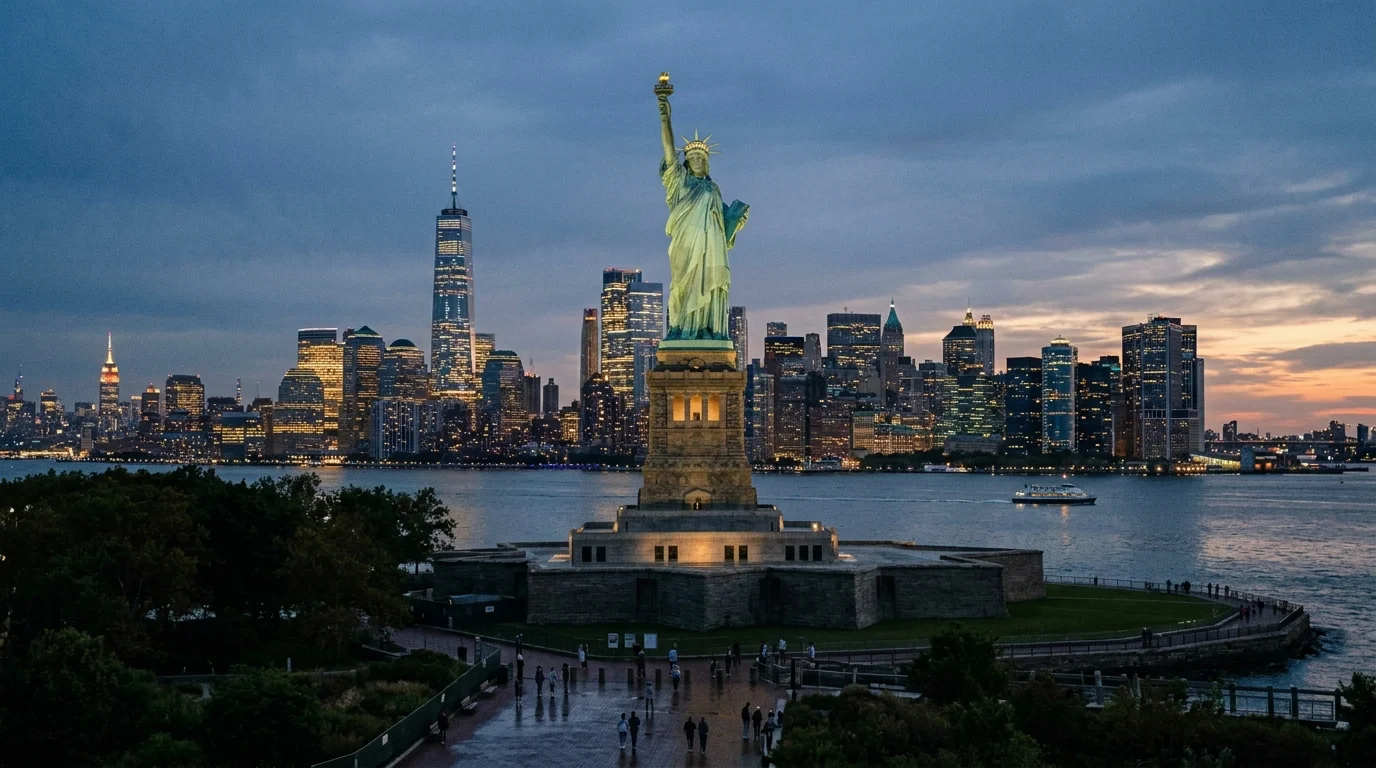
The Statue of Liberty is one of the most powerful symbols in the world — a 93-meter (305-foot) copper figure gifted by France, standing on Liberty Island in New York Harbor since 1886. The ferry ride itself gives you spectacular views of Lower Manhattan, and arriving by water the way millions of immigrants once did adds a powerful emotional dimension to the visit.
Ellis Island, a short additional ferry stop, was the gateway through which over 12 million immigrants entered the United States between 1892 and 1954. The Ellis Island National Museum of Immigration is one of the most moving museum experiences in the country — many American families can trace their ancestors through its records.
Why visit: This is living history. Standing at the crown (reserve far in advance) or simply on the island's promenade gives you an unobstructed view of Manhattan that no observation deck can replicate — and context for understanding America that nothing else in the city provides.
Entrance: Adults $24.50 / Children (4–12) $12 / Seniors $18 (includes ferry; crown access $24 extra, must book months ahead)
Best time: First ferry departure (9:00 AM) to beat crowds
Hours: Daily 9:00 AM – 5:00 PM (last ferry \~3:30 PM); ferry departs from Battery Park, Manhattan
Central Park
Central Park, New York, NY 10024 (main entrance at 5th Ave & 59th St)
Central Park is an 843-acre masterpiece of landscape design sitting at the heart of Manhattan, stretching from 59th Street to 110th Street. Designed by Frederick Law Olmsted and Calvert Vaux and completed in the 1870s, it was the first major landscaped public park in the United States. Today it receives over 42 million visitors per year — more than Yellowstone, the Grand Canyon, and Yosemite combined.
Inside the park: Belvedere Castle, the Great Lawn, the Ramble (bird-watching woodland), Strawberry Fields (John Lennon memorial), the Central Park Zoo, Bethesda Fountain, the Reservoir, and Cleopatra's Needle (a 3,500-year-old Egyptian obelisk). No matter how many times you visit, you find something new.
Why visit: Central Park is not just a green space — it is the emotional and geographic heart of New York. A morning run, a Shakespeare in the Park performance, or a rowboat on the Lake are experiences that define what New York City actually feels like for the people who live here.
Entrance: Free (always open)
Best time: Weekday mornings for quiet; fall for foliage; summer evenings for free concerts
Hours: Open 6:00 AM – 1:00 AM daily
The Metropolitan Museum of Art (The Met)
1000 5th Ave, New York, NY 10028
The Met is one of the world's greatest museums — 17 acres of galleries, 5,000 years of art, and more than two million objects in its permanent collection. Founded in 1870, it occupies the eastern edge of Central Park and contains everything from ancient Egyptian artifacts (including a real temple: the Temple of Dendur) to Vermeer paintings, Japanese samurai armor, and Impressionist masterpieces.
The museum is so large that you could visit every week for a year and still discover something new. The American Wing, the Arms and Armor gallery, the Islamic Art collection, and the Greek and Roman Sculpture Hall are among the must-sees. The rooftop garden (open May–October) has panoramic views over Central Park that are completely free with admission.
Why visit: The Met is not just a museum — it is a city within a city. Even if you are not a dedicated art lover, the scale, the architecture, and the diversity of what is on display make it one of the most extraordinary hours you can spend in New York.
Entrance: Adults $30 / Students $17 / Seniors $22 / Under 12: Free (NYC residents pay suggested donation)
Best time: Friday or Saturday evenings (open until 9:00 PM) — smaller crowds
Hours: Sunday–Thursday 10:00 AM – 5:00 PM; Friday–Saturday 10:00 AM – 9:00 PM; closed Thanksgiving and Christmas
Empire State Building
20 W 34th St, New York, NY 10118
The Empire State Building is the most iconic skyscraper in New York and one of the most recognized buildings in human history. Completed in 1931 in just 410 days, it stood as the world's tallest building for nearly 40 years. At 443 meters (1,454 feet) to the tip of its antenna, it remains one of the most dramatic structures on the Manhattan skyline.
The 86th Floor Observatory is the classic viewing deck — an open-air terrace at 320 meters (1,050 feet) with 360-degree views of all five boroughs. The newly added 102nd Floor Top Deck, enclosed in glass, provides even higher views on clear days stretching over 130 km (80 miles).
Why visit: The views are genuinely spectacular and the building itself is a piece of architectural history. The Art Deco lobby alone — all bronze and marble — is worth stepping inside even if you don't go up.
Entrance: Main Deck (86th floor) $44 adults / Top Deck add-on $77+ / Children (6–12) $38; book online to save time
Best time: Sunset (1 hour before) or after dark for the city lights
Hours: Daily 10:00 AM – 12:00 AM (last elevator 11:15 PM)
The High Line
The High Line, New York, NY 10011 (enter at Gansevoort St, 14th St, 16th St, 18th St, 20th St, 23rd St, 26th St, 28th St, 30th St, or 34th St)
The High Line is an elevated linear park built on a disused 1930s freight railway track running 2.3 km (1.45 miles) through Manhattan's west side from the Meatpacking District to Hudson Yards. Opened in phases between 2009 and 2014, it has become one of the most visited public spaces in the world and a case study in urban regeneration cited by cities globally.
The park features native plantings, art installations, seating areas with Hudson River views, and food vendors. The neighborhood around it — Chelsea, the Meatpacking District — has transformed into one of the city's most design-forward areas as a direct result of the High Line's presence.
Why visit: It is one of the best free experiences in New York. The combination of art, gardens, architecture (the buildings alongside it are some of NYC's most striking contemporary designs), and elevated city views is genuinely unique — there is nothing quite like it anywhere else in the world.
Entrance: Free (always)
Best time: Weekday mornings; spring and fall for the gardens
Hours: Daily 7:00 AM – 10:00 PM (June–September); 7:00 AM – 8:00 PM (October–May)
Brooklyn Bridge
Brooklyn Bridge Pedestrian Walkway, New York, NY 10038 (Manhattan entrance near City Hall Park)
The Brooklyn Bridge is one of the most beautiful and historically significant structures in the United States. Completed in 1883, it was the world's longest suspension bridge at the time and a genuine engineering marvel. Its Gothic stone towers and steel-wire cables remain as visually stunning today as they were when it opened, and it connects Lower Manhattan to Brooklyn Heights across the East River.
The pedestrian walkway runs down the center of the bridge at an elevated level above traffic, giving you eye-level views of the cables and towers as well as panoramic views of the Manhattan and Brooklyn skylines, the East River, and the Statue of Liberty on clear days. It is a 30–45 minute walk end to end.
Why visit: Walking the Brooklyn Bridge is one of the truly great free experiences in New York. The combination of history, engineering, and views is exceptional — and arriving in Brooklyn Heights at the other end puts you steps from DUMBO, one of the most photogenic neighborhoods in the city.
Entrance: Free (always)
Best time: Early morning (6:00–8:00 AM) for golden light and minimal crowds
Hours: Open 24 hours; pedestrian walkway is always accessible
9/11 Memorial & Museum
180 Greenwich St, New York, NY 10007
The 9/11 Memorial & Museum stands on the footprint of the original World Trade Center towers at Ground Zero. The two memorial pools — each nearly an acre in size, with the largest manmade waterfalls in the United States cascading into a central void — are both visually powerful and profoundly moving. The names of all 2,977 victims are inscribed around the pools' edges.
The underground museum, opened in 2014, tells the full story of the attacks with recovered artifacts, audio and video testimonies, and memorial exhibitions. It includes the original slurry wall of the World Trade Center's foundation, survivor stairs, and one of Ladder Company 3's fire trucks, found crushed in the ruins.
Why visit: This is one of the most significant memorial sites in the world. Whether you experienced 9/11 directly or not, the museum is a masterfully constructed and deeply human experience. Allow time afterward to sit by the pools and reflect — the surrounding Oculus transit hub and the rebuilt One World Trade Center are also worth seeing.
Entrance: Memorial (pools): Free. Museum: Adults $33 / Children (7–17) $21 / Under 6: Free
Best time: First entry slot of the day (10:00 AM); Tuesday–Thursday for lighter crowds
Hours: Daily 10:00 AM – 5:00 PM (last entry 3:30 PM)
Museum of Modern Art (MoMA)
11 W 53rd St, New York, NY 10019
MoMA houses one of the most important collections of modern and contemporary art anywhere in the world. Starry Night by Van Gogh, Water Lilies by Monet, Campbell's Soup Cans by Andy Warhol, Les Demoiselles d'Avignon by Picasso — these are not reproductions. They are the originals, and they are here, in Midtown Manhattan.
The museum underwent a major expansion in 2019, adding 47,000 square feet of gallery space and a new approach to presenting its collection that integrates lesser-known artists alongside canonical names. The sculpture garden, free to the public on Friday evenings, is one of the most pleasant outdoor spaces in Midtown.
Why visit: Standing in front of Van Gogh's Starry Night and realizing it is smaller than you imagined, more vibrant than any reproduction you have ever seen, and right there in front of you — that is an experience that no museum outside New York can give you.
Entrance: Adults $30 / Seniors $22 / Students $17 / Under 16: Free; Free on Friday evenings 5:30–9:00 PM
Best time: Friday evening for free admission and lighter crowds
Hours: Wednesday–Monday 10:30 AM – 5:30 PM; Friday 10:30 AM – 9:00 PM; closed Tuesday
What Are the Best Neighborhoods to Explore in New York City?
New York City's neighborhoods each have a distinct character — more like separate villages than sections of one city. Here are the best ones to explore.
Manhattan: The West Village
Character: Cobblestone streets, 19th-century townhouses, independent bookshops, and some of the city's best restaurants tucked into old carriage houses. It feels like a European village dropped into Manhattan.
What makes it special: The West Village resisted the grid — its streets follow old cow paths and are famously easy to get lost in. This is a neighborhood for wandering without a destination. The food scene here is exceptional: from tiny wine bars to long-established New York classics.
Best for: Couples, food lovers, architecture enthusiasts, anyone who wants to feel what old New York actually looked like
Must-see in this area: Hudson Street, Perry Street, the White Horse Tavern (since 1880), Bleecker Street, and Magnolia Bakery on Bleecker
How to get there: Subway A/C/E to 14th St-8th Ave, or L to 8th Ave
Location: West Village, New York, NY 10014
Brooklyn: DUMBO
Character: Former industrial waterfront neighborhood with cobblestone streets, converted warehouses, and the most photographed view of the Brooklyn Bridge in existence. DUMBO stands for Down Under the Manhattan Bridge Overpass.
What makes it special: The view down Washington Street framing the Manhattan Bridge with the Empire State Building behind it is iconic. Brooklyn Bridge Park, running along the waterfront, has beach volleyball, picnic lawns, and carousel rides with a backdrop of the Manhattan skyline. The area has excellent galleries, design studios, and restaurants.
Best for: Photographers, design lovers, families, anyone walking the Brooklyn Bridge
Must-see in this area: Washington Street view, Brooklyn Bridge Park, Jane's Carousel, Grimaldi's Pizza, the Brooklyn Historical Society
How to get there: Subway F to York St, or A/C to High St–Brooklyn Bridge. Walk over the Brooklyn Bridge from Manhattan (the best approach).
Location: DUMBO, Brooklyn, NY 11201
Manhattan: Harlem
Character: The cultural heart of Black America, a neighborhood whose music, art, and cuisine have shaped the world. Harlem stretches from 96th Street to around 155th Street on the Upper West and East sides, with distinct sub-neighborhoods including East Harlem (El Barrio) and Hamilton Heights.
What makes it special: The Apollo Theater, the jazz heritage of 125th Street, spectacular soul food restaurants, and churches whose Sunday gospel services are open to respectful visitors. Harlem's brownstone architecture is stunning, and the neighborhood is rapidly evolving while holding its cultural identity.
Best for: History lovers, music fans, food adventurers, travelers who want to go beyond the tourist bubble
Must-see in this area: Apollo Theater (253 W 125th St), Sylvia's Restaurant (328 Lenox Ave), Studio Museum in Harlem, Marcus Garvey Park
How to get there: Subway 2/3 to 125th St (Lenox Ave), or A/B/C/D to 125th St (8th Ave)
Location: Harlem, New York, NY 10027
Manhattan: Chinatown & Little Italy
Character: Chinatown is one of the most densely populated and authentic Chinese communities outside of Asia — a sensory overload of seafood markets, dim sum palaces, herbal medicine shops, and street vendors. Adjacent Little Italy (now mostly a few blocks on Mulberry Street) is the remnant of what was once a vast Italian immigrant community.
What makes it special: This is old New York — the immigrant city that built the modern one. The food in Chinatown is outstanding and extraordinarily cheap by Manhattan standards. Dim sum on weekend mornings at one of the large hall restaurants is one of the great NYC dining experiences.
Best for: Food lovers, budget travelers, anyone interested in NYC's immigration history
Must-see in this area: Nom Wah Tea Parlor (13 Doyers St), the Mahayana Buddhist Temple, Mott Street, Mulberry Street
How to get there: Subway J/Z/N/Q/R/W/6 to Canal St
Location: Chinatown, New York, NY 10013
Queens: Astoria & Jackson Heights
Character: Queens is the most ethnically diverse urban area on Earth — more than 160 languages are spoken within its borders. Astoria has a strong Greek heritage and excellent Mediterranean dining. Jackson Heights is the gateway to South Asian, Latin American, and Tibetan communities within a few square blocks.
What makes it special: Eating your way through Jackson Heights is a genuine multicultural experience — Nepali dumplings, Colombian empanadas, Bangladeshi sweets, and Indian chaat, all within walking distance. Astoria has excellent Greek seafood restaurants and the Museum of the Moving Image.
Best for: Food explorers, off-the-beaten-path travelers, those who want to experience real New York beyond Manhattan
Must-see in this area: 74th Street (Jackson Heights food row), Museum of the Moving Image (36-01 35th Ave, Astoria), Bohemian Hall Beer Garden (Astoria)
How to get there: Subway N/W to Astoria-Ditmars Blvd; 7 to 74th St for Jackson Heights
Location: Jackson Heights, Queens, NY 11372
What Food Should You Try in New York City?
New York City is one of the greatest food cities in the world — not because of one cuisine, but because every cuisine on Earth exists here at a high level. The must-try experiences range from a $2 slice of pizza eaten standing on the sidewalk to a $500 tasting menu at one of the city's 70+ Michelin-starred restaurants.
What Are the Must-Try Local Dishes in New York City?
- New York Pizza (the slice) — A thin, foldable slice from a coal-oven or deck-oven pizzeria. The dough, the water, and the technique are all distinctly New York. Joe's Pizza (7 Carmine St, Greenwich Village) is the benchmark. Eat it folded, standing up, outside.
- New York Bagel — Boiled then baked, with a chewy crust that no other city has successfully replicated. Best with lox (smoked salmon), cream cheese, capers, and red onion. Russ & Daughters (179 E Houston St) has been making them since 1914.
- New York Cheesecake — Dense, creamy, baked (not gelatin-set), on a graham cracker base. Junior's (386 Flatbush Ave Extension, Brooklyn) is the original and still the standard.
- Black and White Cookie — A New York bakery staple: a soft, cake-like cookie half-covered in white fondant, half in chocolate fondant. Every deli and bakery has them.
- Pastrami on Rye — Hand-cut cured and smoked beef, stacked thick on rye bread with mustard. Katz's Delicatessen (205 E Houston St, Lower East Side) has been serving this since 1888. Order at the counter, keep your ticket.
- Chopped Cheese — A Harlem bodega invention: ground beef, American cheese, onions, and peppers chopped together on a griddle and served on a hero roll. Grab one from any Harlem bodega — Hajji's at 110th and 1st Ave is the most famous.
- Halal Cart Chicken and Rice — The unofficial street food of New York. Seasoned chicken over yellow rice with white sauce and hot sauce, served from thousands of carts citywide. The original Halal Guys cart is at 53rd St and 6th Ave in Midtown.
- Egg Cream — Confusingly, contains neither eggs nor cream: seltzer, milk, and chocolate (or vanilla) syrup. A classic New York soda fountain drink. Find it at old-school diners and candy shops throughout the city.
Where Should You Eat in New York City?
Budget-Friendly (Under $15 per meal)
- Xi'an Famous Foods — Multiple locations including 81 St. Marks Place, East Village — Hand-pulled noodles, cumin lamb burgers, and cold skin noodles from Xi'an province, China. Nothing over $14. The spicy cumin lamb noodles are extraordinary.
- Lucali — 575 Henry St, Carroll Gardens, Brooklyn — The most celebrated pizza in Brooklyn. Cash only, BYOB, often a 2-hour wait. But the thin, pristine pie is worth it for pizza devotees. Arrive at opening to get on the list.
- Mamoun's Falafel — 119 Macdougal St, Greenwich Village — NYC's oldest falafel restaurant (est. 1969). A falafel sandwich runs $4–$6. Open until 5:00 AM on weekends.
Mid-Range ($20–$60 per meal)
- Carbone — 181 Thompson St, Greenwich Village — The most sought-after reservation in New York. Red-sauce Italian in a 1950s supper club atmosphere. The rigatoni vodka and the chicken scarpariello are legendary. Book exactly 30 days out when reservations drop on Resy at midnight.
- Roberta's — 261 Moore St, Bushwick, Brooklyn — Wood-fired pizza in a converted auto body shop, with an outdoor garden. The Bee Sting pizza (honey, soppressata, chili) is one of NYC's iconic dishes.
- The Spotted Pig — 314 W 11th St, West Village — A West Village institution: chargrilled burger with Roquefort cheese and shoestring fries. The pig's ear salad is not to be missed by the adventurous.
- Nom Wah Tea Parlor — 13 Doyers St, Chinatown — New York's oldest dim sum restaurant, open since 1920. Weekend dim sum in the original dining room with cart service is a genuine NYC experience. $25–$40 per person.
Fine Dining ($100+ per meal)
- Le Bernardin — 155 W 51st St, Midtown — Three Michelin stars, consistently ranked among the best restaurants in the world. Chef Éric Ripert's French seafood tasting menu is the gold standard of New York fine dining. Jacket required; book 2–3 months in advance.
- Eleven Madison Park — 11 Madison Ave, Flatiron — Three Michelin stars, plant-based tasting menu in a stunning Art Deco dining room. One of the most theatrical dining experiences in the United States.
What Are the Dining Customs in New York City?
Meal times: New Yorkers eat breakfast early (7–9 AM), lunch from noon to 2 PM, and dinner from 6–8 PM on weekdays, often later on weekends. Brunch (Saturday–Sunday, 10 AM–3 PM) is a cultural institution.
Tipping: 20% is the standard tip in sit-down restaurants in New York — this is not optional courtesy, it is how servers are paid. For coffee and counter service: $1–$2 per order. Pre-tax tip calculation: double the NYC sales tax (8.875%) on your bill to get approximately 18%.
Reservations: Essential for popular restaurants. Use Resy, OpenTable, or Tock. Top restaurants release reservations exactly 30 days in advance at midnight — set an alarm if you want Carbone or Via Carota.
Dress code: Casual for most restaurants; smart casual for mid-range; jackets sometimes required at white-tablecloth fine dining. New Yorkers dress up for dinner at top places.
What Is the Nightlife Like in New York City?
New York City's nightlife earned the city its "city that never sleeps" title for good reason — bars stay open until 4:00 AM, clubs run until 6:00 AM or beyond, and the energy on weekend nights in certain neighborhoods is genuinely electric. The scene ranges from $4 Bud Light dives to $30-cocktail celebrity haunts.
Where Are the Best Areas for Nightlife in New York City?
- Lower East Side (LES): Delancey St & Ludlow St area, NY 10002 — The indie music and bar scene capital of New York. Dozens of bars and live music venues clustered in a few blocks. Best for: 20s–30s crowd, rock and indie, dive bars and cocktail bars side by side.
- Meatpacking District: Little W 12th St, NY 10014 — Upscale clubs and bars, celebrity sightings, rooftop terraces. Best for: dressed-up nights out, bottle service, EDM and hip-hop clubs.
- Brooklyn: Williamsburg & Bushwick: Bedford Ave, Williamsburg, NY 11211 — Brooklyn's nightlife is now as good as or better than Manhattan's. Williamsburg for the beer bars and cocktail lounges; Bushwick for the warehouse clubs and underground parties. Best for: creative scene, rave culture, cheap drinks.
What Are the Best Bars and Clubs in New York City?
Bars & Pubs
- Employees Only — 510 Hudson St, West Village — Award-winning cocktail bar behind a psychic's parlor entrance. The bar team are some of the best in the world. Open until 3:30 AM. Arrive by 9 PM to avoid the queue.
- Please Don't Tell (PDT) — 113 St. Marks Pl, East Village (enter through a phone booth in Crif Dogs) — One of NYC's most famous speakeasy-style cocktail bars. Reservations taken online from 3:00 PM same day. Limited to \~45 seats — book the moment reservations open.
- McSorley's Old Ale House — 15 E 7th St, East Village — The oldest bar in New York (1854). Two beers: light and dark. Cash only. No cocktails. No exceptions. Pure New York City history.
Clubs & Dancing
- Elsewhere — 599 Johnson Ave, Bushwick, Brooklyn — Brooklyn's premier multi-room club. Rooftop, main room, and hall stage. Electronic music and live acts. Cover $15–$30.
- Le Bain — 848 Washington St, Meatpacking District — Rooftop disco with a hot tub on the dance floor (yes, really), sunset views of the Hudson, and rotating DJs. Part of The Standard High Line hotel. Open Thursday–Sunday.
Live Music & Shows
- Village Vanguard — 178 7th Ave S, Greenwich Village — The most important jazz club in America, open since 1935. Miles Davis, John Coltrane, and Bill Evans all recorded seminal live albums here. Two sets nightly; $40 cover minimum + drink.
- Radio City Music Hall — 1260 6th Ave, Midtown — A stunning Art Deco landmark seating 6,000, hosting major concerts and the annual Christmas Spectacular. Check the schedule — touring artists here perform in one of the most beautiful venues in the world.
What Family-Friendly Evening Entertainment Is Available?
Broadway shows are family-friendly for most ages (check age recommendations per production). The Big Apple Circus (seasonal), free evening movies at Bryant Park (summer), and evening visits to the Top of the Rock observatory are excellent family evening options. Younger children enjoy the Central Park Carousel (open until dusk) and the South Street Seaport waterfront.
What and Where Should You Shop in New York City?
The best things to buy in New York City range from world-class vintage clothing and independent designer pieces to beauty products, books, and food items you genuinely cannot find anywhere else. The top shopping areas span every price point from thrift store to Fifth Avenue luxury.
What Are the Best Shopping Districts in New York City?
- Fifth Avenue (Midtown): 5th Ave between 49th–60th St, NY 10019 — The classic luxury shopping street: Saks Fifth Avenue, Bergdorf Goodman, Tiffany & Co., Louis Vuitton, Prada, and the Apple Store flagship. The most concentrated luxury retail in the United States.
- SoHo: Prince St & Spring St area, NY 10012 — Cast-iron loft buildings housing a dense mix of international brands, independent designers, and concept stores. Acne Studios, Opening Ceremony, and dozens of streetwear and contemporary fashion labels. Also excellent art galleries.
- The Bowery / Lower East Side: Bowery, NY 10013 — Restaurant equipment, lighting, and home goods stores that have been there for decades alongside new design boutiques and vintage shops. Unique New York mix.
What Markets Should You Visit in New York City?
Brooklyn Flea — Fort Greene (Saturdays) and Williamsburg (Sundays) — One of America's best flea markets. Vintage furniture, antique jewelry, vinyl records, and handmade goods from over 100 vendors. Open April through November; 10:00 AM–5:00 PM.
Hell's Kitchen Flea Market — 39th St between 9th & 10th Ave, NY 10018 — Weekend flea market with an excellent selection of vintage clothing and antiques. Open Saturday–Sunday, 9:00 AM–5:00 PM year-round. One of Manhattan's better affordable shopping options.
Chelsea Market — 75 9th Ave, NY 10011 — An indoor food and retail market in a converted Nabisco factory under the High Line. Food vendors, specialty grocers, and retail boutiques. Not a traditional flea market, but one of the great indoor shopping experiences in Manhattan.
What Should You Buy in New York City?
- Vintage clothing — New York has some of the world's best vintage shops: L Train Vintage (multiple locations), The RealReal (88 Kensington St, Brooklyn), and countless thrift stores in Brooklyn offer extraordinary finds.
- Books — The Strand Bookstore (828 Broadway) has 18 miles of books — new, used, and rare. One of the great independent bookstores in the world.
- Beauty products — Space NK, Kiehl's (original store at 109 3rd Ave since 1851), and the Sephora at Rockefeller Center carry US-exclusive products and formulations not available internationally.
- NYC-branded food — Gifts: Russ & Daughters smoked fish, Katz's packaged pastrami, Zabar's coffee, and Jake's Pickles are iconic New York food souvenirs.
- Art prints and photography — The MoMA Design Store (44 W 53rd St) and the Brooklyn Museum gift shop carry high-quality affordable art prints.
- Vinyl records — Academy Records (415 E 12th St) and Generation Records (210 Thompson St) have outstanding collections for music lovers.
What Are the Shopping Hours and Customs?
Most retail stores open 10:00 AM–8:00 PM Monday–Saturday, and 11:00 AM–7:00 PM Sunday. Department stores (Bloomingdale's, Macy's) often extend to 9:00 PM on weekdays. Sales tax in New York City is 8.875% on most items; clothing and footwear under $110 per item are exempt from state sales tax — a meaningful saving on everyday clothing purchases. Foreign visitors cannot claim VAT refunds in the US.
What Festivals and Events Happen in New York City?
New York City's biggest festivals include the Macy's Thanksgiving Day Parade, the NYC Marathon, New Year's Eve at Times Square, and the West Indian American Day Carnival — plus thousands of free and paid events running year-round across five boroughs.
What Is the Annual Events Calendar for New York City?
| Month | Event | Description |
|---|---|---|
| January | Restaurant Week (Winter) | NYC restaurants offer prix-fixe lunch ($30) and dinner ($60) menus. Over 500 restaurants participate. Book early — popular spots sell out fast. |
| February | Westminster Kennel Club Dog Show | One of the most prestigious dog shows in the world, held at Madison Square Garden. Tickets from $35; spectacular if you love dogs or sport. |
| March | St. Patrick's Day Parade | The oldest and largest St. Patrick's Day parade in the world, running up 5th Avenue since 1762. Free to watch from the street; arrive early for a good spot. |
| April | Tribeca Film Festival | Founded by Robert De Niro, this major film festival brings world premieres, celebrity appearances, and public screenings to Lower Manhattan. Tickets from $25. |
| May | Fleet Week | US Navy and Coast Guard ships dock in the Hudson River and sailors flood Midtown in their dress whites. Free tours of military vessels available at Pier 88. |
| June | NYC Pride March | One of the world's largest Pride events, centered on 5th Avenue. The march route runs from 25th St to the West Village. Free and open to all; over 2 million attendees. |
| July | Macy's 4th of July Fireworks | The largest Fourth of July fireworks display in the US, launched over the East River. Best viewing from the Brooklyn Bridge, FDR Drive, or Brooklyn waterfront. Free. |
| August | US Open Tennis (late Aug–Sept) | One of tennis's four Grand Slams, held at the USTA Billie Jean King National Tennis Center in Flushing, Queens. Day session tickets from $50–$80; grounds passes allow you to watch qualifying rounds cheaply. |
| September | New York Fashion Week | One of the four global fashion weeks. Public access is limited but street style outside Lincoln Center and the tents is free entertainment. Bryant Park and Hudson Yards during show weeks. |
| October | NYC Marathon | The world's largest marathon: 55,000 runners, 2+ million spectators. Runs through all five boroughs. Free to watch from the street — best spots in Brooklyn at Mile 8 or Central Park near the finish. |
| November | Macy's Thanksgiving Day Parade | One of America's most iconic events. Floats and giant character balloons move from 77th St and Central Park West to 34th St. Free; arrive by 7:00 AM for a viewing spot. Balloon inflation on Nov 27th evening is a lesser-known gem. |
| December | New Year's Eve, Times Square | One million people gather for the ball drop at midnight. Gates open at 3 PM; people stand in designated viewing areas for hours. There are no bathrooms and no re-entry — plan accordingly. Alternatively, watch from a rooftop bar with a reservation. |
How Do Festivals Affect Hotel Prices and Availability?
New York is always busy, but certain events drive prices dramatically higher: Fashion Week (September), the UN General Assembly (September), the NYC Marathon (first Sunday in November), Thanksgiving week, and the Christmas/New Year's period. Book at least 2–3 months ahead for these periods; 6 months ahead for Christmas and New Year's. January and February (excluding Valentine's Day weekend) offer the lowest hotel rates of the year — often 30–40% below peak season prices.
Where Should You Stay in New York City?
The best neighborhood to stay in New York City depends entirely on your travel style and budget. Midtown is convenient and central but expensive and tourist-heavy; Brooklyn is more affordable and gives you a more authentic experience; the Upper West Side is residential and calmer for families.
What Are the Best Neighborhoods to Stay in New York City?
| Neighborhood | Vibe | Price Range (per night) | Best For |
|---|---|---|---|
| Midtown Manhattan | Tourist central, maximum convenience | $250–$600+ | First-timers who want to walk to everything |
| Upper West Side | Residential, leafy, near Central Park | $200–$450 | Families, couples, museum lovers |
| Greenwich Village / West Village | Charming streets, excellent food scene | $250–$550 | Couples, foodies, repeat visitors |
| Williamsburg, Brooklyn | Hipster energy, great restaurants and bars | $150–$350 | Young travelers, budget-conscious visitors, nightlife |
| Lower East Side / East Village | Gritty, creative, very central | $180–$380 | Budget travelers, nightlife seekers, culture lovers |
What Are the Pros and Cons of Each Area?
Midtown Manhattan:
Pros: Walking distance to Times Square, Empire State Building, MoMA, and Grand Central. Excellent subway access. Enormous hotel selection.
Cons: Most expensive area to stay. Heavily tourist-focused — fewer authentic local experiences. Street noise can be relentless.
Williamsburg, Brooklyn:
Pros: Significantly cheaper than Manhattan. Excellent food and bar scene. Just 10 minutes to Manhattan by L train. Feels more like real New York.
Cons: Requires a subway ride to most Manhattan attractions. Area can be noisy on weekends near the bar strip on Bedford Ave.
How Far in Advance Should You Book in New York City?
For standard travel periods, book 4–8 weeks in advance for reasonable rates. For holidays (Thanksgiving, Christmas, New Year's Eve), summer peak (July–August), and major events (Marathon, Fashion Week, UN General Assembly), book 3–6 months ahead. Use flexible cancellation rates whenever possible — NYC hotel rates fluctuate significantly and you may find better prices closer to the date.
What Do You Need to Know Before Visiting New York City?
Here are the essential practical details every visitor to New York City needs to know before arriving.
Essential Travel Details for New York City
- Currency: US Dollar (USD, $). Credit cards accepted virtually everywhere. Cash is used at some delis, pizza slices, and street vendors.
- Credit Cards: Visa and Mastercard accepted everywhere. Amex widely accepted. Contactless/tap payments standard in most stores, taxis, and the subway.
- ATMs: ATMs everywhere — use your bank's network to avoid fees. Bank of America, Chase, Citibank, and Wells Fargo ATMs are the most common. Out-of-network ATM fees: $3–$5 plus your bank's foreign transaction fee.
- Language: English. NYC is one of the most multilingual cities on Earth — you will find speakers of virtually any language, particularly in neighborhoods like Jackson Heights, Flushing, Chinatown, and Brighton Beach.
- Tipping: 20% for sit-down dining, 15–18% for taxis, $1–$2 per drink at bars, $2–$5 per night for hotel housekeeping.
- Electrical Plugs: Type A and B plugs (2 or 3 flat prongs); 120V / 60Hz. European/UK visitors need a voltage converter for high-wattage devices.
- Emergency Number: 911 (police, fire, ambulance)
- NYC311: Dial 311 for non-emergency city services, complaints, and information
- SIM Cards: Available at JFK/LGA/EWR airports (T-Mobile, AT&T, Verizon kiosks). T-Mobile prepaid SIM from $15; unlimited data plans from $40–$55/month. eSIMs from Airalo or Holafly are often cheaper for short visits.
- WiFi: LinkNYC kiosks (thousands throughout Manhattan) provide free gigabit Wi-Fi. Most hotels, cafes, and restaurants offer free Wi-Fi. Subway stations have Wi-Fi in most stations (not in tunnels between stations).
- Tap Water: Excellent and safe to drink. NYC tap water consistently ranks among the best in the US — filtered through the Catskill Mountains reservoir system. No need to buy bottled water.
How Much Does It Cost to Visit New York City?
| Budget Type | Daily Cost (2026) | What's Included |
|---|---|---|
| Budget Traveler | $100–$160 | Hostel or budget hotel in Brooklyn, pizza slices and bodegas, unlimited subway MetroCard, free attractions (parks, Brooklyn Bridge, free museum hours) |
| Mid-Range Traveler | $200–$350 | 3-star Manhattan hotel or Airbnb, sit-down meals at mid-range restaurants, subway plus occasional taxi, 1–2 paid attractions per day |
| Luxury Traveler | $500–$1,000+ | 4–5 star hotel (Park Hyatt, The Plaza, Aman New York), fine dining, private car service, Broadway show tickets, private guided tours |
What Are the Most Useful Phrases in New York City?
- "Excuse me" — Essential. New Yorkers use it constantly and appreciate it.
- "Can I get..." / "I'll have..." — How you order at a deli or counter. "May I please have..." marks you as a tourist instantly.
- "Regular coffee" — In NYC diner and deli culture, "regular" means with milk and two sugars. Specify if you want anything different.
- "What train goes to...?" — MTA staff at station booths will direct you. The subway map is also free at any token booth.
- "How much is it?" — "What's the damage?" is the local version.
Is New York City Safe for Tourists?
New York City is generally safe for tourists and is far safer than its media reputation suggests. Major tourist areas — Midtown, Central Park, Brooklyn Bridge Park, the High Line — are heavily trafficked and well-patrolled. The city's overall crime rate has fallen dramatically since the 1990s.
Areas to be more aware: Parts of the Bronx (particularly late at night), certain blocks of East New York in Brooklyn, and the far southern end of Queens late at night. These are not typical tourist destinations.
Common issues for tourists: Pickpocketing on crowded subway platforms and in Times Square; three-card monte scams near tourist areas; ticket scalpers outside Broadway theaters; unlicensed taxi drivers at airports.
Solo traveler safety: NYC is excellent for solo travel, including women traveling alone. The density of people in public spaces provides inherent safety. LGBTQ+ travelers will find New York one of the most welcoming cities in the world — particularly in Greenwich Village, Chelsea, and Hell's Kitchen, historically the centers of LGBTQ+ life in the city.
What Are the Cultural Customs in New York City?
- Pace: Walk fast and stay to the right on sidewalks. If you need to stop to check your phone or look at a map, move to the side — stopping in the middle of foot traffic will earn you genuine hostility.
- Queuing: New Yorkers queue and respect the line. Cutting is considered extremely rude.
- Public behavior: New Yorkers are direct, not impolite. "Have a good one" at the end of a transaction is standard warmth. Extended small talk with strangers is unusual.
- Photography: Public spaces are fair game; ask permission before photographing strangers. Photography inside some museums and galleries is restricted — check signage.
- Subway etiquette: Give up your seat for elderly, pregnant, or disabled passengers. Do not eat smelly food on the subway. Keep your voice down on phone calls. Move into the center of the car.
Do You Need a Visa to Visit New York City?
Citizens of 42 countries — including the UK, most EU countries, Australia, Japan, and South Korea — can visit the US for up to 90 days without a visa under the Visa Waiver Program, but must register online through ESTA (Electronic System for Travel Authorization) before departure. ESTA approval typically takes minutes and costs $21. Citizens of Canada do not need a visa or ESTA. All other nationalities must obtain a B1/B2 tourist visa from the US Embassy in their home country before traveling — check the US Department of State website for current requirements and processing times, as these change.
What Health Precautions Should You Take in New York City?
Vaccinations: No vaccinations required for entry into the US from most countries. Standard routine vaccinations (tetanus, MMR, etc.) recommended up to date.
Pharmacies: CVS Pharmacy and Duane Reade (owned by Walgreens) have locations throughout the city, many open 24 hours. Common over-the-counter medications like ibuprofen, acetaminophen, cold medicines, and allergy medications are widely available without prescription.
Hospitals: New York has world-class hospitals (NewYork-Presbyterian, NYU Langone, Mount Sinai). Emergency room visits cost $500–$3,000+ without insurance. Travel insurance is strongly recommended — US healthcare is expensive for uninsured visitors. Urgent care clinics (CityMD, FastMed) offer same-day care for non-emergency issues at lower cost ($150–$300 per visit).
Is New York City Accessible for People with Disabilities?
Accessibility in NYC is improving but remains a significant challenge. Only about 28% of subway stations have elevator access (check the MTA's accessibility map before traveling). All MTA buses are wheelchair accessible. Yellow cabs are not required to be accessible, but a growing fleet of accessible taxis exists — book through 311 or the Curb app. Major attractions (Met, MoMA, the 9/11 Museum) are fully accessible. The High Line is fully accessible with elevators at multiple entry points.
Is New York City Good for Families with Kids?
New York is excellent for families. Central Park alone offers playgrounds, a carousel, a zoo, and the Conservatory Water for model boats. The American Museum of Natural History (200 Central Park West) is outstanding for children. The Intrepid Sea, Air & Space Museum (Pier 86, 46th St and 12th Ave) — an aircraft carrier with space shuttles and Cold War-era submarines — is one of the best family attractions in the city. Strollers navigate Manhattan well on the main avenues; the subway can be challenging with strollers (stairs at many stations).
What Are the Best Day Trips from New York City?
The best day trips from New York City include the beaches of the Jersey Shore and the Hamptons, the historic cities of Philadelphia and Boston, the Hudson Valley's art and farm country, and the waterfalls and gorges of the Catskills.
Philadelphia, Pennsylvania
Distance: 150 km / 95 miles; 1 hour 20 minutes by Amtrak
What to see: The Liberty Bell (6th & Market St), Independence Hall (where the Declaration of Independence was signed), the Philadelphia Museum of Art (and its famous Rocky steps), and Reading Terminal Market for outstanding food. Philadelphia also has excellent restaurants at half the price of New York.
How to get there: Amtrak from Penn Station (34th St) to Philadelphia 30th Street Station; trains run hourly; $30–$80 depending on how far in advance you book. Driving via I-95 takes 2–3 hours with traffic.
Time needed: Full day
Best for: History lovers, families, first-time US visitors who want context for American independence
Location: Philadelphia, PA 19102
The Hudson Valley, New York
Distance: 100–200 km / 60–120 miles north of NYC; 1.5–3 hours by train or car
What to see: A stunning stretch of river valley with Dia:Beacon contemporary art museum (3 Beekman St, Beacon — housed in a former box-printing factory), Catskill Mountains hiking, Storm King Art Center (open-air sculpture park at 1 Museum Road, New Windsor), historic mansions like Boscobel and Olana, and farm-to-table restaurants in Hudson and Rhinebeck.
How to get there: Metro-North Hudson Line from Grand Central Terminal to Beacon (75 min, \~$20 round trip) or Rhinecliff (\~2 hours, \~$30). Car rentals from Midtown let you explore more flexibly; route NY-9 along the river is beautiful.
Time needed: Full day; overnight if visiting multiple towns
Best for: Art lovers, hikers, couples, anyone wanting nature within 2 hours of the city
Location: Beacon, NY 12508 (good base point)
The Hamptons, Long Island
Distance: 160 km / 100 miles east of NYC; 2.5 hours by LIRR train
What to see: The most famous beach communities in the United States — Southampton, East Hampton, Montauk. Stunning ocean beaches (Main Beach in East Hampton is consistently rated among the best in the US), art galleries, farm stands, and upscale dining. Montauk is the more relaxed, surfer-culture end of the Hamptons.
How to get there: Long Island Rail Road (LIRR) from Penn Station — frequent trains, $20–$30 round trip to Southampton. In summer, the Hampton Jitney bus runs from Midtown. Driving in summer is slow due to traffic; take the early morning train.
Time needed: Full day; overnight recommended in summer
Best for: Beach lovers, summer visitors, anyone interested in seeing where New York's wealthy spend their weekends
Location: Main Beach, East Hampton, NY 11937
Niagara Falls, New York
Distance: 640 km / 400 miles from NYC; 7–8 hours by car or bus; \~8 hours by Amtrak
What to see: One of the natural wonders of the world — 3,160 tons of water flow over the falls every second. Maid of the Mist boat tour (truly spectacular), Cave of the Winds (walk directly beneath the falls), and Niagara Falls State Park (the oldest state park in the US). The Canadian side in Ontario also offers excellent views.
How to get there: Best as an overnight stay rather than a day trip from NYC. Amtrak from Penn Station to Niagara Falls ($40–$90). Alternatively, fly Buffalo-Niagara Airport (1-hour flight) and rent a car for the 30-minute drive to the falls.
Time needed: Overnight strongly recommended
Best for: Families, nature lovers, international visitors who want a North American landmark
Location: Niagara Falls State Park, 332 Prospect St, Niagara Falls, NY 14303
What Are the Hidden Gems and Insider Tips for New York City?
Beyond the main tourist sites, New York City hides an extraordinary number of places most visitors never find — and local habits that make the city far more affordable and enjoyable.
What Are the Best Hidden Gems in New York City?
- The Cloisters: 99 Margaret Corbin Dr, Fort Tryon Park, Upper Manhattan — The Met's medieval art museum, built from actual pieces of French monasteries, in a hilltop park overlooking the Hudson River. Most tourists have no idea it exists. Free on Fridays 5:30–9 PM with your Met ticket from the same day.
- The Panorama of the City of New York: Queens Museum, Flushing Meadows Corona Park, Queens, NY 11368 — A 1:1200 scale architectural model of all five boroughs, covering 9,335 square feet. Every building in the city is represented. Free on Thursday evenings. Absolutely extraordinary.
- The Elevated Acre: 55 Water St, Financial District — A rooftop public park above a Midtown office building, accessible via a free elevator. Sweeping views of the East River and Brooklyn, almost always quiet. Open 7 AM–9 PM daily.
- Chumley's: 86 Bedford St, West Village — A bar with no sign on the door that was a Prohibition-era speakeasy. The entrance is through an unmarked door; the interiors have barely changed since the 1920s. F. Scott Fitzgerald and Ernest Hemingway used to drink here.
- Little Island: Pier 55 at Hudson River Park, W 13th St, Meatpacking District — A floating park on the Hudson River, built on 132 sculpted concrete piles that create a landscape that rises like a hillside from the river. Spectacular views of the Manhattan skyline. Free to enter; timed entry tickets needed on busy days (free on the Little Island website).
- The Whispering Gallery at Grand Central Terminal: Vanderbilt Ave & E 42nd St, Midtown — Stand in opposite corners of the arched passageway outside the Oyster Bar in Grand Central and whisper to the wall — your voice travels perfectly to the opposite corner due to the dome's acoustics. Face the wall and speak; the person in the other corner hears you clearly. Free, always open.
- City Hall Station (Abandoned Subway): The original 1904 City Hall subway station is a stunning Guastavino-tiled vaulted space that was closed to passengers in 1945. Ride the downtown 6 train past Brooklyn Bridge City Hall station — do not exit — and the train loops around the old station before heading back uptown. You can see it through the windows for free.
Where Are the Best Photo Spots in New York City?
- Brooklyn Heights Promenade: Columbia Heights, Brooklyn — The classic Manhattan skyline view, looking across the East River. Best at sunrise or golden hour before sunset.
- Washington Street, DUMBO: Washington St between Front St and Water St, Brooklyn — The bridge-framed view of Manhattan. Best in morning light; tripods are common here.
- Top of the Rock: 30 Rockefeller Plaza — The view that includes the Empire State Building (unlike the ESB's own observation deck). Best at sunset when the city transitions to night lights.
- Gapstow Bridge, Central Park: Central Park at 58th St and 7th Ave area — The stone bridge reflected in the Pond, with Midtown skyscrapers rising behind it. Best in winter when the trees are bare.
- The High Line at 30th Street: High Line at W 30th St — The view north along the elevated park with the Hudson Yards towers rising to the left and the city stretching ahead. Best early morning before the crowds.
What Do Locals Know That Tourists Don't?
How Can You Save Money in New York City?
The biggest way to save money in New York City is to use the subway instead of taxis for all transportation — the difference between $35 Uber rides and $2.90 subway rides adds up to hundreds of dollars saved over a week's visit.
What Are the Best Money-Saving Strategies for New York City?
- Use the Staten Island Ferry (free) instead of paying for harbor cruises
- Visit MoMA on Friday evenings (free admission 5:30–9:00 PM)
- Use the TodayTix app lottery for $30 Broadway rush tickets
- Eat lunch at top restaurants instead of dinner — same kitchen, 40–50% lower prices
- Walk across the Brooklyn Bridge (free) instead of paying for bridge tours
- Buy a pizza slice ($3–$4) instead of a sit-down pizza meal ($18–$25 per person)
- Visit Central Park — it costs nothing and is one of the best experiences in the city
- Drink tap water — NYC water is excellent; buying bottled water is unnecessary
- Buy groceries at Trader Joe's or Whole Foods for breakfast and snacks
- Use OMNY tap-to-pay instead of MetroCard (saves $0.35/ride and you get a free weekly cap)
- Take the Airporter bus to/from JFK ($19 round trip) instead of taxis ($70+ each way)
- Visit the High Line, Brooklyn Bridge Park, the Ramble in Central Park — all free
- TKTS booth in Times Square sells same-day Broadway tickets at 20–50% off face value
- Eat at Smorgasburg market (Brooklyn, weekends, April–October) — street food at its best, $8–$15/dish
- Check museum free hours: Brooklyn Museum (first Saturday of month, 5–11 PM free), Museum of Natural History (suggested donation, pay what you wish)
What Can You Do for Free in New York City?
- Central Park: 843 acres of free park — concerts, events, walking, running, picnicking
- Brooklyn Bridge Walk: One of the great free experiences in any city
- High Line: Elevated park with art installations — always free
- Staten Island Ferry: Free, spectacular harbor views
- 9/11 Memorial Pools: Free to visit any time
- Little Island: Free park on the Hudson River (timed entry required on busy days)
- Grand Central Terminal: Stunning Beaux Arts architecture, celestial ceiling — free to enter and explore
- Summer in the City events: Bryant Park Movies, SummerStage concerts, Shakespeare in the Park (lottery tickets)
Are There Any Discount Cards or Passes Worth Buying?
New York Pass: From $149/day — Includes 100+ attractions. Worth it if you plan to visit 4–5 paid attractions per day including the Empire State Building, MoMA, and Top of the Rock. Calculate carefully based on your itinerary before purchasing.
New York CityPASS: $142 adults / $116 children — Covers 5 top attractions (Empire State Building, American Museum of Natural History, Intrepid Sea/Air/Space Museum, Guggenheim or Top of the Rock, and 9/11 Museum). Good value if all 5 are on your list.
Explorer Pass: Choose 3, 4, 5, or 7 attractions from a list of 90+. More flexibility than the CityPASS. Good if you want to mix popular attractions with lesser-known ones.
What Are the Budget-Friendly Alternatives?
Instead of the $44 Empire State Building ($77 to the top): Go to Top of the Rock ($40) for a view that includes the Empire State Building itself. For free skyline views: the Staten Island Ferry and Brooklyn Heights Promenade cost nothing. Instead of expensive Broadway shows: TKTS half-price booth in Times Square (2:00–8:00 PM Tuesday–Saturday, 11:00 AM–3:00 PM Saturday matinees) or TodayTix lottery for $30 rush seats.
What Mistakes Should You Avoid in New York City?
The biggest mistake tourists make in New York City is taking taxis everywhere instead of the subway — it wastes both money and time, since cabs frequently sit in traffic while the subway moves freely beneath the city.
What Are the Most Common Tourist Mistakes in New York City?
- Mistake: Eating near Times Square → Instead: Times Square restaurants exist purely for tourists and are expensive for mediocre food. Walk 5–10 blocks west to Hell's Kitchen or south to the Garment District for dramatically better and cheaper options.
- Mistake: Standing on the left side of escalators → Instead: In NYC, stand on the right, walk on the left. Doing the reverse will earn you immediate (and deserved) irritation from commuters.
- Mistake: Trying to see too much in one day → Instead: Build one major attraction and one neighborhood into each day, with meals in between. The city rewards slowness — rushing between sites leaves you exhausted and misses what makes each neighborhood special.
- Mistake: Not booking popular restaurants in advance → Instead: Carbone, Via Carota, Le Bernardin, and dozens of the best NYC restaurants require reservations weeks or months ahead. Use Resy and OpenTable as soon as you know your travel dates.
- Mistake: Buying Broadway tickets from street scalpers → Instead: Use the TKTS booth or TodayTix app for legitimate discounted tickets. Scalpers sell counterfeits and will refuse refunds.
- Mistake: Ignoring the outer boroughs → Instead: Brooklyn, Queens, and the Bronx (for Arthur Avenue Italian food and the Bronx Zoo) offer some of the best and most authentic NYC experiences at lower prices.
- Mistake: Visiting the Statue of Liberty without booking ferry tickets in advance → Instead: Book tickets on statuecruises.com at least 2–3 weeks ahead; they sell out completely on weekends and holidays.
- Mistake: Taking taxis for all transportation → Instead: The subway goes virtually everywhere tourists want to go. A 7-day unlimited pass costs $34 — equivalent to less than one Uber ride across town.
- Mistake: Visiting only Midtown and Lower Manhattan → Instead: Some of the most memorable NYC experiences are in the West Village, DUMBO, Williamsburg, Harlem, and Jackson Heights. Take the subway 20 minutes and discover a completely different city.
- Mistake: Stopping suddenly on busy sidewalks → Instead: Move to the side of the pavement before consulting your phone or map. Stopping in the flow of foot traffic in Midtown is genuinely dangerous and deeply unpopular.
- Mistake: Visiting the 9/11 Museum without booking timed entry → Instead: Book your time slot at 911memorial.org before you travel — the museum frequently sells out on weekends and it is one of the most important things to see in the city.
- Mistake: Underestimating walking distances → Instead: Manhattan looks compact on a map but is 21 km (13 miles) from tip to tip. Take the subway between neighborhoods rather than walking everywhere — you will arrive fresher and see more.
What Is the Best Itinerary for New York City?
The best itinerary depends on your time. Here are three options — 1 day, 3 days, and 5–7 days — each designed to give you a genuine experience of New York rather than just a checklist of tourist photos.
What Can You Do in One Day in New York City?
Morning (7:30 AM – 12:00 PM): Start with a bagel with lox from any midtown deli or Ess-a-Bagel (324 1st Ave). Walk the Brooklyn Bridge (30–45 min; start from the Manhattan side on the 4/5/6 to Brooklyn Bridge–City Hall). Explore DUMBO and take the Washington Street bridge photo. Grab coffee at One Girl Cookies (33 Main St).
Afternoon (12:00 PM – 6:00 PM): Take the A train to Chambers St and walk north through Lower Manhattan. Stop at the 9/11 Memorial pools (free, no reservation needed for outdoor pools). Walk north through Tribeca to the West Village — wander the cobblestone streets. Lunch at Joe's Pizza (7 Carmine St). Walk the High Line from Gansevoort to 30th Street (free, 1.5 hours). End at Hudson Yards for the view or Chelsea Market for a snack.
Evening (6:00 PM – 10:00 PM): Subway to 34th St for the Empire State Building at sunset (book online in advance). Dinner in Hell's Kitchen — Marseille (630 9th Ave) for French bistro or John's Times Square (260 W 44th St) for classic pizza in a former church. Walk through Times Square after dark (it is touristy, but genuinely spectacular at night).
What Is the Perfect 3-Day Itinerary for New York City?
Day 1: Lower Manhattan, Brooklyn Bridge, and Brooklyn
Start at the 9/11 Memorial (book timed entry). Walk to the Oculus and One World Trade Center. Walk across the Brooklyn Bridge to DUMBO — lunch at Luke's Lobster (1 Main St, DUMBO). Explore Brooklyn Heights and the Promenade for Manhattan views. Return via subway to the High Line (enter at Gansevoort St) and walk north. Dinner in the West Village — any restaurant on Commerce Street or Bedford Street is excellent.
Day 2: Midtown, Museum Mile, and Central Park
Grand Central Terminal at 9 AM (catch the morning light in the main concourse). Walk to the New York Public Library (5th Ave & 42nd St — the Rose Main Reading Room is stunning and free). Lunch at Urbanspace Vanderbilt (230 Park Ave — excellent food hall). The Metropolitan Museum of Art (2–4 hours). Walk through Central Park southward — Belvedere Castle, the Great Lawn, Bethesda Fountain. Top of the Rock at sunset (buy in advance). Dinner in Hell's Kitchen.
Day 3: Downtown Neighborhoods and Chelsea
Breakfast at Russ & Daughters Café (127 Orchard St) — the smoked salmon platter is legendary. Explore the Lower East Side Tenement Museum neighborhood (97 Orchard St — book tours in advance). Walk north through the East Village and Union Square. Chelsea Market for lunch. The MoMA (2 hours). Evening: walk through the West Village for dinner. Catch a Broadway show if you have tickets (book through TodayTix rush or TKTS booth earlier in the day).
What Is the Best 5–7 Day Itinerary for New York City?
Days 1–3: Follow the 3-day itinerary above.
Day 4: The Statue of Liberty and Upper Manhattan
Early ferry to the Statue of Liberty and Ellis Island (first departure 9:00 AM from Battery Park). Return by early afternoon. Head uptown: The Cloisters in Fort Tryon Park (take the A train to 190th St) — one of the most underrated experiences in the city. Evening in Harlem: dinner at Sylvia's (328 Lenox Ave) or Red Rooster (310 Lenox Ave), with live music if it's a weekend.
Day 5: Queens Food Tour
Take the 7 train to Jackson Heights — the most ethnically diverse square mile on Earth. Eat your way through the neighborhood: Nepali dumplings at Himalayan Yak, Colombian empanadas from a street cart, Indian chaat from any of the shops on 74th Street. Continue on the 7 to Flushing Chinatown (the largest Chinese community outside of Asia) — lunch at the New World Mall Food Court (136-20 Roosevelt Ave). The Queens Night Market (Saturday evenings, April–October, 47-01 111th St) is extraordinary if your visit overlaps.
Day 6: The Bronx and the American Museum of Natural History
Morning at the American Museum of Natural History (200 Central Park West) — the Hall of Ocean Life and the Rose Center for Earth and Space are spectacular. Afternoon: take the 6 train to the Bronx — walk Arthur Avenue for the best Italian food in New York City (real Italian, not tourist Italian). The Arthur Avenue Retail Market (2344 Arthur Ave, the Bronx) is a working Italian-American market with vendors selling hand-rolled pasta, specialty cheeses, and cured meats.
Day 7: Williamsburg, Final Favorites, and Departure
Morning in Williamsburg, Brooklyn: brunch at Egg (109 N 3rd St), walk Bedford Avenue, browse the vintage shops. Return to Manhattan for any repeat favorites or unfinished sights. Last meal: wherever made the best impression on the trip — many visitors return to a West Village spot or the Grand Central Oyster Bar (89 E 42nd St, lower level) for a final New York moment.
Ready to Explore New York City?
There is nowhere else on Earth quite like it — a city that can overwhelm you on day one and feel like home by day three. Whether you stand on the Brooklyn Bridge at sunrise watching the light hit the skyline, stumble into a jazz club in the West Village at 11 PM, or find yourself eating the best bowl of noodles of your life in a basement in Flushing, New York delivers experiences that you simply cannot find anywhere else. The city is loud, expensive, occasionally chaotic — and completely, irresistibly alive.
Planning to combine your trip with nearby destinations? Philadelphia is just 90 minutes away for American history, and Boston offers a classic New England experience within a short train or flight from the city.
Have a question or a tip to share? Send us a message — we read every message and update our guides regularly.
Frequently Asked Questions
Yes, New York City is generally safe for tourists. The city's crime rate has dropped dramatically since the 1990s, and major tourist areas are heavily patrolled. The most common issues are pickpocketing in crowded areas and tourist-targeted scams (particularly in Times Square). Violent crime against tourists is rare. Use the same common sense you would in any large city: stay aware of your surroundings, keep valuables secured, and stick to populated areas after dark.
New York City is known for its iconic skyline (Empire State Building, One World Trade Center, Chrysler Building), Broadway theater, world-class museums (the Met, MoMA, the Natural History Museum), Central Park, Times Square, the Statue of Liberty, pizza, bagels, and being the cultural, financial, and media capital of the United States. It is also the most ethnically diverse large city on Earth.
Spring (April–June) and Fall (September–November) offer the most pleasant weather, manageable crowds, and beautiful scenery (Central Park in bloom or fall foliage). Fall is considered by many to be the absolute best time — crisp air, spectacular October foliage, and the NYC Marathon in November. Winter offers the lowest hotel prices (January–February) and the magical holiday season (December). Summer is the busiest and hottest season but has the most free outdoor events.
Three to four days is ideal for a first visit to cover Manhattan's highlights including 2–3 major attractions, a day in Brooklyn, and several neighborhoods. Five to seven days allows you to explore all five boroughs, catch a Broadway show, and start to experience the city's authentic rhythms beyond the tourist trail. Two days is enough for a taste — but you will leave wanting more.
Citizens of 42 countries (including the UK, most EU nations, Australia, Japan, and South Korea) can visit the US for up to 90 days without a visa under the Visa Waiver Program, but must apply for ESTA approval (esta.cbp.dhs.gov) at least 72 hours before departure — it costs $21 and is valid for 2 years. Canadians do not need a visa or ESTA. All other nationalities must apply for a B-2 tourist visa at the US Embassy in their home country.
The subway is the best way to get around New York City — 24/7 service, flat fare of $2.90 per ride (OMNY tap), and it reaches every major attraction in all five boroughs. For short walks between nearby attractions, walking is often fastest. Taxis and Uber/Lyft are useful for late-night travel or when carrying heavy luggage, but expensive if used for all transportation. Citi Bike is excellent for the High Line, Hudson River Greenway, and Brooklyn waterfront.
Budget travelers can manage on $100–$160/day (hostel + street food + unlimited subway pass + free attractions). Mid-range travelers should plan for $200–$350/day (3-star hotel, restaurant meals, subway, 1–2 paid attractions). Luxury travel in NYC starts at $500/day and climbs quickly. New York is expensive, but the city's extraordinary range of free experiences (parks, bridges, viewpoints, markets, concerts) means you can have an outstanding trip on a modest budget with planning.
The absolute New York City food essentials are: a pizza slice (Joe's Pizza on Carmine St), a bagel with lox (Russ & Daughters), a pastrami sandwich (Katz's Delicatessen), halal cart chicken and rice (the Halal Guys at 53rd and 6th), and dim sum in Chinatown on a weekend morning. Beyond these classics, the city's extraordinary diversity means you can eat extraordinary Nepalese, West African, Colombian, Bangladeshi, and Korean food all within a single borough at local prices.
Yes. New York City tap water is excellent — filtered through the Catskill Mountain reservoir system and consistently rated among the best municipal water in the United States. There is absolutely no need to buy bottled water. Refill stations exist throughout the city, including in Central Park and major subway stations.
English is the primary language of New York City and all tourist services, hotels, restaurants, and attractions operate entirely in English. However, New York is also home to speakers of over 800 languages — you will find neighborhoods where Mandarin, Spanish, Russian, Cantonese, Bengali, Korean, Arabic, or Hindi are the dominant street language. English is universally spoken at a functional level throughout the city, even in the most culturally distinct neighborhoods.
New York City is outstanding for solo travelers — perhaps the best city in the world for it. The density of activity means you are never far from something interesting, and the city's culture of independence (New Yorkers are comfortable eating alone, going to bars alone, attending events alone) means solo travelers never feel conspicuous. The subway makes independent exploration easy and safe. Women traveling alone will find NYC very comfortable in tourist areas and most neighborhoods; standard big-city awareness applies after midnight.
Pack comfortable walking shoes as your top priority — you will walk 8–15 km per day. Dress in layers for spring and fall; bring a light rain jacket year-round (NYC rain is unpredictable). In summer, light breathable clothing plus a light layer for over-air-conditioned restaurants and museums. In winter, a proper warm coat, gloves, and scarf are essential — wind chill between Manhattan's skyscrapers makes cold days feel brutal. Bring a small day bag for your daily essentials; large backpacks are impractical on crowded subways.