Bologna Travel Guide: Everything You Need to Know for 2026
Last Updated: March 2026
Your complete guide to visiting Bologna — Italy's most delicious, underrated, and welcoming city
Bologna is a historic city in northern Italy and the capital of the Emilia-Romagna region, sitting at the foot of the Apennine Mountains between Milan and Florence. It is best known for its world-class cuisine (earning it the nickname "La Grassa" — The Fat One), its stunning medieval porticoes, and being home to the oldest university in the Western world. Visitors come here for unforgettable food experiences, beautifully preserved medieval architecture, a buzzing student atmosphere, and as a perfect base for exploring northern Italy.
Table of Contents
- Bologna Overview
- Getting There & Around
- Top Attractions & Landmarks
- Neighborhoods & Districts
- Food & Dining
- Nightlife & Entertainment
- Shopping
- Seasonal Events & Festivals
- Accommodation Recommendations
- Practical Information
- Day Trips & Nearby Destinations
- Insider Tips & Hidden Gems
- Money-Saving Tips
- Common Tourist Mistakes to Avoid
- Sample Itineraries
- Frequently Asked Questions
What Is Bologna and Why Should You Visit?
Bologna is one of Italy's most rewarding cities — a vibrant, intellectual, food-obsessed metropolis that most tourists skip in favour of Rome, Florence, or Venice, and that makes it even better for those who do visit. Located in Emilia-Romagna in northern Italy, Bologna combines magnificent medieval architecture, a centuries-old university culture, and a food scene so legendary that the city gave its name to the world's most famous meat sauce. Walking under the city's famous 40 kilometres of covered porticoes, ducking into a bustling covered market, or sitting in a centuries-old osteria with a glass of Pignoletto wine — this city rewards curious travellers at every turn.
What sets Bologna apart from other Italian cities is the perfect combination of authenticity and accessibility. Unlike Florence, it hasn't been overwhelmed by mass tourism. Unlike Rome, it's compact enough to explore on foot in just a few days. The city's large student population (the University of Bologna was founded in 1088) gives it an energetic, youthful edge alongside all that medieval grandeur. It is also one of the most politically progressive cities in Italy — locals are warm, proud of their city, and genuinely happy to share it with visitors.
The city does have a few quirks to be aware of: August can be very quiet (and very hot) because many locals leave for the coast, some restaurants close, and the atmosphere slows right down. Also, because Bologna is slightly off the main tourist circuit, some international visitors underestimate how much there is to see and do — a mistake you won't make after reading this guide.
When Is the Best Time to Visit Bologna?
Spring (April–June): Spring is arguably the finest season to visit Bologna. Temperatures range from 15°C to 25°C (59°F–77°F), the city's parks and piazzas are full of life, outdoor dining fills every terrace, and there are fewer crowds than in Rome or Florence. Flowers bloom in the hills, and the surrounding countryside turns a vivid green. Book accommodation 2–3 months in advance for peak May and June.
Summer (July–August): Summers are hot — often 30°C–35°C (86°F–95°F) — and July can be very busy with Italian domestic tourists. August, however, is the quietest month: many restaurants and shops close as locals head to the coast, which means fewer crowds but reduced choice. If you visit in August, check opening times carefully. Prices drop significantly in August.
Autumn (September–November): Autumn is the other unmissable season. September and October bring cooler temperatures (15°C–22°C), gorgeous golden light, and the start of truffle and mushroom season — a huge deal in Emilia-Romagna. The city fills with food festivals, the countryside is spectacular for day trips, and the student population returns, reinvigorating the city's buzz.
Winter (December–February): Winter in Bologna is cold and often foggy (average 3°C–8°C / 37°F–46°F), but it has a magical quality. Christmas markets appear in Piazza Maggiore, the porticoes protect you from rain and cold, and the food becomes even more indulgent — think steaming tortellini in brodo. Tourist crowds are minimal, prices are low, and you get an authentic, unhurried experience of the city.
How Many Days Do You Need in Bologna?
- 1–2 days: Enough for the major landmarks — Piazza Maggiore, the Two Towers, Quadrilatero market, and a proper Bolognese dinner. Perfect if you're passing through on a train journey between Florence and Milan.
- 3–4 days: The ideal visit for first-timers. Explore all the key sights, take a cooking class, do a day trip to Modena or Ferrara, and fully experience the food scene without rushing.
- 5–7 days: Time to explore hidden neighbourhoods, visit multiple day trip destinations (Ravenna, Modena, Parma), join food tours, and really soak up the university-city atmosphere.
- 1 week+: For food lovers, history enthusiasts, and anyone who wants to live like a local — browse morning markets, join locals at aperitivo hour, take a day trip to the Dolomites or Cinque Terre, and eat your way through the most celebrated food region in the world.
Quick Facts About Bologna
- Population: Approx. 400,000 (city); 1 million+ (metro area)
- Language: Italian; English widely spoken in tourist areas, hotels, and restaurants
- Currency: Euro (€)
- Time Zone: Central European Time (CET) / UTC+1; CEST / UTC+2 in summer
- Country Code: +39
- Area Code: 051
- Climate: Humid subtropical / continental — hot summers, cold foggy winters, pleasant spring and autumn
- Altitude: Approx. 54 metres (177 feet) above sea level
How Do You Get To and Around Bologna?
The easiest way to reach Bologna is by high-speed train — the city sits directly on Italy's main high-speed rail corridor and is extremely well connected to Milan, Florence, Rome, and Venice. There is also a small international airport with flights from across Europe, and excellent motorway connections if you are travelling by car.
Which Airports Serve Bologna?
Bologna Guglielmo Marconi Airport (BLQ)
Via del Triumvirato, 84, 40132 Bologna BO, Italy
Bologna's airport is small but modern and well-organised, located just 6 km northwest of the city centre. It handles flights from major European hubs including London, Amsterdam, Barcelona, Paris, and Frankfurt, as well as some long-haul connections via Rome or Frankfurt. Airlines serving Bologna include Ryanair, easyJet, Lufthansa, Vueling, Air France, and ITA Airways. The airport has good facilities including restaurants, shops, and car rental desks.
How Do You Get from the Airport to the City Centre?
Marconi Express (Automated People Mover): The best and easiest option. This automated train connects the airport directly to Bologna Centrale train station in just 7 minutes. Tickets cost €10.50 (2026) for adults and the train runs every 7 minutes from approximately 05:40 to 00:10. Buy tickets at the station or via the BLQ app.
Official Taxi: White official taxis queue outside Arrivals. The fixed rate to the city centre is approximately €25–€30 (2026), taking about 15–20 minutes depending on traffic. Only use official white taxis — avoid anyone offering rides inside the terminal.
Rideshare (Uber): Uber is available in Bologna. From the airport to the centre, expect to pay €18–€28 (2026). Request your ride from outside the official taxi zone, following in-app directions.
Bus (TPER): The TPER Aerobus runs between the airport and Bologna Centrale every 15–30 minutes. Tickets cost €1.50 (2026) if purchased in advance or €2 on board. The journey takes about 20–30 minutes. This is the budget option but can be slow in traffic.
Private Transfer: Pre-booked private transfers cost €45–€65 (2026) for a private car but offer door-to-door convenience, fixed pricing, and are worth considering if you have a lot of luggage or arrive late at night.
What Is the Best Way to Get Around Bologna?
The best way to get around Bologna is on foot — the historic city centre is compact, flat, and almost entirely walkable under the famous porticoes that shelter you from rain and sun alike. Most major sights are within 20–30 minutes' walk of each other. For longer distances or late-night travel, the city's bus network is reliable and inexpensive.
Walking
Bologna's historic centre (within the first ring of walls) is highly walkable. The main attractions — Piazza Maggiore, the Two Towers, Quadrilatero market, and the university area — are all within a 15–20 minute walk of each other. The flat terrain and continuous porticoes make walking comfortable in all weather, though summer afternoons can be hot.
Walkability Score: 90/100 for the historic centre. Almost everything a tourist needs is within comfortable walking distance.
Public Transport System
Bologna's buses are run by TPER and cover the entire city including areas outside the historic centre. The network is efficient and inexpensive. Most tourists rarely need a bus within the centre, but buses are useful for reaching suburban attractions, the airport, and hilltop churches.
Tickets & Passes (2026):
- Single ride (70 minutes): €1.50 (pre-purchased) / €2.00 (on board)
- Rechargeable card (Carta Roger): €5.00 one-time fee, then load credit
- Daily pass: €5.50
- Weekly pass: €16.00
Taxis & Rideshare
Official white taxis can be found at taxi ranks near the train station, Piazza Maggiore, and major hotels, or called via the iTaxi app. Starting fare is €3.50 (2026) plus €1.10 per kilometre. Uber also operates in Bologna with competitive pricing. For a typical journey within the centre, expect to pay €8–€15. Always confirm the price or insist on the meter before starting your journey.
Cycling
Bologna has an expanding network of cycle lanes and is quite cycle-friendly within the historic centre. The city bike-sharing scheme, BikeBo, offers electric bikes at around €1 per 30 minutes. Several rental companies near the train station offer full-day rentals from €15 (2026). Cycling is a fantastic way to explore the university quarter and the hills to the south of the city.
Smart travellers always compare transfer options before booking — prices for the same route can vary by 40% or more. Take 60 seconds to check all options and choose what works best for your arrival.
What Are the Top Attractions and Landmarks in Bologna?
Bologna's top attractions include its magnificent medieval piazza, the iconic leaning towers, the oldest university in the world, spectacular covered markets, and some of Italy's finest Baroque churches. Here is a complete guide to the unmissable sights.
Piazza Maggiore
Piazza Maggiore, 40124 Bologna BO, Italy
Piazza Maggiore is the magnificent heart of Bologna and one of Italy's most beautiful public squares. Surrounded by magnificent Gothic and Renaissance buildings — the Palazzo dei Notai, Palazzo d'Accursio (City Hall), Palazzo dei Banchi, and the vast Basilica di San Petronio — this is where Bolognese life plays out daily. The square has been the civic centre of Bologna since the 13th century, and today it remains a living, breathing gathering place for locals and visitors alike.
The connected Piazza del Nettuno contains Giambologna's famous bronze Fountain of Neptune (1566), a stunning Renaissance masterpiece depicting the sea god surrounded by figures. The fountain is one of Bologna's most iconic symbols and a favourite meeting point for locals. Together the two piazzas form the cultural and social core of the city.
Why visit: This is the non-negotiable starting point for any Bologna visit — the square is magnificent at any time of day, but especially magical at sunset when the stone turns golden and locals gather for aperitivo.
Entrance: Free (the square is always open)
Best time: Early morning for photos, evenings for atmosphere
Hours: Open 24 hours; surrounding buildings have their own hours
The Two Towers (Le Due Torri) — Torre degli Asinelli & Torre Garisenda
Piazza di Porta Ravegnana, 40126 Bologna BO, Italy
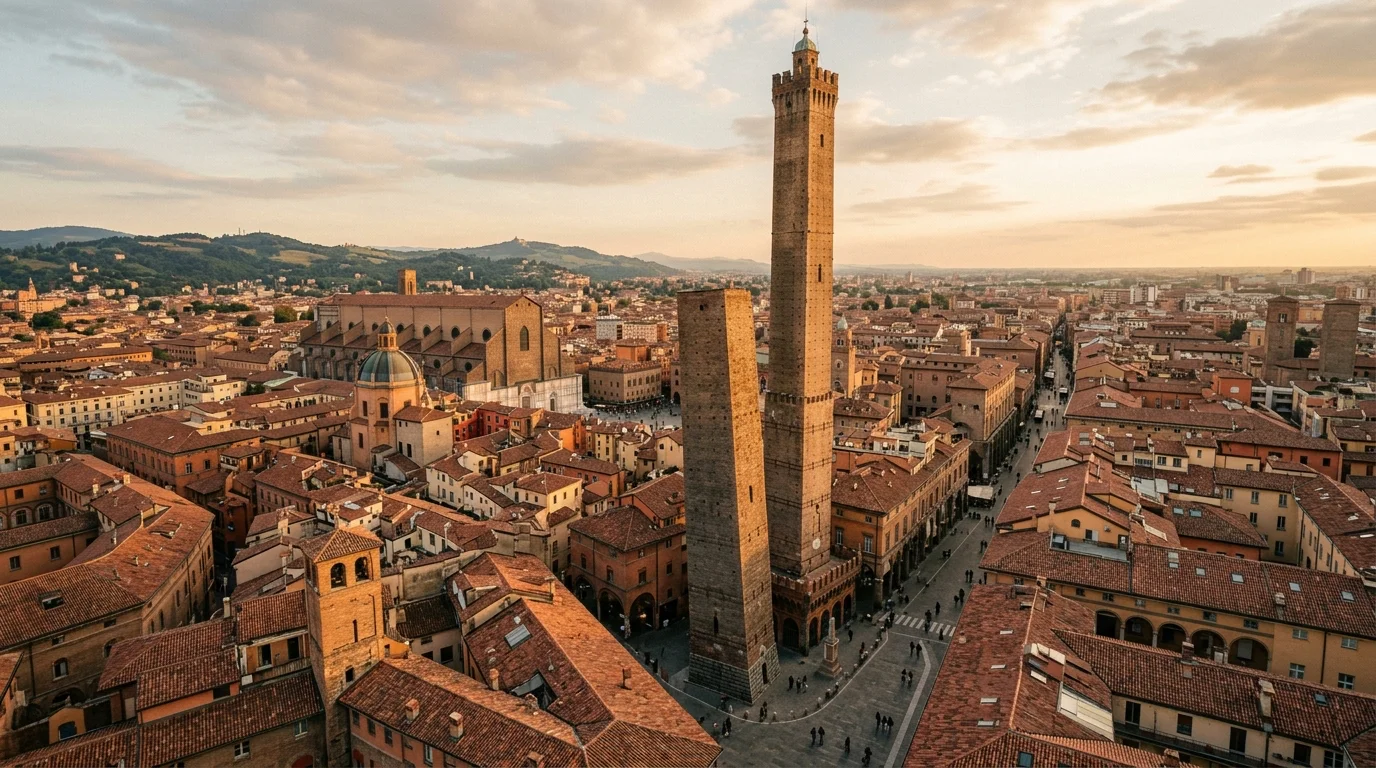
The Two Towers are Bologna's most recognisable symbol and one of the most extraordinary sights in all of Italy. Built between 1109 and 1119 by rival noble families (the Asinelli and Garisenda families) as symbols of power and wealth, the towers are a stunning reminder of medieval Bologna's ambition. At its peak in the 12th and 13th centuries, Bologna had more than 100 such towers — today only about 20 remain. The taller Torre degli Asinelli stands 97.2 metres tall and leans noticeably; the shorter Torre Garisenda leans even more dramatically at just 48 metres but is the more visually striking of the two.
Torre Garisenda was partially dismantled in the 14th century because its lean became dangerously pronounced (it currently leans 3.2 metres from vertical). Torre degli Asinelli can be climbed via 498 steep wooden steps — a physically demanding but absolutely worthwhile experience offering panoramic views over the city's terracotta rooftops and the Apennine mountains beyond.
Why visit: The view from the top of Torre degli Asinelli is one of the finest urban panoramas in Italy and the climb itself is an unforgettable experience. This is Bologna's most iconic photo opportunity.
Entrance: Torre degli Asinelli: €5.00 adults (2026); Torre Garisenda is currently closed to the public for structural assessment
Best time: First thing in the morning to avoid queues
Hours: Daily 09:00–18:00 (check seasonal variations)
Basilica di San Petronio
Piazza Maggiore, 40124 Bologna BO, Italy
The Basilica di San Petronio dominates the southern side of Piazza Maggiore and is one of the largest churches in the world — longer than St Peter's Basilica in Rome would have been, had the original plans been executed. Construction began in 1390 and the church was never actually finished — its famous façade remains part brick, part marble, which gives it a uniquely striking appearance. The interior is vast, serene, and full of art treasures spanning four centuries.
Inside, don't miss Giovanni Cassini's extraordinary astronomical sundial, a 66.8-metre meridian line inlaid in the floor that was used for centuries as Europe's most accurate solar clock. The 22 chapels lining the nave contain paintings and frescoes by some of Italy's greatest artists. The church also played a key role in history — Charles V was crowned Holy Roman Emperor here in 1530.
Why visit: This is one of Italy's most impressive Gothic churches and completely free to enter. The combination of massive scale, architectural drama, and important artworks makes it essential viewing.
Entrance: Free; Museum €3.00 (2026)
Best time: Weekday mornings to avoid tour groups
Hours: Mon–Sat 07:45–18:30, Sun 07:45–19:00 (subject to services)
Mercato di Mezzo (Quadrilatero)
Via Clavature, 12, 40124 Bologna BO, Italy
The Quadrilatero is Bologna's ancient market quarter, a dense network of narrow medieval streets between Piazza Maggiore and Via Rizzoli that has been a food market since Roman times. Today it is a living, breathing celebration of Emilia-Romagna's culinary heritage — tiny shops overflow with hanging prosciutto, wheels of Parmigiano Reggiano, fresh pasta, truffle products, artisan cheeses, fresh produce, and bottles of balsamic vinegar aged for decades. The covered Mercato di Mezzo at its heart brings the market indoors across two floors.
The streets to explore include Via Pescherie Vecchie (old fishmongers), Via Clavature, and Via Drapperie — each lined with centuries-old shops that have barely changed in living memory. This is where Bolognese families do their serious food shopping alongside tourists sampling and photographing everything in sight.
Why visit: Even if you buy nothing, a walk through the Quadrilatero is one of the most sensory-rich experiences in Italy. The scent of aged cheese, fresh pasta, and cured meats is utterly intoxicating. Come hungry.
Entrance: Free
Best time: Tuesday–Saturday mornings for maximum activity
Hours: Most shops open 08:00–13:00 and 16:00–19:30; Mercato di Mezzo open daily 08:00–midnight
University of Bologna & Archiginnasio
Piazza Galvani, 1, 40124 Bologna BO, Italy
The University of Bologna, founded in 1088, is the oldest university in the Western world — a fact locals are immensely proud of. While the modern university is spread across the city, the historic heart is the Archiginnasio, the university's original home built in 1563. This magnificent Renaissance building served as the main seat of the university for nearly three centuries and its courtyard, staircases, and walls are covered in thousands of heraldic crests and memorials to former students — a tradition that continued for 300 years.
Inside, the extraordinary Teatro Anatomico — the world's first permanent anatomy theatre, built in 1637 — is a marvel of Baroque woodwork. Carved wooden tiers surround a central marble table where human dissections were once performed publicly for medical students. The ceiling is decorated with mythological figures and the walls feature carved figures of celebrated anatomists. It is one of the most beautiful and unusual rooms in Italy.
Why visit: The Archiginnasio and its anatomy theatre are among Bologna's most fascinating and least-crowded attractions. The combination of intellectual history, architectural beauty, and the slightly macabre appeal of the anatomy theatre makes this a highlight.
Entrance: Archiginnasio library and anatomical theatre: €3.00 (2026)
Best time: Weekday mornings
Hours: Mon–Fri 10:00–18:00, Sat 10:00–19:00, Sun 10:00–14:00
Santuario di Madonna di San Luca
Via di San Luca, 36, 40135 Bologna BO, Italy
The Sanctuary of the Madonna of San Luca sits on top of the Colle della Guardia hill, 300 metres above the city, and is one of Bologna's most beloved landmarks. The hilltop basilica contains a revered Byzantine icon of the Madonna and has been the spiritual heart of the city for nearly 1,000 years. What makes the approach extraordinary is the world's longest portico: a continuous covered walkway of 666 arches stretching 3.8 kilometres from Porta Saragozza to the sanctuary's door.
The walk up takes about 45–60 minutes each way, winding steeply through the hills with magnificent views over Bologna and the Po Valley. The sanctuary itself, rebuilt in its current Baroque form in the 18th century, has a serene interior decorated with ex-votos (small offerings of thanks) brought by worshippers over centuries. You can also take a cable car (Funivia) or the panoramic lift to reach the top more easily.
Why visit: The walk up through the portico is a quintessentially Bolognese experience — locals do it for exercise, devotion, and the spectacular views. On a clear day you can see as far as the Alps.
Entrance: Sanctuary free; Cable car (Funivia San Luca) €5.00 one-way, €8.00 return (2026)
Best time: Early morning or late afternoon for cooler temperatures and best light
Hours: Sanctuary open daily 07:00–12:30 and 14:30–17:00
Palazzo Poggi & Museum of the History of the University of Bologna
Via Zamboni, 33, 40126 Bologna BO, Italy
Palazzo Poggi houses one of Bologna's most fascinating and undervisited museum complexes — a series of historic scientific collections that once formed the nucleus of Europe's most advanced 18th-century research institute. The collections include extraordinary anatomical wax models created in the 18th century for medical education, antique scientific instruments, natural history specimens, and stunning hand-painted maps and globes from the Age of Exploration. The building itself, a 16th-century palazzo decorated with magnificent frescoes, is worth visiting in its own right.
The wax anatomical models (cerae anatomiche) are the undisputed highlight — these meticulously detailed figures, created by Ercole Lelli and Anna Morandi Manzolini in the 1740s, were designed to teach human anatomy without the need for real cadavers. The level of detail is extraordinary and the craftsmanship is remarkable. These models are a UNESCO-recognised example of Italian artistic and scientific heritage.
Why visit: Palazzo Poggi is one of Bologna's great hidden treasures — extraordinary collections in a beautiful building, rarely crowded, and deeply fascinating for anyone interested in science, art, or history.
Entrance: €5.00 adults; free for University of Bologna students (2026)
Best time: Weekday afternoons
Hours: Tue–Sun 10:00–18:00, closed Monday
Pinacoteca Nazionale di Bologna
Via delle Belle Arti, 56, 40126 Bologna BO, Italy
The National Picture Gallery of Bologna is one of Italy's most important regional art museums and a must for anyone who loves Italian painting. Housed in a former Jesuit college, the collection spans from the 14th to the 18th centuries and features an exceptional concentration of Bolognese artists — Vitale da Bologna, Simone dei Crocifissi, Guido Reni, Annibale Carracci, Guercino, and many others. There are also significant works by Raphael and Giotto.
The gallery is particularly strong in the Bolognese Baroque — the Carracci family (Annibale, Agostino, and Ludovico) essentially invented a new style of painting in 16th-century Bologna that influenced European art for the next two centuries. Seeing their work here in their hometown, in a beautifully presented gallery, is a genuinely enriching experience. The museum is large enough to be impressive but not so large as to be overwhelming.
Why visit: This is one of Italy's finest regional art galleries and it gets a fraction of the visitors that go to the Uffizi in Florence. You can take your time, enjoy the art without crowds, and come away with a deep understanding of one of Italy's most important artistic traditions.
Entrance: €6.00 adults; free for EU citizens under 18 (2026)
Best time: Tuesday–Thursday mornings
Hours: Tue–Sun 09:00–19:00, closed Monday
Basilica di Santo Stefano (Le Sette Chiese)
Via Santo Stefano, 24, 40125 Bologna BO, Italy
The Basilica di Santo Stefano is not one church but a complex of seven interconnected churches dating from the 5th to the 12th century, making it one of the most extraordinary religious complexes in northern Italy. Known locally as "Le Sette Chiese" (The Seven Churches), the complex was designed to replicate the sacred sites of Jerusalem — an early form of religious pilgrimage for those who couldn't make the journey to the Holy Land. The combination of Romanesque architecture, ancient stonework, and labyrinthine interconnecting spaces creates an atmosphere unlike anywhere else in Italy.
The courtyard at the heart of the complex — the Cortile di Pilato — contains an 8th-century stone basin said to be the one Pontius Pilate used to wash his hands, though this is almost certainly medieval legend. The Church of the Holy Sepulchre is a magnificent 5th-century rotunda modelled on the Church of the Holy Sepulchre in Jerusalem. The overall effect of wandering through the layers of history is deeply moving.
Why visit: Santo Stefano is one of Bologna's most atmospheric and genuinely ancient sites. Unlike the city's Baroque churches, this complex takes you back to the very origins of Christian Bologna and has a quiet, contemplative atmosphere that is unlike anything else in the city.
Entrance: Free
Best time: Weekday mornings
Hours: Daily 09:00–12:30 and 15:30–18:30
MAMbo — Museo d'Arte Moderna di Bologna
Via Don Minzoni, 14, 40121 Bologna BO, Italy
MAMbo (Museum of Modern Art Bologna) is one of Italy's finest contemporary art museums, housed in a converted former bakery in the arts district north of the historic centre. The permanent collection focuses on Italian art from the second half of the 20th century, with strong representation from Arte Povera, Conceptual Art, and the Bolognese art scene of the 1960s–80s. Temporary exhibitions regularly showcase major international names and the museum has an excellent programme of events, talks, and evening openings.
Adjacent to MAMbo is the Museo Morandi — the world's leading museum dedicated to Giorgio Morandi (1890–1964), one of Italy's greatest 20th-century painters. Morandi spent nearly his entire life in Bologna and his still-life paintings of bottles and vessels are among the most quietly powerful works in Italian modern art. The collection here is unrivalled.
Why visit: For anyone interested in Italian modern art — or art more generally — MAMbo is a superb museum in a beautifully converted space. The Morandi collection alone is worth the entrance fee for art lovers.
Entrance: €6.00 adults; free on the first Sunday of the month (2026)
Best time: Weekday afternoons or during special evening events
Hours: Tue–Sun 10:00–18:00 (Fri until 22:00), closed Monday
Certosa di Bologna
Via della Certosa, 18, 40135 Bologna BO, Italy
The Certosa is Bologna's historic monumental cemetery, founded in 1801 within a former Carthusian monastery (hence the name). It is one of Italy's most extraordinary cemeteries — a vast complex of cloisters, chapels, underground galleries, and open-air arcades containing the tombs and monuments of generations of Bolognese families. The sculptural decoration is remarkable: works by some of Italy's finest 19th-century sculptors line the colonnades, including pieces by Vincenzo Vela and Giovanni Putti.
This is also the resting place of the great composer Giuseppe Donizetti, the singer Lucio Dalla, and many significant figures in Italian cultural and political history. Far from being morbid, the Certosa has a peaceful, park-like atmosphere and is used by locals for reflective walks. Free guided tours are offered on weekends.
Why visit: The Certosa is one of Italy's most beautiful and undervisited cultural sites. It combines outstanding art, extraordinary architecture, and fascinating social history in a place that sees very few foreign tourists — a genuine hidden gem.
Entrance: Free
Best time: Morning; guided tours on Saturday and Sunday at 10:00
Hours: Daily 08:00–18:00 (summer); 08:00–17:00 (winter)
Book your tours and tickets in advance — it saves hours of queuing and often gets you a better price. These two platforms cover different options, so it's worth checking both.
What Are the Best Neighborhoods to Explore in Bologna?
Bologna's neighbourhoods each have a distinct character shaped by their history, population, and relationship to the university. Here are the most rewarding areas to explore.
Centro Storico (Historic Centre)
Character: The ancient heart of Bologna, bounded by the inner ring road and centred on Piazza Maggiore. Medieval streets lined with porticoes, monumental churches, palaces, and centuries-old food shops.
What makes it special: This is where almost all of Bologna's major sights are located. It's compact, walkable, visually stunning, and full of excellent restaurants, cafés, and shops. The area around the Quadrilatero market is particularly vibrant and atmospheric.
Best for: All types of travellers, but especially first-time visitors, history lovers, and food enthusiasts
Must-see in this area: Piazza Maggiore, Basilica di San Petronio, Neptune Fountain, Quadrilatero market, Two Towers
How to get there: Walk from the train station (15–20 minutes) or take bus no. 11, 13, 20, 25, or 27
Location: Piazza Maggiore, 40124 Bologna BO, Italy
Università Quarter (Via Zamboni & Via delle Belle Arti)
Character: Bologna's vibrant student neighbourhood, stretching northeast of the Two Towers along Via Zamboni. Medieval palazzi housing university faculties, bookshops, small theatres, vintage shops, and an abundance of cheap and cheerful bars and osterie.
What makes it special: This is where Bologna's famous left-wing, intellectual soul lives. The streets are lined with political murals, alternative bookshops, jazz clubs, and the kind of lived-in, genuine atmosphere that tourism hasn't sanitised. The area is most alive in the evenings when students fill the bars for aperitivo.
Best for: Culture lovers, solo travellers, night owls, anyone who wants to experience student Bologna
Must-see in this area: Archiginnasio, Palazzo Poggi, Pinacoteca Nazionale, Teatro Comunale di Bologna
How to get there: 5-minute walk from the Two Towers; walkable from Piazza Maggiore
Location: Via Zamboni, 40126 Bologna BO, Italy
Santo Stefano & Strada Maggiore
Character: One of Bologna's most beautiful and elegant neighbourhoods, stretching southeast from Piazza Maggiore along Via Santo Stefano and Strada Maggiore. Wider porticoes, refined palaces, antique shops, high-end restaurants, and the city's most architecturally impressive church complex.
What makes it special: This area has a more refined and residential character than the bustling university quarter. The long porticoed street of Via Santo Stefano leads to the extraordinary Seven Churches complex and the attractive Piazza Santo Stefano — one of Bologna's most picturesque squares, lined with cafés and wine bars.
Best for: Culture lovers, architecture enthusiasts, couples, food lovers seeking upscale dining
Must-see in this area: Basilica di Santo Stefano, Piazza Santo Stefano, Palazzo Fantuzzi, Oratorio di Santa Cecilia
How to get there: 5-minute walk from Piazza Maggiore via Via Castiglione
Location: Piazza Santo Stefano, 40125 Bologna BO, Italy
Porta San Felice & Bolognina
Character: A genuine working-class neighbourhood north of the train station, currently undergoing a fascinating transformation into Bologna's emerging creative district. Industrial spaces converted into art galleries, craft breweries, vintage shops, and multicultural food spots sit alongside traditional osterie and local markets.
What makes it special: This is where you find the real, ungentrified Bologna. It's home to a diverse community, some of the city's best-value restaurants, a growing arts scene, and the excellent MAMbo museum. It has a rough-edged charm that increasingly attracts creative types and younger Bolognesi.
Best for: Independent travellers, art lovers, budget travellers, anyone interested in authentic local neighbourhood life
Must-see in this area: MAMbo museum, Piazza dell'Unità, craft beer bars, street art
How to get there: 10-minute walk north from Bologna Centrale station
Location: Via Bolognina, 40121 Bologna BO, Italy
Colli Bolognesi (The Hills)
Character: The green hills rising immediately to the south of the city, dotted with villas, medieval churches, hilltop viewpoints, and the famous portico leading to San Luca sanctuary. A completely different side of Bologna — quiet, scenic, and surprisingly wild just 20 minutes' walk from the city centre.
What makes it special: The hills offer extraordinary views over the city and the Po Valley, excellent hiking trails, wine estates producing the local Pignoletto grape, and the magnificent sanctuary of Madonna di San Luca. On clear days, views stretch to the Alps in the north.
Best for: Outdoor enthusiasts, photographers, wine lovers, families, anyone needing a break from the city
Must-see in this area: San Luca Sanctuary, Parco di Villa Ghigi, Osteria del Casalone, Colle dell'Osservanza
How to get there: Walk from Porta Saragozza (about 20 minutes from Piazza Maggiore) or take bus no. 20
Location: Via di San Luca, 40135 Bologna BO, Italy
Piazza Verdi & Via del Pratello
Character: Via del Pratello is one of Bologna's most characterful streets — a long, narrow lane lined with osterie, aperitivo bars, and traditional trattorie that has been Bologna's working-class social artery for centuries. Piazza Verdi, in front of the Teatro Comunale opera house, is a student gathering point with a famously boisterous atmosphere.
What makes it special: Via del Pratello is where you drink properly cheap local wine in no-frills cantinas that charge €2 for a glass of Sangiovese, eat genuine home cooking at plastic-tabled osterie, and feel miles away from the tourist trail. Piazza Verdi comes alive every evening as students crowd out on the steps with wine bottles and guitars.
Best for: Night owls, budget travellers, anyone seeking authentic and non-touristy Bologna
Must-see in this area: Teatro Comunale di Bologna, multiple osterie on Via del Pratello, Cantina Bentivoglio jazz club
How to get there: 10-minute walk west from Piazza Maggiore
Location: Via del Pratello, 40122 Bologna BO, Italy
What Food Should You Try in Bologna?
Bologna is the undisputed food capital of Italy — a city so devoted to eating well that it earned the nickname "La Grassa" (The Fat One) centuries ago. The cuisine of Emilia-Romagna — the region surrounding Bologna — is generally considered Italy's finest, and the city is home to the original recipes for some of the world's most famous foods: Bolognese ragù, mortadella, tortellini, and tagliatelle.
What Are the Must-Try Local Dishes in Bologna?
- Ragù alla Bolognese — The original Bolognese sauce, which bears almost no resemblance to what the rest of the world calls "Bolognese." The authentic version (registered with the Bologna Chamber of Commerce in 1982) is a slow-cooked meat sauce of minced beef and pork, soffritto, white wine, and just a splash of tomato, served with fresh egg tagliatelle — never spaghetti. Taste it at a proper old-school trattoria and you will never look at pasta sauce the same way again.
- Tortellini in Brodo — Tiny ring-shaped egg pasta filled with a mix of mortadella, prosciutto, and Parmigiano Reggiano, served in a deeply flavoured capon broth. This is Bologna's most beloved dish — the combination of silky pasta and rich broth is one of Italy's greatest culinary achievements. It's a must-try in winter.
- Mortadella — The original and only true mortadella is made in and around Bologna. This large, pink cured pork sausage studded with pistachios and white fat is a world away from the watery "bologna sausage" sold elsewhere. Eat it freshly sliced at a market stall or in a tigella (a local bread) for the best experience.
- Tagliatelle al Ragù — Fresh egg tagliatelle (flat, wide ribbons made with egg pasta dough) served with the authentic meat ragù. The tagliatelle must be made fresh daily — even the acceptable width of tagliatelle is officially registered: exactly 8mm when cooked, or 1/12,270th the height of Torre degli Asinelli (a beloved local regulation).
- Parmigiano Reggiano — The king of Italian cheeses, made in the area around Bologna for nearly 800 years. Buy it fresh at the Quadrilatero market in different ages (young at 12 months, mature at 24 months, extra mature at 36 months) and taste the extraordinary differences. Local shops will let you taste before you buy.
- Tigelle e Gnocco Fritto — Two of Emilia-Romagna's great street foods: tigelle are small, round, slightly crispy flatbreads split and filled with mortadella, squacquerone cheese, or cured meats; gnocco fritto are puffed, deep-fried dough squares eaten with prosciutto and cheese. Find both in any traditional osteria as part of an antipasto spread.
- Lasagne Verdi alla Bolognese — Another registered Bolognese masterpiece: layers of green (spinach-infused) egg pasta, ragù, béchamel sauce, and Parmigiano Reggiano, baked until golden. This is the original, authentic version of a dish that the whole world makes badly.
- Certosino (Panspeziale) — Bologna's traditional Christmas cake — a dense, spiced cake filled with dried fruit, nuts, chocolate, and preserved fruit, then topped with almonds and glazed fruit. Available in bakeries from October onwards. A deeply aromatic, ancient recipe.
Where Should You Eat in Bologna?
Budget-Friendly (Under €15 per meal)
- Osteria dell'Orsa — Via Mentana, 1, 40126 Bologna — A legendary student osteria near the university that has served generous portions of authentic Bolognese food at remarkably low prices for decades. The tagliatelle al ragù is excellent and often costs under €10. Arrive early or queue.
- Eataly Bologna — Via degli Orefici, 19, 40124 Bologna — The food hall's casual eating areas offer high-quality Emilian products at reasonable prices. The pasta counter and the mortadella bar are excellent budget lunch options in a spectacular setting.
- Simoni — Via Drapperie, 5, 40124 Bologna — A historic delicatessen in the Quadrilatero where you can build a superb stand-up lunch from the finest local products. Order a tigella or a piadina filled with fresh mortadella and Parmigiano for around €6–€8 (2026).
Mid-Range (€20–€45 per meal)
- Trattoria da Me — Via San Felice, 50, 40122 Bologna — One of Bologna's most celebrated modern trattorias, run by a mother-daughter duo who produce stunning contemporary takes on Emilian classics. The stuffed pasta is extraordinary. Booking essential.
- Drogheria della Rosa — Via Cartoleria, 10, 40124 Bologna — A beautiful osteria in a converted 19th-century pharmacy. The menu is short, seasonal, and deeply rooted in Bolognese tradition. The wine list is excellent and the atmosphere is warm and unpretentious.
- Trattoria Anna Maria — Via delle Belle Arti, 17/a, 40126 Bologna — A Bologna institution covered floor-to-ceiling with photos of celebrity guests. The handmade pasta — particularly the tortellini in brodo — is made by hand every day by Anna Maria herself and is considered by many locals to be the city's finest.
- Osteria Bottega — Via Santa Caterina, 51, 40123 Bologna — A modern wine-bar-meets-osteria with a carefully curated menu of seasonal Emilian dishes and an exceptional wine list focused on natural and artisan producers. Popular with food-savvy locals and visiting chefs.
Fine Dining (€60+ per meal)
- I Portici Restaurant — Via dell'Indipendenza, 69, 40121 Bologna — Bologna's most acclaimed fine dining restaurant, located inside the elegant Grand Hotel Majestic. One Michelin star. Chef Agostino Iacobucci produces refined contemporary Italian cuisine with a strong Emilian identity. The setting — a gorgeous Belle Époque dining room — is magnificent.
- Ristorante Diana — Via dell'Indipendenza, 24, 40121 Bologna — A Bologna institution since 1909, Diana is a formal, old-school grande cucina restaurant where the city's establishment has always dined. The tortellini in brodo and the classics of the Bolognese table are done with impeccable precision. A special-occasion restaurant.
What Are the Dining Customs in Bologna?
Meal times: Locals eat breakfast (colazione) between 07:00 and 09:30 — usually a standing espresso and cornetto at a bar. Lunch (pranzo) is typically 12:30–14:00 and is often the main meal of the day. Dinner (cena) starts no earlier than 19:30 and 20:00–21:00 is peak time. Restaurants that open at 19:00 often fill up by 20:30.
Tipping: Tipping is not mandatory in Italy but is appreciated. Leave 5–10% for good service or round up the bill. Many restaurants include a "coperto" (cover charge) of €1–€3 per person — this is legitimate and not a tip replacement.
Reservations: Strongly recommended at mid-range and above, especially Friday–Sunday evenings. Many of Bologna's best trattorias (Trattoria Anna Maria, Trattoria da Me) require booking 1–2 weeks ahead on busy weekends.
Dress code: Smart-casual for mid-range and above; relaxed at osterie and traditional trattorias. Fine dining restaurants expect at minimum smart casual — no shorts or flip-flops.
What Is the Nightlife Like in Bologna?
Bologna's nightlife is some of the liveliest in Italy — driven by the city's enormous student population of around 85,000 students, the city comes alive every evening with aperitivo bars, live music, jazz clubs, and a club scene that punches well above its weight for a mid-sized city. Things get going around 18:00 with aperitivo hour and continue until well past midnight on weekends.
Where Are the Best Areas for Nightlife in Bologna?
- Via del Pratello: Via del Pratello, 40122 Bologna — The most authentic and local nightlife street. A long lane lined with old osterie, wine bars, and aperitivo spots that fill up with students, artists, and neighbourhood regulars every evening. Prices are very low, atmosphere is genuine, and it stays busy until late.
- Piazza Verdi & Via Zamboni: Piazza Giuseppe Verdi, 40126 Bologna — The student epicentre. The steps of the Teatro Comunale become a massive outdoor social gathering point from early evening, with students drinking and socialising. The surrounding bars and osterie are cheap, noisy, and full of life.
- Quadrilatero & Via Clavature: Via Clavature, 40124 Bologna — More upscale aperitivo territory, closer to the tourist centre. Smart wine bars, craft cocktail spots, and enotéche where you can enjoy excellent Emilian wines with free snacks from 18:00.
What Are the Best Bars and Clubs in Bologna?
Bars & Pubs
- L'Osteria del Sole — Vicolo Ranocchi, 1, 40124 Bologna — Bologna's oldest osteria (1465), this extraordinary place sells only wine — you bring your own food from the nearby market. Atmospheric, chaotic, and completely unique. A piece of genuine Bolognese history.
- Berberè — Via Giuseppe Petroni, 16c, 40126 Bologna — A modern craft beer bar and award-winning pizza spot near the university that has built a national reputation. Excellent Italian craft beers, natural wines, and seriously good pizza in a lively, informal setting.
- Enoteca Italiana — Via Marsala, 2/b, 40126 Bologna — A superb wine bar near the train station with an exceptional cellar of Italian wines available by the glass or bottle. Knowledgeable staff, excellent cheese and charcuterie boards, and a relaxed, sophisticated atmosphere.
Clubs & Dancing
- Locomotiv Club — Via Sebastiano Serlio, 25/2, 40128 Bologna — Bologna's best-known live music and club venue. A 1,500-capacity space that attracts major Italian and international acts. Strong indie, electronic, and alternative music programming. Check the calendar in advance — this is a serious music venue.
- Estragon Club — Via Stalingrado, 83, 40128 Bologna — A large club and live music venue on the northern edge of the city with a more mainstream programme of concerts, DJ nights, and club events. Popular with a mixed-age crowd. Cover charge varies by event: €10–€25 (2026).
Live Music & Shows
- Cantina Bentivoglio — Via Mascarella, 4/b, 40126 Bologna — Bologna's most beloved jazz club, operating in a beautiful medieval cellar with live jazz performances every night. The wine and food are excellent too — arrive early for dinner, stay for the music (usually starts at 22:00). Tickets €5–€15 (2026) depending on the act.
- Teatro Comunale di Bologna — Largo Respighi, 1, 40126 Bologna — One of Italy's finest opera houses, offering world-class opera, ballet, and classical concerts. The building itself is spectacular. Book tickets well in advance for the main opera season (October–June). Tickets from €15 (gallery) to €150+ (stalls, 2026).
What Family-Friendly Evening Entertainment Is Available?
Bologna's evening culture is welcoming to families. Italian dining culture means children are always welcome in restaurants (even quite late), and the summer outdoor cinema season (arene estive) at Piazza Maggiore and Giardini Margherita offers free or very cheap film screenings. The Cineteca di Bologna, one of Europe's great film archives, also hosts regular evening screenings of restored classic films that are accessible to families.
What and Where Should You Shop in Bologna?
The best things to buy in Bologna are food products — artisan pastas, cured meats, aged Parmigiano Reggiano, balsamic vinegar, and local wines. Beyond food, the city has excellent shops for fashion, design, vintage clothing, books, and artisan crafts, particularly in the university quarter.
What Are the Best Shopping Districts in Bologna?
- Via d'Azeglio & Via Farini: Via d'Azeglio, 40123 Bologna — Bologna's most elegant shopping street runs through the southern historic centre. Lined with mid-to-high-end fashion boutiques, leather goods shops, jewellery, and design stores. This is where well-heeled Bolognesi shop for clothes and accessories.
- Via dell'Indipendenza & Via Rizzoli: Via dell'Indipendenza, 40121 Bologna — The main pedestrian shopping artery running from the train station to Piazza Maggiore. High street chains, shoe shops, and affordable fashion. Busy and practical rather than charming.
- Via Zamboni & Vicinity: Via Zamboni, 40126 Bologna — The university quarter's shopping scene is dominated by independent bookshops, vintage clothing stores, record shops, and artisan products. Far more interesting and authentic than the high street.
What Markets Should You Visit in Bologna?
Quadrilatero Market — Via Pescherie Vecchie, 40124 Bologna — Open Tuesday–Saturday 07:00–13:30 and 15:30–19:30. The heart of Bolognese food culture — an ancient warren of market streets and specialist food shops selling every possible Emilian delicacy. This is where to buy authentic mortadella, fresh pasta, Parmigiano Reggiano, and local wines to take home. Bargaining is not the culture here — prices are fair and fixed.
Mercato delle Erbe — Via Ugo Bassi, 25, 40121 Bologna — Open Monday–Saturday 07:00–14:00 (with some evening openings). A large covered municipal market in the historic centre selling fresh produce, fish, meat, cheese, and prepared foods at excellent prices. More local and less touristy than the Quadrilatero — this is where Bolognesi do their daily shopping.
Flea Market at Piazza VIII Agosto (Piazzola) — Piazza VIII Agosto, 40126 Bologna — Open Friday and Saturday 07:00–14:00. Bologna's famous outdoor flea market, one of the largest in Italy. Clothing (vintage and new), household items, antiques, books, records, plants, and curiosities from hundreds of stalls. Arrive early for the best finds.
What Should You Buy in Bologna?
- Parmigiano Reggiano — Buy a wedge directly from a market vendor for the best price and quality. A 300–500g piece of aged Parmigiano costs €8–€15 (2026) and makes an extraordinary gift. Look for DOP certification on the rind.
- Mortadella — Ask for it freshly sliced (at least 3–4mm thick — never the thin machine slices). A 400g vacuum-packed pack suitable for travel costs €6–€10 (2026) from market vendors. Look for "Mortadella IGP Bologna" certification.
- Fresh Pasta (dry or vacuum-packed) — Artisan dried pasta and vacuum-packed fresh pasta travel well and make wonderful souvenirs. Look for egg tagliatelle, tortellini, and garganelli from specialist pasta shops in the Quadrilatero.
- Aged Balsamic Vinegar — The true Aceto Balsamico Tradizionale di Modena or Reggio Emilia — aged for minimum 12 years in wooden barrels — is one of the world's great condiments. Small 100ml bottles cost €30–€80+ (2026) but a few drops are all you need. Buy from a specialist food shop.
- Local Wine — Pignoletto (a light, slightly sparkling white), Sangiovese di Romagna (red), and Lambrusco Grasparossa (a dry sparkling red) are all specialities of the region. Wine shops (enoteche) throughout the city offer excellent selections from €5–€15 per bottle (2026).
- Vintage Books & Prints — The university quarter has several excellent second-hand and antiquarian bookshops, print sellers, and map shops. Italian-language books and antique prints of Bologna make beautiful and inexpensive souvenirs.
What Are the Shopping Hours and Customs?
Most shops in Bologna are open Monday–Saturday 09:30–13:00 and 15:30–19:30. Many shops in the historic centre now stay open all day (orario continuato). Sundays, particularly in the city centre, see more shops open than in smaller Italian cities. Summer sales (saldi estivi) run in July; winter sales (saldi invernali) start in early January. VAT refunds (Tax-Free Shopping) are available for non-EU residents on purchases over €154.94 — ask for the form at the shop.
Can Non-EU Visitors Claim a VAT Tax Refund in Bologna?
Yes — if you are a visitor from outside the European Union (including travellers from the USA, Canada, Australia, the UK, and most of Asia and Latin America), you are entitled to a refund of the VAT (Value Added Tax) included in the price of goods you buy in Italy. VAT in Italy is 22% on most goods; 10% on some food items, which means this refund can be significant on high-value purchases like clothing, leather goods, jewellery, designer fashion, and electronics.
How to Claim Your VAT Refund — Step by Step
- Spend at least €154.94 in a single shop in a single day. This is the minimum threshold for a VAT refund claim in Italy. It does not apply across multiple shops — the full amount must be spent in one store.
- Look for the "Tax Free" sign. Participating shops display a "Tax Free Shopping," "Global Blue," or "Planet" logo in the window or at the register.
- Ask for the tax refund form at the register before you pay. Present your non-EU passport — the shop will fill out the form with your details and the purchase amount. Keep the form with your receipt.
- Get the form stamped at customs before you leave. Go to the Customs office at Bologna Guglielmo Marconi Airport (BLQ) before check-in and have an officer stamp your tax refund form. Keep your purchases accessible in hand luggage — do not pack them deep in your checked bags.
- Collect your refund. Hand the stamped form to the Global Blue or Planet desk at the airport. You can receive the refund in cash (minus a processing fee) or as a credit card refund (lower fees, takes a few weeks).
VAT Refund Quick Facts for Bologna
- Minimum spend: €154.94 in one shop in one day
- VAT rate on most goods: 22% on most goods; 10% on some food items
- Typical refund after fees: 10–15% of the purchase price
- Refund processors: Global Blue and Planet (formerly Premier Tax Free) at Bologna Guglielmo Marconi Airport (BLQ)
- Who qualifies: Anyone with a non-EU passport who is not a resident of an EU country
- UK visitors: British passport holders qualify since Brexit — the UK is no longer in the EU
- Deadline: Purchases must be exported within 3 months of the date of purchase
- Full guide: VAT Refund in Europe — Complete Guide for Non-EU Travelers
What Festivals and Events Happen in Bologna?
Bologna's biggest festivals include Il Cinema Ritrovato (a world-class restored film festival), Mortadella Please (the city's beloved celebration of its most famous food product), and a packed calendar of music, food, and cultural events driven by the university community throughout the year.
What Is the Annual Events Calendar for Bologna?
| Month | Event Name | Description |
|---|---|---|
| January | Saldi (Winter Sales) | Post-holiday sales begin in all shops, with discounts of 30–70%. Great time to buy Italian fashion and food products at reduced prices. |
| February | Carnevale Bologna | Bologna's Carnival celebrations include parades, costumes, and special events in the historic centre. Smaller and more local than Venice's Carnevale, but genuinely festive. |
| March | Bologna Children's Book Fair | One of the world's most important trade events for children's book publishing, held at the Bologna Fiere exhibition centre. Open to trade visitors; brings significant literary energy to the city. |
| April | Cosmoprof Worldwide Bologna | The world's largest professional beauty exhibition. Brings tens of thousands of professionals to the city — accommodation books up very early around this event. |
| May | Jazz Fest Bologna | An annual jazz festival held across multiple venues in the historic centre, featuring Italian and international jazz artists. Many free outdoor performances in the evenings. |
| June | Estate Bolognese | The summer cultural festival kicks off — hundreds of free and low-cost events including outdoor cinema at Piazza Maggiore, concerts in the parks, theatre in the courtyards, and food events throughout the city. |
| June | Il Cinema Ritrovato | An internationally acclaimed festival dedicated to restored and rediscovered cinema. Free outdoor evening screenings at Piazza Maggiore — a magical Bologna experience. Runs late June–early July. |
| July | Bologna Estate (Summer events) | Summer entertainment continues throughout July with outdoor concerts, food festivals, and free events. The city is quieter in late July as locals leave, but events continue. |
| August | Ferragosto | August 15th is Italy's biggest national holiday. Most Bolognese leave for the coast. The city is quiet but there are some food events and the usually crowded sites are remarkably empty. |
| September | Mortadella Please! | Bologna's joyful festival dedicated to its most famous food product. Tastings, cooking demonstrations, pop-up stalls, and plenty of mortadella in all its forms around the historic centre. |
| October | Cioccoshow | A major artisan chocolate festival held in the historic centre, featuring chocolate makers from across Italy and internationally. Free entry; the chocolate is not free but irresistible. |
| November | Sana — Organic & Natural Food Fair | Europe's leading international trade fair for organic and natural products, held at Bologna Fiere. Growing in influence as interest in sustainable food increases. |
| December | Christmas Markets & Fiera di Santa Lucia | Christmas markets appear in Piazza Maggiore and around the historic centre from early December. The Fiera di Santa Lucia (December 13) is a beloved traditional fair with stalls selling toys, sweets, and gifts. |
How Do Festivals Affect Hotel Prices and Availability?
The major trade fairs — Cosmoprof (April), the Children's Book Fair (March–April), and Sana (September) — cause the biggest spikes in hotel prices, sometimes tripling standard rates. Book accommodation 2–3 months ahead for fair dates. Il Cinema Ritrovato and Mortadella Please cause moderate price increases in the high season but rooms are usually available with 2–4 weeks' notice. Christmas is increasingly popular; book December stays 6–8 weeks ahead.
Where Should You Stay in Bologna?
The best neighbourhood to stay in Bologna depends on your travel style, but for most visitors the answer is simple: stay in or as close to the historic centre as possible. The centre is compact, walkable, and being within the porticoes at all hours is a wonderful experience. Here is a full breakdown.
What Are the Best Neighborhoods to Stay in Bologna?
| Neighbourhood | Vibe | Price Range (per night, 2026) | Best For |
|---|---|---|---|
| Centro Storico (Historic Centre) | Lively, cultural, central | €120–€300 (hotels); €80–€180 (B&Bs/apartments) | First-time visitors, couples, culture lovers |
| University Quarter (Via Zamboni) | Buzzy, student energy, authentic | €70–€180 | Solo travellers, budget-conscious, nightlife seekers |
| Near Bologna Centrale Station | Convenient, mixed quality | €60–€150 | Business travellers, early departures, budget stays |
| Santo Stefano / Strada Maggiore | Quiet, elegant, residential | €100–€250 | Couples, longer stays, those seeking calm |
| Bolognina (North of station) | Local, emerging, budget-friendly | €50–€120 | Budget travellers, repeat visitors wanting authenticity |
What Are the Pros and Cons of Each Area?
Centro Storico:
Pros: Walking distance to all sights, magnificent architecture all around, excellent restaurant choice, safe and lively at all hours, immersive Bologna experience.
Cons: Most expensive area; limited parking; can be noisy near bars and restaurants on weekend evenings; traffic restricted zone (ZTL) means driving to your hotel requires a permit.
University Quarter:
Pros: Great value for money, authentic student atmosphere, excellent cheap eating and drinking options, close to multiple museums and the Pinacoteca.
Cons: Can be very noisy on Thursday–Saturday nights; some streets feel rough after midnight; fewer luxury accommodation options.
Near Bologna Centrale Station:
Pros: Excellent transport connections, good range of budget hotels, easy airport access via the Marconi Express, close to the historic centre on foot (15 minutes).
Cons: The area immediately around the station is uninspiring and can feel unsafe after dark; further from the best restaurants and nightlife.
How Far in Advance Should You Book in Bologna?
For peak season (April–June, September–October), book at least 6–8 weeks ahead for good central hotels. During major trade fairs (Cosmoprof, Children's Book Fair), book 2–3 months ahead or prices will be astronomical. For Christmas, book 4–6 weeks ahead. Winter (excluding Christmas and New Year) is the easiest time to find last-minute availability at low prices.
What Do You Need to Know Before Visiting Bologna?
Here are the essential practical details every visitor to Bologna needs to know — from currency and language to safety, visas, and local customs.
Essential Travel Details for Bologna
- Currency: Euro (€); most transactions are electronic but cash is useful for markets, osterie, and small shops
- Credit Cards: Widely accepted at hotels, restaurants, and shops; some small osterie and market vendors are cash-only
- ATMs: Bancomat (ATMs) are plentiful throughout the historic centre; use bank ATMs rather than standalone machines to avoid high fees
- Language: Italian; English widely spoken in tourist areas, hotels, and most restaurants, though older residents in local osterie may speak only Italian
- Tipping: Not mandatory; 5–10% for good service; a coperto (cover charge) of €1–€3 per person is standard and is NOT a tip
- Electrical Plugs: Type F (Schuko) and Type L (Italian) — 230V, 50Hz. Bring a universal European adapter
- Emergency Number: 112 (all emergencies); 113 (police); 118 (ambulance); 115 (fire)
- Tourist Police: +39 051 640 1111 (Questura di Bologna)
- SIM Cards: Available at TIM, Vodafone, WindTre, and ILIAD stores near the station and in the centre. A tourist SIM with data costs approximately €15–€30 (2026). Bring your passport for purchase.
- WiFi: Free WiFi widely available in hotels, cafés, and restaurants. "Bologna Wi-Fi" covers much of the historic centre (register on the portal)
- Tap Water: Safe to drink throughout Bologna and northern Italy. The public drinking fountains (nasoni) are also safe and free.
Skip the airport queue — order your eSIM before you travel and activate it the moment you land. Prices and data allowances vary, so it pays to compare providers.
How Much Does It Cost to Visit Bologna?
| Budget Type | Daily Cost (2026) | What's Included |
|---|---|---|
| Budget Traveller | €60–€90 per day | Hostel or budget hotel, market lunches and osteria dinners, public transport, free sights (Piazza Maggiore, Santo Stefano, Quadrilatero), occasional paid attraction |
| Mid-Range Traveller | €120–€200 per day | 3-star hotel or B&B, mix of trattorias and mid-range restaurants, taxi for some journeys, Torre degli Asinelli, museum entries, a food tour or cooking class |
| Luxury Traveller | €300–€500+ per day | 4–5 star hotel, fine dining at I Portici or similar, private transfers, private guides, premium food experiences (truffle hunting, wine tasting), premium Parmigiano/balsamic shopping |
What Are the Most Useful Phrases in Bologna?
- Hello (formal): Buongiorno (morning/afternoon) / Buonasera (evening)
- Hello (informal): Ciao
- Thank you: Grazie
- Please: Per favore
- Excuse me: Scusi (formal) / Scusa (informal)
- How much?: Quanto costa?
- Where is...?: Dov'è...?
- I don't understand: Non capisco
- Help!: Aiuto!
- Bathroom: Il bagno / I servizi
- Check, please: Il conto, per favore
- Delicious!: Buonissimo! (You will use this constantly in Bologna)
Is Bologna Safe for Tourists?
Yes — Bologna is one of Italy's safest cities and is widely considered very tourist-friendly. Violent crime is rare and the city centre is generally very safe to walk around at all hours. Bologna regularly ranks among Italy's most liveable cities for quality of life, which is a good indicator of overall safety and civic organisation.
Areas to be more cautious: The area around Bologna Centrale train station, particularly after midnight. The Bolognina neighbourhood at night (though it is improving rapidly). These areas have higher rates of petty theft and are best avoided after 23:00.
Common scams: Unlicensed taxi drivers at the station (use official white taxis or Uber); "friendship bracelet" street sellers who tie a bracelet to your wrist then demand payment; fake official guides outside major sights; overcharging at tourist-facing restaurants near Piazza Maggiore (always check the menu's prices before sitting down).
Pickpocketing: Relatively uncommon by Italian standards but does occur on crowded buses, in the Quadrilatero market at busy times, and around the train station. Keep bags in front of you, don't leave phones on café tables, and be aware in crowds.
Solo traveller safety: Bologna is very safe and welcoming for solo travellers of all backgrounds. The large student population creates a diverse, open-minded city. LGBTQ+ travellers will find Bologna one of Italy's most progressive and welcoming cities — it has a long history of LGBTQ+ rights activism and a visible, active community.
What Are the Cultural Customs in Bologna?
- Greetings: Use "Buongiorno" when entering shops, restaurants, and public buildings — it is considered rude not to greet. Shake hands with new acquaintances; close friends exchange cheek kisses (two, left first).
- Dress code: Italians are well-dressed and Bolognesi take particular pride in their appearance. Smart-casual is appropriate almost everywhere. Religious sites require covered shoulders and knees.
- Photography: Ask before photographing market vendors, locals, and people in osterie — most are happy but it is polite to ask. Photography inside churches and museums may be restricted.
- Public behaviour: Keep voices at a reasonable volume in restaurants and churches. Queueing is loosely observed; firmly but politely holding your place is normal.
- Dining: Standing at the bar for coffee is cheaper than sitting at a table (often by 50–100%). Cappuccino is a morning drink — ordering one after lunch or dinner is technically incorrect, though no one will be rude about it.
- Gestures to avoid: Don't make the "horns" gesture (index and little finger extended) as it can be offensive in different contexts.
Do You Need a Visa to Visit Bologna?
Italy is a member of the Schengen Area. Citizens of the EU, EEA, the UK, USA, Canada, Australia, New Zealand, and most other Western countries do not need a visa for stays of up to 90 days in any 180-day period. Citizens of most other countries will require a Schengen visa. From late 2025, non-EU visitors to the Schengen Area must also register via the ETIAS (European Travel Information and Authorisation System) — check the official ETIAS website for current requirements and fees before travelling.
What Health Precautions Should You Take in Bologna?
Vaccinations: No specific vaccinations are required for Bologna. Standard up-to-date vaccinations (tetanus, hepatitis A and B) are recommended. COVID-19 requirements may apply — check current Italian government guidelines.
Pharmacies: Farmacia (pharmacies) are widespread throughout Bologna and sell a wide range of over-the-counter medicines. Many pharmacists speak basic English. 24-hour pharmacies include Farmacia Uniamico (Via Ugo Bassi, 7).
Hospitals: The main hospital is Policlinico di Sant'Orsola, one of Italy's largest and best-equipped university hospitals. EU citizens with a European Health Insurance Card (EHIC) receive free or reduced-cost treatment. Non-EU visitors should carry comprehensive travel insurance — treatment without insurance can be expensive.
Common health issues: Tap water is perfectly safe. Food safety is generally excellent. Heat exhaustion is the main risk in July–August; carry water and avoid the hottest part of the day. Bologna has no significant altitude or mosquito issues.
Do You Need Travel Insurance for Bologna?
Yes — and you should buy it before you board your flight, not after. Travel insurance covers the situations that can turn a great trip into a financial disaster: a medical emergency (a single ambulance ride and hospital stay in Europe can cost €3,000–€10,000 without coverage), a cancelled or delayed flight, lost or stolen baggage, or a last-minute trip cancellation. EU citizens with an EHIC or GHIC card receive reciprocal state healthcare, but this does not cover repatriation, trip cancellation, or lost luggage — a full travel policy fills those gaps. Non-EU travellers have no state coverage at all and should never visit without insurance.
Choosing the right policy matters — coverage limits, exclusions, and pre-existing condition terms vary significantly between providers. Read our full guide before you buy: Best Travel Insurance for Europe — Honest Comparison for 2026.
Travel insurance is strongly recommended for Bologna — an unexpected medical bill, flight cancellation, or lost luggage can cost far more than the policy. Get covered before you go.
What Are Your Rights If Your Flight to Bologna Is Delayed or Cancelled?
Under EU Regulation 261/2004, if your flight to or from Bologna is delayed by more than 3 hours or cancelled without sufficient notice, you are entitled to compensation of up to €600 per passenger — regardless of which airline you flew with, and regardless of how long ago it happened (claims can go back up to 6 years in some countries). This applies to all flights departing from an EU airport, and all flights arriving into an EU airport on an EU-based carrier. Most travellers don't realise they are owed money, and airlines rarely volunteer to pay. A claims service handles everything on your behalf and only charges a fee if they win — so there is no risk to you.
Both services check your eligibility for free with no upfront cost — they only charge a commission if they successfully recover your compensation.
Is Bologna Accessible for People with Disabilities?
Bologna's historic centre has improved its accessibility significantly in recent years. The city's flat terrain within the inner ring makes wheelchair use generally manageable, though some cobbled streets and narrow porticoes can be challenging. Major museums including the Pinacoteca Nazionale and MAMbo have full wheelchair access and accessible toilets. The Torre degli Asinelli is not accessible. The Marconi Express and most buses are wheelchair accessible. For detailed accessibility information, contact the Bologna Tourism Office at +39 051 658 3111.
Is Bologna Good for Families with Kids?
Bologna is an excellent family destination. Italian culture is extremely welcoming to children — kids are welcome in virtually all restaurants, high chairs are usually available, and children's menus are common. The city's many free parks (Giardini Margherita is spectacular for families), the hands-on science museums, the Two Towers climb, and the San Luca cable car all make excellent family activities. The covered porticoes are brilliant for rainy days with a pushchair. MAST (Via Speranza, 42) is a technology and innovation museum with excellent family programming.
What Are the Best Day Trips from Bologna?
The best day trips from Bologna include Modena (for Ferrari and food), Ferrara (for cycling and Renaissance history), Ravenna (for UNESCO mosaics), Parma (for Prosciutto and Parmigiano), and the Apennine Mountains. Bologna's central location on Italy's high-speed rail network makes day trips exceptionally easy.
Modena
Distance: 40 km / 25 miles; 17–20 minutes by high-speed train (every 30 minutes)
What to see: Modena is home to the Ferrari Museum and factory in nearby Maranello, Italy's greatest Romanesque cathedral (a UNESCO World Heritage site), the extraordinary Osteria Francescana (three Michelin stars — the world's best restaurant at one point), and the best traditional balsamic vinegar producers. Don't miss the Mercato Albinelli — one of Italy's finest covered food markets. Modena is also where the original Lambrusco is produced.
How to get there: Take the Frecciarossa or Intercity train from Bologna Centrale to Modena. Trains leave every 15–30 minutes. Tickets from €4–€10 one-way (2026). Buses also run frequently from Bologna but the train is much faster.
Time needed: Full day
Best for: Food lovers, car enthusiasts, architecture fans, anyone interested in Italian craftsmanship
Location: Piazza Grande, 41121 Modena MO, Italy
Ferrara
Distance: 48 km / 30 miles; 30–35 minutes by train
What to see: Ferrara is one of Italy's best-preserved Renaissance cities and a UNESCO World Heritage site. The extraordinary Castello Estense (a 14th-century moated castle in the city centre), Europe's first city planned on a Renaissance grid, excellent cycling infrastructure (Ferrara is Italy's most cycle-friendly city), and the wonderful Palazzo dei Diamanti art gallery. The city has a quiet, unhurried quality very different from Bologna's bustle.
How to get there: Regional train from Bologna Centrale to Ferrara. Departs every 30–60 minutes. Journey time 30–35 minutes. Tickets from €4–€7 one-way (2026). Rent a bicycle at Ferrara station immediately on arrival.
Time needed: Full day
Best for: History lovers, cyclists, couples, architecture enthusiasts, anyone seeking a genuinely different pace
Location: Piazza Castello, 44121 Ferrara FE, Italy
Ravenna
Distance: 75 km / 47 miles; 1 hour by train or bus
What to see: Ravenna is home to eight UNESCO World Heritage Byzantine mosaics — the most spectacular early Christian art in existence. The Basilica di San Vitale, the Mausoleum of Galla Placidia, the Basilica di Sant'Apollinare Nuovo, and the Battistero Neoniano all contain mosaics of extraordinary beauty and historical significance. The city also has a charming historic centre, excellent seafood restaurants (it's close to the Adriatic coast), and was Dante Alighieri's final home.
How to get there: Train from Bologna Centrale to Ravenna, changing at Castel Bolognese. Journey time approximately 1 hour. Tickets from €7–€12 one-way (2026). Direct buses also run from Bologna.
Time needed: Full day (allow 5–6 hours minimum for the UNESCO sites)
Best for: History and art lovers, religious travellers, photography enthusiasts, anyone with an interest in Byzantine civilization
Location: Piazza del Popolo, 48121 Ravenna RA, Italy
Parma
Distance: 95 km / 59 miles; 35–55 minutes by high-speed train
What to see: Parma is one of Italy's most elegant and food-obsessed cities — the home of Prosciutto di Parma, Parmigiano Reggiano, and Culatello di Zibello (the king of Italian cured meats). Beyond food, Parma has a magnificent Romanesque cathedral with extraordinary Correggio frescoes, the elegant Farnese Theatre (one of the oldest wooden theatres in the world), and a refined, aristocratic atmosphere. The Museo del Prosciutto in nearby Langhirano is a genuine pilgrimage for food lovers.
How to get there: High-speed Frecciarossa train from Bologna Centrale to Parma. Tickets from €10–€25 one-way (2026). The journey takes 35–55 minutes depending on the service.
Time needed: Full day
Best for: Food lovers (this is the single best food day trip from Bologna), opera fans (birthplace of Toscanini and home of a serious opera tradition), art lovers
Location: Piazza Garibaldi, 43121 Parma PR, Italy
The Apennine Mountains & Castello di Torrechiara
Distance: 30–60 km south of Bologna; 45–90 minutes by car or bus
What to see: The Apennine Mountains rising immediately south of Bologna offer spectacular hiking, the medieval village of Dozza (a living museum of murals on every building), the extraordinary Castello di Torrechiara (a perfectly preserved 15th-century castle surrounded by vineyards near Parma), and wine estates producing Colli Bolognesi wines for tasting. In autumn, the hills turn golden and truffle and mushroom foraging are in full swing.
How to get there: Best done by car (rent from Bologna airport or station) for maximum flexibility. Some destinations reachable by local bus from Bologna — the TPER network covers the main Apennine villages.
Time needed: Full day; can be combined with a visit to Parma
Best for: Outdoor enthusiasts, hikers, wine lovers, photographers, anyone seeking rural Italian atmosphere
Location: Castello di Torrechiara, Strada del Castello, 43010 Torrechiara PR, Italy
Car rental prices vary significantly between agencies — the same car on the same date can differ by 30–50% depending on where you book. Always compare before confirming.
What Are the Hidden Gems and Insider Tips for Bologna?
Beyond the main tourist sites, Bologna hides some incredible spots most visitors never find — secret courtyards, viewpoints, medieval alleyways, and local rituals that reveal the city's true character.
What Are the Best Hidden Gems in Bologna?
- Piazza Cavour (the "Secret Piazza"): Piazza Cavour, 40124 Bologna — A small, elegant square tucked off Via Farini that most tourists never stumble upon. Lined with beautiful porticoes and traditional cafés, it's where Bolognesi sit for morning coffee away from the tourist crowds. The atmosphere is completely authentic and very lovely.
- The Underground Channels (Canali): Via Piella, 40122 Bologna — Bologna once had an extensive network of canals, largely hidden underground. At Via Piella there is a small window cut into the portico wall that reveals one of the few remaining visible stretches of water — a miniature "Little Venice" moment. Easy to walk past if you don't know to look for it.
- Oratorio di Santa Cecilia: Via Zamboni, 15, 40126 Bologna — An extraordinary Renaissance oratory (1504) decorated with a complete cycle of frescoes depicting the life of St Cecilia, painted by some of Bologna's greatest 16th-century artists including Francesco Francia and Lorenzo Costa. Completely free, almost never crowded, and genuinely beautiful.
- Giardini Margherita: Viale Gozzadini, 40124 Bologna — Bologna's largest and most beautiful park, a 10-minute walk south of the centre. The park has a small lake, beautiful gardens, outdoor sports areas, and on summer evenings transforms into an outdoor social venue with food stalls, concerts, and thousands of locals. One of the best free experiences in the city.
- Cortile di Palazzo d'Accursio: Piazza Maggiore, 6, 40124 Bologna — The inner courtyard of the City Hall on Piazza Maggiore is open to the public but barely visited by tourists. The vaulted ground floor, the Cappella Farnese, and the views from the upper floors are remarkable. Also free.
- The Former Ghetto (Via del Carro): Via del Carro, 40124 Bologna — Bologna had a significant Jewish community from the medieval period. The former Ghetto neighbourhood, a tight network of narrow streets east of Via dell'Indipendenza, retains its medieval character and contains the 16th-century Synagogue (bookable for guided visits).
- Colle dell'Osservanza at Sunset: Via dell'Osservanza, 72, 40136 Bologna — A hilltop park just above the southern edge of the city, accessible by a short walk through the porticoes. The view at sunset over Bologna's rooftops with the Apennines behind and the Po Valley stretching to the north is one of the most beautiful in Emilia-Romagna. Almost no tourists come here.
Where Are the Best Photo Spots in Bologna?
- Piazza Maggiore at Golden Hour: Piazza Maggiore, 40124 Bologna — The terracotta stone turns extraordinary shades of amber and pink in the hour before sunset. Photograph looking south toward the Basilica di San Petronio for the classic Bologna shot.
- Via Piella Canal Window: Via Piella, 40122 Bologna — The tiny window overlooking the hidden canal. Best photographed in morning light when the reflection in the water is clearest. Arrive early — up to 10 people crowd around this spot at any given time during peak season.
- Top of Torre degli Asinelli: Piazza di Porta Ravegnana, 40126 Bologna — The 360-degree panoramic view from the top is the definitive Bologna cityscape. Best in the golden hour before the tower closes. The terracotta sea of rooftops extending in every direction is unmissable.
- Via Santo Stefano at Dawn: Via Santo Stefano, 40125 Bologna — One of Bologna's most beautiful streets, lined with medieval palaces and elegant porticoes. At dawn, before the streets fill with people, the light is extraordinary and the composition of the porticoes receding into the distance is remarkably photogenic.
- Colle dell'Osservanza Viewpoint: Via dell'Osservanza, 40136 Bologna — Best at sunset for the full panoramic view with San Luca silhouetted on its hill to the left and the city spread out below. Bring a wide-angle lens.
What Do Locals Know That Tourists Don't?
How Can You Save Money in Bologna?
The biggest way to save money in Bologna is to eat like a local — standing at bar counters for coffee, shopping at the market for lunch ingredients, and choosing traditional osterie over tourist restaurants near the main piazzas. Bologna's food quality is so high that even the cheapest options are extraordinary by international standards.
What Are the Best Money-Saving Strategies for Bologna?
- Eat lunch using the fixed-price "pranzo fisso" menus available at most trattorias and osterie — typically two courses plus wine for €12–€18 (2026), representing 50–60% saving vs dinner prices.
- Buy coffee and cornetti at the bar counter, not sitting at a table — saves 50–100% compared to table service.
- Visit the Pinacoteca Nazionale and other state museums on the first Sunday of the month, when admission is free for all visitors.
- Use the Marconi Express to get from the airport (€10.50) rather than a taxi (€25–€35) — saves €15–€25 each way.
- Walk everywhere within the historic centre — the porticoes make this pleasant in all weather and you see far more of the city than on a bus.
- Buy a day bus pass (€5.50) only if you're planning more than 3 bus trips; otherwise single tickets offer better value.
- Shop for food souvenirs at Mercato delle Erbe (Via Ugo Bassi) rather than tourist-facing shops — prices for the same Parmigiano and mortadella can be 30–40% lower.
- Picnic in Piazza Santo Stefano or Giardini Margherita with market purchases rather than eating at a restaurant for at least one meal.
- Take the free Sunday guided tour at the Certosa di Bologna rather than paying for a private guide.
- Attend the free outdoor cinema screenings at Piazza Maggiore in summer (June–August) — world-class films in a spectacular setting, completely free.
- Use the Bologna Welcome Card if it's available for your visit dates — it offers free or discounted entry to multiple museums and attractions.
- Book train tickets to day trip destinations well in advance on the Trenitalia website — advance tickets can be 50% cheaper than walk-up fares for high-speed services.
What Can You Do for Free in Bologna?
- Piazza Maggiore: Simply being in this magnificent square costs nothing — it's one of Italy's finest urban spaces.
- Quadrilatero Market: Wandering the ancient market streets costs nothing, even if tasting everything is irresistible.
- Basilica di San Petronio: One of Italy's largest and most impressive churches, with free entry.
- Basilica di Santo Stefano: Seven interconnected churches dating from the 5th century, all free to enter.
- Certosa di Bologna: The monumental cemetery with extraordinary sculpture — free entry, free guided tours on weekends.
- Giardini Margherita: Bologna's magnificent main park — lovely for a walk at any time and incredible on summer evenings when the outdoor events season is running.
- San Luca Portico Walk: The world's longest portico, stretching 3.8 kilometres up to the sanctuary, is free to walk at any time.
- Oratorio di Santa Cecilia: Renaissance frescoes of extraordinary quality, free to visit during opening hours.
Are There Any Discount Cards or Passes Worth Buying?
Bologna Welcome Card: Available from the Bologna Tourism Office and some hotels. Check current pricing and inclusions on the Bologna Tourism website (bolognawelcome.com) — the card typically offers entry to multiple museums, discounts on restaurants and tours, and public transport benefits. Whether it pays for itself depends entirely on how many museums you plan to visit.
What Are the Budget-Friendly Alternatives?
Instead of paying for a guided food tour (€60–€100), do your own self-guided version: spend two hours in the Quadrilatero market, buy samples from different vendors, and finish with a glass of local wine at the Osteria dell'Orsa. Instead of the cable car to San Luca (€8 return), walk the portico — it's free, more memorable, and genuinely beautiful. Instead of expensive restaurant dinners every night, alternate with aperitivo buffets and market lunches.
What Mistakes Should You Avoid in Bologna?
The biggest mistake tourists make in Bologna is treating it as a quick one-night stopover between Florence and Venice — the city rewards those who linger, and most first-time visitors leave wishing they had stayed longer. Here are the most common mistakes and how to avoid them.
What Are the Most Common Tourist Mistakes in Bologna?
- Mistake: Only spending one day in Bologna. → Instead: Allow a minimum of 2–3 days to properly experience the food, sights, and atmosphere. Bologna is much richer than it first appears and consistently surprises visitors who stay longer.
- Mistake: Eating "Bolognese pasta" and ordering spaghetti. → Instead: Order tagliatelle al ragù — the authentic Bolognese pasta. Spaghetti Bolognese is an international invention; genuine Bolognese ragù is only ever served with fresh egg tagliatelle in Bologna.
- Mistake: Driving into the ZTL historic centre without a permit. → Instead: Park in one of the designated car parks outside the restricted zone (Autostazione, Via Zanolini, Tanari) and walk or take a bus. The fines arrive weeks later and are non-negotiable.
- Mistake: Buying Parmigiano or mortadella from tourist shops near Piazza Maggiore. → Instead: Go to the Quadrilatero market or Mercato delle Erbe for the same products at 30–50% lower prices and often better quality.
- Mistake: Missing the Quadrilatero market by arriving too late. → Instead: The market is at its best and most active between 08:00 and 12:00. Many stalls start packing up by 13:00.
- Mistake: Assuming Bologna is just a stopover and not booking a proper restaurant. → Instead: Book at least one sit-down meal at a traditional osteria or trattoria — it is one of the essential Italian food experiences and requires a reservation.
- Mistake: Taking unofficial taxis at the station. → Instead: Use the official taxi rank (white taxis with meters) or book Uber through the app. Walk past anyone who approaches you offering a ride.
- Mistake: Visiting only in August. → Instead: If you must visit in August, know that many restaurants and shops will be closed. Spring and early autumn are far better times to visit for food, weather, and atmosphere.
- Mistake: Skipping the University Quarter. → Instead: The area around Via Zamboni and Piazza Verdi is some of the most authentic, lively, and interesting Bologna — don't limit yourself to the main tourist circuit.
- Mistake: Not tipping the correct amount for the coperto. → Instead: The coperto (cover charge, €1–€3 per person) on Italian restaurant bills is NOT a tip — it is a legitimate service charge. If you leave just the coperto amount as a "tip," you are actually leaving nothing extra. Add 5–10% on top for good service.
- Mistake: Ordering cappuccino after lunch. → Instead: In Italian culture, cappuccino is a morning drink only. After lunch or dinner, order an espresso (caffè) or a macchiato. No one will be rude, but locals will notice.
- Mistake: Missing day trips to Modena or Ravenna. → Instead: Both cities are under an hour by train and offer completely different but equally extraordinary experiences to Bologna itself. Don't miss them if you have 3+ days in the area.
What Is the Best Itinerary for Bologna?
The best itinerary depends on your time — but whether you have one day or a full week, the key is to balance the major sights with proper meals and genuine immersion in the city's food culture. Here are three well-tested itineraries.
What Can You Do in One Day in Bologna?
Morning (08:00 AM – 12:30 PM): Begin with a standing espresso and cornetto at a traditional bar near your accommodation, then head to the Quadrilatero market for an hour of sensory overload (arrive by 09:00 for the market at its best). Walk to Piazza Maggiore to see the square in morning light, then visit the Basilica di San Petronio (45 minutes inside is enough for a thorough visit). Finish the morning with a climb up Torre degli Asinelli for the panoramic view — book tickets online in advance.
Afternoon (12:30 PM – 17:30 PM): Lunch at Osteria dell'Orsa (arrive by 12:30 to avoid the queue) for a classic tagliatelle al ragù. Walk off lunch with a stroll through the Santo Stefano neighbourhood to see the Seven Churches complex (free, 45 minutes). Walk back through Via Farini and the university quarter, stopping at the Archiginnasio to see the Anatomical Theatre (€3, 30 minutes). Browse Via Zamboni bookshops and vintage stores in the late afternoon.
Evening (18:00 PM – 22:00 PM): Join the aperitivo culture at a wine bar near Via Clavature around 18:30 for a Pignoletto wine and free snacks. Return to Piazza Maggiore at sunset for photographs and the golden-hour atmosphere. Dinner at a traditional osteria — book ahead for Drogheria della Rosa or Trattoria Anna Maria. Return via the illuminated Two Towers at night for a final photograph.
What Is the Perfect 3-Day Itinerary for Bologna?
Day 1: Historic Centre & Food Culture
Follow the one-day itinerary above. In the evening, if you haven't done so, make a reservation at Trattoria Anna Maria for the finest handmade pasta in the city. After dinner, join the evening passeggiata (stroll) around Piazza Maggiore and the Two Towers — the streets are full and the atmosphere is wonderful.
Day 2: Hills, Art, & Student Bologna
Begin with a walk up the San Luca portico to the hilltop sanctuary (start by 08:30 for the coolest temperatures and best light, arriving at the top by 09:30). Take the cable car down and return to the city for coffee. Afternoon: visit the Pinacoteca Nazionale (1.5 hours) and the University Museum of Natural History at Palazzo Poggi (1.5 hours) in the university quarter. Early evening: aperitivo on Via Zamboni, followed by dinner on Via del Pratello at one of the traditional osterie for maximum local atmosphere.
Day 3: Day Trip to Modena or Ravenna
Take the morning high-speed train to Modena (17 minutes) or Ravenna (1 hour). In Modena: Ferrari Museum in the morning, Mercato Albinelli for lunch, and the Cathedral and Ghirlandina Tower in the afternoon. In Ravenna: spend the day moving between the five main UNESCO mosaic sites (purchase the combined ticket at the first one). Return to Bologna for dinner — you've earned a proper meal at a top trattoria.
What Is the Best 5-7 Day Itinerary for Bologna?
Days 1–3: Follow the 3-day itinerary above for a comprehensive introduction to the city's main sights, food culture, and university atmosphere.
Day 4: Day Trip to Ferrara or Parma
Take the morning train to Ferrara (30 minutes): rent a bicycle at the station and cycle through the UNESCO World Heritage city — the Castello Estense, the Renaissance city grid, Palazzo dei Diamanti gallery, and the famous pampepato cake from a Ferrara bakery. Alternatively, head to Parma (45 minutes) for the ham and cheese experience of a lifetime — a morning visit to a Prosciutto di Parma producer's shop, lunch of culatello and tortelli d'erbetta, and afternoon in the magnificent Duomo with Correggio's frescoes.
Day 5: Hidden Bologna — Certosa, MAMbo & Bolognina
Morning at the Certosa cemetery (free, join the weekend guided tour if available). Afternoon at MAMbo and the Museo Morandi. Evening exploring Bolognina neighbourhood — the emerging arts district north of the station that is Bologna's most authentically local area right now.
Day 6: Cooking Class or Food Tour & Shopping
Morning: join a hands-on pasta-making class (numerous excellent options available via GetYourGuide) — making fresh tagliatelle and tortellini in a Bolognese home or cooking school is one of the most memorable travel experiences in Italy. Afternoon: serious food shopping at the Quadrilatero and Mercato delle Erbe. Pack your Parmigiano, mortadella, balsamic, and pasta carefully for the journey home.
Day 7: Ravenna or the Apennines, then Departure
If you haven't visited Ravenna, today is the day — the UNESCO Byzantine mosaics are unmissable. Alternatively, a morning drive into the Apennine hills south of the city for hiking, wine tasting at a local estate, and the medieval village of Dozza before returning for an afternoon departure.
Ready to Explore Bologna?
Bologna is one of those rare travel discoveries that changes how you think about Italy — a city that has everything (extraordinary history, world-class art, magnificent medieval architecture, and the finest food culture in the country) but has somehow remained wonderfully itself, unhurried and unintimidated by the tourist machine. Once you have stood in Piazza Maggiore at golden hour, eaten real tortellini in brodo in a centuries-old osteria, and looked out over the terracotta rooftops from the top of Torre degli Asinelli, you will understand why Bolognesi regard their city as quite possibly the best place in the world to live.
Start planning your trip today — and when you go, do yourself one favour: stay longer than you think you need to. Bologna always rewards those who linger. Buon viaggio, and buon appetito!
Have questions about your Bologna trip, or did you visit recently and want to share your experience? Send us a message — we would love to hear from you!
Frequently Asked Questions
Yes — Bologna is one of Italy's safest cities and is generally very safe for tourists. Violent crime is rare. The main risks are petty theft (pickpocketing near the train station and in crowded market areas) and taxi scams near Bologna Centrale. The historic centre is very safe to walk around at all hours. Stick to official taxis or Uber and keep bags secure in crowded areas.
Bologna is most famous for being Italy's food capital — the birthplace of tortellini, tagliatelle al ragù (the original Bolognese sauce), mortadella, and home to the finest Parmigiano Reggiano and balsamic vinegar producers in the world. It is also known for housing the world's oldest university (founded 1088), its magnificent medieval porticoes (40 km in total), the iconic Two Towers, and its progressive political culture.
The best times to visit Bologna are spring (April–June) and autumn (September–October). Both seasons offer pleasant temperatures (15–25°C), beautiful light, and the city at its most lively. Autumn has the added bonus of truffle and mushroom season. Avoid August if possible — many restaurants close and the city is quiet. Winter (November–February) offers the most authentic experience with minimal crowds and low prices.
Most visitors need 3–4 days to see Bologna's main sights comfortably and experience the food culture properly. Two days is the minimum for a meaningful visit. With 5–7 days you can add day trips to Modena, Ravenna, Ferrara, or Parma — all highly recommended as they form the food and culture heartland of Emilia-Romagna.
Most Western tourists (EU, UK, USA, Canada, Australia, New Zealand) do not need a visa for stays up to 90 days in the Schengen Area, which includes Italy. From late 2025, travellers from many countries require ETIAS pre-travel authorisation — check the official ETIAS website (travel-europe.europa.eu) for current requirements for your nationality well before travelling.
Walking is by far the best way to get around Bologna's historic centre — the city is compact, flat, and covered by magnificent porticoes that make walking pleasant in all weather. For longer journeys or reaching areas outside the centre, the TPER bus network is efficient and cheap (€1.50 per ride). Taxis and Uber are available for late-night travel.
Budget travellers can get by on €60–€90 per day (hostel, market lunches, osteria dinners, free sights). Mid-range travellers should budget €120–€200 per day (3-star hotel, regular restaurants, some paid attractions). Luxury travellers spending at €300–€500+ per day will have access to Bologna's finest hotels, Michelin-starred dining, and private experiences. Bologna is generally good value compared to Rome, Florence, or Venice.
The absolute must-tries are: tagliatelle al ragù (the genuine Bolognese pasta — served with fresh egg tagliatelle, never spaghetti), tortellini in brodo (tiny filled pasta in capon broth), and mortadella freshly sliced from a market stall. Beyond these, try lasagne verdi alla Bolognese, tigelle e gnocco fritto (local fried breads with cured meats), and fresh Parmigiano Reggiano bought directly from a market vendor.
Yes — tap water in Bologna is completely safe and good quality. There are also free public drinking fountains (nasoni) throughout the historic centre. There is absolutely no need to buy bottled water during your visit.
English is widely spoken in tourist-facing businesses — hotels, restaurants, major attractions, and shops near the historic centre. Younger Bolognesi (under 40) generally speak reasonable English, and the large university community ensures good English competence throughout the city. In very traditional osterie or local markets, you may encounter staff who speak only Italian. Learning a few basic Italian phrases is appreciated and often rewarded with genuine warmth.
Bologna is an excellent destination for solo travellers. The large student population creates an open, sociable atmosphere — it's easy to strike up conversations in bars and osterie. The city is safe, compact, and easy to navigate alone. Solo female travellers report feeling very comfortable throughout the city. LGBTQ+ solo travellers will find Bologna one of Italy's most welcoming and progressive cities.
For spring and autumn visits (April–June, September–October), pack layers — warm days and cool evenings. A light waterproof jacket is useful as spring showers are common. Comfortable walking shoes are essential (some cobblestones). For church visits, bring a light scarf to cover shoulders. In summer, light breathable clothing, sunscreen, and a hat are important for the July–August heat. Bring a reusable water bottle to fill at the city's free fountains.