Belgium Travel Guide: Everything You Need to Know for 2026
Last Updated: March 2026
Your complete guide to visiting Belgium — the heart of Europe, packed with medieval cities, world-class beer, chocolate, and breathtaking architecture.
Belgium is a small but incredibly rich country in Western Europe, bordered by France, Germany, Luxembourg, the Netherlands, and the North Sea. It is best known for its medieval old towns, world-famous Belgian beer and chocolate, spectacular Gothic architecture, and the vibrant capital city of Brussels. Visitors come here for a truly European experience that blends Flemish and French cultures, outstanding food and drink, and history stretching back over a thousand years — all packed into a country smaller than the state of Maryland.
Table of Contents
- Belgium Overview
- Getting There & Around
- Top Attractions & Landmarks
- Neighborhoods & Districts
- Food & Dining
- Nightlife & Entertainment
- Shopping
- Seasonal Events & Festivals
- Accommodation Recommendations
- Practical Information
- Day Trips & Nearby Destinations
- Insider Tips & Hidden Gems
- Money-Saving Tips
- Common Tourist Mistakes to Avoid
- Sample Itineraries
- Frequently Asked Questions
What Is Belgium and Why Should You Visit?
Belgium is a small federal kingdom in the heart of Western Europe that punches far above its weight when it comes to culture, history, cuisine, and charm. Despite being only about 30,000 square kilometers, Belgium contains some of Europe's most stunning medieval cities, including Bruges, Ghent, and Antwerp, alongside the buzzing capital Brussels. It is a country where you can wander cobblestone streets flanked by Gothic cathedrals, sip abbey-brewed Trappist beer, and bite into a freshly made waffle — all in the same afternoon.
People visit Belgium because it offers an extraordinarily concentrated European experience. You get world-class art museums, UNESCO-listed town centers, battlefield history, some of the best food on the continent, and a beer culture so revered it has been recognized by UNESCO as an Intangible Cultural Heritage of Humanity. Brussels is also the de facto capital of the European Union, giving the city a truly international character.
Belgium does get overlooked in favor of neighboring France and the Netherlands, but that is actually a good thing — it means smaller crowds at incredible places, better value for money, and a more authentic experience. Once travelers discover Belgium, most wish they had come sooner and stayed longer.
When Is the Best Time to Visit Belgium?
Spring (April–May): This is one of the best times to visit Belgium. Temperatures are mild (10–18°C / 50–65°F), tulip and flower fields are blooming, Easter markets pop up across cities, and the famous Ghent Floraliën flower show takes place in spring. Crowds have not yet hit peak summer levels and prices are reasonable. Book accommodations two to three months ahead for the best options.
Summer (June–August): Belgium's warmest season brings temperatures of 18–25°C (65–77°F) and long daylight hours. Outdoor terraces ("terrassen") overflow with locals and tourists. Music festivals like Tomorrowland and Rock Werchter draw massive international crowds, especially in July. This is the busiest and most expensive season, particularly in Bruges. Book well in advance — three to six months for peak July and August.
Autumn (September–October): September and October offer some of the smartest travel timing. The summer crowds fade, prices drop, autumn foliage is beautiful in the Ardennes forest region, and the beer festival circuit (including Brussels' Zinneke Parade) is in full swing. Average temperatures of 12–18°C (55–65°F) make it ideal for walking cities.
Winter (November–February): Belgium transforms into a magical Christmas market destination from late November through early January. Cities like Bruges, Ghent, Brussels, and Liège host some of Europe's best Christmas markets. January and February are the quietest months with the lowest prices, though rain and grey skies are common. Indoor attractions like museums and chocolate shops are at their best on wet days.
How Many Days Do You Need in Belgium?
- 1–2 days: Enough for a quick hit of Brussels' Grand Place, a waffle, some chocolate, and the Manneken Pis. Good for transit travelers.
- 3–4 days: Ideal for first-time visitors — covers Brussels plus one or two other cities like Bruges or Ghent.
- 5–7 days: Allows deep exploration of Brussels, Bruges, Ghent, and Antwerp, plus the Ardennes or a battlefield day trip.
- 1 week+: For enthusiasts who want to explore smaller towns like Dinant, Leuven, Mechelen, and the Belgian coast — living like a local with time to linger.
Quick Facts About Belgium
- Population: Approximately 11.6 million (Brussels metro: \~2 million)
- Languages: Dutch (Flemish, 60%), French (39%), German (1%) — English widely spoken in tourist areas
- Currency: Euro (€)
- Time Zone: Central European Time (CET), UTC+1; Summer: CEST, UTC+2
- Country Code: +32
- Area Code (Brussels): 02
- Climate: Temperate maritime — mild, wet, and cloudy year-round
- Altitude: Brussels: 56m (184 ft) above sea level; Ardennes region peaks at 694m (2,277 ft)
How Do You Get To and Around Belgium?
The easiest way to reach Belgium is by flying into Brussels Airport (BRU), though Charleroi Airport (CRL) serves budget airlines. Belgium is also exceptionally well-connected by high-speed Eurostar and Thalys trains from London, Paris, Amsterdam, and Cologne — making it one of the best train-travel destinations in Europe.
Which Airports Serve Belgium?
Brussels Airport (BRU) — Zaventem
Brussels Airport, Leopoldlaan, 1930 Zaventem, Belgium
Located 12 km northeast of Brussels city center, Brussels Airport is Belgium's main international hub, served by over 60 airlines including Brussels Airlines, Lufthansa, British Airways, and many transatlantic carriers. The airport has excellent facilities including shopping, dining, lounges, and car rental desks.
Brussels South Charleroi Airport (CRL)
Aéroport de Charleroi, Rue des Frères Wright 8, 6041 Gosselies, Belgium
Located 60 km south of Brussels in Charleroi, this budget airport serves Ryanair, Wizz Air, and other low-cost carriers. It is cheaper to fly into but the transfer to Brussels takes longer and costs more. Good for travelers whose primary destination is southern Belgium or the Ardennes.
How Do You Get from the Airport to the City Center?
Train from Brussels Airport (BRU): The fastest and cheapest option — trains run every 15–20 minutes directly to Brussels Centraal, Midi, and Noord stations. Journey time: 17 minutes to Brussels Centraal. Cost: approximately €12.30 per adult (2026). Buy tickets at the airport station or via the NMBS/SNCB app.
Official Taxi from BRU: Around €45–55 for the 20–30 minute ride to central Brussels. Use licensed taxis from the official taxi rank outside the arrivals hall. Avoid unofficial drivers who approach you inside the terminal.
Rideshare (Uber/Bolt): Uber and Bolt both operate in Brussels and are typically €30–45 from BRU to city center, depending on traffic. Both apps work well and are reliable options.
From Charleroi (CRL) to Brussels: Take the TEC bus to Charleroi-Sud station (about 15 minutes), then a train to Brussels. Total journey: around 75–90 minutes. Cost: approximately €15–18. Alternatively, a direct TEC bus to Brussels Midi runs several times daily for around €17.
Private Transfer: Book in advance for around €60–80 from BRU to Brussels city center. Useful for families or groups with heavy luggage. Several companies offer meet-and-greet services.
What Is the Best Way to Get Around Belgium?
The best way to get around Belgium is by train — the national rail network (NMBS/SNCB) is fast, frequent, affordable, and connects almost every city and town of interest. Belgium is one of the most train-friendly countries in Europe, and you can travel from Brussels to Bruges in under an hour and to Ghent in just 30 minutes.
National Rail (NMBS/SNCB)
Belgium's national railway covers the entire country with regular and reliable services. Trains run frequently (every 30–60 minutes between major cities) and are generally on time. The network makes it easy to visit multiple cities in a single day without renting a car.
Tickets & Passes:
- Single ride Brussels–Bruges: approximately €16.50 (2026)
- Single ride Brussels–Ghent: approximately €10.30 (2026)
- 10-journey card ("Go Pass 10"): €100 for travelers under 26; €103 for adults — great value for multi-city trips
- B-Excursion Day Trips: Discounted combo train + attraction tickets sold by NMBS/SNCB
- Weekend return tickets: Available at reduced prices on Saturdays and Sundays
City Public Transport (Metro, Tram, Bus)
Brussels has a metro, tram, and bus network operated by STIB/MIVB. Single tickets cost €2.10 (2026) when bought in advance on the app, or €3.00 onboard. A 24-hour unlimited pass is €8.00 and a 48-hour pass is €14.00. In Bruges, the city center is so compact that most visitors walk everywhere. In Ghent and Antwerp, trams and buses connect the main sites easily.
Taxis & Rideshare
Taxis in Belgium start at around €2.40 flagfall plus €1.80–2.20 per km in Brussels (2026). Uber and Bolt are widely available in Brussels, Ghent, and Antwerp and are often cheaper than traditional taxis. Always confirm the fare before entering an unlicensed vehicle.
Cycling
Belgium is extremely cycling-friendly, especially in Flanders. Bruges, Ghent, and Antwerp all have extensive bike networks and rental options. The Villo! bike share operates in Brussels. Renting a bike in Bruges is one of the most enjoyable ways to explore the city and its surrounding countryside. Bike rental costs roughly €10–15 per day (2026).
Walkability: 85/100 for Bruges old town; 80/100 for Ghent center; 75/100 for central Brussels. Belgium's historic city centers are compact and extremely walkable, though Brussels' hills and cobblestones can be tiring on longer days.
Smart travellers always compare transfer options before booking — prices for the same route can vary by 40% or more. Take 60 seconds to check all options and choose what works best for your arrival.
What Are the Top Attractions and Landmarks in Belgium?
Belgium's top attractions range from the Gothic splendor of the Grand Place in Brussels and the fairy-tale canals of Bruges to the world-class diamond district of Antwerp and the haunting WWI battlefields of Flanders. Here are the must-see sights.
Grand Place (Grote Markt), Brussels
Grand Place / Grote Markt, 1000 Brussels, Belgium
The Grand Place in Brussels is one of the most beautiful town squares in the entire world, and it was designated a UNESCO World Heritage Site in 1998. Surrounded by ornate 17th-century guild houses draped in gold leaf, the Gothic Town Hall, and the King's House (now the City Museum), the square is dramatic at any time of day but utterly breathtaking at night when it is lit up like a lantern.
The square was built primarily between 1695 and 1700 after French forces destroyed the earlier buildings. The architectural harmony of Baroque, Gothic, and Louis XIV styles is remarkable — 39 guild houses, each one more elaborately decorated than the last, wrap around the central cobblestoned plaza. Victor Hugo, who lived nearby, called it "the most beautiful square in the world."
Why visit: The Grand Place is the heart and soul of Brussels. Even if you only have a few hours in the city, standing in the middle of this square at golden hour is an experience you will never forget.
Entrance: The square itself is free. Brussels City Museum: Adults €8, students/seniors €6, under 18 free (2026)
Best time: Early morning for fewer crowds; evening for lighting
Hours: Square open 24/7; City Museum Tue–Sun 10:00–17:00
Bruges Historic Centre & Canal Network
Markt, 8000 Bruges (Brugge), Belgium
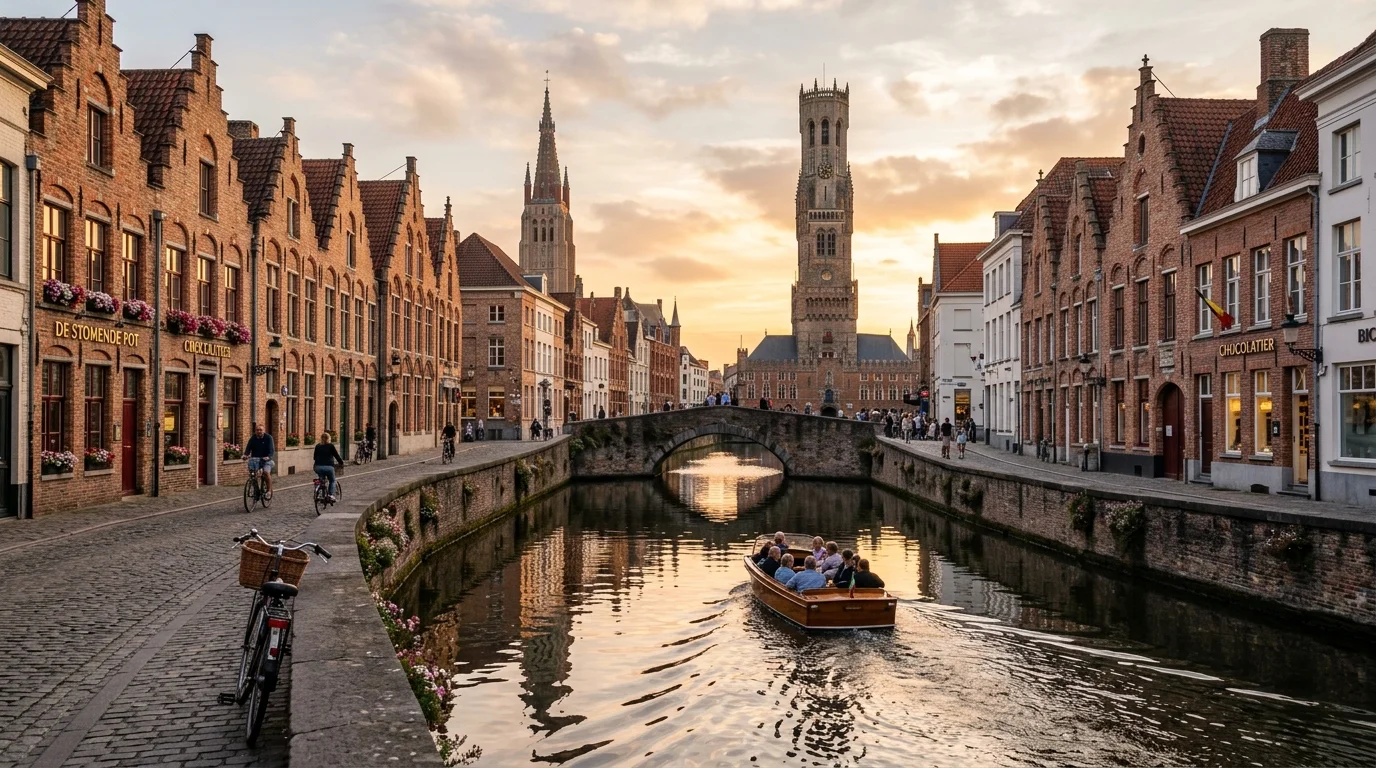
Bruges is arguably the best-preserved medieval city in Europe and its entire historic center is a UNESCO World Heritage Site. With a network of picture-perfect canals, cobblestone lanes, soaring Gothic spires, and chocolate-box Flemish architecture, Bruges looks like a film set — except it is entirely real and extraordinarily beautiful. The Market Square (Markt) at the center is dominated by the 13th-century Belfry tower that chimes every quarter-hour.
The city grew wealthy from the medieval cloth trade and was once one of the most important commercial cities in Europe. Today, its 13th- to 15th-century streetscape is almost perfectly intact. A canal boat tour is the best way to appreciate the architecture from the water level, gliding under humpback bridges and past weeping willows reflected in the calm water.
Why visit: Bruges is a once-in-a-lifetime kind of place that genuinely looks like stepping into a medieval painting. Canal tours, chocolate shops, lace makers, and Gothic churches make it endlessly rewarding.
Entrance: Old town is free to walk; Belfry: Adults €14, under 18 €10 (2026)
Best time: Weekdays in spring or autumn to avoid weekend crowds
Hours: Open city; Belfry daily 09:30–18:00
Ghent's Gravensteen Castle and Graslei Quay
Sint-Veerleplein 11, 9000 Ghent (Gent), Belgium
Ghent is Belgium's best-kept secret — a medieval powerhouse city that combines the beauty of Bruges with the energy and authenticity of a real, lived-in university town. Gravensteen, the 12th-century Castle of the Counts, rises dramatically from the city center with its moat and stone battlements. The adjacent Graslei and Korenlei quays, lined with Medieval guild houses beside the Leie River, create one of Belgium's most photogenic scenes.
Ghent was one of the wealthiest cities in medieval Europe, and remnants of that power are everywhere — from the massive Saint Bavo's Cathedral (home to the famous Ghent Altarpiece painting) to the enormous Belfry. Unlike Bruges, Ghent is not frozen in amber — it is a thriving student city with buzzing bars, hip restaurants, and a world-class contemporary art scene.
Why visit: Gravensteen offers an excellent castle tour with medieval torture room exhibits and rooftop city views. Ghent overall delivers the medieval atmosphere of Bruges with far fewer tourists and a more authentic local buzz.
Entrance: Gravensteen: Adults €14, students €10, under 18 €4 (2026)
Best time: Morning for the castle; evenings on Graslei
Hours: Gravensteen daily 10:00–18:00
Atomium, Brussels
Atomiumsquare 1, 1020 Brussels (Laeken), Belgium
The Atomium is one of Belgium's most iconic and unusual landmarks — a giant steel model of an iron crystal enlarged 165 billion times, originally built for the 1958 World Expo. The structure stands 102 meters tall and consists of nine connected spheres. Inside, the spheres house permanent exhibitions about the 1958 Expo, Atomium history, and temporary art exhibitions. The top sphere offers a 360-degree panoramic view of Brussels.
The Atomium is located in the Laeken district alongside the Mini-Europe miniature park and the Royal Greenhouses of Laeken. It has become one of the most photographed structures in Europe and a symbol of Brussels' quirky, forward-looking character.
Why visit: The Atomium is a brilliant mix of retro-futurism, Art Deco design, and Belgian ambition. The interior is fascinating and the view from the top sphere across Brussels on a clear day is spectacular.
Entrance: Adults €16, students €9, children (6–11) €9, under 6 free (2026)
Best time: Weekday mornings or early evenings
Hours: Daily 10:00–18:00; extended hours in summer
Antwerp's Cathedral of Our Lady (Onze-Lieve-Vrouwekathedraal)
Handschoenmarkt 3, 2000 Antwerp (Antwerpen), Belgium
The Cathedral of Our Lady in Antwerp is one of the finest examples of Brabantine Gothic architecture in the world, and its 123-meter spire dominates the Antwerp skyline. Construction began in 1352 and took nearly 170 years to complete. Inside, the cathedral houses four masterworks by Peter Paul Rubens, including the famous Descent from the Cross triptych — one of the most celebrated paintings in Belgium.
The cathedral's interior is enormous and filled with artwork. The Rubens triptychs are displayed on the cathedral floor in their original positions, meaning you see them exactly as Rubens intended — in a real church, bathed in natural light from Gothic windows above. The effect is genuinely moving.
Why visit: This is one of the few places in the world where you can experience Rubens' greatest paintings in the exact location for which they were painted, inside a spectacular Gothic cathedral.
Entrance: Adults €12, students €10, under 18 free (2026)
Best time: Weekday mornings for fewest crowds
Hours: Mon–Fri 10:00–17:00; Sat 10:00–15:00; Sun 13:00–17:00
Royal Museums of Fine Arts of Belgium, Brussels
Rue de la Régence 3, 1000 Brussels, Belgium
The Royal Museums of Fine Arts of Belgium form one of the largest and most important art museum complexes in the world, housing an extraordinary collection of Belgian and European art from the 15th century to the present. The complex includes the Old Masters Museum, the Modern Art Museum, the Magritte Museum, and the Meunier Museum. The Magritte Museum alone is worth the trip, dedicated to Belgium's most famous surrealist painter René Magritte.
The Old Masters collection features major works by Pieter Bruegel the Elder, Rubens, Van Dyck, and many other Flemish masters. The sheer depth of the Belgian painting tradition on display here is staggering — Bruegel's "Fall of the Rebel Angels" and "The Census at Bethlehem" are absolute highlights.
Why visit: For art lovers, this complex is one of Europe's finest museum experiences. The Magritte Museum alone — with over 200 works — is unmissable for anyone interested in surrealism.
Entrance: Adults €15 (all museums combined), students €8, under 18 free (2026)
Best time: Tuesday–Friday mornings
Hours: Tue–Fri 10:00–17:00; Sat–Sun 11:00–18:00; closed Monday
In Flanders Fields Museum, Ypres (Ieper)
Lakenhalle, Grote Markt 34, 8900 Ypres (Ieper), Belgium
The In Flanders Fields Museum in Ypres is one of the most powerful and moving WWI museums in Europe. Located inside the magnificent Cloth Hall on the Great Market Square, the museum takes visitors through the entire experience of WWI from 1914–1918 through compelling multimedia exhibits, personal stories, and historical artifacts. A personal "poppy bracelet" issued at entry lets you track the story of a real person who lived through the war.
The surrounding Ypres Salient battlefields contain hundreds of cemeteries, preserved trenches, and memorials to the hundreds of thousands who died there. Each evening at 8:00 PM under the Menin Gate memorial arch, buglers play the Last Post ceremony — a tradition that has continued every night since 1928, except during WWII occupation.
Why visit: The Last Post ceremony at the Menin Gate is one of the most profoundly moving rituals in Europe. Combined with the museum and battlefield sites, Ypres is an essential and deeply humbling day trip from Bruges or Ghent.
Entrance: Adults €12, students €8, under 18 €4 (2026)
Best time: 7:30 PM to attend the Last Post at 8:00 PM
Hours: Daily 10:00–18:00 (July–Aug to 18:30); closed last Monday of the month
Galeries Royales Saint-Hubert, Brussels
Galerie du Roi 5, 1000 Brussels, Belgium
The Galeries Royales Saint-Hubert is a magnificent 19th-century shopping arcade in the heart of Brussels, opened in 1847 and one of the oldest covered shopping galleries in Europe. Its soaring glass-and-iron vaulted ceiling floods the arcade with natural light, and the interior is lined with upmarket boutiques, chocolate shops, cafés, a theatre, and a cinema. Walking through it feels like stepping into a painting of Belle Époque elegance.
The gallery houses some of Brussels' finest chocolatiers, including Neuhaus (the inventor of the praline) and Wittamer. The ambiance is superb at any time of day but especially on rainy afternoons when the warm golden light inside contrasts with the grey Brussels sky outside.
Why visit: The Galeries is an architectural gem that is also genuinely useful — a lovely sheltered walk between Grand Place and the rest of the city center, packed with Belgium's finest chocolate and some excellent lunch spots.
Entrance: Free (shopping and cafés are paid)
Best time: Afternoons, any day
Hours: Open 24/7 (individual shops: roughly 10:00–19:00)
Ardennes Region — Han-sur-Lesse Caves and Bastogne War Museum
Domaine des Grottes de Han, Rue Joseph Lamotte 2, 5580 Han-sur-Lesse, Belgium
The Belgian Ardennes is a stunning region of forested hills, river valleys, medieval castles, and outdoor adventures in the southeast of the country. The Grottes de Han are among Europe's most impressive cave systems — a full underground tour by boat and on foot takes you through massive stalactite-filled chambers inside a mountain. Nearby Bastogne is famous for the crucial WWII Battle of the Bulge, and the Bastogne War Museum is one of Europe's finest WWII experiences.
The Ardennes offers a completely different face of Belgium — wild nature, cycling trails, kayaking, and charming small towns like Durbuy (claimed to be the smallest city in the world). In autumn, the forests turn brilliant orange and red, making it a prime destination for foliage lovers and hikers.
Why visit: The Ardennes is perfect for nature lovers, cyclists, and history enthusiasts who want to experience a completely different side of Belgium away from the historic cities.
Entrance: Grottes de Han: Adults €22, children €16 (2026); Bastogne War Museum: Adults €14, students €10
Best time: Late spring through autumn; stunning in October for foliage
Hours: Grottes de Han daily tours from 10:00; Bastogne Museum daily 10:00–17:00
Antwerp's Grote Markt and MAS Museum
Grote Markt 1, 2000 Antwerp, Belgium (Grote Markt); Hanzestedenplaats 1, 2000 Antwerp (MAS Museum)
Antwerp's Grote Markt is the beating heart of one of Belgium's most confident and stylish cities. The 16th-century City Hall, the Brabo Fountain (depicting the legend of the city's founding), and the guild houses create a spectacular ensemble. Antwerp was the richest city in the world in the 16th century, and the grandeur of its architecture reflects that glory. A short walk north brings you to the MAS (Museum aan de Stroom) — a strikingly modern red-and-white building stacked in spiral form on the waterfront.
The MAS museum tells the story of Antwerp's deep connection to the world through trade and migration across eight floors of superb exhibitions. The rooftop terrace offers a free panoramic view across the city and port — one of the best viewpoints in Belgium. Antwerp is also Europe's diamond capital, and the Diamond District around Central Station is fascinating to walk through.
Why visit: Antwerp is Belgium's most underrated city — fashion-forward, historically rich, and full of great restaurants and bars. The MAS Museum's free rooftop alone is worth the visit to Antwerp.
Entrance: MAS permanent collection: Adults €12, students €6, under 12 free; Rooftop free (2026)
Best time: Weekday mornings for museum; evening for rooftop sunset
Hours: MAS Tue–Fri 10:00–17:00; Sat–Sun 10:00–18:00; closed Monday
Book your tours and tickets in advance — it saves hours of queuing and often gets you a better price. These two platforms cover different options, so it's worth checking both.
What Are the Best Neighborhoods to Explore in Belgium?
Belgium's neighborhoods and districts each have a distinct character — from the grand EU Quarter of Brussels to Antwerp's hip Eilandje waterfront. Here are the best areas to explore across Belgium's major cities.
Brussels — Ixelles / Elsene
Character: Ixelles is the trendiest and most diverse district of Brussels — a mix of Art Nouveau townhouses, African restaurants, vintage boutiques, and buzzing squares. The area around Place Flagey and Place Châtelain has the best café terraces in the city.
What makes it special: Ixelles has the highest concentration of Art Nouveau architecture in Brussels, including several Horta-designed buildings. The weekly Wednesday and Saturday markets at Place Châtelain draw local foodies with fresh produce, cheese, and street food.
Best for: Culture-seekers, foodies, architecture lovers, and anyone wanting a more local Brussels experience away from the tourist center
Must-see in this area: Place Flagey, Place Châtelain market, Horta Museum, Ixelles Ponds, Rue Lesbroussart restaurants
How to get there: Tram 81 or 82 from central Brussels; 20-minute walk from Grand Place
Location: Place Flagey, 1050 Ixelles, Brussels, Belgium
Bruges — The Golden Triangle (Markt, Burg, and Dijver)
Character: The absolute historic core of Bruges — three interconnected squares and canal-side promenades that contain the greatest concentration of Gothic and Baroque architecture in northern Europe. The Markt is dominated by the Belfry, the Burg has the Basilica of the Holy Blood and City Hall, and the Dijver follows the canal past the Groeninge Museum.
What makes it special: This compact triangle of streets, canals, and squares is where Bruges is at its most photogenic. Every corner reveals another spectacular view. Horse-drawn carriages clip-clop past medieval facades, swans glide on the canals, and chocolate shops perfume the air.
Best for: First-time visitors to Bruges, photographers, history buffs, and anyone with limited time wanting to see the very best of the city
Must-see in this area: Market Square Belfry, Basilica of the Holy Blood, Bruges City Hall, Groeninge Museum, Rozenhoedkaai (most photographed canal bend in Belgium)
How to get there: 15-minute walk from Bruges train station, or any bus to Markt
Location: Markt 1, 8000 Bruges (Brugge), Belgium
Ghent — Patershol
Character: Patershol is the oldest, most atmospheric district of Ghent — a labyrinth of narrow cobblestone lanes and crooked medieval houses that has been transformed into Ghent's finest restaurant quarter. The streets are barely wide enough for two people to pass and the buildings lean at impossible angles.
What makes it special: Patershol manages to be both completely medieval and brilliantly alive at the same time. It is packed with excellent restaurants serving Belgian, French, and international cuisines in intimate settings. By day it is a photographer's paradise; by night, the restaurants glow warmly and the streets buzz with happy diners.
Best for: Food lovers, couples, those who want the most authentic Ghent experience
Must-see in this area: Kraanlei street, Carmelite Church ruins, Korenlei quay (nearby), any restaurant on Gewad or Kraanlei
How to get there: 10-minute walk from Ghent Sint-Pieters station; tram 1 to Korenlei
Location: Kraanlei 1, 9000 Ghent (Gent), Belgium
Antwerp — Eilandje (The Little Island)
Character: Eilandje is Antwerp's regenerated port district — a striking mix of 19th-century red-brick warehouses, modern glass architecture, museum spaces, and waterfront cafés. It is where the old Antwerp port meets contemporary city living.
What makes it special: Eilandje is home to the iconic MAS Museum and the beautifully restored Vintage port architecture. The Sunday flea market at Kloosterstraat nearby is one of the best in Belgium. Wander the docklands, watch ships on the River Scheldt, and end the day on a waterfront terrace.
Best for: Architecture enthusiasts, museum-goers, and travelers who enjoy regenerated post-industrial neighborhoods
Must-see in this area: MAS Museum, Red Star Line Museum, Bonaparte Dock, Sint-Felixpakhuis, Friday Market
How to get there: 20-minute walk from Antwerp Centraal; tram 7 or 24 to Eilandje
Location: Hanzestedenplaats 1, 2000 Antwerp, Belgium
Brussels — Sablon (Le Sablon / De Zavel)
Character: The Sablon is Brussels' most elegant neighborhood — a refined quarter of antique dealers, art galleries, upscale chocolate shops, and the stunning Gothic Church of Our Lady of the Sablon. It sits on a gentle hill between the Upper and Lower Town, flanked by chestnut trees and weekend antique markets.
What makes it special: The Grand Sablon square hosts one of Brussels' best antique markets on weekends, and the district has the highest concentration of luxury chocolatiers in the world — Pierre Marcolini, Wittamer, and others are all here. The Royal Museums of Fine Arts are a two-minute walk away.
Best for: Luxury shoppers, chocolate lovers, antique hunters, and those who appreciate elegance over hustle
Must-see in this area: Church of Our Lady of the Sablon, Grand Sablon antique market, Pierre Marcolini chocolatier, Small Sablon garden with guild statues
How to get there: Metro to Louise then walk (10 minutes); tram 92 or 97 to Petit Sablon
Location: Place du Grand Sablon 1, 1000 Brussels, Belgium
What Food Should You Try in Belgium?
Belgium is genuinely one of the world's great food destinations — a country famous for its chocolate, waffles, beer, and fries that also produces some extraordinary cheeses, mussels, stews, and pastries. The must-try dishes are moules-frites (mussels with chips), carbonnade flamande, Belgian waffles, and of course, handmade praline chocolates.
What Are the Must-Try Local Dishes in Belgium?
- Moules-Frites — Belgium's national dish: fresh steamed mussels in a white wine and shallot broth served with a huge portion of thick-cut fries. Usually eaten with a spoon and fingers in a big black pot. Try them in season (September–April) when mussels are at their best. Find them at almost every brasserie.
- Belgian Frites — Not "French" fries — these are cooked twice in beef tallow for a crispy outside and fluffy inside, served in a paper cone with your choice of sauces (mayonnaise is the classic). A "frituur" or "frietkot" (chip stand) is a Belgian institution. Try: Maison Antoine in Brussels (Place Jourdan).
- Carbonnade Flamande (Stoofvlees) — A rich Flemish beef stew slow-cooked in Belgian beer with onions, herbs, and bread. Hearty, deeply savory, and typically served with fries. It is Flanders' answer to French boeuf bourguignon and is vastly better than it sounds.
- Belgian Waffles (Liège and Brussels style) — The Brussels waffle is rectangular, light, and crispy — best eaten plain or with powdered sugar. The Liège waffle is round, dense, caramelized at the edges, and eaten warm without toppings. Both are extraordinary. The sugar-coated Liège waffle from a street stall is one of Belgium's best quick snacks.
- Pralines and Belgian Chocolate — Belgian pralines (filled chocolate shells) were invented in Brussels in 1912 by Neuhaus. The best chocolate uses 100% cocoa butter and Belgian recipes. Look for Neuhaus, Pierre Marcolini, Wittamer, and Godiva (the original, not the airport versions). A handmade praline box makes the perfect souvenir.
- Waterzooi — A creamy Ghent specialty — traditionally a stew of freshwater fish in a vegetable and cream broth, now more commonly made with chicken. Comfort food at its most refined. Order it in Ghent for the authentic experience.
- Speculoos (Biscoff) — Belgium's iconic spiced shortcrust biscuit — crunchy, caramelized, flavored with cinnamon, nutmeg, and cloves. You know these as the tiny biscuits served with coffee — but in Belgium they come in all sizes and are used in cakes, spreads, and ice cream. Try the original Lotus Biscoff.
- Belgian Cheeses — Belgium produces over 300 varieties of cheese, including the famous Herve (a pungent washed-rind cheese from the province of Liège) and various abbey cheeses made by Trappist monks. The cheese market at Brussels' Place du Châtelain on Wednesdays is excellent.
Where Should You Eat in Belgium?
Budget-Friendly (Under €15 per meal)
- Maison Antoine — Place Jourdan 1, 1040 Etterbeek, Brussels — The most famous chip stand in Brussels, serving perfectly twice-fried frites with over 20 sauces. A large cone with mayo costs around €4 (2026). Queue can be long but moves fast. A Brussels institution since 1948.
- Chez Léon — Rue des Bouchers 18, 1000 Brussels — A Brussels institution since 1893, specializing entirely in moules-frites. The €18–22 meal deal (2026) includes a big pot of mussels with fries and a drink. Tourist-friendly but genuinely good. Arrive before noon to avoid a long queue.
- 't Brugsch Friethuys — Simon Stevinplein 14, 8000 Bruges — One of the best chip stands in Bruges, run by a family with decades of experience. Huge cone of crispy frites with homemade mayonnaise for around €4 (2026).
Mid-Range (€20–45 per meal)
- In 't Nieuw Museum — Hooistraat 42, 8000 Bruges — A beloved Bruges brasserie serving classic Belgian dishes including carbonnade, waterzooi, and excellent local beers. Very popular with locals — a sure sign of quality. Mains €18–28 (2026). Reservations recommended for dinner.
- De Tap en de Tepel — Gewad 7, 9000 Ghent — A cozy wine and cheese bar in Patershol, Ghent, beloved by students and locals for its excellent selection of Belgian cheeses, charcuterie boards, and natural wines. Perfect for a long, lazy lunch. Around €20–30 per person (2026).
- Brasserie de l'Union — Place Communale 49, 1640 Rhode-Saint-Genèse — A classic Belgian brasserie outside central Brussels, popular with Eurocrats and locals. Excellent moules, steak, and traditional Belgian desserts. Mains €22–35 (2026).
- Restaurant Amadeus — Plotersgracht 8–10, 9000 Ghent — Famous for its all-you-can-eat spare ribs served in a gorgeous setting in a Ghent canal house. Around €28–32 per person (2026). Book ahead — this is one of Ghent's most popular restaurants.
Fine Dining (€60+ per meal)
- The Jane, Antwerp — Paradeplein 1, 2018 Antwerp — One of Belgium's most stunning fine dining experiences, set inside a deconsecrated military chapel designed by Piet Boon. Two Michelin stars. The tasting menu at €175+ (2026) is a world-class Belgian-international cuisine experience. Book weeks in advance.
- Hof van Cleve — Riemegemstraat 1, 9770 Kruisem — Belgium's most celebrated restaurant and one of the best in the world, holding three Michelin stars since 2006. Chef Peter Goossens serves refined Flemish cuisine in a pastoral setting outside Ghent. Tasting menu from €250+ (2026). Reserve months ahead.
What Are the Dining Customs in Belgium?
Meal times: Breakfast typically 7:00–9:00 AM; lunch 12:00–2:00 PM; dinner 7:00–10:00 PM. Restaurants generally do not serve food outside these windows — arriving at 3 PM for lunch will often be met with a closed kitchen.
Tipping: Service is typically included in Belgian restaurant bills. An additional tip of 5–10% for excellent service is appreciated but never obligatory. Leaving a few euros for the server is a nice gesture.
Reservations: Essential for mid-range and fine dining restaurants in Brussels, Ghent, and Antwerp, especially on Friday and Saturday evenings. Book at least a week ahead for popular spots, and months ahead for Michelin-starred restaurants.
Dress code: Smart casual for most restaurants; formal for fine dining. Belgian diners tend to dress well — a collared shirt and clean trousers are appropriate for mid-range and above.
What Is the Nightlife Like in Belgium?
Belgium's nightlife scene varies dramatically by city — Brussels is an international city that stays up late with bars closing at 4 or 5 AM; Ghent has one of the best student bar scenes in Europe; Antwerp is Belgium's most fashionable city with upscale clubs and bars; and Bruges is more relaxed, with cozy beer bars closing earlier. Beer is the star of the show across all Belgian nightlife.
Where Are the Best Areas for Nightlife in Belgium?
- Place Saint-Géry, Brussels: Place Saint-Géry, 1000 Brussels — The historic heart of Brussels' bar scene, centered on a large covered market hall surrounded by packed outdoor terraces. The square is lively from Thursday through Sunday, with bars and nightclubs spilling out onto the streets until 4–5 AM. A mix of ages and nationalities.
- Overpoort, Ghent: Overpoortstraat, 9000 Ghent — The legendary student street of Ghent, lined with over 30 bars on a single road. The atmosphere is young, loud, and extremely fun, especially Thursday nights during term time. The cheapest beer in Belgium is found here.
- Leien / South Antwerp: Groenplaats area, 2000 Antwerp — Antwerp's bar and club scene runs from the Groenplaats square south toward Zurenborg. More fashionable and adult than Ghent's student strip, with excellent cocktail bars, live music venues, and clubs.
What Are the Best Bars and Clubs in Belgium?
Bars & Pubs
- Delirium Café — Impasse de la Fidélité 4, 1000 Brussels — Holds the Guinness World Record for most beers available — over 3,000 types. A must-visit for beer tourists. Lively, loud, and great fun. Belgian beers from €3.50 (2026).
- 2be Beer Wall — Wollestraat 53, 8000 Bruges — A beer shop, bar, and terrace in one. Over 500 Belgian beers available, with a stunning canal-side terrace. The "beer wall" at the back has hundreds of bottles stacked floor to ceiling.
- 't Dreupelkot — Groentenmarkt 12, 9000 Ghent — Ghent's legendary jenever (gin) bar serving over 200 varieties of Belgian jenever (traditional grain spirit). A tiny, intimate bar run by the same family for decades. Essential for adventurous drinkers.
Clubs & Dancing
- Fuse — Rue Blaes 208, 1000 Brussels — Belgium's most famous electronic music club, open since 1994 and hosting legendary techno and house nights. Cover charge: €10–20 depending on the night (2026). Opens at midnight and runs until 7 AM or later.
- Café d'Anvers — Verversrui 15, 2000 Antwerp — One of Belgium's most respected clubs, set inside a converted 17th-century church near the Eilandje waterfront. Techno, house, and deep house. Cover €10–15 (2026).
Live Music & Shows
- Ancienne Belgique (AB) — Boulevard Anspach 110, 1000 Brussels — Brussels' premier indie and alternative music venue hosting 400+ events per year. Tickets €15–40 depending on act (2026). Check their website for the program — there is almost always something excellent on.
- Vooruit / Arts Centre — Sint-Pietersnieuwstraat 23, 9000 Ghent — Ghent's landmark arts center in a stunning Art Nouveau building, hosting concerts, theatre, dance, and club nights. A cultural institution that defines Ghent's creative spirit.
What Family-Friendly Evening Entertainment Is Available?
Belgium has excellent family evening options including the Planétarium in Brussels (evening astronomy shows), Canal boat night tours in Bruges, dinner theatres in several major cities, and the spectacular Belfort Carillon concerts that ring out across Ghent and Bruges on summer evenings. In winter, all major cities' Christmas market ice rinks are perfect for families from late afternoon into the evening.
What and Where Should You Shop in Belgium?
The best things to buy in Belgium are handmade praline chocolates, Belgian beer (especially Trappist beers), fine Belgian lace, Brussels-designed fashion, and diamond jewelry in Antwerp. The top shopping areas are the Galeries Royales in Brussels, Antwerp's Meir boulevard, and the boutique streets of Ghent.
What Are the Best Shopping Districts in Belgium?
- Meir, Antwerp: Meir, 2000 Antwerp — Antwerp's main pedestrian shopping boulevard, lined with international high-street brands and Antwerp's own excellent fashion designers. Antwerp is Belgium's fashion capital with a world-renowned design scene — look for boutiques from Walter Van Beirendonck, Dries Van Noten, and Ann Demeulemeester off the Meir.
- Rue Neuve / City2, Brussels: Rue Neuve 1–100, 1000 Brussels — Brussels' main high-street shopping pedestrian strip, home to Fnac, H&M, Zara, and the City2 indoor mall. Not particularly unique but very convenient for everyday shopping needs.
- Veerle Market / Vrijdagmarkt, Ghent: Vrijdagmarkt, 9000 Ghent — Friday Market square and its surrounding streets host Ghent's weekend antique market, secondhand bookshops, vintage clothing stores, and excellent independent shops. A fantastic area for browsing and discovery.
What Markets Should You Visit in Belgium?
Place du Grand Sablon Antique Market — Grand Sablon / Grote Zavel, 1000 Brussels — Every Saturday 9:00–17:00 and Sunday 9:00–14:00. The finest antique market in Brussels, selling antique silver, old maps, Belgian art, vintage clocks, books, and jewelry. Prices are fixed and quality is high. No bargaining culture here — this is an upscale market.
Ghent Sunday Flea Market (Bevrijdingsmarkt) — Sint-Jacobsmarkt, 9000 Ghent — Every Sunday 7:00–13:00. One of Belgium's best flea markets, spread across several streets near Sint-Jacobskerk. Vintage clothes, vinyl records, furniture, art, ceramics, and all manner of secondhand treasures. Bargaining is acceptable and encouraged.
Brussels Midi Market — Place de la Constitution / Boulevard du Midi, 1060 Brussels — Every Sunday 6:00–13:00. The largest market in Belgium, stretching for almost two kilometers outside Brussels Midi station. Primarily food — North African and Middle Eastern ingredients, fresh produce, olives, cheeses, fish, and street food. Hugely atmospheric and very cheap.
What Should You Buy in Belgium?
- Belgian Praline Chocolates — The quintessential Belgian souvenir. Buy from Neuhaus, Pierre Marcolini, Wittamer, or Marcolini — not the touristy bulk shops on Rue des Bouchers. A 250g box of handmade pralines costs €18–30 (2026) from quality chocolatiers.
- Belgian Beer — Bring home Trappist beers (Westmalle, Chimay, Rochefort) and specialty ales from local breweries. A great selection at beer specialist shops like Bières Artisanales (Rue du Marché aux Fromages 5, Brussels) or 2be in Bruges. Six-packs of Trappist beers: €12–20 (2026).
- Belgian Lace — Handmade Belgian lace from Bruges is a traditional and beautiful souvenir. Genuine handmade bobbin lace is expensive (€30–200+) but extraordinarily delicate and beautiful. Machine-made lace is sold as décor for much less. Visit the Lace Centre (Peerdenbrug 14, Bruges) to see lacemakers at work.
- Speculoos Products — Lotus Biscoff biscuits, speculoos spreads, speculoos chocolates, and speculoos ice cream sauces are uniquely Belgian. Widely available in supermarkets for very low prices (€2–5). Perfect lightweight gifts.
- Belgian Comics / Tintin Merchandise — Belgium is the birthplace of Tintin (Hergé), the Smurfs, and Lucky Luke. The Belgian Comic Strip Center in Brussels sells official merchandise. Tintin prints, first-edition books, and figurines are serious collector's items.
- Diamonds (Antwerp) — Antwerp processes 80% of the world's rough diamonds. The Diamond District around Antwerp Centraal station has hundreds of reputable dealers. Buying a loose stone or finished piece in Antwerp is significantly cheaper than in other countries. Always ask for a GIA or HRD certificate.
What Are the Shopping Hours and Customs?
Most Belgian shops open Monday–Saturday 10:00–18:00 or 19:00. Many shops in tourist areas also open on Sundays 11:00–17:00. The winter sales (soldes/solden) start in late December, and summer sales start in late June — both offer genuine discounts of 30–70% at clothing stores. VAT in Belgium is 21%, and non-EU tourists can claim a VAT refund at the airport on purchases over €125 from participating retailers. Look for the "Tax Free" sign in shop windows.
Can Non-EU Visitors Claim a VAT Tax Refund in Belgium?
Yes — if you are a visitor from outside the European Union (including travellers from the USA, Canada, Australia, the UK, and most of Asia and Latin America), you are entitled to a refund of the VAT (Value Added Tax) included in the price of goods you buy in Belgium. VAT in Belgium is 21% on most goods, which means this refund can be significant on high-value purchases like clothing, leather goods, jewellery, designer fashion, and electronics.
How to Claim Your VAT Refund — Step by Step
- Spend at least €125 in a single shop in a single day. This is the minimum threshold for a VAT refund claim in Belgium. It does not apply across multiple shops — the full amount must be spent in one store.
- Look for the "Tax Free" sign. Participating shops display a "Tax Free Shopping," "Global Blue," or "Planet" logo in the window or at the register.
- Ask for the tax refund form at the register before you pay. Present your non-EU passport — the shop will fill out the form with your details and the purchase amount. Keep the form with your receipt.
- Get the form stamped at customs before you leave. Go to the Customs office at Brussels Airport (BRU) before check-in and have an officer stamp your tax refund form. Keep your purchases accessible in hand luggage — do not pack them deep in your checked bags.
- Collect your refund. Hand the stamped form to the Global Blue or Planet desk at the airport. You can receive the refund in cash (minus a processing fee) or as a credit card refund (lower fees, takes a few weeks).
VAT Refund Quick Facts for Belgium
- Minimum spend: €125 in one shop in one day
- VAT rate on most goods: 21% on most goods
- Typical refund after fees: 10–15% of the purchase price
- Refund processors: Global Blue and Planet (formerly Premier Tax Free) at Brussels Airport (BRU)
- Who qualifies: Anyone with a non-EU passport who is not a resident of an EU country
- UK visitors: British passport holders qualify since Brexit — the UK is no longer in the EU
- Deadline: Purchases must be exported within 3 months of the date of purchase
- Full guide: VAT Refund in Europe — Complete Guide for Non-EU Travelers
What Festivals and Events Happen in Belgium?
Belgium's biggest festivals are the Tomorrowland electronic music festival in July (one of the world's largest), the Ghent Festival (Gentse Feesten) in July, the Brussels Flower Carpet in August (every two years), and spectacular Christmas markets in December across all major cities. Belgium has a remarkably rich cultural calendar year-round.
What Is the Annual Events Calendar for Belgium?
| Month/Season | Event Name | Description |
|---|---|---|
| January | Brussels Motor Show | One of Europe's largest car shows at Brussels Expo, drawing hundreds of thousands of visitors. Held in odd-numbered years. Check dates online. |
| February | Carnival of Binche | A UNESCO-recognized carnival in the small town of Binche, 60 km south of Brussels. The famous Gilles (men in elaborate yellow-and-black costumes) parade through the streets throwing oranges at spectators. One of Belgium's most distinctive traditions — held on Shrove Tuesday. |
| March | Brussels International Fantastic Film Festival | A beloved genre film festival celebrating horror, sci-fi, and fantasy cinema at Palais des Beaux-Arts (Bozar), Brussels. Running since 1974 — a cult event for film lovers. |
| April | Ghent Floraliën (every 5 years, next 2025/2030) | A spectacular international flower show held in Ghent every five years. When it runs, it is one of the most stunning horticultural events in the world. |
| May | Brussels Jazz Weekend | Free outdoor jazz concerts across Grand Place and surrounding squares over three days in late May. One of the best free events in Belgium — world-class musicians, zero cost, and a wonderful atmosphere. |
| June | Couleur Café Festival | A three-day world music and arts festival held at Tour & Taxis, Brussels, celebrating African, Latin, reggae, and global sounds. One of Belgium's most diverse and joyful festivals. |
| July | Tomorrowland (Boom, near Antwerp) | The world's most famous electronic music festival — an enormous, theatrical, multi-stage event in the small town of Boom. Up to 400,000 attendees over two weekends. Tickets sell out within minutes of release — book in October for the following July. |
| July | Gentse Feesten (Ghent Festival) | Ten days in mid-July when Ghent transforms into Belgium's biggest party — hundreds of free outdoor concerts, street performances, beer tents, and food stalls across the entire city center. One of the best free festivals in Europe. Over 1.5 million visitors annually. |
| August | Brussels Flower Carpet (every 2 years) | A stunning 75m × 24m carpet of live begonias laid across the Grand Place for four days in mid-August in even years. The 2026 edition will be spectacular — check the official Brussels website for exact dates. |
| September | Brussels Beer Festival | Belgian Beer Weekend on the Grand Place — over 400 Belgian beers available from 80+ breweries. The opening parade and costumes make it a spectacle as well as a tasting event. Held the first weekend of September. |
| October | Antwerp Wine & Food Festival | A major food and drink event at Antwerp Expo celebrating Belgian and international cuisine, artisan producers, and sommelier competitions. Growing in stature each year. |
| November–December | Christmas Markets | Belgium hosts some of Europe's finest Christmas markets — Brussels' Winter Wonders market at Grand Place runs from late November to early January. Bruges, Ghent, and Liège all have beautiful atmospheric markets. Bruges' market around the Markt and Burg squares is particularly magical. |
How Do Festivals Affect Hotel Prices and Availability?
Major festivals cause significant price spikes and sell-outs across Belgium. During Tomorrowland in July, hotels within 50 km of Boom (including Antwerp and Ghent) are booked up months in advance. The Gentse Feesten causes Ghent hotels to fill up 3–6 months ahead. Christmas markets in December (especially Bruges) mean hotels in those cities are extremely tight from late November through January 1. Book at least three months ahead for any festival period, and six months or more for peak summer events.
Where Should You Stay in Belgium?
The best neighborhood to stay in Belgium depends on your travel style and which cities you plan to visit. Staying centrally in Brussels gives you excellent transport connections to all other cities; staying in Bruges or Ghent overnight gives you the magical experience of these cities after the day-trippers leave.
What Are the Best Neighborhoods to Stay in Belgium?
| City / Area | Vibe | Price Range Per Night (2026) | Best For |
|---|---|---|---|
| Brussels Centre / Grand Place area | Bustling, central, touristy but convenient | €90–250 (hotel) | First-timers, short stays, maximum convenience |
| Brussels Ixelles / Saint-Gilles | Trendy, residential, authentic local feel | €60–180 (hotel/apartment) | Repeat visitors, foodies, Art Nouveau fans |
| Bruges Old Town (within canal ring) | Fairy-tale medieval, extremely atmospheric at night | €100–300 (hotel); €80–200 (B&B) | Couples, honeymoons, first-time Belgium visitors |
| Ghent Historic Centre | Lively, student city energy, authentic and beautiful | €80–200 (hotel) | Younger travelers, solo travelers, culture lovers |
| Antwerp Center / Eilandje | Fashionable, cosmopolitan, design-led | €90–250 (hotel) | Fashion lovers, art fans, business travelers |
What Are the Pros and Cons of Each Area?
Brussels Centre:
Pros: Walking distance to Grand Place, Galeries Royales, and central stations; excellent restaurant and bar scene; easy access to trams and metro.
Cons: Can be noisy at night; some streets near Rue des Bouchers are very touristy; prices are higher than outer neighborhoods.
Bruges Old Town:
Pros: Waking up inside a UNESCO World Heritage Site; magical evening atmosphere when day-trippers leave; everything within walking distance.
Cons: Expensive relative to other Belgian cities; can feel like a theme park in peak season; limited nightlife beyond beer bars.
Ghent Historic Centre:
Pros: Authentic university city atmosphere; excellent food and bar scene; medieval architecture; fewer tourists than Bruges; great transport connections.
Cons: Can be loud near student bars on weekends; slightly further from Brussels than Bruges (30 minutes by train).
Antwerp Center:
Pros: Belgium's most fashionable city; great restaurant scene; excellent museums; the Diamond District is fascinating; Antwerp Centraal is one of Europe's most beautiful train stations.
Cons: Somewhat further from Bruges and Ghent; can feel more urban and less "quaint" than other Belgian cities.
How Far in Advance Should You Book in Belgium?
For summer travel (June–August) and Christmas markets (December), book accommodation at least three to six months in advance, especially in Bruges which has limited hotel capacity inside the canal ring. For spring and autumn travel, two to four weeks ahead is usually sufficient, though popular properties fill up faster. Direct booking via hotel websites often yields better rates than platforms, and many Belgian hotels offer free cancellation up to 48 hours before arrival. Always check both the hotel's own website and booking platforms to compare prices.
What Do You Need to Know Before Visiting Belgium?
Here are the essential practical details every visitor to Belgium needs to know — from money and language to safety and health.
Essential Travel Details for Belgium
- Currency: Euro (€). ATMs widely available everywhere. Best exchange rates at ATMs using your bank card.
- Credit Cards: Visa and Mastercard widely accepted everywhere. American Express less so. Many smaller shops and markets are cash-only.
- ATMs: Very widely available in all cities and towns. Most charge no fee for international withdrawals, but check with your bank. Daily limit typically €500.
- Language: Dutch/Flemish in Flanders; French in Wallonia; German in a small eastern region. Brussels is officially bilingual. English is widely and confidently spoken in tourist areas throughout the country.
- Tipping: Not obligatory — service is included in prices. 5–10% tip for excellent restaurant service is appreciated. Round up taxi fares.
- Electrical Plugs: Type E plug (round pins), 230V / 50Hz. UK and US travelers need an adapter.
- Emergency Number: 112 (all emergencies — police, ambulance, fire). Works in English.
- Tourist Police: Available in Brussels at Grand Place area.
- SIM Cards: Available at Proximus, Orange, and BASE stores at Brussels Airport and in city centers. A tourist SIM with data costs €15–25 (2026). eSIMs available from major providers before departure.
- WiFi: Excellent — free WiFi in almost all hotels, cafés, and restaurants. Brussels city center has free municipal WiFi in many public areas.
- Tap Water: Completely safe to drink throughout Belgium. Tap water quality is excellent — no need to buy bottled water.
Skip the airport queue — order your eSIM before you travel and activate it the moment you land. Prices and data allowances vary, so it pays to compare providers.
How Much Does It Cost to Visit Belgium?
| Budget Type | Daily Cost (2026) | What's Included |
|---|---|---|
| Budget Traveler | €60–90 per day | Hostel dorm (€25–35/night), frites and brasserie meals, public transport, free attractions (Grand Place, city walks, parks) |
| Mid-Range Traveler | €120–180 per day | 3-star hotel (€80–130/night), one sit-down restaurant meal, museum entries, occasional taxi, beer tasting |
| Luxury Traveler | €250–500+ per day | 4–5 star hotel (€180–400+/night), fine dining, private tours, Michelin-star lunches, premium experiences and shopping |
What Are the Most Useful Phrases in Belgium?
- Hello (Dutch/French): Hallo / Bonjour
- Thank you (Dutch/French): Dankuwel / Merci
- Please (Dutch/French): Alstublieft / S'il vous plaît
- Excuse me (Dutch/French): Pardon / Pardon
- How much? (Dutch/French): Hoeveel kost het? / Combien ça coûte?
- Where is...? (Dutch/French): Waar is...? / Où est...?
- I don't understand (Dutch/French): Ik begrijp het niet / Je ne comprends pas
- Help! (Dutch/French): Help! / Au secours!
- Bathroom (Dutch/French): Toilet / Les toilettes
- Check, please (Dutch/French): De rekening, alstublieft / L'addition, s'il vous plaît
Is Belgium Safe for Tourists?
Yes, Belgium is generally very safe for tourists. It consistently ranks among Europe's safer destinations, with low levels of violent crime in tourist areas. Standard European city precautions apply, particularly in busy tourist areas of Brussels and around major train stations.
Areas to avoid: The Molenbeek and Schaerbeek districts in Brussels at night are less tourist-friendly, though most visitors will have no reason to visit these areas. The area directly around Brussels Midi station can feel intimidating at night — be aware and move purposefully.
Common scams: Friendship bracelet scam (someone ties a bracelet on your wrist then demands payment); fake charity petition signers who pickpocket while you are distracted; unofficial taxi drivers outside Brussels Midi charging inflated fares; restaurant touts on Rue des Bouchers who aggressively pull customers inside — the food at these places is reliably poor and overpriced.
Pickpocketing: Common at Grand Place (Brussels), on the Brussels metro (especially ligne 1 and 5), at Bruges Markt, and anywhere large tourist crowds gather. Use a money belt or keep valuables in front pockets. Do not put your phone on café tables.
Solo traveler safety: Belgium is excellent for solo travelers of all genders. Women traveling alone generally feel very safe. The LGBTQ+ community is well-accepted, particularly in Brussels, Ghent, and Antwerp — Belgium was the second country in the world to legalize same-sex marriage in 2003.
What Are the Cultural Customs in Belgium?
- Greetings: Belgians typically greet with one kiss on the right cheek between friends; a handshake with strangers. Don't be surprised if new acquaintances give you a single cheek kiss fairly quickly.
- Dress code: Smart casual is the norm for restaurants and evenings out. Very few places require formal dress. Cover shoulders and knees in churches and religious sites.
- Photography: Free in public spaces. Ask permission before photographing individuals, especially in markets or religious ceremonies. Many museum collections prohibit photography or require a paid permit.
- Public behavior: Belgians are fairly reserved in public. Speak at moderate volume in restaurants and cafés. Queueing is respected and important — cutting in line is very poorly received.
- Dining: Belgians take meal times seriously. Sitting down for a meal means taking your time. Asking for the check immediately after finishing eating is considered rude — wait, relax, then signal the server when you're ready.
- Gestures to avoid: Pointing at people is considered rude. Discussing Belgian political divisions (Flemish vs. Walloon) can be sensitive — it's a genuine and ongoing source of tension in the country.
Do You Need a Visa to Visit Belgium?
Citizens of the EU, USA, Canada, Australia, UK, and most Western countries do not need a visa to visit Belgium for stays up to 90 days. Belgium is part of the Schengen Area — your 90-day allowance applies to the entire Schengen zone, not just Belgium. From 2025–2026, non-EU visitors to the Schengen Zone (including from the US, UK, and Australia) must register for ETIAS (European Travel Information and Authorization System) before travel — check the official EU website for current requirements and fees.
What Health Precautions Should You Take in Belgium?
Vaccinations: No special vaccinations required for Belgium. Routine vaccinations (measles, flu, COVID-19) should be up to date. Belgium has excellent healthcare standards.
Pharmacies: Widely available in all cities and towns. Pharmacies (Apotheek/Pharmacie) are marked by a green cross and open typically Monday–Saturday 9:00–18:00. After-hours pharmacies are listed on signs posted at any closed pharmacy's door.
Hospitals: Belgium has excellent public and private hospitals. EU citizens with a European Health Insurance Card (EHIC) can access healthcare at standard Belgian rates. Non-EU tourists should have comprehensive travel insurance — medical care for tourists without insurance can be expensive. UZ Brussel (Laarbeeklaan 101, Jette) and Cliniques Universitaires Saint-Luc (Avenue Hippocrate 10, Brussels) are two of the best hospitals in Brussels.
Common health issues: Tap water is safe throughout Belgium. Food safety standards are very high. Main health considerations are weather-related — bring layers and a waterproof jacket as Belgian weather is unpredictable even in summer.
Do You Need Travel Insurance for Belgium?
Yes — and you should buy it before you board your flight, not after. Travel insurance covers the situations that can turn a great trip into a financial disaster: a medical emergency (a single ambulance ride and hospital stay in Europe can cost €3,000–€10,000 without coverage), a cancelled or delayed flight, lost or stolen baggage, or a last-minute trip cancellation. EU citizens with an EHIC or GHIC card receive reciprocal state healthcare, but this does not cover repatriation, trip cancellation, or lost luggage — a full travel policy fills those gaps. Non-EU travellers have no state coverage at all and should never visit without insurance.
Choosing the right policy matters — coverage limits, exclusions, and pre-existing condition terms vary significantly between providers. Read our full guide before you buy: Best Travel Insurance for Europe — Honest Comparison for 2026.
Travel insurance is strongly recommended for Belgium — an unexpected medical bill, flight cancellation, or lost luggage can cost far more than the policy. Get covered before you go.
What Are Your Rights If Your Flight to Belgium Is Delayed or Cancelled?
Under EU Regulation 261/2004, if your flight to or from Belgium is delayed by more than 3 hours or cancelled without sufficient notice, you are entitled to compensation of up to €600 per passenger — regardless of which airline you flew with, and regardless of how long ago it happened (claims can go back up to 6 years in some countries). This applies to all flights departing from an EU airport, and all flights arriving into an EU airport on an EU-based carrier. Most travellers don't realise they are owed money, and airlines rarely volunteer to pay. A claims service handles everything on your behalf and only charges a fee if they win — so there is no risk to you.
Both services check your eligibility for free with no upfront cost — they only charge a commission if they successfully recover your compensation.
Is Belgium Accessible for People with Disabilities?
Belgium has made significant improvements in accessibility in recent years, though the ancient cobblestone streets of Bruges and Ghent present real challenges for wheelchair users. Major museums and attractions in Brussels and Antwerp generally have good wheelchair access and adapted facilities. The national rail network has wheelchair assistance services — book at least 24 hours ahead via NMBS/SNCB. Brussels metro stations have elevators at most major stops. For detailed accessibility information, contact Tourism Flanders or VisitBrussels for city-specific guides.
Is Belgium Good for Families with Kids?
Belgium is excellent for families — Mini-Europe and the Atomium in Brussels are perfect for children; the Belgian Comic Strip Center delights kids and adults; canal boat rides in Bruges enchant all ages; and the Ardennes offers outdoor adventure. Belgian restaurants are generally very family-friendly with children's menus, high chairs, and an informal attitude toward young diners. Stroller-friendliness varies — the cobblestones of Bruges are manageable but can be tiring for longer routes. Baby supplies, formula, and diapers are widely available in supermarkets.
What Are the Best Day Trips from Belgium's Major Cities?
The best day trips from Belgium's major cities include Bruges from Brussels, Ghent from Brussels, Ypres from Ghent or Bruges, Dinant from Brussels, and even Amsterdam or Paris by high-speed train. Belgium's central position in Europe and excellent rail connections make it a fantastic base for broader regional exploration.
Bruges from Brussels
Distance: 95 km / 60 miles; 55 minutes by direct train
What to see: Bruges' entire medieval city center is a UNESCO World Heritage Site. Key highlights include the Belfry, canal boat tours, the Groeninge Museum (Flemish primitive paintings), Basilica of the Holy Blood, the Begijnhof, and the Minnewater "Lake of Love." Every canal corner in Bruges is a photo opportunity.
How to get there: Direct IC trains from Brussels Midi to Bruges every 30 minutes. Cost: around €16.50 each way (2026). No booking required — just buy at the station or on the app.
Time needed: Full day; overnight stay strongly recommended
Best for: First-time visitors to Belgium, couples, architecture lovers, photographers
Location: Markt 1, 8000 Bruges (Brugge), Belgium
Ghent from Brussels or Bruges
Distance: 55 km from Brussels / 45 km from Bruges; 30 minutes by direct train from Brussels
What to see: Ghent's three medieval towers (Belfry, Saint Bavo's Cathedral, and Saint Nicholas Church), Gravensteen Castle, the Ghent Altarpiece at Saint Bavo's, the Patershol restaurant district, and the gorgeous Graslei and Korenlei quays. Ghent is lively, authentic, and less crowded than Bruges.
How to get there: Trains from Brussels Midi every 10–15 minutes. Cost: around €10.30 each way (2026). From Bruges: regular trains, 30 minutes.
Time needed: Full day; evening highly recommended
Best for: Those who want more authentic Belgian city experience; food lovers; art enthusiasts
Location: Korenmarkt 1, 9000 Ghent (Gent), Belgium
Ypres (Ieper) and the WWI Battlefields
Distance: 120 km from Brussels; 70 km from Bruges; approximately 1h20 by train (change at Kortrijk)
What to see: In Flanders Fields Museum, the Menin Gate (Last Post ceremony at 8 PM every evening), Tyne Cot Cemetery (largest Commonwealth war cemetery in the world), Essex Farm Cemetery, Passchendaele Museum, and the preserved trenches at Sanctuary Wood.
How to get there: Train from Brussels Midi or Bruges to Ypres (change at Kortrijk). Cost: approximately €18–22 each way (2026). Guided battlefield tours from Bruges or Brussels are available and highly recommended.
Time needed: Full day; if attending the Last Post ceremony, stay for the evening
Best for: History buffs, school groups, families with older children, Commonwealth travelers
Location: Grote Markt, 8900 Ypres (Ieper), Belgium
Dinant and the Meuse Valley
Distance: 95 km from Brussels; 1 hour 20 minutes by train (change at Namur)
What to see: The dramatically beautiful town of Dinant sits between steep limestone cliffs and the Meuse River, dominated by a Gothic collegiate church and a clifftop citadel. Birthplace of the saxophone inventor Adolphe Sax — the main street is lined with saxophone sculptures. Kayaking on the Meuse from Dinant to nearby villages is one of Belgium's best outdoor activities.
How to get there: Train from Brussels Midi to Namur, then connection to Dinant. Cost: approximately €15–18 each way (2026). Car is ideal for exploring surrounding villages.
Time needed: Full day
Best for: Outdoor enthusiasts, families, those who want to see a different (non-Flemish) side of Belgium
Location: Place Reine Astrid 1, 5500 Dinant, Belgium
Amsterdam from Brussels
Distance: 210 km; 1 hour 50 minutes by Thalys high-speed train
What to see: Amsterdam is an easy and popular day trip from Brussels by high-speed train. The Rijksmuseum, Van Gogh Museum, Anne Frank House, canal boat tours, and Vondelpark are all within easy reach of Amsterdam Centraal station.
How to get there: Thalys or Eurostar trains from Brussels Midi to Amsterdam Centraal. Cost: from €29–80 each way depending on booking time (2026). Book ahead for best prices — Thalys tickets often sell out or become expensive close to travel date.
Time needed: Full day; overnight gives a much better experience
Best for: Those combining Belgium with the Netherlands; art lovers; canal enthusiasts
Location: Amsterdam Centraal Station, Stationsplein 15, 1012 AB Amsterdam, Netherlands
Car rental prices vary significantly between agencies — the same car on the same date can differ by 30–50% depending on where you book. Always compare before confirming.
What Are the Hidden Gems and Insider Tips for Belgium?
Beyond the main tourist sites, Belgium hides some incredible spots most visitors never find — from secret medieval alleys in Bruges to spectacular viewpoints in Ghent, rooftop bars in Brussels, and tiny brewery taprooms accessible only to those who know.
What Are the Best Hidden Gems in Belgium?
- Begjinhof (Begijnhof), Bruges: Wijngaardplein, 8000 Bruges — A perfectly preserved medieval beguinage (religious community) tucked behind the Minnewater lake. A UNESCO World Heritage Site within a UNESCO World Heritage Site — white-washed cottages around a grass courtyard under ancient trees. Utterly peaceful even in peak tourist season. Visit before 9 AM for almost complete solitude.
- Saint John's Hospital (Memling in Sint-Jan Museum), Bruges: Mariastraat 38, 8000 Bruges — One of Europe's oldest surviving hospital buildings, now housing six masterworks by Hans Memling in their original setting. Profoundly atmospheric and criminally undervisited compared to other Bruges museums. The medieval wards are extraordinary.
- Patershol, Ghent: Kraanlei, 9000 Ghent — Ghent's labyrinthine medieval quarter of crooked lanes and leaning houses, now packed with excellent restaurants. Most visitors walk straight past it toward the more famous Gravensteen Castle. Wander in any direction and discover something wonderful.
- Rue des Bouchers Alternatives, Brussels: Instead of eating on the famous (and overpriced) Rue des Bouchers, walk two blocks to Rue de la Fourche or Place Sainte-Catherine for better food at lower prices with fewer touts.
- Het Gravensteen at Night, Ghent: Sint-Veerleplein 11, 9000 Ghent — Ghent's castle is magnificently lit at night. Cross the Leie River and photograph the floodlit castle reflected in the water — one of Belgium's best night photography spots and totally free.
- Wijnegem Shopping Outlet, Antwerp: Turnhoutsebaan 5, 2110 Wijnegem — A large outlet shopping center near Antwerp with genuine discounts of 30–70% on Belgian and international brands. A short bus or tram ride from Antwerp center. Great for fashionistas on a budget.
- Château de Lavaux-Sainte-Anne, Ardennes: Rue du Château 8, 5580 Lavaux-Sainte-Anne — A stunning intact 15th-century water castle in the Ardennes, far less visited than the famous Bouillon Castle. The combination of medieval architecture, moat, and forest setting is extraordinary. Very few tour groups here.
Where Are the Best Photo Spots in Belgium?
- Rozenhoedkaai Canal Bend, Bruges: Rozenhoedkaai, 8000 Bruges — The most photographed spot in Belgium — a bend in the canal where the Belfry rises dramatically above the medieval rooftops. Best at golden hour in the morning (around 7:30–8:30 AM in summer) when there are no crowds and the light is warm.
- Graslei at Night, Ghent: Graslei 1, 9000 Ghent — The guild houses along the Graslei quay, reflected in the Leie River at night with floodlighting, is one of Belgium's most spectacular scenes. Best from the Korenlei (opposite bank) around 9–10 PM.
- Grand Place at Night, Brussels: Grand Place, 1000 Brussels — The Grand Place is extraordinary at any time but the floodlit facades at night create a golden theatrical atmosphere unlike almost anywhere in Europe. Visit after 9 PM when the tourist crowds thin out. Best shots from the center of the square facing the Town Hall.
- MAS Rooftop at Sunset, Antwerp: Hanzestedenplaats 1, 2000 Antwerp — The free rooftop of the MAS Museum faces west over the River Scheldt. Sunset here — with the water golden and the port cranes silhouetted behind — is one of Belgium's best free photo experiences.
- Minnewater Lake, Bruges: Minnewaterpark, 8000 Bruges — The "Lake of Love" at the southern end of Bruges' old town is peaceful, swan-filled, and beautifully photogenic in all seasons. Particularly magical in morning fog or winter snow.
What Do Locals Know That Tourists Don't?
How Can You Save Money in Belgium?
The biggest way to save money in Belgium is to use the national rail network smartly — the Go Pass 10 card offers substantial discounts on train travel, and NMBS B-Excursion tickets bundle transport and attraction entry at reduced rates. Combined with eating at brasseries rather than tourist restaurants, Belgium can be surprisingly affordable.
What Are the Best Money-Saving Strategies for Belgium?
- Buy a Go Pass 10 rail card for unlimited train travel between Belgian cities at a flat reduced rate — one of Belgium's best value purchases for multi-city visitors.
- Visit city attractions on their free days — many Belgian museums offer free admission on the first Wednesday afternoon of each month (Museum Night), or are permanently free (like the Cinquantenaire Museum courtyard in Brussels).
- Order the "dagschotel" (dish of the day) at lunch rather than the full menu — typically 30–40% cheaper for the same quality food.
- Buy picnic supplies from Delhaize or Colruyt supermarkets — Belgian cheeses, charcuterie, bread, and Trappist beers cost a fraction of restaurant prices and Belgian parks and canal banks are gorgeous picnic spots.
- Walk or cycle everywhere in Bruges and Ghent — these cities are so compact that taxis and buses are rarely necessary. Save transport costs entirely.
- Stay in Bruges on a weekday and avoid Saturday nights — Bruges hotels charge up to 50% more on weekends versus mid-week stays.
- Buy Belgian chocolates at quality chocolatiers (not tourist bulk shops) but look for the smaller "palets" formats rather than luxury gift boxes — same quality, much smaller price.
- Use Brussels' free city bikes (Villo!) for short journeys in Brussels — the first 30 minutes are free and most city center destinations are reachable within that time.
- Book Thalys and Eurostar trains to Brussels from Paris, London, or Amsterdam well in advance (4–8 weeks) for prices as low as €29 each way.
- The Manneken Pis, Grand Place, Galeries Royales, all church exteriors, all city squares, canal walks, and parks in Belgium are completely free to enjoy.
- Eat moules-frites at lunch rather than dinner — the same dish at the same restaurant can be €3–6 cheaper at lunchtime.
- Pre-book museum tickets online to avoid paying at-door prices, which are often €1–2 more expensive, and to skip queues.
What Can You Do for Free in Belgium?
- Grand Place, Brussels: Grand Place, 1000 Brussels — Simply standing in this UNESCO World Heritage square is one of Europe's greatest free experiences. Free day and night.
- Bruges Old Town Walking: The entire canal network and medieval city center of Bruges — churches, bridges, alleyways, canal banks — is free to walk. The best of Bruges costs nothing.
- Ghent Graslei and Patershol: The most beautiful parts of Ghent — the canal quays and medieval restaurant district — are free to explore on foot.
- MAS Museum Rooftop, Antwerp: Hanzestedenplaats 1, 2000 Antwerp — The rooftop panorama is completely free to access. One of the best views in Belgium at zero cost.
- Galeries Royales Saint-Hubert, Brussels: Galerie du Roi 5, 1000 Brussels — Free to walk through this beautiful 1847 shopping arcade. Window shopping and people-watching cost nothing.
- Brussels Jazz Weekend (May): Grand Place area — Multiple days of free outdoor jazz concerts by world-class musicians. One of Europe's best free music events.
- Gentse Feesten (July): Ghent city center — Ten days of free concerts, performances, and street events. Hundreds of shows, all free.
- Tyne Cot Cemetery, Ypres: Tynecotstraat 182, 8980 Passendale — Free to visit. The world's largest Commonwealth war cemetery is one of the most moving places in Belgium, and entry is free. Open every day.
Are There Any Discount Cards or Passes Worth Buying?
Brussels Card: €38 for 24h, €48 for 48h, €58 for 72h (2026) — Includes free public transport throughout Brussels and free or discounted entry to 50+ museums and attractions. Pays for itself quickly if you plan to visit 3+ museums. Available at Brussels tourist offices and online.
Visit Flanders Museum Pass: Check current pricing at visitflanders.com — Annual pass offering free or discounted entry to over 140 museums and attractions throughout Flanders. Excellent value for longer stays or repeat visitors.
What Are the Budget-Friendly Alternatives?
Instead of paying for an elevated viewpoint, get the same (or better) view for free — MAS Museum rooftop in Antwerp (free) versus paid towers and observation decks; Ghent Belfry costs €8 but the view from the nearby free river banks is equally beautiful. Instead of expensive guided tours, download the free audio guides from city tourism apps. Instead of fine dining, try "estaminets" (traditional Flemish taverns) for excellent carbonnade and waterzooi at half the price of tourist restaurants.
What Mistakes Should You Avoid in Belgium?
The biggest mistake tourists make in Belgium is treating it as only a Brussels stop — flying in, seeing the Grand Place and the Manneken Pis, and flying out without discovering Bruges, Ghent, Antwerp, and the Ardennes. Belgium rewards deeper exploration more than almost any country its size.
What Are the Most Common Tourist Mistakes in Belgium?
- Mistake: Only visiting Brussels and missing Bruges, Ghent, and Antwerp. → Instead: Take the short trains to Belgium's other magnificent cities — Bruges is 55 minutes from Brussels and utterly transforms your experience of the country.
- Mistake: Visiting Bruges only as a day trip and missing the evening atmosphere. → Instead: Stay at least one night in Bruges. After 6 PM when day-trippers leave, the city becomes magical and completely different.
- Mistake: Eating on Rue des Bouchers, Brussels. → Instead: Walk to Place Sainte-Catherine, Place du Grand Sablon, or Ixelles for food that is both better and cheaper.
- Mistake: Buying Belgian chocolate at bulk tourist shops near the Grand Place. → Instead: Buy from a proper chocolatier (Neuhaus, Pierre Marcolini, Mary, Wittamer) — the quality difference is enormous and the price difference is smaller than you'd expect.
- Mistake: Ignoring the Belgian beer culture entirely and drinking familiar lagers. → Instead: Ask your server what Belgian beers they recommend — every Belgian bartender loves talking about beer and will guide you to something extraordinary. Try a Trappist beer (Chimay Bleu, Rochefort 10, Westmalle Tripel) at least once.
- Mistake: Taking an unlicensed taxi from Brussels Midi. → Instead: Use Uber, Bolt, or licensed white taxis with the official blue roof sign. Save yourself from paying triple the correct fare.
- Mistake: Confusing Dutch (Flemish) and French regions and using the wrong language. → Instead: In Bruges, Ghent, and Antwerp, start with "Hallo" and Dutch — locals appreciate the effort enormously. In Brussels and southern Belgium, use "Bonjour." English is widely understood everywhere as a fallback.
- Mistake: Rushing through Ghent to get back to Brussels in one day. → Instead: Slow down in Ghent — have dinner in Patershol, walk the lit-up Graslei at night, have a jenever at 't Dreupelkot. Ghent reveals itself only to those who take their time.
- Mistake: Not booking popular Bruges hotels and Michelin restaurants well in advance. → Instead: Book Bruges accommodation 3–6 months ahead for summer visits, and fine dining restaurants 1–2 months ahead. Belgium's best experiences are in high demand.
- Mistake: Skipping the Ardennes entirely. → Instead: Even a single day trip to the Ardennes shows you a completely different and utterly beautiful Belgium of forests, rivers, and medieval castles. Hire a car or take a train to Namur and bus to Dinant.
- Mistake: Assuming all Belgian waffles are the same. → Instead: The Brussels waffle (rectangular, light, crispy) and the Liège waffle (round, dense, caramelized) are two completely different things. Try both. The Liège waffle eaten warm from a street stall is one of Belgium's finest quick snacks.
- Mistake: Visiting Brussels in only one day and seeing nothing but the Grand Place and the Manneken Pis. → Instead: Brussels is vastly more than its two most famous sights. The Ixelles neighborhood, Sablon district, Art Nouveau architecture, Cinquantenaire park, and the Belgian Comic Strip Center are all extraordinary and often ignored by one-day visitors.
What Is the Best Itinerary for Belgium?
The best itinerary for Belgium depends on your available time. Even one day in Brussels reveals extraordinary things, but three days is the minimum to begin appreciating what Belgium has to offer, and five to seven days unlocks the full depth of this remarkable country.
What Can You Do in One Day in Belgium (Brussels)?
Morning (8:00 AM – 12:00 PM): Start early at the Grand Place before the crowds arrive — photograph the gilded guild houses in the morning light. Walk to the nearby Galeries Royales Saint-Hubert for your first Belgian waffle from one of the arcade's cafés. Visit the Brussels City Museum for the history of the square (€8 adults). Walk south to the Sablon district and browse the antique market if it is the weekend, or enjoy a coffee at one of the beautiful café terraces.
Afternoon (12:00 PM – 5:00 PM): Lunch at a proper Brussels brasserie — try the moules-frites at Chez Léon or find the dagschotel at a local estaminet. Walk or take the metro to the Royal Museums of Fine Arts for two hours with the Magritte and Old Masters collections. Head to the Atomium in Laeken (30 minutes by metro) for the late afternoon, when golden light catches the steel spheres beautifully.
Evening (5:00 PM – 10:00 PM): Return to central Brussels and pick up perfectly cooked frites at Fritland (Rue Henri Maus). Return to the Grand Place at sunset for the magic golden light on the facades, then for dinner, walk to Place Sainte-Catherine for fresh moules at a proper seafood restaurant. Finish the evening with a Belgian beer at Delirium Café — just one, from their extraordinary 3,000+ beer selection.
What Is the Perfect 3-Day Itinerary for Belgium?
Day 1: Brussels
Follow the one-day Brussels itinerary above — Grand Place, Galeries Royales, Royal Museums of Fine Arts (with Magritte Museum), Atomium, and evening at Place Sainte-Catherine. Stay centrally in Brussels or in the Ixelles district for easy metro access.
Day 2: Bruges
Take the 8:00 AM train from Brussels Midi to Bruges (55 minutes). Arrive early and walk the canals before the day-trippers arrive — head straight for the Rozenhoedkaai for morning photos with the Belfry. Explore the Burg square, visit the Basilica of the Holy Blood, and take a canal boat tour (€12). Afternoon: climb the Belfry (€14) for panoramic views, visit the Groeninge Museum for Flemish primitives, and wander through the Begijnhof. Stay the night in Bruges — this is essential. Evening: experience the city with the magical atmosphere of lit-up canals and near-empty streets.
Day 3: Ghent
Morning train from Bruges to Ghent (30 minutes). Arrive and walk straight to the Graslei quay for the best first impression of Ghent. Visit Gravensteen Castle (€14), then Saint Bavo's Cathedral and the Ghent Altarpiece (book timed entry online in advance). Lunch in Patershol. Afternoon: climb the Ghent Belfry (€8) and walk the city's medieval streets. Evening train back to Brussels (30 minutes) for your onward journey, or stay overnight in Ghent for maximum enjoyment.
What Is the Best 5–7 Day Itinerary for Belgium?
Days 1–3: Follow the 3-day itinerary above — Brussels, Bruges overnight, Ghent.
Day 4: Antwerp
Train from Brussels or Ghent to Antwerp (30–40 minutes). Explore the Cathedral of Our Lady and the Rubens masterpieces (€12), walk the magnificent Grote Markt, visit the MAS Museum and enjoy the free rooftop at sunset. Evening on the Groenplaats bar terraces with Belgian gin or Antwerp's excellent craft beers. Stay overnight in Antwerp to experience its sophisticated evening atmosphere.
Day 5: WWI Battlefields and Ypres
Train from Antwerp or Bruges to Ypres (change at Kortrijk). Spend the morning at the In Flanders Fields Museum (€12), visit the Menin Gate. Afternoon: guided battlefield tour to Tyne Cot Cemetery, Essex Farm, and Passchendaele. Attend the Last Post ceremony under the Menin Gate at 8:00 PM — a deeply moving experience. Return to Bruges or Ghent for the night.
Day 6: Ardennes Day Trip — Dinant or Han-sur-Lesse
Train from Brussels to Namur then connection to Dinant (total journey \~1h30). Explore Dinant's dramatic cliff-town setting, climb the citadel (€9) for valley views, and kayak on the Meuse if time permits. Alternatively, rent a car for the day and drive to the Grottes de Han caves (€22) and the Bastogne War Museum (€14) — a different face of Belgium entirely. Return to Brussels in the evening.
Day 7: Brussels Revisited and Departure
Use the morning to revisit any Brussels highlights you missed, explore the Cinquantenaire Park and the Art and History Museum, or simply linger over a final Belgian breakfast at a Grand Place café. Pick up last-minute chocolates from the Galeries Royales before heading to Brussels Midi for your train or to Zaventem Airport.
Ready to Explore Belgium?
Belgium is one of Europe's most rewarding and underrated travel destinations — a country where medieval fairy-tale cities, world-class art, extraordinary beer, and some of the best chocolate on Earth are packed into a space the size of Maryland. Whether you fall in love with the glowing canals of Bruges, the authentic energy of Ghent, the fashion and diamonds of Antwerp, or the grand European capital of Brussels, Belgium has a way of completely exceeding expectations. It is a country that surprises people — they expect a stopover and they find a destination.
Now get out there, order a Trappist beer, eat a warm Liège waffle beside a medieval canal, and find your own Belgium. We'd love to hear how your trip goes — share your experiences, tips, and questions in the comments below!
Frequently Asked Questions
Yes, Belgium is very safe for tourists. Petty theft can occur in busy areas like Brussels' Grand Place and Bruges' city center — keep bags close and stay aware of your surroundings. The country has a low violent crime rate.
Belgium is best known for its chocolate, waffles, and world-class beer. It is also famous for its medieval cities (Bruges, Ghent), the Manneken Pis statue, the Atomium, and as the headquarters of the European Union and NATO.
The best time to visit Belgium is April to June (spring) and September to October (early autumn). The weather is mild, crowds are manageable, and the cities are at their most photogenic. July and August are busy with tourists and warmer temperatures.
Most visitors spend 4 to 5 days in Belgium to cover Brussels, Bruges, and Ghent comfortably. A long weekend (3 days) works for Brussels and Bruges only. A full week lets you explore Antwerp, Ghent, and the Ardennes region too.
Citizens of the EU, USA, Canada, Australia, UK, and most Western countries do not need a visa for stays up to 90 days. Belgium is part of the Schengen Area, so your 90-day allowance covers all Schengen countries combined.