Paris Shopping Guide (2026): Best Districts, Tips and Tax-Free Shopping
Last Updated: June 3, 2026
Walk into any Parisian department store and you’ll understand immediately why this city has been synonymous with shopping for centuries. The sheer density of quality — couture houses, independent designers, perfumers, chocolatiers, antique dealers, and book sellers — packed into the city’s arrondissements is unmatched anywhere in the world. Whether you’re hunting a silk scarf from Hermès, a perfect vintage leather jacket, or a jar of Dijon mustard to take home, Paris will deliver. And if you time your trip right — or know how to claim your VAT refund — you can do it for significantly less than you might expect. For everything else you need before your trip, see our Paris travel guide.
Here’s everything you need to shop Paris like a local.
What Are the Best Shopping Districts in Paris?
Paris is a city of neighbourhoods, and each one has its own distinct retail personality. Knowing where to go before you arrive saves time and avoids tourist-trap disappointment.
Le Marais (3rd and 4th arrondissements) is the most exciting neighbourhood for independent shopping. Centred on Rue des Francs-Bourgeois and Rue Vieille du Temple, it mixes emerging French designers with international concept stores, vintage boutiques, and jewellery makers. It’s also one of the few areas where shops open on Sundays — a major advantage for weekend visitors. If you have time for only one neighbourhood and you’re not exclusively chasing luxury logos, Le Marais is your answer.
Saint-Germain-des-Prés (6th arrondissement) is the neighbourhood for refined French style without the extremes of the luxury quarter. You’ll find established fashion names like Sandro, Isabel Marant, and APC alongside exceptional bookshops, antique dealers, and the famous Le Bon Marché department store. The mood here is intellectual and elegant — this is where Parisians who care about quality but not flash tend to shop.
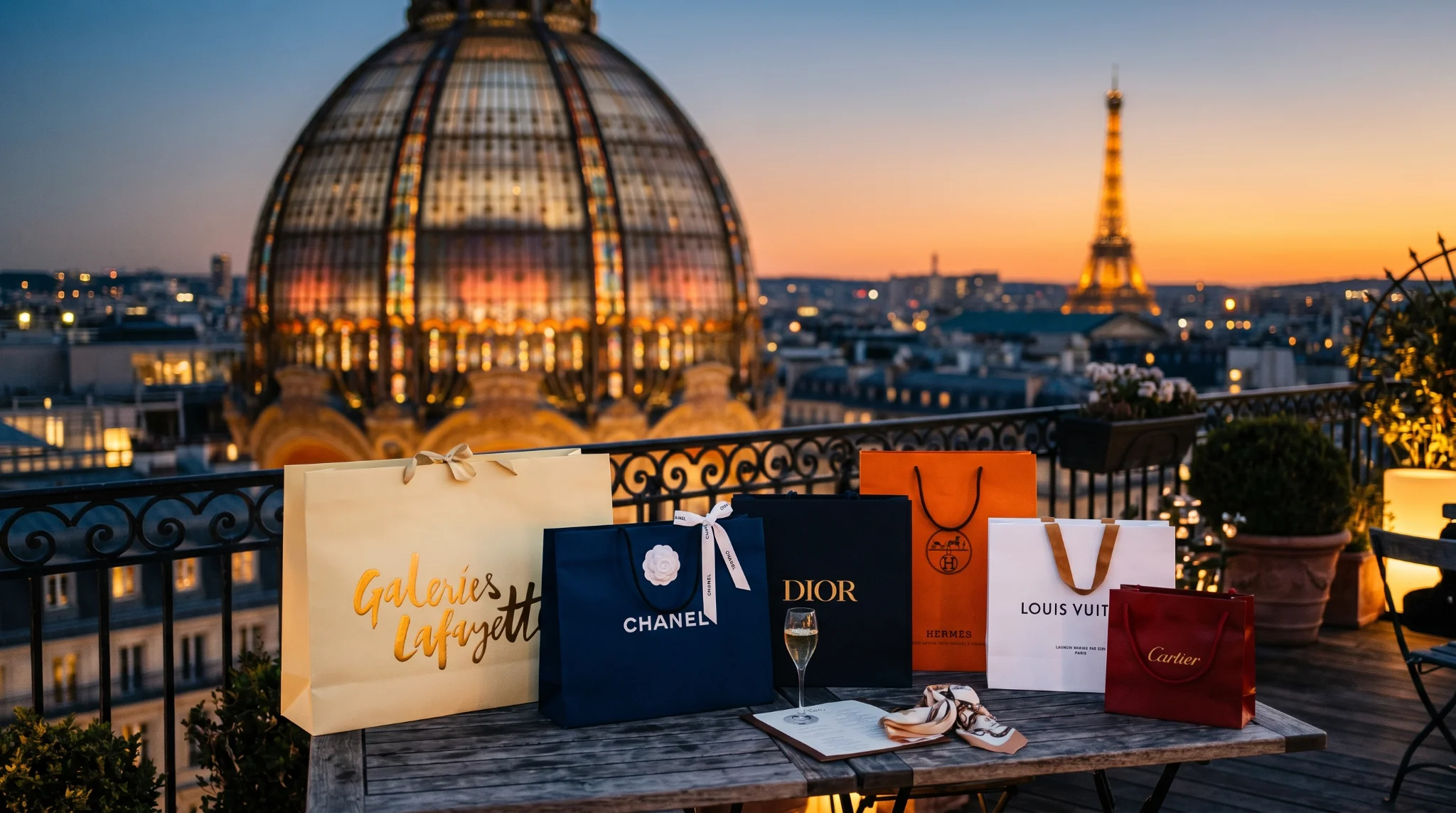
The Champs-Élysées and the Golden Triangle are where the global luxury brands live at their most theatrical. The area is home to flagship stores including Dior 30 Montaigne, Louis Vuitton Champs-Élysées, Hermès on Faubourg Saint-Honoré, Chanel on Rue Cambon, and Place Vendôme legends like Cartier and BVLGARI. Prices here are full retail, but the flagship experience — the architecture, the service, the presentation — is worth at least a stroll, even if you’re not buying. This is also prime territory for VAT refund shopping, since all major luxury retailers participate in tax-free schemes.
Opéra and the Grands Boulevards (9th arrondissement) is the practical shopper’s district. This is where you’ll find Galeries Lafayette and Printemps side by side on Boulevard Haussmann, plus a dense mix of mid-range French and international brands. It’s busier and less atmospheric than other neighbourhoods, but for sheer variety and efficiency, nothing beats it.
Montmartre and the Marché aux Puces de Saint-Ouen offer a completely different experience. The flea market at Saint-Ouen, known as Les Puces, is one of the largest antique markets in the world, spread across several indoor and outdoor markets with dealers selling vintage furniture, art, clothing, vinyl, silverware, and curiosities. Arrive early, bring cash, and be prepared to negotiate.
What Are the Best Department Stores in Paris?
Paris has four department stores worth knowing, each with a distinct character.
Galeries Lafayette Haussmann is the one most visitors picture when they think of Parisian department shopping. The main building is anchored by a breathtaking Belle Époque glass dome, and the fashion floors cover everything from accessible French brands to international luxury. There’s also a rooftop terrace with views toward Sacré-Cœur — free to access and ideal for a break between floors. The tax-free desk is easy to find and staff are experienced with international visitors.
Printemps, next door on Boulevard Haussmann, operates across two connected buildings — one dedicated to fashion and the other to beauty and homeware. Its beauty hall is considered one of the best in Paris, with an extraordinary range of French pharmacy brands alongside international names. The rooftop restaurant is a lovely spot for lunch with a view.
Le Bon Marché in the 7th arrondissement is the oldest department store in Paris, and arguably the most sophisticated. It’s quieter, more curated, and favoured by Parisians themselves rather than tourists. The adjacent La Grande Épicerie food hall is exceptional — an ideal stop for gourmet food gifts including wine, cheese, and specialist pantry items.
BHV Marais (Bazar de l’Hôtel de Ville) sits in the heart of Le Marais and has a different focus from the others. While it carries fashion and beauty, its real strength is homeware, design, and hardware — it’s the store Parisians go to for quality kitchen equipment, tools, and interior accessories. A useful stop if you’re shopping for the home rather than the wardrobe.
How Do You Get Tax-Free Shopping in Paris?
This is one of the most valuable things any Canadian, American, British, or Australian visitor can know before shopping in Paris — and one of the most commonly overlooked.
France’s standard VAT rate is 20%, and non-EU visitors can typically reclaim around 12–15% of the purchase price on eligible goods. Retailers — particularly in Paris — are highly experienced with international shoppers and tax-free procedures. When you’re ready to pay, inform the sales staff that you’d like a tax-free form (détaxe) before they process payment.
Here’s the process step by step:
1. Confirm your eligibility. You must be a resident of a non-EU country (Canadians, Americans, Australians, and British passport holders all qualify) and you must be visiting France temporarily — not living or working there long-term.
2. Meet the minimum spend. The minimum is €100 — and with some VAT refund apps, you can combine purchases across multiple stores to reach that threshold rather than spending €100 in a single shop.
3. Ask at the till. Look for stores displaying “Détaxe,” “Tax-Free Shopping,” “VAT Refund,” or “PABLO” signs. When in doubt, ask: “Proposez-vous la détaxe?” (Do you offer tax-free shopping?)
4. Show your passport. The store will issue a tax-free form (either paper or electronic). You’ll need to show your passport at the time of purchase.
5. Validate before you fly. France uses the PABLO electronic system at Charles de Gaulle and Orly airports. Look for the green PABLO kiosks before passport control, scan your form to validate it. If you have paper forms, have them stamped at the customs desk instead.
6. Receive your refund. The refund can be credited to your credit card or paid in cash at refund desks in the terminal.
Items eligible for VAT refund include fashion and luxury goods (clothing, shoes, jewellery, handbags), unused beauty products and sealed perfumes, electronics, and wine or spirits (sealed and exported). Services like hotel stays, restaurant meals, and transport tickets are not eligible. Food products in France carry a reduced VAT rate of 5.5% and do not qualify for tourist VAT refunds.
For a full walkthrough of the process, see our VAT refund France guide. We also have a broader VAT refund guide for Europe if you’re continuing your trip after France.
When Is the Best Time to Shop in Paris?
Timing your Paris trip around the sales calendar can make a meaningful difference to your budget — particularly if you’re shopping for fashion or luxury goods.
Les Soldes — France’s Government-Regulated Sales
France operates two official sale periods per year, known as Les Soldes. These are not optional promotional events — they’re legally regulated, and retailers are only allowed to sell items below cost during these specific weeks. That makes them genuinely different from the discount promotions you see elsewhere.
The official 2026 dates are: Summer sales (les soldes d’été) — Wednesday June 24 to Tuesday July 21, 2026. Winter sales 2027 — Wednesday January 6 to Tuesday February 2, 2027.
Discounts start at around 20–30% in the first week and climb to 50–70% by the final week — though selection narrows as the weeks go on. The smart strategy is to visit in the first week for choice, or the last week for maximum discount on whatever remains. If you’re visiting Paris in late June or July 2026, you’ll land right in the middle of the summer sales — an excellent coincidence.
Outside Les Soldes
Outside of sale periods, Paris shopping is full-price — but not without opportunity. Department stores like Galeries Lafayette run loyalty programmes with occasional private sale access. Some luxury brands hold sample sales twice a year around the same time as Les Soldes. And vintage and flea markets operate year-round with prices that depend far more on your negotiating skill than the calendar.
What Should You Buy in Paris?
Some categories are genuinely better value or quality in Paris than anywhere else. Here’s where to focus your spending:
Fashion and accessories — particularly scarves, leather goods, and classic French basics. Brands like APC, Sandro, Maje, Rouje, and Jacquemus offer the Parisian aesthetic at more accessible price points than the heritage luxury houses, and you’ll find them at their fullest range in their home market.
Perfume and beauty — Paris pharmacies are legitimate treasure troves. French pharmacy brands like La Roche-Posay, Avène, Nuxe, and Caudalie are cheaper in France than when exported. Sephora on the Champs-Élysées stocks an enormous range and is fully set up for tax-free purchases.
Chocolate and macarons — patisseries and chocolate shops in Paris operate at a completely different level from what most visitors are used to. Pierre Hermé, Patrick Roger, and Jacques Genin are worth the pilgrimage for gifts and personal indulgence.
Wine and Champagne — buying directly in France saves money compared to import prices back home. Wine shops (cavistes) in Le Marais and Saint-Germain can advise on what will travel well. Check your country’s alcohol import allowance before you buy. Sealed wine and spirits do qualify for VAT refunds if your total purchase meets the €100 threshold.
Cookware — French cookware brands like Le Creuset, Staub, and Mauviel are made in France and often priced better at source. BHV Marais and the homeware floors of Le Bon Marché are excellent stops.
Vintage and antiques — Le Marais has some of the city’s best vintage clothing shops, and the Marché aux Puces at Saint-Ouen is irreplaceable for furniture, art, and objects.
What Are the Best Outlet Stores Near Paris?
If you want designer labels at significantly reduced prices without waiting for Les Soldes, Paris has one outstanding answer: La Vallée Village.
La Vallée Village is part of the Bicester Collection, the same group that operates Bicester Village in the UK and similar outlets across Europe. Located just 40 minutes from the heart of Paris, it’s a premier shopping destination offering a luxury retail experience with year-round discounts of up to 60%.
The outlet features over 110 designer boutiques, from Gucci and Dior to Prada, all in a charming, Parisian-style village setting. Entry is free. Brands have included Givenchy, Chloé, Acne Studios, Balenciaga, Stella McCartney, Valentino, Bally, Armani, and many more. Discounts are permanent and applied to prior-season stock — so you’re not getting the current collection, but the savings are genuine.
Getting there: The village is accessible by RER A train to Val d’Europe station (then a 10-minute walk), by car, or via the Shopping Express shuttle bus. Head in the direction of Marne-la-Vallée Chessy (Disneyland Paris). Val d’Europe is the penultimate stop, around 30–40 minutes from central Paris.
Practical tips:
- Go on a weekday morning to avoid crowds
- Head to the concierge/welcome centre first — they issue VIP discount cards for additional savings at select brands
- Tax-free shopping is available for non-EU visitors spending over €100
- Compare prices before you go — some outlet prices can be surprisingly close to regular Paris boutique prices
For visitors also considering Best Travel Insurance for Europe, note that many policies cover purchases against theft or damage — worth checking before a serious shopping day.
Ready to Plan Your Paris Trip?
Now that you know where and how to shop in Paris, explore our related guides:
Frequently Asked Questions
It depends on your style and budget. Le Marais is ideal for independent boutiques, vintage, and emerging designers. Saint-Germain-des-Prés suits those after refined French fashion and homeware. The Champs-Élysées and Opéra/Grands Boulevards area (home to Galeries Lafayette and Printemps) are best for luxury brands and department store shopping.
The four big names are Galeries Lafayette Haussmann (the most iconic, with a spectacular glass dome), Printemps (two buildings covering fashion and homeware), Le Bon Marché (the oldest and most refined, in the 7th arrondissement), and BHV Marais (great for homeware and hardware, with a strong lifestyle focus).
Yes. Non-EU residents who spend a minimum of €100 (in a single store or combined across stores using certain apps) are eligible for a VAT refund. France's standard VAT rate is 20%, and tourists can typically reclaim around 12–15% of the purchase price. You'll need to request a tax-free form at the point of sale, show your passport, and validate your refund at the PABLO kiosks before departing from CDG or Orly.
Paris holds two government-regulated sale periods each year, called Les Soldes. The summer sales (les soldes d'été) run approximately late June to late July — in 2026, June 24 to July 21. The winter sales (les soldes d'hiver) run from early January to early February. Discounts start at 20–30% and climb to 50–70% by the final week.
It can be — but it doesn't have to be. Luxury goods at flagship boutiques are genuinely expensive, especially with the euro. However, Le Marais has excellent vintage and independent shops at accessible prices, and the Marché aux Puces de Saint-Ouen flea market is one of the best in the world for unique finds. During Les Soldes, even high-end stores discount significantly.
Paris is best known for fashion and accessories (scarves, handbags, leather goods), perfume and beauty products, wine and champagne, cookware (Le Creuset, Mauviel), and antiques. For the best value and authenticity, shop at local markets, pharmacy chains like Monoprix, and concept stores rather than tourist-facing souvenir shops.
Yes. La Vallée Village (part of the Bicester Collection) is the premier designer outlet near Paris, located in Serris, about 40 minutes from central Paris via RER A to Val d'Europe station. It features over 110 boutiques from brands like Gucci, Dior, Prada, and Chloé, with year-round discounts of up to 60%. Entry is free.
Most Paris shops open around 10am and close at 7pm, Monday to Saturday. Many smaller boutiques and independent stores are closed on Sundays, particularly outside the Marais (which is one of the few areas where Sunday trading is common). Department stores like Galeries Lafayette open seven days a week.